There is an ocean beneath the ocean we know.
Sunlight disappears with depth. Pressure rises relentlessly. Temperatures fall, food becomes scarce and familiar visual cues vanish. Yet animals survive there with bodies that can seem almost invented: transparent tissues, enormous jaws, expandable stomachs, bioluminescent organs and sensory systems tuned to faint signals.
The deep sea looks strange because the environment is strange.
Each bizarre feature is a solution to a problem imposed by darkness, pressure, scarcity and distance from the surface.
Where Does the Deep Sea Begin?
There is no single depth at which the ocean suddenly becomes “deep.” Oceanographers divide the water column into zones according to light and other environmental conditions.
Sunlight becomes progressively weaker with depth. In the upper ocean, enough light remains for photosynthesis. Below the photic zone, sunlight is insufficient to support ordinary photosynthetic ecosystems.
Further down, darkness becomes effectively complete.
Temperature, pressure, oxygen availability and food supply also vary with depth and location, so “the deep sea” represents many different environments rather than one uniform habitat.
What Do Animals Eat in Total Darkness?
One of the central problems is energy.
Most ocean life ultimately depends on photosynthesis near the surface. Microscopic organisms use sunlight to convert carbon dioxide and water into organic matter, creating the foundation for much of the marine food web.
Some of that organic material eventually sinks.
Dead organisms, waste, mucus, microscopic particles and fragments of organic matter form what is commonly called marine snow. It falls slowly through the water column, carrying energy into deeper environments.
Marine Snow Is a Slow Rain of Energy
The deep ocean is therefore connected to the surface in a surprisingly direct way.
A piece of organic matter produced near the surface may be consumed while sinking, broken down by microorganisms or transported into deeper water.
Only a fraction reaches the seafloor, but over enormous areas even a small flux becomes ecologically significant.
Deep-sea organisms have adapted to this scarcity. Some wait for long periods between meals. Others are opportunistic predators or scavengers capable of consuming unusually large prey when the opportunity appears.
Why Some Deep-Sea Animals Have Enormous Mouths
When food is unpredictable, refusing a rare meal can be costly.
Natural selection can therefore favor animals with large mouths, expandable stomachs or flexible feeding structures that allow them to capture prey larger than their normal body proportions might suggest.
The famous “gulping” appearance of some deep-sea fish is not evidence of monstrosity. It is a response to an environment where the next meal may not arrive for a long time.
Pressure Is One of the Biggest Problems
Water pressure increases by roughly one atmosphere for every ten metres of depth.
At several kilometres below the surface, pressure is hundreds of times greater than at sea level.
Pressure affects biological molecules. Protein structures, cell membranes and chemical reactions can behave differently under extreme pressure.
Deep-sea organisms therefore possess biochemical adaptations that allow essential cellular processes to continue.
Why Deep-Sea Animals Can Be Damaged at the Surface
Many deep-sea organisms are adapted to a narrow pressure range.
Rapidly bringing them to the surface can disrupt physiological processes, damage tissues or alter the behavior of gases and dissolved compounds in their bodies.
This creates a practical problem for scientists. Studying an organism in a laboratory is not always equivalent to observing it in its natural environment.
Darkness Changes the Meaning of Vision
Eyes are useful when there is light.
In permanent darkness, however, visual information becomes scarce and other senses become more important.
Many deep-sea animals have highly sensitive eyes capable of detecting extremely faint light. Others have reduced eyes or rely more heavily on chemical, mechanical or pressure-sensitive cues.
Some organisms can detect the movement of water created by nearby animals. Others sense chemical gradients that help them locate food or mates.
Bioluminescence: Making Light in the Dark
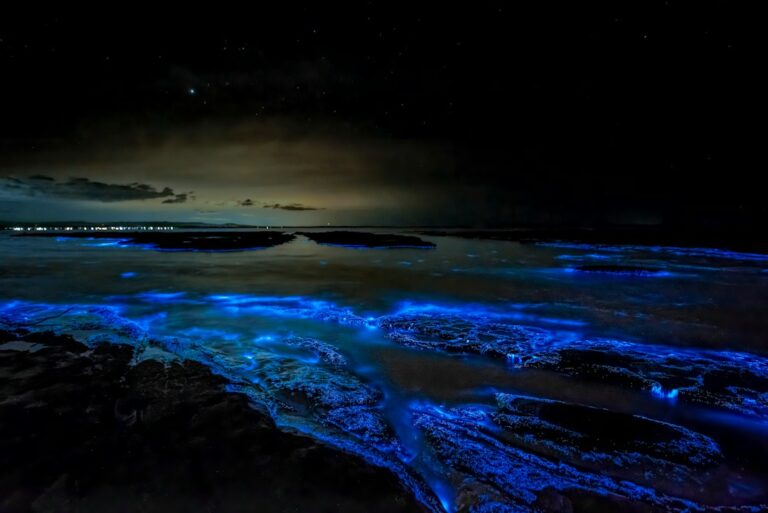
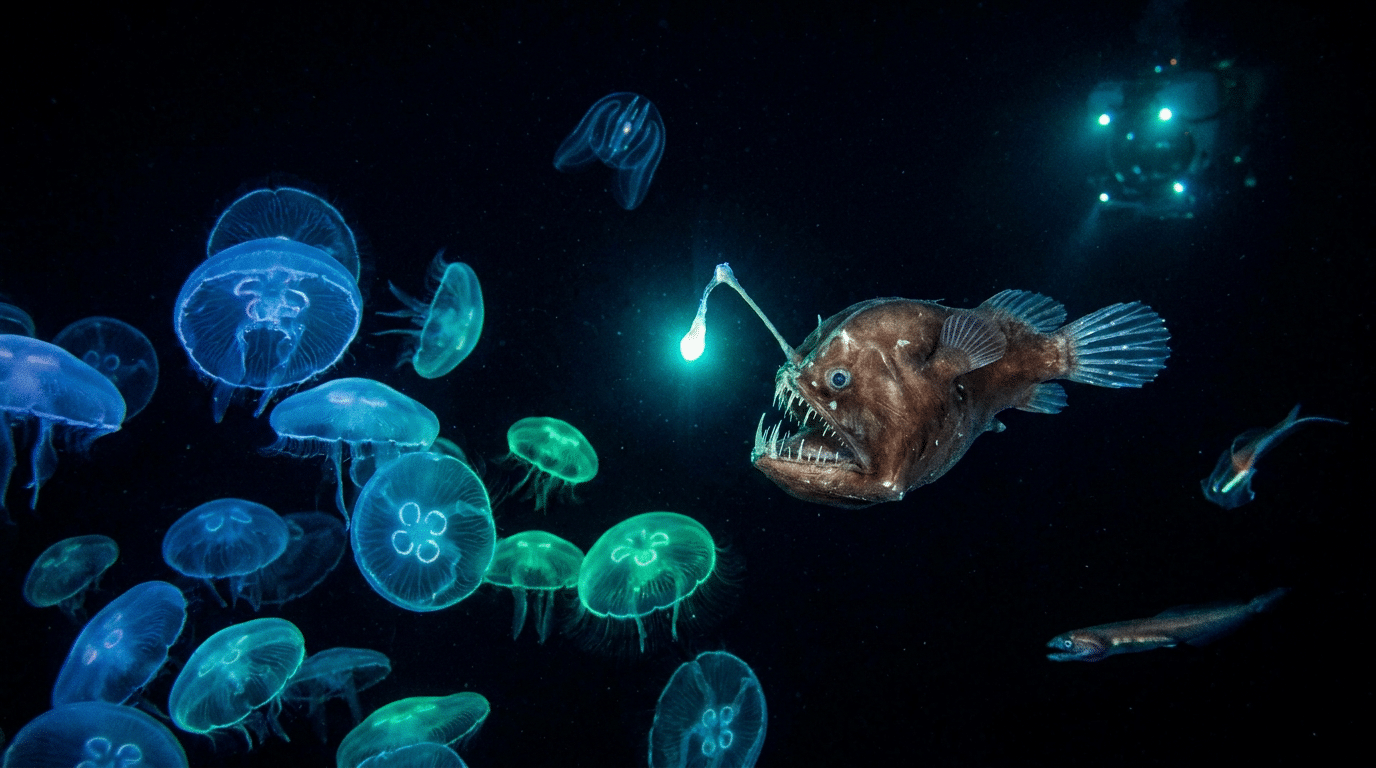
One of the most famous adaptations of the deep sea is bioluminescence—the production of light by living organisms through chemical reactions.
Bioluminescence is not limited to fish. Many marine organisms, including jellyfish, crustaceans, worms and microorganisms, can produce light.
The function depends on the species.
Light can attract prey, startle or confuse predators, signal to potential mates or provide a way to recognize members of the same species.
Sometimes Light Is Used as Camouflage
This seems paradoxical.
If an animal produces light, should it not become easier for predators to see?
Not necessarily.
Some animals use counterillumination, producing light on their underside that matches the faint light filtering down from above. From below, this can reduce the animal’s silhouette against the brighter water.
In the deep sea, light can therefore be both a weapon and a form of camouflage.
Hydrothermal Vents Create a Completely Different Food Web
Not all deep-sea ecosystems depend on marine snow.
Hydrothermal vents occur where seawater interacts with hot rock beneath the seafloor. The resulting fluids can contain high concentrations of chemicals that provide energy for specialized microorganisms.
These microbes use chemical reactions rather than sunlight to produce organic matter.
The process is called chemosynthesis in its broad biological sense, and it supports dense communities of animals around vent systems.
Life Without Sunlight
Hydrothermal vent ecosystems were especially important to biology because they demonstrated that complex communities could thrive without sunlight as their immediate energy source.
Large animals such as giant tube worms depend on symbiotic microorganisms that obtain energy from chemicals in the vent environment.
The discovery expanded scientists’ understanding of where life can exist and became relevant to questions about possible ecosystems beyond Earth.
What About Cold Seeps?
Cold seeps are another type of chemically driven deep-sea ecosystem.
Instead of extremely hot vent fluids, seeps release methane and other chemicals from the seafloor more gradually.
Microorganisms can use these compounds as energy sources, supporting communities of specialized organisms.
Again, the deep ocean demonstrates that sunlight is not the only way ecosystems can obtain energy.
Why Some Deep-Sea Animals Are Gigantic
“Deep-sea gigantism” describes cases in which related species or groups can reach unusually large sizes at depth.
The causes are not universal. Cold temperatures, slow metabolism, food availability, predation pressure and life-history strategies can all influence body size.
It would therefore be misleading to say that extreme depth automatically produces giant animals.
But in certain lineages, unusual size can be advantageous in an environment where energy is scarce and growth is slow.
Transparency Can Be a Survival Strategy
Some deep-sea animals are remarkably transparent.
Transparency reduces the amount of light an animal reflects or absorbs, making it harder to detect against the surrounding water.
In an environment where there may be very little background light, even a small visual contrast can reveal a predator or prey item.
Reproduction Is Difficult Too
Finding food is not the only challenge in the deep sea.
Finding a mate can be equally difficult when individuals are widely dispersed across a vast, dark environment.
Some species have evolved extraordinary reproductive strategies. In certain deep-sea anglerfish, for example, males can become highly specialized for locating and attaching to females.
Other species release gametes into the water, synchronize spawning or use chemical signals.
The Deep Sea Is Part of the Carbon Cycle
The deep ocean is also important to Earth’s carbon system.
Organic matter produced near the surface can sink and transport carbon into deeper water. Some of this carbon is respired and returned to dissolved form; some is incorporated into deeper ecosystems; some eventually becomes part of marine sediments.
This process is one component of the broader biological and physical mechanisms that move carbon through the ocean.
Why We Know So Little About It
The deep ocean is enormous, dark and physically difficult to access.
A research vessel may travel for days to reach a study site. Remotely operated vehicles and autonomous underwater systems can observe or sample only limited areas during each mission.
Even high-resolution mapping does not automatically reveal what lives inside every canyon, trench or sediment environment.
The result is a strange scientific situation: the deep ocean covers a huge fraction of Earth’s surface, yet many individual ecosystems remain poorly observed.
How Scientists Explore the Deep
Researchers use a combination of technologies.
Remotely operated vehicles can descend thousands of metres while transmitting video and allowing scientists to collect samples. Autonomous underwater vehicles can survey larger areas without a continuous tether. Crewed submersibles provide direct human observation but are expensive and limited in range.
Sonar, environmental sensors, cameras, genetic sampling and chemical analysis provide additional information.
No single method is sufficient. Scientists combine observations to reconstruct an ecosystem that cannot be viewed continuously.
Why Bringing Animals Up Can Mislead Us
A deep-sea animal removed from its natural environment immediately experiences changes in pressure, temperature, light and chemistry.
Its behavior in an aquarium may therefore differ dramatically from its natural behavior.
This is why direct observation through submersibles and in situ instruments is so valuable.
The Deep Ocean and the Search for Life Beyond Earth
Deep-sea environments have influenced astrobiology because some of their conditions resemble environments scientists hypothesize may exist elsewhere.
Jupiter’s moon Europa and Saturn’s moon Enceladus are thought to contain subsurface oceans beneath ice. Those oceans receive little or no sunlight at depth.
If life exists there, it would need energy sources that do not depend on ordinary surface photosynthesis. Hydrothermal-vent ecosystems on Earth provide one example of how complex life can be supported through chemical energy.
This is not evidence that extraterrestrial life exists. It simply expands the range of environments considered scientifically plausible.
The Bigger Perspective
The strangest creatures of the deep sea are not monsters.
They are evolutionary solutions.
Large mouths solve the problem of rare meals. Bioluminescence solves problems of communication, hunting and concealment. Pressure-resistant proteins allow life to function under extreme compression. Chemosynthetic ecosystems demonstrate how biology can exploit chemical energy without sunlight.
The deep ocean is therefore a reminder that what we call “normal biology” is often just biology adapted to the environment humans know best.
Descend far enough beneath the surface and the rules of survival change—and evolution begins writing solutions that look almost alien.
Curiosity Publication by Aadvik Agastya
Sources & further reading
Have a question about this topic?
Join fellow Qurons on the Quron Forum to ask questions, challenge ideas, share discoveries and explore further.
Discuss on Quron Forum