Imagine swimming in the ocean after dark and seeing every movement surrounded by tiny flashes of blue-green light. Waves seem to sparkle. A fish darts through the water and leaves a glowing trail.
This is bioluminescence: light produced by living organisms through chemical or biochemical processes. In the deep sea, where sunlight becomes scarce or disappears entirely, biological light can become part of the basic visual environment.
Who makes the ocean glow?
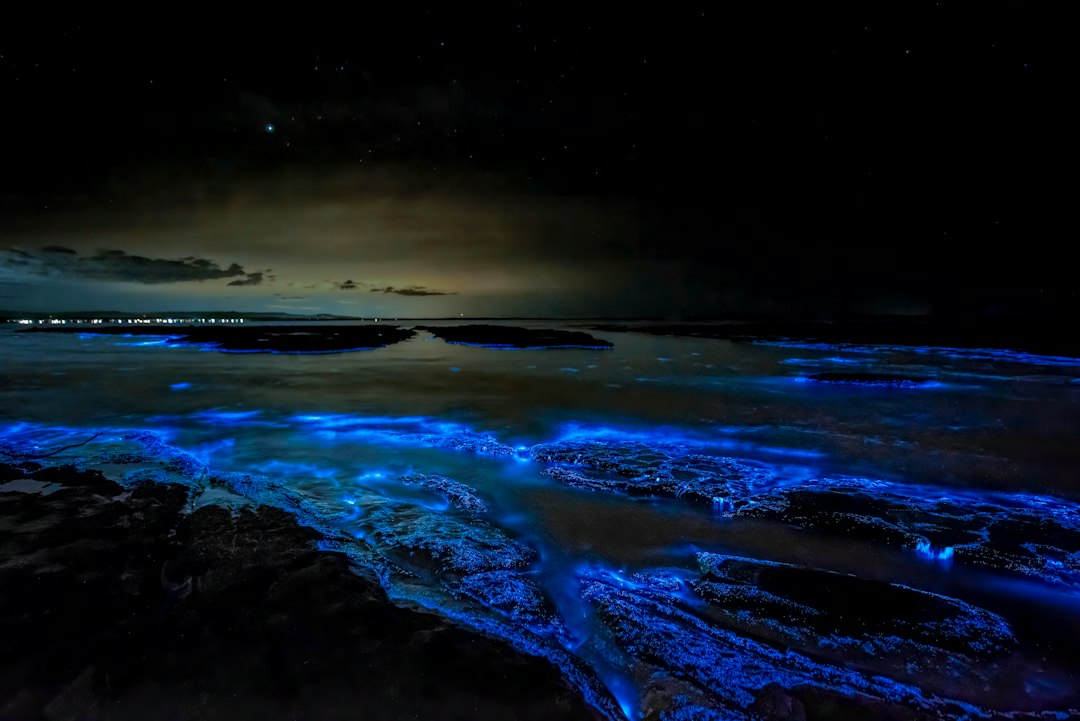
Bioluminescence occurs in many branches of marine life, including microscopic plankton, jellyfish, worms, crustaceans, molluscs and fish. Dinoflagellates are responsible for some spectacular glowing surf near coastlines.
There is no single “bioluminescent animal.” Different lineages evolved light production independently, using different molecules and mechanisms.
How does biological light work?
Many bioluminescent systems involve a light-producing molecule called luciferin and an enzyme called luciferase. When the relevant chemical reaction occurs, energy is released partly as visible light.
The exact chemistry varies among organisms. Some systems rely on additional cofactors, while some animals obtain luminous bacteria through symbiosis rather than manufacturing every component themselves.
Why is the light usually blue?
Water absorbs light unevenly. Longer wavelengths such as red are absorbed relatively quickly, while blue-green wavelengths travel farther through seawater.
That makes blue-green light useful for signaling, detecting objects and attracting prey in marine environments. It is not an absolute rule: some organisms produce yellow, green or other colours.
Light can be a weapon
A sudden flash can startle a predator. In some organisms, illumination may also attract a larger predator that attacks the original threat—a defensive strategy sometimes described as the “burglar alarm” effect.
Other organisms release glowing material into the surrounding water, creating a distraction or making an attacker easier for another predator to detect.
Light can attract prey
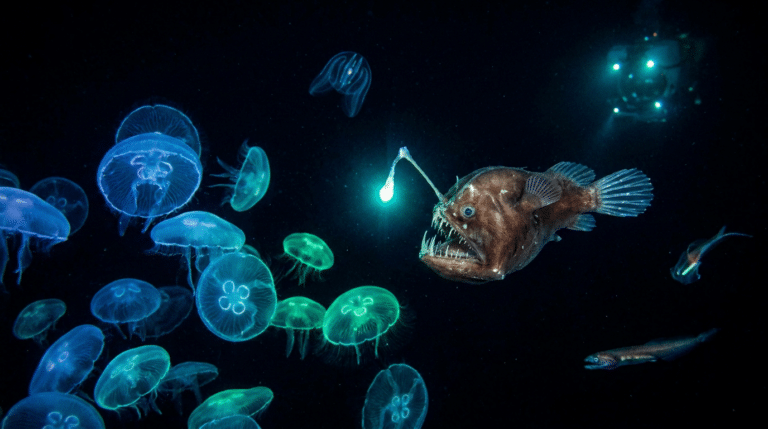
Some deep-sea predators use luminous structures as visual lures. The classic anglerfish is an example: a modified structure near its head can act as a glowing lure in an environment where ordinary visual signals are limited.
The same physical principle—producing light in darkness—can therefore serve either the hunter or the hunted.
Counterillumination: hiding with light
One of the strangest uses of bioluminescence is camouflage. At depth, a small amount of sunlight can still arrive from above. An animal viewed from below may appear as a dark silhouette against that brighter background.
Some animals produce light on their underside to reduce that contrast. Instead of hiding by becoming darker, they hide by producing exactly the right amount of light.
Bioluminescence and communication
Light can also function as a signal between members of the same species. Flash patterns may help organisms find mates, recognize one another or coordinate behavior.
The meaning of a flash depends on the species. Human eyes see “glowing,” but the animal may be receiving a highly specific visual message.
Bioluminescence is not fluorescence
These terms are often confused. Bioluminescence generates light through a chemical reaction. Fluorescence occurs when a substance absorbs incoming light and then re-emits part of that energy at another wavelength.
An organism can be fluorescent without producing light in darkness, because fluorescence normally requires an external light source.
Why glowing organisms matter to science
Bioluminescent proteins and related systems have become powerful research tools. Scientists can attach light-producing markers to biological processes and observe where particular molecules are expressed or how cells behave.
A mechanism that evolved for survival in the ocean can therefore become an instrument for studying life in the laboratory.
What the deep sea teaches us
On land, light is abundant during the day and darkness is largely a nighttime condition. In the deep ocean, darkness can be the default environment.
Evolution responded by turning chemistry into light. The result is not one spectacular trick but an entire ecological language of defense, camouflage, attraction and communication.
What looks magical from the surface is the visible expression of organisms adapting to one of Earth’s largest and least explored environments.
Why the Ocean Glows
Bioluminescence is the production of light by living organisms. It is widespread in the ocean and occurs in organisms ranging from microscopic plankton to fish and invertebrates.
The glow is not simply an underwater version of sunlight. In the deep ocean, where sunlight becomes weak or disappears, biological light can become an important form of communication, defense and predation.
The Chemistry Behind the Light
Many bioluminescent systems rely on a chemical reaction involving a light-producing molecule and an enzyme. The details differ among organisms, and not all bioluminescent species share the same biochemical machinery.
The key advantage is efficiency: biological light can be produced locally without needing an external light source.
Defense Through Illumination
For some organisms, light is a defensive tool. A sudden flash can startle a predator or reveal the presence of an attacker. Some animals release glowing material into the surrounding water, potentially creating a distraction or making a predator more visible.
Other organisms use light in ways that may make them less conspicuous from below by matching the faint light coming from the surface. This strategy, called counterillumination, shows how the same basic phenomenon can serve opposite purposes.
Predators Use Light Too
Bioluminescence is not only defensive. Some predators use light to attract prey, illuminate their surroundings or create deceptive signals. The deep sea is therefore an environment in which light itself can become part of an ecological arms race.
The Famous Ocean “Glow” Near the Surface
Large glowing patches in coastal water can be produced by blooms of microscopic organisms such as dinoflagellates. Mechanical disturbance can trigger flashes, so waves, boats and swimming animals may appear to ignite the water.
These displays are spectacular, but they are also biological events influenced by temperature, nutrients, currents and population density.
Why Bioluminescence Evolved So Many Times
Bioluminescence appears to have evolved independently in multiple lineages. That repetition is informative. If producing light provides useful advantages in dark environments, natural selection can arrive at similar functional solutions through different evolutionary histories.
The resulting diversity is a reminder that evolution does not search for one perfect design. It explores many workable solutions to similar problems.
Light as Information
In an environment where visibility is limited, a flash can carry information. It can indicate danger, attract a mate, confuse a predator or signal that prey is nearby. The meaning depends on timing, wavelength, location and the organism receiving the signal.
A Window Into the Deep Ocean
Because much of the deep ocean remains difficult to observe continuously, bioluminescence also provides clues about ecological interactions that humans rarely see directly. Cameras and submersibles can capture flashes that reveal animals moving, feeding and responding to one another.
The deeper mystery is not simply why the ocean glows. It is how much of the underwater world is communicating through signals that human eyes evolved without ever needing to perceive.
Why the ocean is such a good place for bioluminescence
The deep ocean is enormous, dark and structurally different from most terrestrial environments. Visual signals that work on land can become ineffective when sunlight disappears and organisms may encounter one another only briefly.
Producing light creates a private source of visibility. An organism can switch it on only when useful, making the signal potentially more controllable than a permanent visual feature.
Not every glow means the same thing
A flash can startle a predator, attract prey, signal a mate or make an animal less visible against faint downwelling light. The evolutionary value depends on the species and the environment.
This is an important reminder that bioluminescence is not one behavior. It is a biochemical capability that evolution has repeatedly adapted for different purposes.
Why glowing plankton create waves of light
When dense populations of certain dinoflagellates are disturbed, mechanical stimulation can trigger brief flashes. A breaking wave can therefore activate thousands of organisms at once, producing the appearance of glowing surf.
The display is beautiful, but it is also a biological response to physical disturbance. Population density, temperature, nutrients and water movement all influence when spectacular displays occur.
Bioluminescence is an evolutionary toolbox
Because different organisms evolved light production independently, there is no single evolutionary story. Similar environmental problems can produce similar functional solutions even in unrelated groups.
That repeated evolution is scientifically valuable because it shows how strongly ecological conditions can shape biological innovation.
From ocean chemistry to laboratory science
Researchers have adapted naturally occurring light-producing proteins and chemical systems into experimental tools. Light can reveal gene activity, track cells and make otherwise invisible biological processes easier to observe.
A chemical reaction that evolved in darkness beneath the ocean can therefore become a way of watching life operate under a microscope.
The glow is only the visible part
When waves shine blue at night, humans see a spectacular surface effect. Beneath it lies a much larger system of organisms using chemistry to communicate, hunt and avoid being hunted.
The deeper mystery is therefore not simply why the sea glows. It is how many ecological signals exist in the ocean that human senses cannot naturally detect at all.
Curiosity Publication by Aadvik Agastya
Sources & further reading
Have a question about this topic?
Join fellow Qurons on the Quron Forum to ask questions, challenge ideas, share discoveries and explore further.
Discuss on Quron Forum