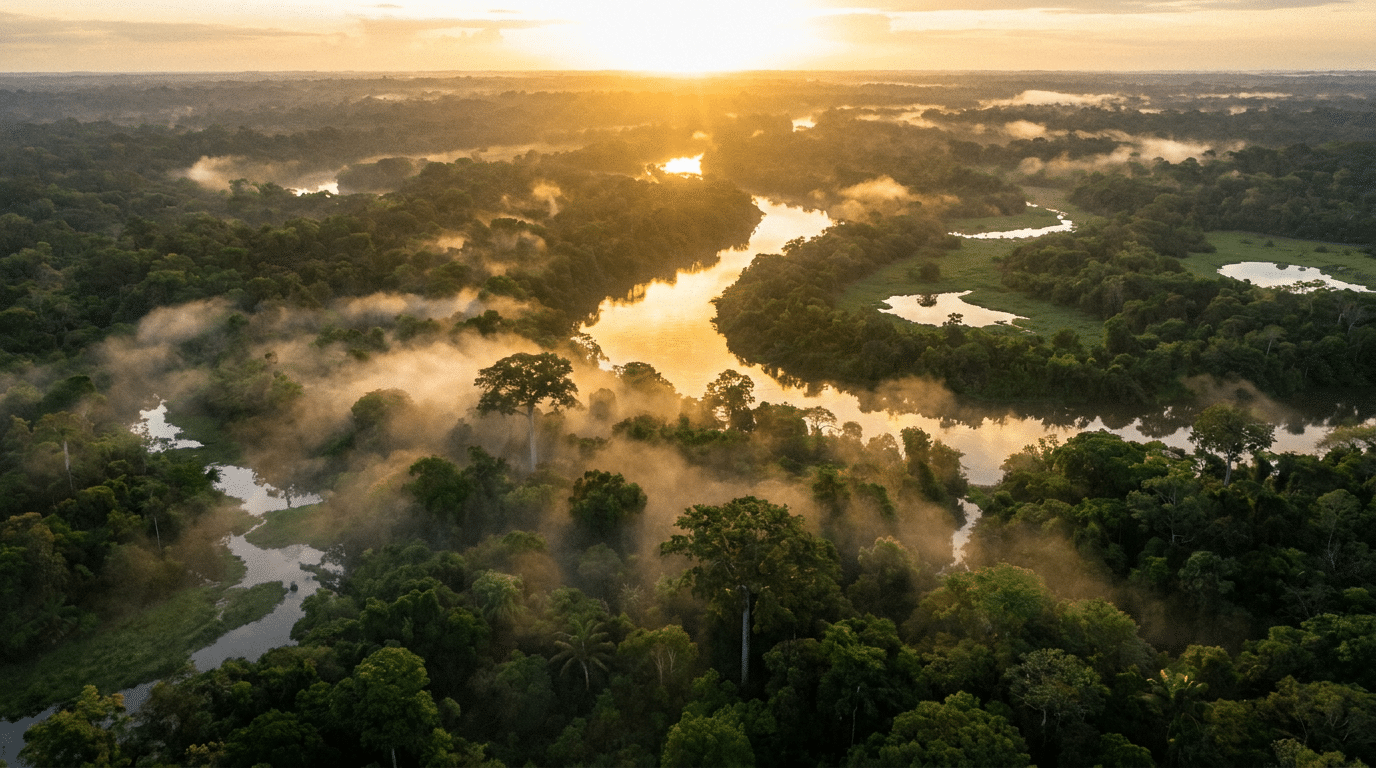
The Amazon rainforest is often called Earth’s “lungs.”
The metaphor is memorable, but scientifically it is incomplete.
The Amazon does not simply manufacture oxygen for the planet in the way a pair of lungs supplies oxygen to a body. The forest produces oxygen through photosynthesis, but plants, animals and microorganisms also consume oxygen through respiration and decomposition.
The Amazon’s real importance is more complicated—and arguably more fascinating. It is a continental-scale biological system that stores and cycles carbon, moves enormous quantities of water through the atmosphere, supports extraordinary biodiversity, shapes regional climate and provides habitat for human communities.
It is not a machine with one function. It is a living system whose parts constantly interact.
How Large Is the Amazon?
The Amazon basin covers a huge portion of South America, extending across several countries and encompassing an enormous network of rivers, wetlands, forests and other ecosystems.
The word “Amazon” can refer to the entire basin, the river system or the rainforest itself, and those boundaries do not always coincide.
This matters when discussing scientific measurements. A statement about carbon stored in the Amazon rainforest is not necessarily the same as a statement about carbon stored throughout the entire Amazon basin.
Why the “Lungs” Metaphor Is Misleading
Plants take in carbon dioxide and release oxygen during photosynthesis. That process is essential to life on Earth.
But mature ecosystems also respire. Plants consume oxygen, animals consume oxygen and microorganisms use oxygen while decomposing organic material.
Over long periods, much of the oxygen produced by photosynthesis in a mature rainforest is balanced by respiration and decomposition.
The Amazon therefore does not function like a giant oxygen factory supplying the rest of the planet with a net atmospheric surplus.
Its global importance lies elsewhere.
The Carbon Story Is Much More Important
Forests contain carbon in many forms.
Living trees store carbon in trunks, branches, leaves and roots. Dead wood and leaf litter contain additional carbon, while soils can store substantial amounts below ground.
When a forest grows, carbon can be removed from the atmosphere and incorporated into biomass. When vegetation dies and decomposes, some of that carbon returns to the atmosphere.
When forests are cleared and burned, stored carbon can be released much more rapidly.
Carbon Storage Is Not the Same as Permanent Carbon Removal
This distinction is important.
A forest can hold enormous quantities of carbon without permanently removing all of that carbon from the atmosphere. Carbon is constantly moving between plants, soils, microorganisms and the atmosphere.
The value of an intact forest therefore includes both the carbon it currently stores and its ability to continue participating in the carbon cycle.
Disturbance can alter both.
The Forest Helps Move Water
Rainfall does not simply fall onto the Amazon and then flow immediately into rivers.
Trees absorb water through their roots and release water vapor through transpiration. Water also evaporates from soil, rivers and other surfaces.
Across a huge forest, these processes recycle moisture through the atmosphere.
That means the relationship between forest and rainfall is partly circular: rainfall supports the forest, while the forest helps return water to the atmosphere.
Does the Amazon Create Its Own Rain?
Not entirely.
The rainforest depends on moisture transported into the basin, including moisture originating from the Atlantic Ocean. But once that moisture enters the region, evaporation and transpiration can recycle a significant fraction of it.
This creates a feedback between vegetation and atmosphere.
Deforestation can alter surface energy, evapotranspiration and moisture recycling, potentially changing rainfall patterns at local and regional scales.
Why Rivers Are Central to the Amazon
The Amazon is not only a forest. It is also one of the world’s great river systems.
Its waterways connect upland forests, floodplains, wetlands and human settlements. Seasonal flooding can transform large areas of land, creating habitats that differ sharply from permanently dry forest.
Flooding also redistributes nutrients and organic matter. Aquatic organisms move through connected waterways, while terrestrial animals and plants depend on the productivity of floodplain ecosystems.
Floodplain Forests Are Different
Not all Amazonian forests experience the same hydrological conditions.
Some areas are flooded regularly by nutrient-rich river water. Others experience seasonal flooding from rainfall or groundwater. Upland forests may remain above flood levels.
These differences shape which plants can survive, how trees reproduce and what animals use particular habitats.
Thinking of the Amazon as one uniform forest therefore hides enormous ecological diversity.
Why the Amazon Is So Biodiverse
The Amazon supports extraordinary numbers of plants, insects, birds, mammals, fish, amphibians and microorganisms.
Its biodiversity is not merely a long list of species. It is a web of interactions.
Plants depend on pollinators. Trees rely on animals to disperse seeds. Predators influence prey populations. Fungi and bacteria decompose organic matter. River organisms transport nutrients between aquatic and terrestrial environments.
Remove one component and the consequences can extend beyond that species.
Why Biodiversity Is Hard to Replace
A forest can appear green from above even after substantial ecological degradation.
Some species may survive in isolated fragments while others disappear. Specialist pollinators can decline. Seed dispersal networks can break down. Edge effects can alter temperature and humidity inside fragments.
This means measuring forest health only by the number of trees remaining can miss important ecological changes.
Deforestation Does More Than Remove Trees
When forest is cleared, the immediate change is obvious: trees disappear.
But the ecological consequences can extend much farther.
Habitat becomes fragmented. Roads create barriers and edges. Soil conditions change. Local temperature and humidity can shift. Fire becomes easier to spread in some disturbed landscapes.
The remaining forest may therefore become more vulnerable even when it has not been directly cleared.
Why Fire Is Especially Important
Many Amazonian ecosystems did not evolve under the same frequency of large-scale human-set fires seen in some other biomes.
Repeated burning can damage vegetation, alter soil conditions and encourage grasses or other fire-tolerant plants in places where dense forest once dominated.
This can create a feedback: disturbance increases fire susceptibility, while fire creates further disturbance.
Drought can intensify the risk by drying vegetation and reducing moisture.
Drought and a Changing Climate
Climate change can interact with land-use change.
Higher temperatures and altered rainfall patterns can increase water stress in some parts of the basin. When forests are simultaneously fragmented or degraded, their ability to recover from drought or fire may be reduced.
But the Amazon is geographically enormous, so impacts are not identical everywhere. Some regions can become wetter while others experience more severe dry periods.
Is the Amazon Approaching a Tipping Point?
Scientists have investigated whether interactions among deforestation, drought, warming and fire could push parts of the Amazon toward a substantially different ecological state.
The concept of a tipping point refers to a threshold beyond which feedbacks can produce a large and potentially difficult-to-reverse change.
Research suggests that such risks are worth taking seriously, but the exact thresholds are uncertain. They may differ between regions and depend on how climate change, land use and ecosystem resilience interact.
It would therefore be misleading to announce a single precise date at which “the Amazon will collapse.” The science is more complicated than that.
Indigenous Peoples Are Part of the Amazon’s History
The Amazon is not an untouched wilderness devoid of human history.
Indigenous communities have lived across the basin for thousands of years, developing detailed knowledge of plants, animals, rivers and seasonal cycles.
Archaeology has also revealed evidence that some parts of the Amazon were shaped by long-term human activity, including changes in vegetation, soils and settlement patterns.
This does not mean that ancient peoples transformed the entire rainforest into an artificial landscape. It means the simplistic contrast between “untouched nature” and “human society” is inadequate.
Traditional Ecological Knowledge
Indigenous knowledge systems can contain detailed information about species behavior, medicinal plants, soils, weather and seasonal changes.
Scientific research and Indigenous knowledge are different knowledge systems, but they can sometimes complement one another when studying ecosystems.
Respecting Indigenous communities also means recognizing that conservation policies affect people who live in and depend upon these landscapes.
Why the Amazon Matters to the Global Climate
The Amazon is part of the global carbon and water cycles.
Its forests store carbon, exchange gases with the atmosphere, move water through transpiration and interact with regional climate.
These processes do not mean the Amazon single-handedly controls global climate. The world’s oceans, forests, soils, ice systems and atmosphere all interact.
But changing a continental-scale ecosystem can alter important parts of that global system.
What Happens When Forest Becomes Pasture?
Converting forest to pasture changes the carbon balance, surface properties, biodiversity and water cycle.
Pasture can support human livelihoods, but it does not provide the same ecological functions as mature forest.
When land is later abandoned, vegetation may regrow, but secondary forests do not immediately reproduce the full structure and species composition of old-growth ecosystems.
Can the Forest Recover?
In many circumstances, yes—but recovery can take decades or longer and depends on the severity of disturbance.
Some secondary forests regenerate relatively quickly. Others face barriers such as repeated fire, invasive grasses, degraded soils or continuing fragmentation.
Recovery also depends on what was lost. Re-establishing tree cover is not necessarily equivalent to restoring the full biodiversity and ecological relationships of an old-growth forest.
Why Satellite Images Are So Important
The Amazon is too large to monitor entirely from the ground.
Satellites allow researchers to track changes in forest cover, fires, vegetation condition and other characteristics across enormous areas.
Ground observations are still essential because satellite signals require calibration and interpretation. Together, remote sensing and field research provide a much clearer picture than either could provide alone.
The Bigger Perspective
The Amazon is not Earth’s lungs in the literal sense.
It is something more complex: a vast biological system that stores carbon, recycles water, supports biodiversity, influences regional climate and interacts continuously with human societies.
Its importance is therefore not captured by one metaphor.
The forest is simultaneously a carbon reservoir, a water-cycle engine, a habitat network, a river landscape, a climate participant and a human environment.
That complexity is precisely why protecting the Amazon cannot be reduced to saving trees. It means maintaining the relationships among trees, soil, water, atmosphere, animals and people that make a rainforest function as a living system.
Curiosity Publication by Aadvik Agastya
Sources & further reading
Have a question about this topic?
Join fellow Qurons on the Quron Forum to ask questions, challenge ideas, share discoveries and explore further.
Discuss on Quron Forum