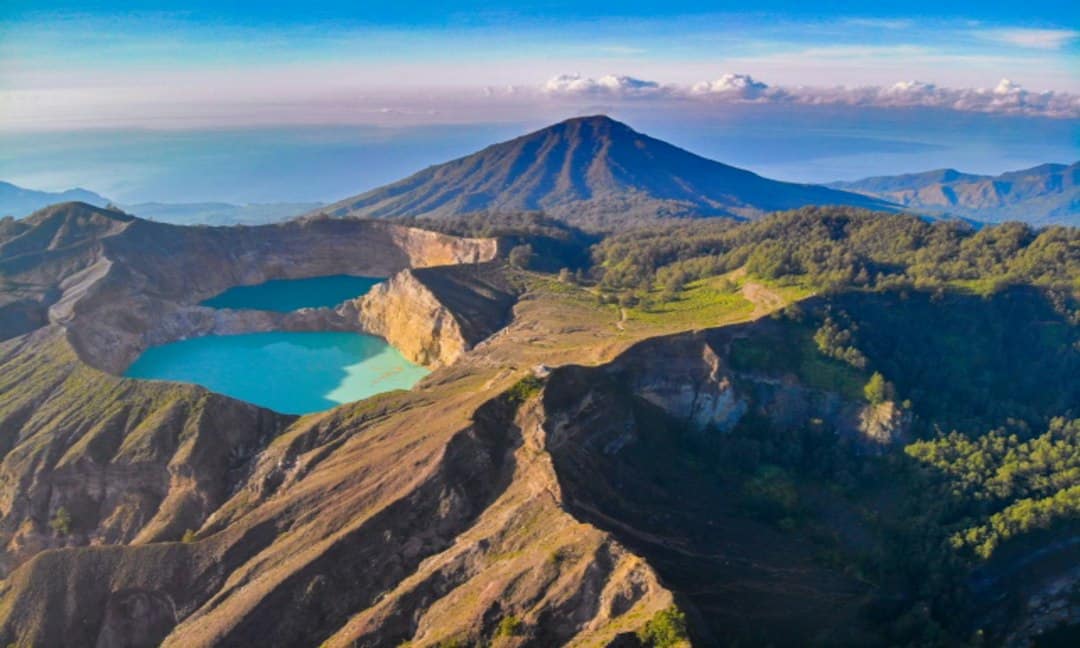
In western India, a lake sits inside a nearly circular depression whose origin is linked to an impact from space.
Lonar Lake in Maharashtra is one of the rare impact craters on Earth formed in basaltic rock, making it a natural laboratory for geology, chemistry and biology.
How did the crater form?
The leading explanation is that a high-speed cosmic body struck the basaltic terrain, excavating a crater and altering the surrounding rock.
Impact craters form when enormous kinetic energy is released in seconds.
Why is Lonar unusual?
Many large impact craters on Earth are heavily eroded or buried. Lonar remains relatively recognizable because of its geological setting.
The crater contains a lake whose chemistry has attracted scientific interest.
Water chemistry makes the lake special
Lonar has experienced changes in salinity, alkalinity and microbial communities. Its unusual environment provides researchers with a place to study organisms adapted to chemical conditions unlike ordinary freshwater lakes.
Could Lonar help us understand Mars?
Impact craters and basaltic terrains also occur on Mars. Studying how impacts alter basalt and create unusual mineral and chemical environments on Earth can help planetary scientists interpret remote observations.
This does not make Lonar a direct Mars analogue, but it makes the comparison scientifically useful.
The lake changes over time
Rainfall, evaporation, groundwater interaction and biological activity can change the lake’s chemistry and water level.
Researchers therefore treat Lonar as a dynamic system rather than a fixed chemical experiment.
The deeper lesson
Lonar connects several scales of science in one place.
A cosmic impact shaped the geology. Geology shaped the lake. The lake shaped its chemistry. Chemistry shaped the organisms able to live there.
A crater from space became an ecosystem on Earth.
Why impact craters are scientific time machines
An impact occurs in seconds, but its geological consequences can last millions of years. A high-speed asteroid or other body transfers enormous energy into the ground, melting, fracturing and excavating rock.
Studying the resulting crater allows scientists to reconstruct not only the impact itself but the properties of the material that was struck.
Why basalt makes Lonar especially useful
Basalt is volcanic rock, and the Moon and Mars also contain extensive basaltic terrains. When an impact disturbs basalt, it can create minerals and textures that help planetary scientists interpret remote observations.
Lonar is not a perfect miniature of Mars. Earth’s atmosphere, water cycle and biology make its environment fundamentally different. But it is a valuable terrestrial laboratory for studying impact processes in basalt.
The lake is chemically unusual
Lonar’s water chemistry has varied over time and can be influenced by evaporation, rainfall, groundwater and biological activity. The lake has therefore attracted research into microorganisms capable of living under unusual chemical conditions.
These organisms are interesting not because they prove life could exist on another planet, but because they demonstrate how flexible life on Earth can be when environmental conditions change.
The crater has a human history too
The lake and surrounding landscape have long been part of local cultural and religious traditions. Temples and other structures around the crater show that the geological feature is not merely a scientific object.
Natural landscapes acquire cultural meanings as people interact with them over centuries.
Why the crater’s age matters
Determining when an impact occurred helps scientists connect geological events with broader changes in Earth’s history. Different dating methods can provide constraints, while ongoing erosion and human activity can complicate interpretation.
As with many geological questions, the best conclusions come from combining several independent lines of evidence.
What Lonar teaches us about planetary science
A cosmic event created a depression in Earth’s basaltic crust. Water accumulated in that depression. Chemistry and climate shaped the lake. Microorganisms adapted to the resulting environment.
The chain connects astronomy, geology, hydrology and biology in one landscape.
The crater is a reminder of scale
Lonar looks like a lake when viewed from its shore. From above, its circular structure reveals a much larger geological story.
A feature created by an object moving through space thousands or millions of years ago can become an ecosystem, a cultural landmark and a scientific laboratory at the same time.
How a Meteorite Made Lonar Lake
Lonar Lake in Maharashtra is unusual because it occupies a crater formed by a high-energy impact into basaltic rock. The crater is therefore both a geological structure and a natural laboratory. Its water chemistry, surrounding rocks and biological communities have attracted scientific attention, but the most important story begins with the impact process that created the basin itself.
An impact in basalt
Lonar is a rare example of a confirmed impact crater formed in basalt, the volcanic rock that makes up much of the Deccan Plateau. When a sufficiently large extraterrestrial object strikes at high velocity, enormous energy is released in a fraction of a second. Rock is fractured, heated and displaced, producing a crater and characteristic geological effects.
How scientists recognize an impact crater
A circular depression alone does not prove an impact. Researchers look for multiple lines of evidence, including shock effects in minerals, unusual rock deformation and geochemical or structural signatures consistent with high-pressure impact processes. At Lonar, geological investigations have provided evidence supporting an impact origin rather than a volcanic or ordinary erosional explanation.
The lake came later
The crater and the lake are related but not identical things. The impact created the basin; water accumulated within it through rainfall, groundwater and local hydrological processes. Over time, the lake became an enclosed chemical environment whose properties depend on geology, evaporation and biological activity.
Why the water is unusual
Lonar’s water has unusual chemical characteristics that have varied with environmental conditions. The crater’s basaltic geology influences the dissolved minerals, while evaporation can concentrate substances in the lake. Seasonal changes can also affect water chemistry and microbial communities. Such environments are useful for studying how geology and biology interact in an isolated system.
Life in an extreme environment
Microorganisms can survive in environments that appear hostile to humans. Research at Lonar has examined microbial diversity and organisms adapted to particular chemical conditions. The presence of unusual microbes does not mean the lake is identical to an extraterrestrial environment, but extreme habitats on Earth can help scientists understand the range of conditions under which life can persist.
Why astrobiologists care
Impact craters occur on planets and moons throughout the Solar System. An impact can destroy life locally, but it can also expose fresh rock, create temporary heat and alter chemical environments. Studying Lonar provides a terrestrial example of how an impact-generated basin evolves after the initial collision.
Environmental change matters
Lonar is not a chemically fixed object. Water levels, microbial communities and surrounding land use can change over time. Pollution, nutrient inputs and other human pressures can affect the lake as well. Protecting the site therefore matters not only for heritage but for maintaining a natural laboratory whose chemistry can be studied over generations.
A crater with several stories
Lonar’s significance comes from the convergence of geology, hydrology and biology. A cosmic impact created the basin, Earth’s climate and groundwater filled it, and living organisms adapted to the resulting environment. The lake is therefore a reminder that planetary events can leave effects that persist long after the original impactor has disappeared.
The crater is an evolving experiment
The impact was instantaneous, but everything that followed happened on very different timescales. Fractured rock weathered, water accumulated, minerals dissolved, sediments moved and microbial communities responded to changing conditions. In that sense, Lonar is not simply a record of one cosmic collision. It is a record of what happens to an impact structure after the dramatic event is over.
Chemistry can look biological without being biological
Unusual chemistry is one reason Lonar attracts astrobiological attention, but unusual chemistry should not be confused with evidence of life. Minerals, evaporation, redox reactions and interactions between water and rock can create complex chemical signatures without organisms.
The presence of microorganisms at Lonar demonstrates something different: terrestrial life can occupy chemically challenging environments. That is useful for understanding biological limits, but it does not demonstrate that a comparable environment on Mars or another world contains life.
Why imperfect analogues are valuable
An Earth analogue does not need to reproduce another planet perfectly. Its value comes from isolating one process or environmental feature. Lonar can help researchers think about impacts into basalt, post-impact alteration and the relationship between rock and water. Other analogues may be better for radiation, extreme cold or atmospheric chemistry.
Using several imperfect analogues can therefore be more informative than searching for one place on Earth that supposedly duplicates an entire extraterrestrial world.
Lonar’s real scientific power
The crater brings together processes that are usually studied separately. Planetary impacts belong to astronomy and geology; water chemistry belongs to geochemistry and hydrology; microbial adaptation belongs to biology. At Lonar, those disciplines meet in one landscape.
That is what makes the lake more than an unusual geographical feature. It allows scientists to follow a chain from a cosmic collision to a long-lived terrestrial ecosystem—and to ask which parts of that chain might also occur elsewhere in the Solar System.
How an impact crater can become a lake
An impact crater is initially a geological wound, but over time it can become a basin that collects water and develops its own ecological environment. Lonar is especially interesting because the crater formed in basalt, a volcanic rock that reacts with water in distinctive ways. The result is a system in which geology, water chemistry, microorganisms and climate interact.
The impact evidence is written into the rocks
Scientists identify impact structures through several kinds of evidence, including unusual deformation, shock effects and crater geometry. No single visual feature is always sufficient. At Lonar, geological context and morphology provide clues to its origin and allow comparisons with impact structures elsewhere on Earth and other planetary bodies.
A lake with unusual chemistry
Lonar’s water is alkaline and its conditions differ from many ordinary freshwater systems. Such environments can support specialized microorganisms adapted to unusual chemistry. This makes Lonar useful to astrobiology as well as geology: extreme environments on Earth can help researchers understand how life might persist under conditions that appear hostile by everyday standards.
The crater is changing today
Impact craters are not frozen monuments. Rainfall, evaporation, groundwater, vegetation, erosion and human activity continually alter their landscapes. Changes in water level can affect chemistry and ecology, so long-term monitoring is essential.
Why Lonar matters beyond India
Lonar offers a rare opportunity to study an impact structure that is both accessible and ecologically active. Its value comes from the combination of impact geology, basalt chemistry and living systems, helping scientists understand both Earth’s history and environments in which life can persist.
Curiosity Publication by Aadvik Agastya
Sources & further reading
Have a question about this topic?
Join fellow Qurons on the Quron Forum to ask questions, challenge ideas, share discoveries and explore further.
Discuss on Quron Forum