A laboratory result that should not have existed
In 1972, the puzzle was not a strange crater or a glowing rock. It was a number. Uranium processed in France had slightly less of a particular isotope than naturally occurring uranium was expected to contain. The discrepancy was small enough to look like a laboratory nuisance and consequential enough that the analysts could not simply ignore it. The material was traced to ore from Oklo, in Gabon. When investigators examined the chemistry more closely, the question became almost absurd: had part of this deposit already been used as nuclear fuel?
A nuclear reactor sounds like a human invention: carefully machined fuel, cooling systems, engineered control rods and a workforce monitoring the chain reaction. Yet the ore at Oklo carried the chemical signature of fission from roughly two billion years before any human existed. What made this more than an entertaining geological curiosity was the trail of evidence. Scientists could identify not only the uranium that had disappeared but also the atomic products left behind. Decades later, the distribution of xenon in tiny mineral grains even suggested that one of these ancient reactors repeatedly switched itself on and off.
The story is a lesson in what science can discover when an apparently boring measurement refuses to behave. It also has a twist: the rock was not an ancient nuclear power station, and it does not prove that nature can make modern nuclear waste safe. Its value lies in the much more interesting details of how the reaction started, why it stopped, and which atoms stayed put.
What was missing from the uranium?
Uranium is not a single atomic species. Its naturally occurring isotopes have the same number of protons but different numbers of neutrons. Uranium-238 makes up almost all natural uranium today. The less abundant uranium-235 is particularly important because a neutron can cause its nucleus to split, releasing energy and more neutrons. If enough of those neutrons cause additional fissions, a chain reaction can sustain itself.
Modern natural uranium contains only about 0.7 percent uranium-235. Some Oklo samples were depleted below that expectation. A 1976 United States Geological Survey study, for example, describes ore with uranium-235 abundances as low as 0.4 percent and documents a gamma-spectrometry check of a sample whose mass-spectrometer result was about 0.51 percent. These are measurements of particular samples, not a claim that every rock at the mine had the same composition. The original French investigation followed the anomalous material back through processing to its geological source.
The missing isotope alone would have been an incomplete case. Uranium can be redistributed by geological processes, and unusual measurements demand independent confirmation. The decisive clue was that the ore also contained abnormal isotopic patterns in elements created or altered by nuclear fission. Neodymium and other products were not arranged as ordinary unfissioned rock would predict. The combination of depleted fuel and fission-product fingerprints made a natural chain reaction the explanation that accounted for both observations. This is the difference between finding a suspicious number and reconstructing an event.
Why the reactor could run then, but not in the same way now
A reader might reasonably ask why uranium deposits are not routinely heating themselves today. One essential ingredient has changed over geological time. Uranium-235 decays faster than uranium-238. Its half-life is roughly 704 million years, whereas uranium-238 lasts about 4.47 billion years before half of a starting amount decays. Go backward two billion years and the proportion of uranium-235 is therefore higher than it is today: several percent rather than today’s roughly seven-tenths of one percent. The exact estimate depends on the age assumed, but the direction is unavoidable.
That greater share made a self-sustaining reaction physically possible under conditions that a present-day deposit of ordinary natural uranium would not generally meet. Still, the isotope mixture was only one requirement. The uranium had to be concentrated in a sufficiently substantial ore body. Neutrons had to avoid being absorbed by too many impurities or escaping the deposit. And something had to slow many of the neutrons down, making further uranium-235 fissions more likely. At Oklo, groundwater appears to have served that moderating role.
This is why ‘a rock became a reactor’ is both true and misleading. It was not an isolated pebble spontaneously exploding. It was a rare intersection of ore concentration, geometry, isotope abundance and water movement, developed through geological processes over immense time. The International Atomic Energy Agency’s account emphasizes these prerequisites. The uranium deposit did not need a control room; it did need a very specific environment.
Water was the control mechanism—and possibly the clock
Water is a familiar coolant in nuclear engineering, but its role here is more surprising. Ordinary water can slow neutrons through collisions with its hydrogen nuclei. In a suitably arranged uranium deposit, that makes the neutron population more effective at sustaining fission. If the water disappears from the active zone, the reaction can weaken or stop. In other words, water can both enable a reaction and be driven away by the heat it produces.
A 2004 study in Physical Review Letters by Alexander Meshik, Charles Hohenberg and Olga Pravdivtseva examined fission-produced noble gases preserved in a uranium-free mineral associated with the Oklo/Okelobondo reactors. Using selective laser extraction and sensitive mass spectrometry, they investigated the isotopic composition of xenon and krypton. From the xenon signature, they inferred a cycling pattern: approximately thirty minutes of active fission followed by about two and a half hours of dormancy. That is a reconstruction from ancient atomic evidence, not an eyewitness record or a stopwatch left in the ground.
The proposed mechanism resembles a geothermal geyser. As fission heats water in the ore, the water can boil or move out of the zone, reducing moderation and interrupting the chain reaction. Cooling permits water to return, restoring the conditions for another pulse. This feedback offers an elegant explanation of how a natural reactor could operate intermittently without engineered controls. It does not establish that every reactor zone at Oklo had an identical three-hour cycle, nor that its exact water pathways can now be mapped with certainty.
The especially striking part is the method: the researchers did not find a surviving valve or an ancient pipe. They found a pattern in noble-gas isotopes that had been trapped by minerals. Different isotopes were produced, retained and released differently as the system heated and cooled. The mineral became a kind of imperfect recorder of events too old to be seen directly. The story turns a microscopic measurement into a reconstruction of an underground process.
The second mystery: what happened to the waste?
Fission produces a family of elements and isotopes with different chemical behavior. Some remain near the place where they form; others can move with water, react with minerals or escape as gases. That matters to modern scientists because long-term nuclear-waste disposal also depends on the movement of radionuclides through rock, groundwater and engineered barriers. Oklo offers a rare natural experiment in what can happen over geological timescales, far longer than any human monitoring programme.
The tempting headline is that the Earth stored nuclear waste safely for two billion years. That is too broad. Some materials were retained extremely well, but not all products behaved alike. Research published in Applied Geochemistry in 2021 examined metallic aggregates from reactor zone 13 using high-resolution isotopic techniques. The study found evidence that technetium-derived signatures were largely retained in the studied reactor fuel, while much fission-derived caesium had been lost from the fuel, with a portion captured in particular metallic phases. Local mineral chemistry made a crucial difference.
This is a more useful finding than a blanket promise of geological safety. A rock can immobilize one element while allowing another to migrate. Water chemistry, mineral surfaces, temperature history and later geological events matter. Oklo does not replicate a modern sealed repository, its waste inventory or its engineered design. What it offers is an unusually long record against which models of radionuclide retention and movement can be challenged. Scientists can ask not merely whether a material stayed, but where it went and why.
What the numbers mean—and what they do not
Several figures circulate in popular accounts of Oklo: a dozen or more reactor zones, operating periods lasting hundreds of thousands of years, modest average thermal power, and large cumulative energy production. These are geological reconstructions that depend on the zones included and on models of their operating histories. They should not be mistaken for the continuously measured output of a modern power plant. The simplest robust claims are narrower: multiple zones in the Gabon deposits underwent sustained natural fission; the event happened roughly two billion years ago; and their products are still measurable.
Nor should the phrase ‘natural nuclear reactor’ be confused with a natural nuclear explosion. The evidence points to self-sustaining fission in a geological setting with strong negative feedback from changing water conditions. It does not imply a bomb-like event, a hidden technological civilization or an anomalous physical law. The real discovery is extraordinary precisely because it fits known nuclear physics while exposing a configuration that scientists had not expected to find preserved.
There is another boundary to the analogy. The Oklo deposits formed in a particular part of Earth’s history, with different atmospheric and geological conditions from those of today. The distribution of uranium ore and groundwater was contingent, not inevitable. Even if the same basic physics applies everywhere, the existence of a natural reactor in Gabon is not evidence that every uranium-rich planet must have one. The question of whether comparable ancient natural reactors existed elsewhere on Earth remains open to geological investigation, not speculation about extraterrestrial engineering.
A discovery that is still being investigated
Oklo is not a frozen story ending in 1972. The 2004 xenon analysis added a possible operating rhythm; subsequent geochemical work complicated the story of waste retention. A March 2025 workshop announced by the Japan Atomic Energy Agency described a renewed international research collaboration involving Japanese, French, Algerian and American institutions to investigate reaction mechanisms and unresolved questions. A workshop programme is evidence of active research planning, not proof that its participants have already solved those questions.
That distinction matters whenever a decades-old discovery becomes popular online. A dramatic old result may remain sound while the explanation grows more detailed, and later studies may narrow or revise earlier generalizations. Here, the established fact of natural fission is much firmer than a single universal operating cycle or a sweeping claim about the fate of every fission product. The scientific story is stronger, not weaker, when those levels of confidence are separated.
Why this should change how we think about scientific discovery
Imagine being told that a factory has received a shipment with a tiny accounting discrepancy. The obvious response is to check the paperwork. The more imaginative response is to ask what physical history could have produced the discrepancy. The investigators at Oklo did both. They traced the material, checked its isotope ratios, and recognized the products of a process that had happened long before laboratories existed. In that sense, the uranium sample was an archaeological object whose ‘inscription’ was written in nuclear isotopes.
The same intellectual habit appears in other fields. An unexpected atmospheric measurement helped reveal the Antarctic ozone hole; a surprising isotope ratio in ancient wood can anchor a historical date. QuroPedia has examined both the ozone-hole investigation and the cosmic marker that dated Norse activity to 1021. The methods differ, but the shared idea is powerful: a small anomaly can become an instrument for reconstructing an enormous event, provided the explanation survives independent tests.
For readers in India and elsewhere, Oklo also offers a disciplined way to think about nuclear technology. The existence of a natural chain reaction does not settle questions about modern energy policy, waste management or reactor safety. Those require engineering data, regulatory scrutiny and local environmental assessment. It does, however, remind us that nuclear processes are part of nature, and that geology can preserve evidence useful to contemporary science. Neither reassurance nor alarm should outrun what the samples actually show.
The rock that kept a record
The most memorable image from Oklo is not a spectacular explosion. It is an analyst confronted by a number that would not fit the expected isotope ratio, followed by scientists reading the atomic residues of a vanished underground system. Water probably helped start and interrupt the reaction. Some fission products stayed in particular minerals; others travelled. Decades of measurements transformed a depleted ore sample into a record of physics, chemistry and geological time.
No one built those reactors. Yet the evidence that they operated is as material as the ore itself. The enduring surprise is not that nature somehow broke the rules of nuclear physics. It is that the rules, acting in the right circumstances, left a story for scientists to recover two billion years later.
Research and image documentation
Primary and institutional sources: USGS, Robert M. Moxham (1976), isotope measurements in Oklo ore; IAEA Bulletin (June 2018), Oklo discovery and nuclear conditions; Meshik, Hohenberg and Pravdivtseva (2004), Physical Review Letters, xenon and cycling; Applied Geochemistry (2021), caesium and technetium retention; OECD Nuclear Energy Agency, natural-reactor geological analogue; JAEA (March 2025), international research workshop programme. These sources support different parts of the reconstruction; the cycling model and element-mobility results are not interchangeable claims.
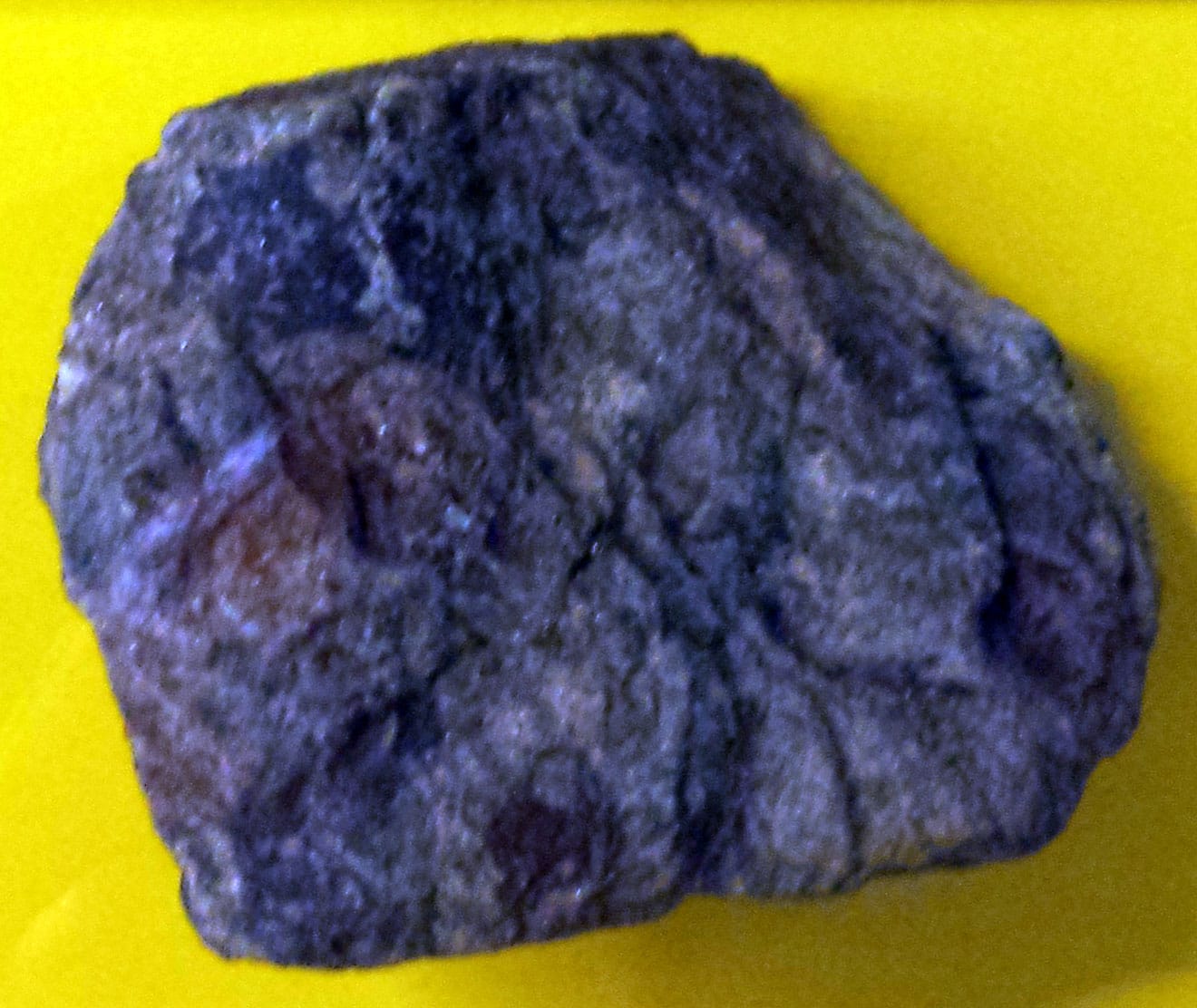
Featured image: Photograph of a uranium-bearing specimen by LSDSL, Wikimedia Commons, CC BY-SA 3.0. The image is illustrative uranium material, not an identified sample from the Oklo reactor deposit; no alteration is claimed.
Have a question about this topic?
Join fellow Qurons on the Quron Forum to ask questions, challenge ideas, share discoveries and explore further.
Discuss on Quron Forum