Across the granite hills of southeastern Zimbabwe stand the remains of an extraordinary stone-built city.
Its name is Great Zimbabwe.
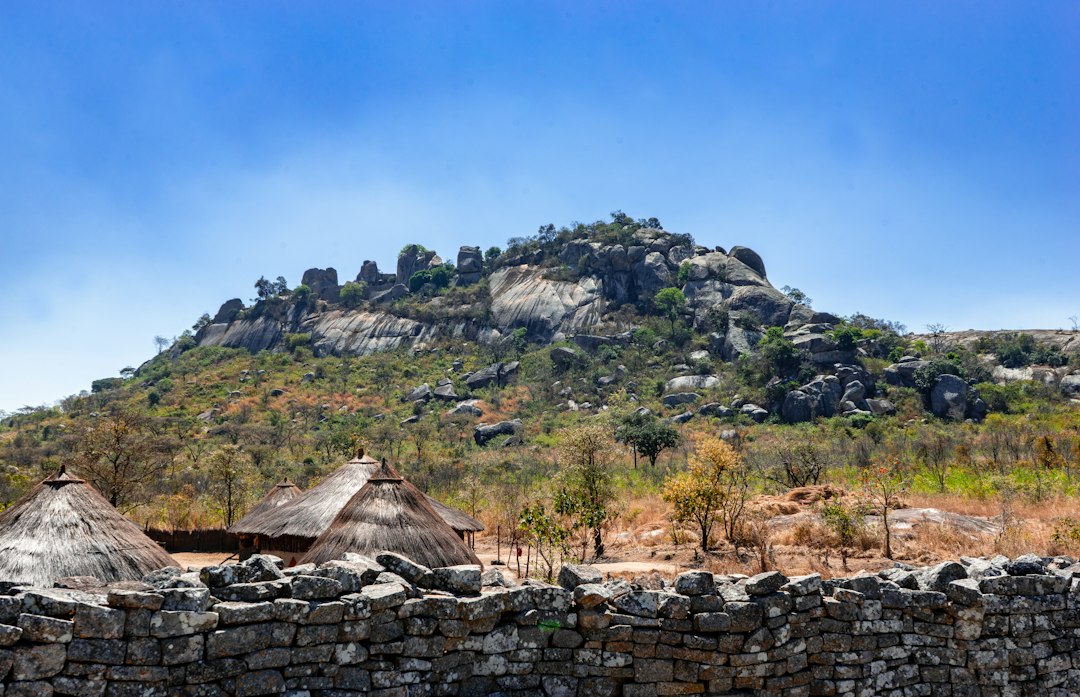
Massive dry-stone walls curve across the landscape. Towers rise from enormous enclosures. Narrow passages lead between carefully constructed spaces.
For a long time, colonial-era writers refused to believe that the city had been built by the ancestors of the African communities who lived in the region.
Archaeology eventually made the evidence difficult to ignore.
What was Great Zimbabwe?
Great Zimbabwe was a major settlement and political centre in southern Africa between roughly the eleventh and fifteenth centuries.
It belonged to the wider Zimbabwe culture, whose communities built stone architecture, farmed the surrounding landscape and participated in long-distance trade.
The site was not simply a fortress.
Its stone enclosures, residential areas and surrounding settlements formed a complex urban landscape associated with political authority, ceremony and economic activity.
Why are the walls so remarkable?
Great Zimbabwe’s most famous structures were built from carefully fitted granite blocks without mortar.
Builders selected and arranged stones so that the walls could remain stable through gravity, weight distribution and carefully controlled curves.
The result is architecture that is both technically sophisticated and visually striking.
The Great Enclosure is the largest of the site’s monumental structures. Its walls contain enormous quantities of stone and surround an interior space whose exact functions remain debated.
The walls were not simply defensive
It is tempting to see any massive wall as a military fortification.
But the architecture of Great Zimbabwe suggests more complex functions.
Some spaces may have controlled movement, created privacy, marked status or provided settings for ritual and political activity.
The walls themselves could communicate authority without needing to stop an invading army.
Architecture can be political even when it is not primarily military.
Who built Great Zimbabwe?
Archaeological evidence identifies the builders as African communities of the region, particularly ancestors of Shona-speaking peoples.
Evidence comes from settlement remains, local material culture, chronology and the broader archaeological context.
The site’s construction fits the development of complex societies in southern Africa rather than requiring an outside civilization.
Why was its African origin denied for so long?
During the colonial period, some European writers could not accept that such monumental architecture had been created by African societies.
They proposed Phoenicians, Arabs, ancient Egyptians, biblical peoples and other outsiders as supposed builders.
These theories were not supported by the archaeological evidence.
They reflected colonial assumptions about African history more than the material record.
Archaeology changed the story
Excavations recovered African ceramics, objects, building remains and other evidence that place Great Zimbabwe firmly within the archaeological development of southern Africa.
The chronology also fits a period when regional African states were becoming more complex and long-distance trade was expanding.
The stone walls therefore make sense as the achievements of local societies with their own political institutions and architectural traditions.
Great Zimbabwe was connected to the Indian Ocean
One of the most fascinating aspects of the site is evidence of long-distance trade.
Archaeologists have recovered objects such as Chinese ceramics, glass beads and other imported materials associated with wider Indian Ocean trade networks.
These objects did not mean that Chinese or Arab builders constructed the city.
They demonstrate something more interesting: Great Zimbabwe’s inhabitants participated in a global trading system that connected southern Africa to ports and markets thousands of kilometres away.
Gold mattered
The wider region was rich in gold resources, and gold became an important part of southern African trade.
Great Zimbabwe’s position within regional production and exchange helped support its political importance.
Trade, however, should not be reduced to one commodity. Cattle, ivory, agricultural products, crafts and other goods also moved through regional networks.
What did people eat?
The city depended on surrounding communities and agricultural production.
People cultivated crops, raised livestock and used wild resources.
The monumental centre therefore required an economic landscape capable of supporting people who built and maintained the structures.
Urban archaeology is always partly about food. A city cannot survive without systems that move resources from surrounding landscapes into the settlement.
Was Great Zimbabwe a capital?
The precise political structure is still debated.
But the scale of the site and its relationship with surrounding settlements indicate that it was more than an ordinary village.
It appears to have been a major centre of political and economic authority in the region.
The monumental architecture likely helped materialize that authority.
The Great Enclosure
The Great Enclosure is one of the most famous structures at the site.
Its enormous curved wall creates an enclosed space with carefully arranged architectural features, including the distinctive conical tower.
The exact purpose of the enclosure remains uncertain.
Possibilities include elite residence, ceremonial activity, initiation, political gatherings or combinations of these functions.
The absence of a written explanation means archaeologists must infer function from architecture, artefacts and comparisons with other sites.
The conical tower
One of Great Zimbabwe’s most recognizable structures is a tall stone tower inside the Great Enclosure.
Its purpose remains uncertain.
It may have carried symbolic or political meaning rather than serving a simple practical function.
The tower’s presence also demonstrates that the builders were deliberately creating monumental forms that were visually distinctive within the enclosure.
Why was the city abandoned?
Great Zimbabwe’s decline occurred gradually over the fifteenth century.
Several explanations have been proposed, including changing trade routes, environmental pressures, resource demands and the movement of political power toward other centres.
There is no need to imagine one catastrophic event that suddenly emptied the city.
As regional economies and political systems changed, the importance of the centre could decline even while the wider population continued to thrive.
The rise of other centres
Great Zimbabwe was part of a broader sequence of powerful southern African states.
After its decline, other centres became more prominent, including Khami and later Mutapa-related political systems.
This continuity is important because it shows that Great Zimbabwe was not the endpoint of African state development.
Political power moved.
The landscape mattered
Great Zimbabwe’s builders did not simply choose a random place to construct stone walls.
The site sits within a landscape of granite outcrops, valleys, agricultural land and routes connecting different parts of southern Africa.
Natural stone was abundant, making dry-stone construction practical.
The surrounding environment also supported the agricultural and pastoral economy on which the settlement depended.
What makes the walls so durable?
The builders used dry-stone masonry rather than mortar.
Granite blocks were stacked in carefully controlled courses, with the weight of the upper stones distributed through the wall.
The curved geometry was not merely decorative. It contributed to the stability of the structures.
The surviving walls demonstrate that sophisticated engineering does not require industrial materials.
Great Zimbabwe and the myth of the “lost civilization”
The old colonial story described Great Zimbabwe as mysterious because Europeans could not imagine Africans building it.
Modern archaeology reverses the premise.
The real historical question is not “Who else could have built this?”
It is “What social and economic conditions allowed African communities in southern Africa to build a centre of this scale?”
That question leads to a richer history.
A city at the centre of an African trading world
Great Zimbabwe demonstrates that medieval Africa was deeply connected to wider networks of exchange.
Goods could move from the interior to the Indian Ocean coast and onward to distant markets.
Ideas, technologies and cultural influences moved with them.
The city therefore belongs not only to the history of Zimbabwe but to the history of the Indian Ocean world.
Why the archaeological evidence matters
Written sources about Great Zimbabwe from its own inhabitants are limited.
That makes archaeology especially important.
Walls, houses, pottery, animal remains, imported objects, metalworking evidence and settlement patterns become the historical record.
When different categories of evidence point in the same direction, the reconstruction becomes stronger.
The real mystery is not who built it
We know enough to reject the old claim that Great Zimbabwe required an unknown foreign civilization.
The more interesting mysteries remain open.
How exactly was political authority organized? What ceremonies took place inside the major enclosures? How did rulers manage long-distance trade? How did ordinary people experience the city?
Those questions are difficult precisely because archaeology gives us buildings and objects rather than diaries.
Great Zimbabwe should not be called a “lost” African civilization
The city declined, but the communities that created its culture did not vanish.
Later African societies inherited and transformed regional traditions.
The idea of a completely lost civilization came partly from the colonial-era habit of separating monumental architecture from the people who actually lived in the surrounding landscape.
Modern archaeology tells a different story: continuity, transformation and local innovation.
The stone city that changed a historical narrative
Great Zimbabwe is extraordinary because of its walls.
But its greatest historical importance may lie beyond the stone.
The site demonstrates that complex political systems, monumental architecture and long-distance trade were part of African history on their own terms.
The people who built Great Zimbabwe did not need an outsider to teach them how to construct a city.
They developed their own architecture, political institutions and trading networks—and left behind one of the most remarkable archaeological landscapes in Africa.
The walls still stand.
But the most important thing they preserve is not a mystery about who built them.
They preserve evidence of what African societies were already capable of building.
Curiosity Publication by Aadvik Agastya
Sources & further reading
- UNESCO World Heritage Centre — Great Zimbabwe National Monument
- Encyclopaedia Britannica — Great Zimbabwe
Have a question about this topic?
Join fellow Qurons on the Quron Forum to ask questions, challenge ideas, share discoveries and explore further.
Discuss on Quron Forum