Long before European cities dominated the landscape of North America, a vast urban centre rose beside the Mississippi River near what is now St. Louis.
Its name was Cahokia.
At its height, the settlement contained monumental earthen mounds, plazas, neighborhoods, craft areas and a population large enough to challenge the assumption that pre-Columbian North America was dominated only by small, scattered communities.
Cahokia was not a “lost city” in the sense of a vanished mystery civilization. Archaeology has revealed a great deal about it.
The deeper mystery is how such a large society emerged—and why its urban centre eventually declined.
A city built from earth
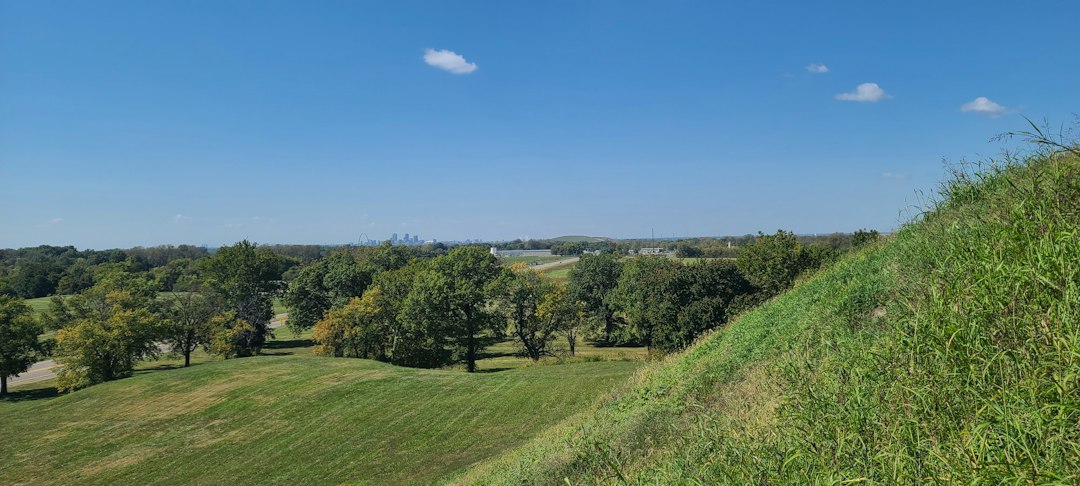
Cahokia’s most visible monuments are its earthen mounds.
Unlike stone pyramids, these monuments were built by moving enormous quantities of soil, often by human labor using simple tools and baskets.
The largest is Monks Mound, a massive platform mound that once supported important structures.
Its scale demonstrates not only engineering ability but the existence of a society capable of organizing large numbers of people for communal construction.
Where was Cahokia?
Cahokia developed near the Mississippi River floodplain, in a landscape with access to water, fertile soils and major transportation routes.
The location offered opportunities for agriculture, fishing, hunting and trade.
Rivers also connected communities over long distances, making the Mississippi region a natural corridor for the movement of people, materials and ideas.
When did Cahokia flourish?
Cahokia’s major growth occurred around the first millennium AD, with its greatest expansion generally placed around the eleventh and twelfth centuries.
The settlement was not static. Its population, buildings, political institutions and ceremonial spaces changed over time.
Archaeologists therefore study Cahokia as a developing urban society rather than a single city frozen at one moment.
How large was the population?
Population estimates vary because archaeologists cannot simply count the people who once lived there.
Different estimates have placed the urban population in the thousands to potentially tens of thousands, with a much larger surrounding regional population connected to the centre.
Whatever precise number is chosen, the archaeological evidence clearly demonstrates a major concentration of people and infrastructure.
That is the important point: Cahokia was urban in scale and organization even though it looked very different from later European cities.
Monks Mound was more than a pile of dirt
Monks Mound is often compared with pyramids because of its monumental scale.
But the comparison can be misleading.
The mound was a platform designed to elevate structures and create an imposing architectural space. It formed part of a larger ceremonial and political landscape.
The mound therefore represented more than engineering. Height itself could communicate status, authority and the relationship between leaders, ritual and the community.
The great plazas
Large open plazas surrounded the monumental areas.
These spaces could accommodate gatherings, ceremonies and public activities.
Urban life requires more than houses. It requires places where people can assemble, exchange goods, conduct rituals and encounter political authority.
Cahokia’s plazas are evidence that public space was deliberately incorporated into the settlement’s design.
Woodhenge and the sky
Archaeologists have also identified circles of large wooden posts known collectively as Woodhenge.
These structures appear to have had astronomical and ceremonial significance, with alignments connected to the movements of the Sun.
The existence of such monuments suggests that Cahokians observed seasonal cycles and incorporated celestial phenomena into aspects of their social and ceremonial life.
But astronomical alignment does not mean that Cahokia was simply an observatory. The sky, agriculture, ritual and political symbolism could all have been connected.
Who built Cahokia?
The people who built Cahokia belonged to complex Indigenous societies of the Mississippi region.
They cultivated crops, produced pottery and tools, built houses and participated in extensive exchange networks.
Archaeology does not support the old idea that monumental sites in North America must have been built by a mysterious non-Indigenous civilization.
Cahokia was created by Indigenous peoples with their own political, religious and economic systems.
A city connected to a huge region
Cahokia’s influence extended far beyond its central mounds.
Archaeologists have found evidence of long-distance exchange involving materials that originated far from the Mississippi region.
Marine shell, copper and other non-local materials indicate that people, goods and ideas travelled through broad networks.
This is another reason to think of Cahokia as an urban centre within a regional system rather than an isolated settlement.
Trade was not just about objects
When archaeologists find a material hundreds of kilometres from its source, they are not simply discovering evidence of commerce.
They are discovering relationships.
People had to know where resources existed, how to acquire them, how to transport them and how to exchange them.
Long-distance networks also move ideas, technologies, symbols and social practices.
What did people eat?
Agriculture was central to Cahokian life.
Maize became an important crop, alongside other plants and foods obtained through hunting, fishing and gathering.
The floodplain and surrounding ecosystems provided a broad resource base.
But agriculture also created vulnerability. A large urban population requires reliable food production, and environmental changes can have consequences that are minor for small settlements but severe for cities.
Was Cahokia ruled by a king?
The exact political structure is unknown.
The scale of monumental construction indicates strong forms of organization, but archaeology cannot simply translate that evidence into a European-style monarchy.
Power may have been concentrated among hereditary elites, religious authorities, political leaders or combinations of institutions.
The monumental landscape suggests hierarchy, but the exact political system remains a subject of research.
Evidence of social inequality
Burials and residential patterns suggest that Cahokian society was not completely egalitarian.
Some individuals were buried with unusual quantities or types of objects, while access to monumental spaces and high-status structures appears to have been differentiated.
Such evidence suggests social ranking and institutional power.
But inequality does not automatically tell us the precise nature of political authority.
Why did Cahokia decline?
This is one of the most important unanswered questions.
Cahokia’s urban population declined over time, and parts of the site were eventually abandoned.
Researchers have considered multiple factors, including environmental change, flooding, deforestation, soil stress, climate variability, political instability and changing regional relationships.
No single explanation has been proven to account for the entire process.
Climate and flooding
Cahokia’s location near the Mississippi River provided enormous advantages but also created environmental risks.
Flooding can affect crops, housing and transportation.
Changes in rainfall and river behavior can become particularly important when a city depends on a narrow agricultural and ecological system.
Evidence from environmental archaeology suggests that changing hydrological conditions were part of the story, but they should be considered alongside social and political factors rather than treated as a single “climate collapse.”
Deforestation and urban pressure
A large settlement consumes wood for construction, fuel and other purposes.
As populations grow, the surrounding environment can be transformed.
Archaeologists have investigated evidence for changing vegetation and land use around Cahokia, raising the possibility that urban growth altered the ecological conditions on which the city depended.
Again, this does not prove that environmental degradation alone caused the decline.
Did Cahokia disappear suddenly?
No.
The archaeological record suggests a long process of transformation rather than one catastrophic event that instantly emptied the city.
People moved, political relationships changed and regional centres rose and declined.
Descendant communities continued to live in the wider region long after the central urban concentration diminished.
The city was “forgotten” only from a later perspective
Cahokia is sometimes described as a forgotten city.
But Indigenous peoples did not simply lose all knowledge of the Mississippi landscape because the monumental centre declined.
The idea of a completely forgotten civilization reflects a later historical perspective in which European Americans encountered monumental earthworks without understanding their origins.
Modern archaeology has corrected much of that misconception.
Why Cahokia matters today
Cahokia changes the history of North America.
It demonstrates that complex urban societies existed north of Mexico before European colonization, with monumental architecture, organized agriculture, regional trade and sophisticated ceremonial traditions.
Its history also challenges the old assumption that cities must look like later European cities to qualify as urban.
An urban world built without stone
Cahokia’s greatest monuments were made primarily from earth and wood.
That means much of its architecture was vulnerable to erosion, decay and later land use.
What survives today is therefore only part of the original city.
Geophysical survey and archaeology have revealed that the landscape once contained far more structures, houses, posts, plazas and activity areas than the most obvious surviving mounds suggest.
The city beneath the fields
One of the most fascinating aspects of Cahokia is that the archaeological site extends beyond what a visitor can see as a mound.
Remote sensing, excavation and soil analysis can reveal buried features that leave little visible trace.
This means that Cahokia is partly a city hidden beneath the modern landscape.
The monumental mounds are only the most obvious remnants of a much larger urban system.
What happened to the people?
Urban decline is not the same thing as population extinction.
When a major centre loses its political or economic importance, people can relocate to smaller settlements, join other communities or reorganize their social systems.
The archaeological challenge is that these movements may leave fewer dramatic structures behind.
Cahokia’s decline should therefore be understood as a transformation of regional society, not simply the disappearance of a people.
Cahokia was not a mystery civilization
The most interesting thing about Cahokia is not that archaeologists cannot explain it.
They can explain many parts of it.
We know how people built the mounds. We know they farmed. We know they traded over long distances. We know they created ceremonial spaces and observed the sky.
The unanswered questions concern the details of their social organization, beliefs and the interacting causes of urban decline.
The forgotten city that should not have been forgotten
Cahokia was a major centre of Indigenous North America.
Its people transformed the Mississippi landscape, built monumental earthworks and created a complex urban society connected to communities across a vast region.
Its decline was probably not caused by one simple disaster.
Like cities everywhere, Cahokia depended on relationships between people, resources, institutions, environment and trade.
When those relationships changed, the city changed with them.
What remains are enormous mounds rising above the landscape—quiet reminders that North America’s pre-colonial past contained urban worlds far larger and more sophisticated than older histories once acknowledged.
Curiosity Publication by Aadvik Agastya
Sources & further reading
- National Park Service — Cahokia Mounds
- UNESCO — Cahokia Mounds State Historic Site
- Smithsonian Institution — Cahokia and Mississippian archaeology
Have a question about this topic?
Join fellow Qurons on the Quron Forum to ask questions, challenge ideas, share discoveries and explore further.
Discuss on Quron Forum