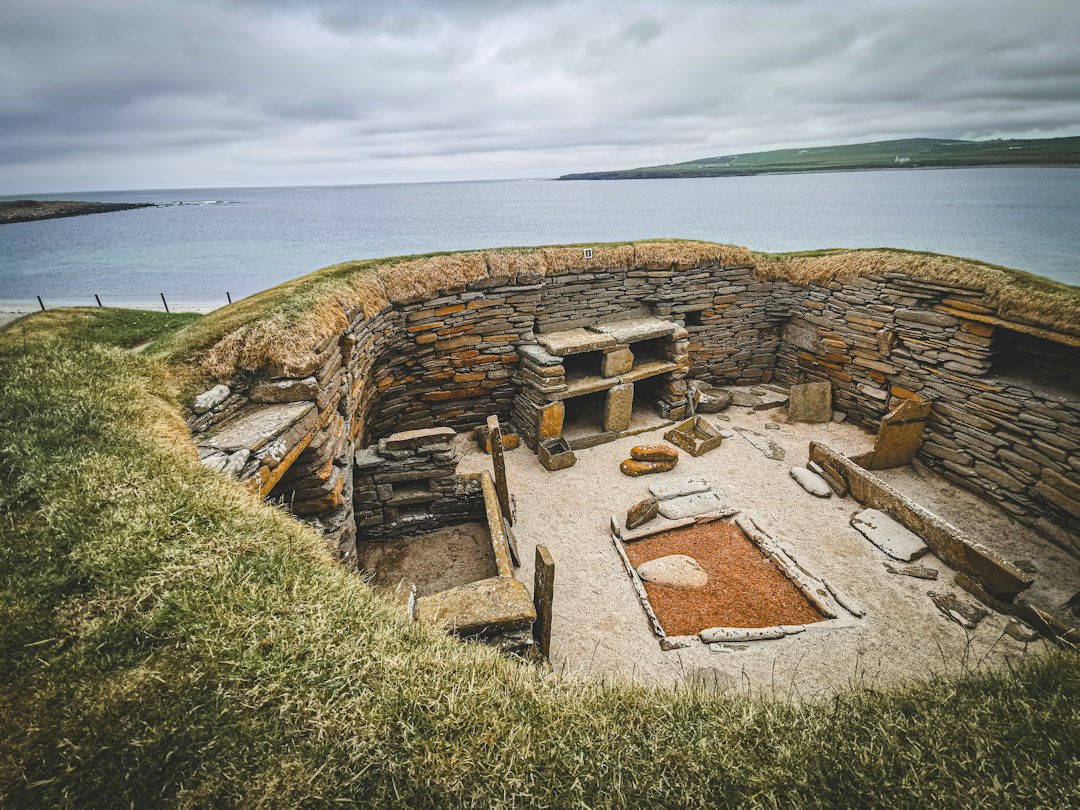
On the edge of Skaill Bay in Orkney, Scotland, lies a stone settlement that looks as though its inhabitants left only yesterday.
Low stone walls define rooms. Stone beds remain in place. Dressers still stand against walls. Narrow passageways connect the houses.
But the settlement is roughly 5,000 years old.
This is Skara Brae, one of Europe’s most remarkable prehistoric settlements and part of the UNESCO World Heritage property known as the Heart of Neolithic Orkney.
A village older than the pyramids
Skara Brae was occupied during the Neolithic period, roughly between 3100 and 2500 BC according to archaeological dating. It therefore predates the great Egyptian pyramids and belongs to a period when farming communities were becoming established across parts of Europe.
UNESCO describes Skara Brae as one of the best-preserved Neolithic settlements in northern Europe and an exceptional source of evidence for domestic life, social organization and material culture.
The village was discovered by a storm
For centuries, much of Skara Brae was buried beneath layers of sand and soil.
Then a powerful storm in 1850 stripped away part of the coastal covering and exposed ancient stone structures.
What appeared was not a single monument but a settlement containing multiple houses.
The discovery was remarkable because burial had protected the stonework from many of the processes that normally destroy prehistoric buildings.
What makes the preservation so extraordinary?
Skara Brae was built largely from flat stone slabs and incorporated into substantial deposits of midden—the accumulated waste and soil of the settlement.
The buildings became partly protected beneath these layers, while the dry stone construction survived unusually well.
UNESCO describes the state of preservation as unparalleled among Neolithic settlements in northern Europe.
The preservation is not perfect. Coastal erosion has already removed parts of the original settlement, and the sea remains one of the site’s major long-term threats.
What did a Skara Brae house look like?
Each house was roughly circular or rectangular in plan, with a central living space surrounded by thick stone walls.
Inside were built-in features that reveal how people organized domestic life.
- Stone box-beds were set into the walls.
- A central hearth provided a place for fire.
- Stone dressers or shelving units stood against walls.
- Small stone tanks or compartments may have served specialized purposes.
Historic Environment Scotland notes that these fitted stone furnishings survive alongside the walls, giving unusually direct evidence of how the houses were arranged.
The dresser may have been more than storage
One of Skara Brae’s most recognizable features is the stone dresser.
It has often been interpreted as a storage or display structure, but its precise function cannot be established with complete certainty.
That uncertainty is typical of archaeology. An object survives, but the behavior associated with it does not.
A dresser might have held tools, food, containers or valued objects. Its prominent position may also have had a social or symbolic dimension.
Archaeologists therefore use wear patterns, associated finds, spatial arrangement and comparisons with other settlements to narrow the possibilities.
Why are the houses connected by passages?
Covered passageways connect parts of the settlement.
They would have provided protected movement between buildings, particularly valuable in Orkney’s exposed climate.
The arrangement also suggests that the houses were not isolated family units scattered across the landscape. They formed a connected settlement.
That organization raises questions about community structure, privacy, cooperation and shared resources.
Life on a cold northern island
Orkney is exposed to strong winds, cool temperatures and changing weather.
The people who lived at Skara Brae adapted their architecture to that environment.
Partly sunken structures and thick stone walls provided insulation and protection. The compact arrangement reduced exposure to the weather, while covered passages allowed movement without constantly crossing open ground.
The buildings therefore demonstrate practical environmental knowledge rather than simply a desire to build in stone.
Who lived at Skara Brae?
The settlement appears to have been occupied by farming communities, but the inhabitants also exploited marine and wild resources.
Archaeological finds include tools, pottery, animal remains, jewellery and other objects.
Historic Environment Scotland describes the inhabitants as farmers, hunters and fishermen.
This combination is important. Neolithic communities were not simply farmers who abandoned every older way of obtaining food. Their economies could combine agriculture, animal husbandry, fishing, hunting and gathering.
The people had time for more than survival
Skara Brae’s artefacts include beads, pendants, gaming objects and carefully made stone items.
Such objects demonstrate that the community invested labor in things that were not simply food or shelter.
Some carved stone objects may have had symbolic or ritual functions, although individual interpretations remain debated.
The evidence therefore points toward a society with social practices, identities and perhaps ceremonial traditions—not merely a group of people struggling to survive in a harsh climate.
Was Skara Brae a peaceful village?
No weapons have been found in the settlement, and its location was not especially defensive.
Historic Environment Scotland notes that these features have contributed to interpretations of Skara Brae as a relatively peaceful community.
But absence of weapons is not proof that violence never occurred. Archaeology can reveal what survives; it cannot document every event that did not leave physical traces.
A cautious conclusion is that the settlement does not currently provide strong evidence for a heavily fortified or militarized way of life.
Skara Brae was part of a much larger landscape
The settlement did not exist alone.
Orkney contains an extraordinary concentration of Neolithic monuments, including Maeshowe, the Stones of Stenness and the Ring of Brodgar.
Together, these sites form the Heart of Neolithic Orkney, a cultural landscape in which domestic, ceremonial and funerary monuments existed within visual and geographical relationships.
This context changes how Skara Brae should be understood. It was not simply a village in an isolated corner of Scotland. It belonged to a wider society capable of building monumental structures and maintaining connections across the landscape.
What happened to the village?
Skara Brae appears to have been abandoned around the middle of the third millennium BC.
The exact reason remains uncertain.
Older explanations proposed that a sudden sandstorm forced the inhabitants to flee. Other interpretations suggest a more gradual change in settlement patterns, environment or social organization.
Historic Environment Scotland explicitly notes that no single explanation for the end of village life has been established.
This is important because the spectacular preservation can create the impression of a sudden Pompeii-like catastrophe. The evidence does not require such a dramatic ending.
Could climate change have played a role?
Environmental change is one possibility among several.
Coastal environments are dynamic, and long-term changes in climate, soil conditions, resources and shoreline position could have altered the attractiveness of the site.
But archaeology rarely permits a single-cause explanation for settlement abandonment. Social changes, population movement, changing agricultural strategies and shifts in ceremonial life could all have contributed.
The sea both revealed and threatened Skara Brae
There is a striking irony in the site’s history.
A storm exposed the settlement to modern archaeologists.
But the same coastal environment that helped bury and preserve parts of the site has also destroyed others.
UNESCO identifies coastal erosion and visitor pressure among the physical threats facing the fragile archaeological landscape.
The settlement we see today is therefore not the complete village. It is the surviving portion of a larger prehistoric landscape.
What archaeology can reveal from a stone bed
A stone bed may seem like a simple object.
At Skara Brae it becomes evidence about sleeping arrangements, house layout, household organization and possibly social differences.
The same applies to hearths, storage spaces and passages.
Archaeologists rarely learn about prehistoric life from one spectacular discovery. They reconstruct it by combining hundreds of small clues.
Why Skara Brae feels strangely modern
Perhaps the most unsettling feature of Skara Brae is how recognizable the domestic environment remains.
There are separate rooms, beds, storage spaces, hearths and pathways connecting homes.
The people who lived there had furniture designed around the architecture rather than loose objects filling empty rooms.
For a moment, the distance between modern life and prehistoric life seems to shrink.
Then the scale of time returns.
These rooms were being used more than 5,000 years ago.
The houses preserve routines, not just buildings
Archaeological sites often tell us where people lived.
Skara Brae can tell us something about how they lived.
The placement of furniture suggests where people sat, slept, stored things and gathered around fires. The arrangement of houses indicates how domestic life was organized at the community level.
We cannot reconstruct every conversation that happened inside those rooms, but the architecture preserves the physical framework within which thousands of ordinary days unfolded.
A prehistoric village at the edge of the sea
Skara Brae is often called a village that survived the sea.
That is only partly true.
The sea helped shape the landscape, exposed the buried settlement and continues to threaten it. The preservation owes as much to burial, stone construction and environmental conditions as to the coastline itself.
What survives is therefore a combination of human architecture and geological chance.
Why Skara Brae matters
The greatest importance of Skara Brae is not that it is old.
It is that it preserves enough detail to make a prehistoric community visible.
We can see the houses. We can see the furniture. We can trace the passages. We can study the objects left behind.
And when those details are combined with the monuments elsewhere in Orkney, a much larger picture emerges: a Neolithic society with sophisticated architecture, farming, craft production, ritual traditions and a highly organized relationship with its landscape.
The village that the storm uncovered
Five thousand years ago, people lived ordinary lives at Skara Brae.
They cooked food. Maintained fires. Slept in stone beds. Stored objects. Worked. Raised families. Built and repaired their homes.
Then, sometime around 2500 BC, the village ceased to be occupied.
For thousands of years, the buildings disappeared beneath the landscape.
Until a storm pulled the covering away.
What emerged was not a treasure chest or a monument built for kings.
It was something rarer.
A prehistoric home still looking like a home.
Curiosity Publication by Aadvik Agastya
Sources & further reading
- UNESCO World Heritage Centre — Heart of Neolithic Orkney
- Historic Environment Scotland — Skara Brae
- Historic Environment Scotland — Skara Brae history and stories
- Historic Environment Scotland — The Story of Skara Brae
Have a question about this topic?
Join fellow Qurons on the Quron Forum to ask questions, challenge ideas, share discoveries and explore further.
Discuss on Quron Forum