When Mount Vesuvius erupted in AD 79, the Roman town of Herculaneum disappeared beneath volcanic material.
That sounds like a story of destruction.
But Herculaneum’s destruction also created one of archaeology’s most extraordinary time capsules.
Unlike Pompeii, which was largely buried by falling ash and pumice, Herculaneum was overwhelmed by extremely hot pyroclastic surges and flows. The rapidly deposited material sealed buildings, objects and organic remains, creating conditions in which wooden furniture, food, textiles and even upper floors could survive.
Herculaneum was a living Roman town
Before the eruption, Herculaneum was not an archaeological site. It was a functioning community on the Bay of Naples.
Its location gave it access to the sea and to the wider network of Roman Campania. Houses, shops, baths, religious buildings and public spaces formed a compact urban settlement.
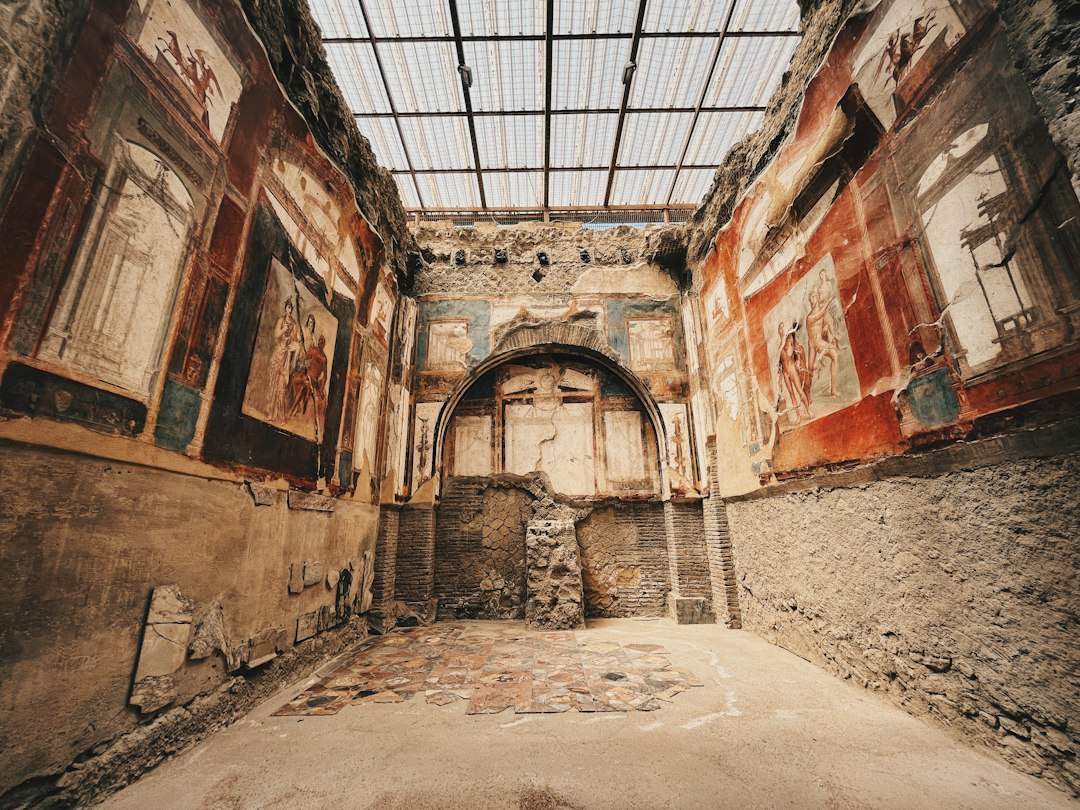
Some wealthy residents owned elaborate homes decorated with frescoes and mosaics, while ordinary commercial spaces contained the equipment and storage vessels of everyday life.
That social mixture is one reason the site matters so much: it preserves not only monumental architecture but the physical traces of ordinary routines.
The eruption of Vesuvius
In AD 79, Vesuvius entered a catastrophic eruptive phase.
The eruption did not affect every place in the same way.
At Pompeii, falling pumice and ash accumulated over the city, eventually burying streets and buildings. Herculaneum experienced a different sequence, with pyroclastic surges and flows depositing thick volcanic material over the town.
The exact chronology of the eruption has been reconstructed through geology, archaeology and historical evidence, but the crucial point is that Herculaneum was rapidly sealed.
Why did Herculaneum survive differently from Pompeii?
The contrast is striking.
At Pompeii, falling material could accumulate on roofs until structures collapsed under the weight. At Herculaneum, later pyroclastic deposits filled buildings rapidly and solidified around them.
UNESCO notes that Herculaneum’s preservation includes upper storeys and large amounts of carbonized organic material, including wooden furniture and architectural elements.
The difference is not simply “one city was buried better.” It is the result of different volcanic processes interacting with different buildings and materials.
Heat destroyed some things—and preserved others
High temperatures sound like the enemy of preservation.
In many cases, they are.
But under particular conditions, intense heat can rapidly carbonize organic materials. If the material is then sealed from oxygen and later environmental disturbance, the carbonized remains can survive.
That is why archaeologists have recovered objects that normally disappear within decades or centuries: wooden doors, beams, furniture, foodstuffs and other organic remains.
The result is a rare archaeological record of materials that are usually almost invisible in Roman sites.
Wooden furniture is more important than it sounds
Stone buildings and marble statues can tell us about wealth and architecture. Wooden objects reveal something different.
Furniture, shelving, doors and structural timbers show how rooms were actually used.
A preserved wooden object can reveal construction techniques, joinery, decoration and patterns of wear.
Because organic materials usually decay, archaeologists often have to reconstruct ancient domestic life from fragments or indirect evidence. Herculaneum provides unusually direct evidence.
Food survived too
Some food remains were carbonized and preserved by the eruption.
These remains can provide clues about diet, agriculture, trade and storage.
A preserved food item may appear mundane, but it answers questions that monuments cannot: What did people eat? How was food processed? What crops were available? How were supplies stored?
Archaeology becomes especially powerful when thousands of small details begin forming a picture of everyday life.
The shoreline and the skeletons
One of the most haunting parts of Herculaneum is the ancient shoreline.
About 300 skeletons were discovered in areas along the former coast. Their remains have provided evidence for studying the health, lifestyles and deaths of people caught in the eruption.
Human remains also complicate the popular image of the eruption as a single instant of death. The archaeological record reflects a sequence of volcanic processes and different circumstances of exposure.
The skeletons are therefore not simply tragic objects. They are scientific evidence about the final population of the town.
Why were so many people near the shore?
The shoreline structures have generated extensive archaeological study.
People may have gathered in waterfront buildings while attempting to escape, seek shelter or wait for conditions to improve. Their precise intentions cannot always be reconstructed.
What the remains demonstrate is that the population did not disappear from a single uniform location. Different people encountered the eruption in different places and under different conditions.
The Villa of the Papyri
One of Herculaneum’s most famous discoveries is the Villa of the Papyri, an enormous luxury residence outside the main town.
Its name comes from the extraordinary library of carbonized papyrus scrolls discovered there.
Thousands of fragments and scrolls survived because the eruption transformed them into carbonized material rather than allowing them to decay completely.
The library provides rare evidence of what an elite Roman intellectual collection could look like—and of how Greek philosophical writing circulated within the Roman world.
A city hidden beneath another city
Herculaneum has an unusual archaeological problem.
Unlike an isolated ruin, much of the ancient town lies beneath the modern settlement of Ercolano.
This means archaeologists cannot simply excavate everything.
Some ancient areas are known through tunnels excavated in the eighteenth century, while others remain beneath modern buildings. UNESCO notes that substantial portions of the ancient town still lie below the modern city.
The archaeological site is therefore only part of Herculaneum.
The tunnels came before modern archaeology
Herculaneum was rediscovered and explored through underground tunnelling in the eighteenth century.
Early excavators did not work according to modern archaeological standards. Objects could be removed without the detailed recording archaeologists would expect today, and some areas were explored primarily to recover valuable artworks.
Those early excavations are themselves part of the site’s history.
They also explain why archaeologists sometimes know that something existed without possessing the complete archaeological context modern research would ideally require.
Herculaneum changed how archaeologists see Roman life
Many Roman sites preserve walls and foundations.
Herculaneum preserves something closer to a snapshot of a functioning town.
Shops still contain storage vessels. Houses retain decorative schemes. Wooden elements survive. Food remains reveal diet. Human remains provide biological evidence. Literary material survives in extraordinary circumstances.
All of these categories can be studied together.
What does Herculaneum tell us about social class?
The site contains both modest and luxurious spaces.
That makes it possible to examine differences in architecture, decoration, domestic equipment and access to public amenities.
The Roman world was deeply stratified, but social hierarchy was not visible only in grand monuments. It appeared in the size of houses, the materials used, the objects people owned and the spaces in which they lived and worked.
Herculaneum preserves these differences unusually well.
Preservation is also a problem
Being preserved by a catastrophe does not mean being permanently safe.
Once archaeologists expose ancient buildings to air, sunlight, rainfall, plant growth and modern environmental change, the conditions that protected them for centuries disappear.
Wall paintings can deteriorate. Masonry can weaken. Organic materials can decay.
UNESCO’s recent conservation reports emphasize that Herculaneum requires continued stabilization, maintenance and careful management.
The archaeological excavation therefore creates a paradox: uncovering the past can expose it to the forces that will destroy it.
Modern conservation has become part of the site’s story
Since the twentieth century, conservation approaches have changed significantly.
Earlier restoration sometimes used modern materials such as concrete and steel. Contemporary conservation places greater emphasis on authenticity, compatible materials, long-term monitoring and treating entire districts rather than isolated monuments.
The Herculaneum Conservation Project has also played a major role in long-term site management.
UNESCO’s 2026 assessment noted continued conservation efforts while identifying areas requiring sustained attention, including parts of the Herculaneum component and the Villa of the Papyri.
What we can learn from a carbonized piece of wood
A preserved wooden beam may seem less spectacular than a statue.
Scientifically, it can be more informative.
It can reveal tree species, construction practices, woodworking technology, building phases and sometimes even the resources available to the ancient community.
The same principle applies to food, textiles, seeds and other organic materials.
Herculaneum’s greatest gift to archaeology is not one famous object. It is the survival of thousands of small things that normally disappear.
The eruption became an accidental archive
Vesuvius destroyed Herculaneum’s living community.
But the same processes that caused that destruction created an archive of extraordinary richness.
Buildings were sealed. Organic objects were carbonized. Upper floors survived. Food remained. Human remains could be studied. A library was preserved.
Instead of simply leaving ruins, the eruption froze fragments of daily life into the archaeological record.
Herculaneum is not simply a smaller Pompeii
The two cities are often mentioned together, but their archaeological personalities are different.
Pompeii offers an exceptionally extensive picture of an urban environment buried under volcanic ash and pumice.
Herculaneum is smaller but preserves certain materials in extraordinary condition, particularly organic objects and upper architectural levels.
Studying them together allows archaeologists to compare how different volcanic processes can preserve different aspects of the same Roman world.
The town that survived because it was destroyed
Herculaneum is one of archaeology’s great paradoxes.
Its inhabitants experienced a catastrophe that ended their town.
Yet the catastrophe also prevented the complete disappearance of their world.
Two thousand years later, a wooden door can still show how it was built. A carbonized loaf can reveal what people ate. A wall painting can preserve a decorative scheme. A papyrus can preserve a philosophical text.
The eruption was a disaster for the people who lived there.
For modern archaeology, it became an accidental archive.
And that is why Herculaneum feels less like a ruin than a moment in Roman life that was interrupted—and then sealed away until we learned how to look again.
Curiosity Publication by Aadvik Agastya
Sources & further reading
- UNESCO World Heritage Centre — Archaeological Areas of Pompeii, Herculaneum and Torre Annunziata
- UNESCO — Archaeological Park of Herculaneum
- UNESCO — 2026 conservation decision
Have a question about this topic?
Join fellow Qurons on the Quron Forum to ask questions, challenge ideas, share discoveries and explore further.
Discuss on Quron Forum