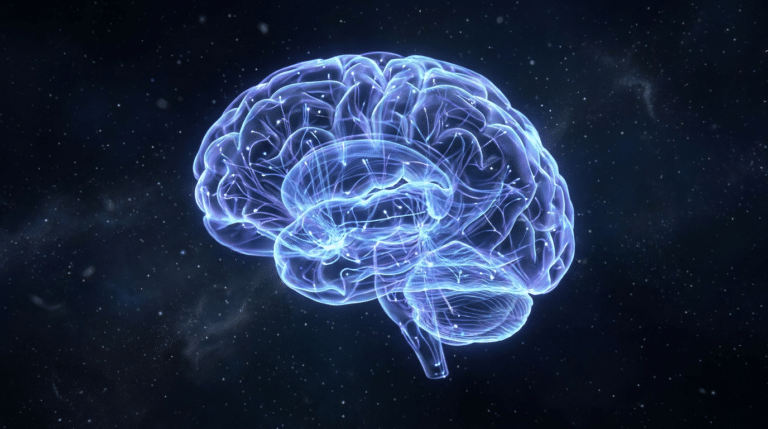

Look at a cloud and you may see a face. Hear a random noise and your brain may detect a voice. See two unrelated events happen close together and you may immediately connect them.
Pattern detection is not simply a flaw. It is one of the most useful things a nervous system can do. The difficulty begins when the brain detects meaningful structure in randomness.
The brain is constantly predicting
We rarely experience the world as raw sensory data. The brain combines incoming signals with expectations built from previous experience.
If you hear a rustle in a forest, your brain does not wait for a perfect measurement before asking what caused it. It rapidly compares the sound with possible sources. This speed is useful when decisions have consequences.
False positives can sometimes be safer
Imagine an animal moving through tall grass. Treating every unexpected sound as harmless may save energy, but missing a genuine predator could be disastrous.
A nervous system can therefore benefit from being sensitive to weak signals, even if that sensitivity creates false alarms. This is a plausible evolutionary pressure, although it does not mean every modern pattern illusion is itself an adaptation.
Pareidolia: faces in clouds
Pareidolia occurs when ambiguous information is perceived as a recognizable object, especially a face. Human brains are highly sensitive to faces because identifying other people is socially important.
Two dark marks and a horizontal line can therefore produce a surprisingly strong impression of a face. Once the pattern is recognized, it can be difficult to “unsee” it.
Apophenia and meaningful coincidences
Apophenia is a broader term for perceiving meaningful connections among unrelated things. It can appear in superstition, coincidences and some forms of conspiracy thinking.
But recognizing the tendency does not mean every unusual connection is false. Real patterns exist. The challenge is determining whether the pattern remains after careful testing.
Randomness does not look random enough
People often expect random sequences to alternate smoothly. In reality, randomness naturally produces clusters and streaks.
A sequence of several heads in a row can feel suspicious even though such streaks are expected in sufficiently long sequences. Our intuition has difficulty estimating how much apparent structure randomness can generate on its own.
Statistics is a defense against pattern illusion
Statistics asks how surprising an observed pattern would be under an appropriate model. It also asks whether the pattern appears again in independent data.
This is important because almost any sufficiently large dataset contains something interesting. If researchers search until they find a striking relationship and only then test it, they can mistake coincidence for discovery.
Science begins with pattern recognition
Scientific discovery often starts with noticing something unexpected. A researcher sees a repeated effect and asks whether it represents a real phenomenon.
The next stage is crucial. The observation must be tested under controlled conditions, compared with alternatives and ideally reproduced by independent researchers.
Pattern recognition generates hypotheses. Evidence decides which hypotheses survive.
Why dreams and coincidences feel connected
Humans also search for patterns in dreams, lucky numbers, repeated encounters and apparently meaningful coincidences. Emotional events receive more attention, which can make coincidences involving them especially memorable.
We also forget countless non-events. That imbalance can make a rare coincidence feel more common than it statistically is.
Pattern seeking can produce both error and discovery
The same cognitive ability can lead to superstition or scientific insight. Recognizing a repeated astronomical cycle can produce a calendar. Recognizing a false correlation can produce a bad prediction.
The difference is not whether a pattern was noticed. It is whether the pattern survives a method designed to challenge it.
The deeper mystery
Humans are remarkable not simply because we see patterns, but because we can sometimes detect when our pattern detector is wrong.
We invented mathematics, experiments and statistics partly because intuition is powerful but imperfect. The brain gives us the first question. Critical thinking gives us a way to find out whether the pattern is real.
The same mental ability that helps us recognize a friend, predict weather from clouds or notice a dangerous change in an environment can also produce superstition, false correlations and elaborate explanations for coincidences.
A deeper look: The brain is constantly predicting
If you hear a rustle in a forest, your brain does not wait for a perfect measurement before asking what caused it. It rapidly compares the sound with possible sources.
This predictive process is useful because the world is noisy. Sensory information is incomplete, ambiguous and sometimes contradictory. A nervous system that had to wait for certainty before interpreting anything would be slow to act.
Pattern recognition is therefore partly a strategy for making predictions from limited information.
A deeper look: False positives can sometimes be safer
Imagine an animal moving through tall grass.
If you treat every unexpected movement as harmless, you may conserve energy but occasionally miss a genuine predator. If you react to every suspicious sound, you may waste energy running from harmless causes but reduce the chance of ignoring a real threat.
This is a classic signal-detection problem: how much evidence should be required before deciding that a meaningful signal is present?
Evolution can favor sensitivity in situations where missing a genuine danger is especially costly. That provides one plausible reason why humans can be so ready to detect possible agents and threats.
It does not mean that every modern illusion is itself an adaptation. Cognitive systems can produce side effects outside the conditions in which they evolved.
A deeper look: Pareidolia: faces in clouds
Pareidolia occurs when ambiguous sensory information is perceived as a recognizable object or pattern, especially a face.
Human perception is particularly sensitive to faces. Social life depends on rapidly identifying other people, their expressions and the direction of their attention.
As a result, a few dark regions and a horizontal line can produce an immediate impression of eyes and a mouth.
Once the pattern has been recognized, it can be difficult to stop seeing it. The cloud has not changed. The interpretation has.
Apophenia is broader
Apophenia is a broader term for perceiving meaningful connections among things that may not actually be related.
It can appear in the interpretation of coincidences, numbers, events and apparently connected experiences.
But recognizing apophenia does not mean every unusual connection is false.
Real patterns exist. The challenge is deciding whether a suspected pattern survives methods capable of distinguishing genuine structure from chance.
Randomness naturally produces clusters
One of the biggest obstacles to intuitive reasoning is that random sequences do not always look random.
People often expect randomness to alternate smoothly: heads, tails, heads, tails. But genuine random sequences naturally contain streaks, clusters and unusually long gaps.
Imagine flipping a fair coin many times. Several heads in a row may look suspicious, yet long sequences inevitably occur when the number of trials becomes large enough.
Our intuition can therefore mistake a normal feature of randomness for evidence of an underlying cause.
Humans are bad at estimating coincidence
Coincidences feel meaningful partly because we notice them selectively.
If you think about an old friend and receive a message from them shortly afterward, the event stands out. But you probably do not remember the thousands of times you thought about someone and nothing happened.
This creates an asymmetry in memory. Striking coincidences are stored; ordinary non-coincidences disappear.
The result can be a powerful subjective impression that unusual events happen more often than they actually do.
Confirmation bias strengthens patterns
Once a person believes a pattern exists, they may begin looking for confirming examples.
Suppose someone believes that a particular number brings good luck. Each time something positive happens after seeing the number, the event feels like evidence. Instances in which the number appears and nothing happens may receive much less attention.
This is one reason pattern detection and confirmation bias can reinforce each other.
The mind first notices a possible relationship. Attention then selectively gathers evidence that seems to support it.
Large datasets guarantee strange-looking patterns
The larger the number of observations, the more opportunities there are for apparently remarkable coincidences.
With thousands of variables, some will correlate by chance. With millions of observations, unusual clusters are inevitable.
This is one reason modern data analysis can be both extraordinarily powerful and dangerously misleading. A researcher can find a striking relationship without realizing how many alternative relationships were searched first.
The technical problem is sometimes described through concepts such as multiple comparisons, selection effects or p-hacking.
Statistics is partly a defense against the pattern detector
Statistics provides tools for asking whether an observed relationship is more surprising than we would expect under a specified model.
It also encourages researchers to test hypotheses on independent data rather than repeatedly searching the same dataset until something interesting appears.
Replication is especially valuable because a coincidence found once may disappear when the analysis is repeated with new observations.
In that sense, statistics does not eliminate pattern recognition. It disciplines it.
A deeper look: Science begins with pattern recognition
Scientific discovery often starts with noticing something unexpected.
A researcher sees that a phenomenon repeats under apparently similar conditions and asks whether a real mechanism could explain it.
But the initial pattern is only the beginning. Researchers then need to test alternative explanations, measure the effect more carefully and attempt replication.
The distinction is crucial:
Pattern recognition generates hypotheses. Evidence determines whether the pattern deserves belief.
Sometimes the pattern is real but the explanation is wrong
There is another subtle possibility. A person may correctly notice a correlation while misunderstanding its cause.
Ice cream sales and swimming accidents can rise at the same time, for example, without ice cream causing the accidents. A third factor—hot weather—can influence both.
This is why discovering a relationship is not equivalent to discovering a mechanism.
The brain is excellent at asking “What explains these events?” It is less reliable when it assumes that the first plausible explanation must be correct.
Pattern detection helped humans build calendars
Not all pattern seeking is misleading.
Recognizing recurring astronomical cycles can support calendars. Identifying seasonal regularities can improve agriculture. Noticing repeated animal behavior can help with hunting or navigation.
Many forms of science begin with exactly this kind of observation: something keeps happening, and we want to know why.
The important difference is what happens after the pattern is noticed.
Pattern detection also creates superstition
Humans can connect events that are merely adjacent in time.
If a particular action is followed by a positive outcome once or twice, the action may acquire symbolic importance. Repetition can strengthen the association even when no causal mechanism exists.
This is understandable because learning systems are designed to detect relationships, not to prove causality from first principles.
The challenge is knowing when a repeated association is a genuine signal and when it is a coincidence.
Why emotional events produce stronger patterns
Emotion changes attention and memory.
A frightening coincidence or emotionally significant event is more likely to be remembered than an ordinary one. That can make emotionally charged patterns appear especially convincing.
If two dramatic events happen close together, the mind may search intensely for a connection because accepting them as unrelated feels unsatisfying.
Meaning itself can become part of the pattern.
Pattern recognition and conspiracy thinking
Conspiracy theories often involve the perception that many apparently separate events are connected by a hidden cause.
That does not mean every claim involving coordinated activity is false. Real conspiracies can occur and should be investigated through evidence.
The cognitive danger appears when the number of assumed connections grows faster than the evidence supporting them. Almost any event can then be interpreted as another piece of confirmation.
A useful safeguard is to ask what observation would count against the proposed explanation.
A pattern should make risky predictions
One way to distinguish an explanatory pattern from a retrospective story is to ask whether it makes predictions that could fail.
If a theory predicts that a particular event will occur under specific conditions, and the prediction repeatedly succeeds beyond what chance would reasonably produce, confidence can increase.
If every possible outcome is reinterpreted afterward as confirmation, the theory becomes difficult to test.
The human advantage may be correcting the detector
Humans are remarkable not simply because we see patterns, but because we can sometimes recognize that our pattern detector is wrong.
We developed mathematics, controlled experiments, statistical methods and systems of peer criticism partly because intuition is powerful but imperfect.
The first flash of recognition can be valuable. It tells us where to look.
But the same cognitive flexibility that generates the hypothesis can also question it.
A deeper look: The deeper mystery
Perhaps the most interesting feature of pattern seeking is that the same mental ability can produce both our greatest discoveries and some of our most persistent errors.
We see structure because the world contains structure. We also see structure because our brains are built to find it.
The challenge is separating the two.
A cloud really has complex physical shapes, but the face is supplied by perception. A statistical correlation may be real, but its cause may remain unknown. A coincidence may be extraordinary without being evidence of a hidden force.
Pattern recognition gives us the first question.
Critical thinking gives us a way to ask whether the pattern survives when we deliberately try to break it.
Curiosity Publication by Aadvik Agastya
Sources & further reading
Have a question about this topic?
Join fellow Qurons on the Quron Forum to ask questions, challenge ideas, share discoveries and explore further.
Discuss on Quron Forum