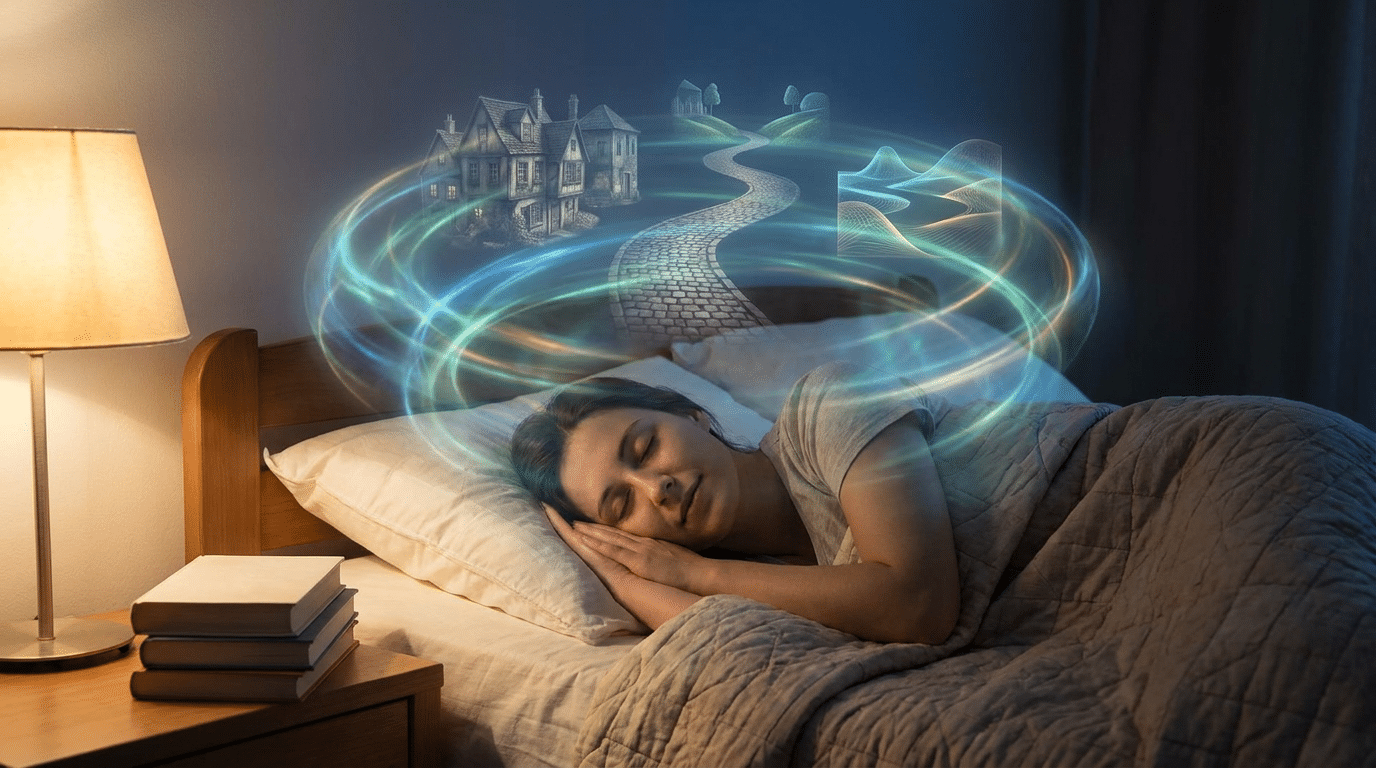
You are awake. You can see the room. You may even hear sounds around you. Then you realize something is wrong: you cannot move.
You try to lift an arm, turn your head or speak, but the body does not respond. Some people also report a sensation of pressure, a presence in the room or vivid visual and auditory experiences. This frightening state is known as sleep paralysis.
What is happening?
Sleep is not one uniform state. The brain cycles through non-REM and REM stages, with REM sleep commonly associated with vivid dreaming. During REM, neural systems suppress most voluntary skeletal muscle activity. This temporary atonia is one reason dreams normally do not turn into full physical movements.
In sleep paralysis, elements of wakefulness return while REM-related muscle inhibition persists. The person can become aware of the room before normal motor control has fully returned.
Why can it feel completely real?
The experience sits at an unusual boundary between dreaming and waking. A person may have genuine sensory information from the bedroom while dream imagery and internally generated perceptions are still active.
This can produce a remarkably convincing mixture. A dark corner may be interpreted as a figure. A bodily sensation may become the feeling of pressure. An internally generated sound may seem to come from the room.
The perception is real as an experience. That does not establish that its apparent external cause was real.
The “presence” in the room
One of the most widely reported features is a strong sense that another being is nearby. Researchers have proposed that this may involve the brain’s systems for representing the body and other agents interacting with unusual sensory conditions during the transition out of REM sleep.
Cultural expectations can influence the content. Similar physiological experiences have historically been described as demons, spirits, witches, ghosts, extraterrestrials or other beings depending on the surrounding culture.
Why chest pressure is so frightening
Some episodes include a feeling of weight or pressure on the chest. Breathing does not necessarily stop, but the unusual state of muscle control, body position and fear can make normal breathing sensations feel threatening.
Once fear rises, attention becomes intensely focused on bodily signals. That can amplify the experience and make an episode seem longer and more dangerous than it actually is.
How long does an episode last?
Episodes are generally brief, although subjective time can feel distorted. The person may regain movement spontaneously as the brain completes the transition between sleep and wakefulness.
Because the experience is so vivid, people may remember it in detail. A single episode can therefore remain emotionally powerful long after normal movement has returned.
What makes sleep paralysis more likely?
Research has associated sleep paralysis with sleep deprivation, irregular schedules and disrupted sleep. It can also occur in connection with narcolepsy and other sleep-related conditions. Some people experience it occasionally without an underlying disorder.
Stress and unusual sleep timing can be relevant, but no single trigger explains every episode.
Why understanding the mechanism can help
During an episode, panic can make the situation feel like an emergency. Knowing that temporary REM-related paralysis can occur during awakening provides a non-supernatural explanation and may reduce fear.
Some people report that concentrating on slow breathing or attempting a very small movement helps them remain calm until the episode passes. These strategies are not guaranteed, but reducing panic can make the experience easier to tolerate.
Sleep paralysis and culture
The biology of sleep paralysis is increasingly studied, but its interpretation has always been cultural. In different societies, people have placed the experience into very different explanatory frameworks.
This is a useful reminder that an unusual perception can have two layers: a physiological event and a story that the mind uses to explain it. The physiological event may be broadly similar while the perceived visitor, threat or meaning changes.
When should someone seek medical advice?
Occasional isolated episodes are generally not dangerous, but repeated episodes accompanied by excessive daytime sleepiness, sudden loss of muscle control or other major sleep symptoms deserve professional evaluation because they can occur with sleep disorders such as narcolepsy.
The important distinction is between the frightening experience itself and the possibility of an underlying condition affecting sleep.
The deeper mystery
Sleep paralysis reveals something strange about consciousness: waking is not necessarily an instant switch. Brain systems responsible for awareness, movement, perception and dreaming can transition on different timelines.
That is why an experience can feel supernatural while having a plausible neurological mechanism. Understanding the mechanism does not make the event less extraordinary. It shows how thin the boundary between dreaming and waking can sometimes become.
You try to lift an arm, turn your head or speak, but the body does not respond. Some people also report a sensation of pressure, a presence in the room or vivid visual and auditory experiences.
This frightening state is known as sleep paralysis.
For centuries, people have interpreted it as an attack by demons, spirits, witches or other beings. Modern sleep science offers a different explanation: sleep and waking are not always perfectly synchronized transitions. Different brain systems can change state at slightly different times.
Sleep is not one uniform state
Sleep consists of recurring stages, broadly divided into non-REM and REM sleep. REM—rapid eye movement—sleep is particularly associated with vivid dreaming.
During REM sleep, the brain normally suppresses most voluntary skeletal muscle activity. This temporary paralysis, known as REM atonia, is useful because it helps prevent the body from physically acting out most dream movements.
Sleep paralysis can occur when aspects of wakefulness return while this REM-related muscle inhibition has not yet fully disappeared.
The person becomes conscious before normal motor control has completely returned.
Why can the experience feel completely real?
Sleep paralysis sits at an unusual boundary between dreaming and waking.
A person may receive genuine sensory information from the bedroom while dream-related imagery, expectations and internally generated perceptions remain active.
This can create a hybrid experience.
A dark corner may be interpreted as a figure. A bodily sensation may become the feeling that someone is touching or pressing on the person. An internally generated sound may seem to originate from somewhere in the room.
The brain may be partly awake and partly dreaming
It is tempting to imagine waking as a single switch: asleep, then awake.
Sleep paralysis suggests a more complicated picture.
Awareness, muscle control, sensory processing and dream generation involve different neural systems. Their transitions do not necessarily occur at exactly the same instant.
This helps explain how someone can be aware of the bedroom while still experiencing elements associated with REM dreaming.
The strange feeling is not necessarily evidence that the person is “still dreaming” in a simple sense. It may be better understood as an unusual overlap between states.
A deeper look: The “presence” in the room
One of the most striking features of sleep paralysis is a powerful sense that another being is nearby.
Researchers have proposed several interacting mechanisms, including disturbances in the brain’s representation of the body, unusual sensory integration and the interpretation of ambiguous signals during a vulnerable transition state.
The experience can feel extraordinarily convincing because the brain is normally very good at inferring the presence and intentions of other agents.
When that system operates under unusual conditions, a feeling of another presence may emerge even when no external person is there.
Why does the “visitor” change across cultures?
The physiological experience may be broadly similar while the interpretation differs.
Historical accounts from different societies have described nocturnal attackers, demons, spirits, witches, ghosts and other supernatural or nonhuman beings.
Modern people may describe similar experiences using different cultural concepts.
This does not mean culture creates the underlying paralysis. It may influence how ambiguous sensations are interpreted and which image or explanation becomes available to the mind.
In that sense, sleep paralysis can reveal an interaction between biology and culture: the body produces an unusual state, while the surrounding culture supplies possible meanings for it.
Why chest pressure can feel terrifying
Some episodes include a sensation of weight or pressure on the chest.
Breathing does not necessarily stop. But the combination of unusual muscle control, body position, altered perception and sudden fear can make ordinary breathing sensations feel threatening.
Once fear rises, attention becomes intensely focused on bodily signals. A sensation that might normally be ignored can become the central feature of the experience.
This can create a feedback loop: frightening sensations increase fear, fear increases attention to sensations, and increased attention makes the sensations seem even more intense.
Why the inability to move is so disturbing
Voluntary movement is normally so automatic that we rarely notice it.
During sleep paralysis, the intention to move can be completely intact while the expected movement does not occur.
That creates a powerful mismatch between agency and physical control.
You know what you want your body to do. You may even feel that you are trying as hard as possible. Yet the body does not respond.
That mismatch can contribute to the intense fear and helplessness reported during episodes.
How long does sleep paralysis last?
Episodes are generally brief, although subjective time can be distorted.
Fear and intense attention can make a short episode seem much longer. The person may regain movement spontaneously as the brain completes its transition out of the REM-related state.
Because the experience can be vivid, people may remember it in unusual detail even though the episode itself was short.
A deeper look: What makes sleep paralysis more likely?
Sleep paralysis has been associated with disrupted or insufficient sleep, irregular schedules and changes in sleep timing.
It can also occur in association with narcolepsy and some other sleep-related conditions. Some people experience isolated episodes without having an underlying sleep disorder.
Stress may be relevant for some individuals, but there is no single trigger that explains every episode.
Sleep patterns, individual vulnerability and other factors can interact.
Sleep position may matter for some people
Some research and clinical reports have associated episodes with sleeping on the back, although this is not a universal rule.
It is better understood as a possible contributing factor rather than a guaranteed cause.
That distinction matters because sleep paralysis is a phenomenon with multiple potential influences rather than a condition explained by one simple trigger.
Can someone control an episode?
People report different strategies, and none is guaranteed to work.
Some find it helpful to remain aware that the episode is temporary, concentrate on calm breathing or attempt a very small movement rather than trying to force the entire body to move.
The practical value of such approaches may partly come from reducing panic. When fear is lower, the experience can feel less overwhelming even if the physiological transition takes the same amount of time.
Sleep paralysis is not the same as a dream
The distinction can be subtle.
A normal dream occurs while the person remains asleep, whereas sleep paralysis involves a degree of conscious awareness of the surrounding environment during a period in which REM-related motor inhibition may still be present.
Some dream imagery can intrude into the waking experience, which is why people sometimes describe vivid figures, sounds or sensations.
The resulting state can feel more realistic than an ordinary dream precisely because genuine waking perception is also involved.
Why understanding the mechanism can reduce fear
During an episode, the experience can feel like an emergency because the person has no immediate explanation for what is happening.
Knowing that REM-related muscle inhibition can persist briefly during awakening provides a physiological framework for understanding the event.
That does not make the experience trivial. It simply separates the intensity of the perception from the assumption that an external attacker must be present.
When sleep paralysis may need medical attention
Occasional isolated episodes are generally not dangerous in themselves. But repeated episodes accompanied by excessive daytime sleepiness, sudden loss of muscle tone or other significant sleep symptoms can warrant professional evaluation.
Such symptoms can occur with narcolepsy and other sleep disorders.
The important distinction is between the frightening experience of paralysis itself and the possibility that repeated episodes are part of a broader sleep problem.
The cultural history is part of the mystery
Sleep paralysis provides an unusual example of how a physiological event can generate supernatural stories.
The same basic ingredients—immobility, fear, unusual sensations and a sense of presence—can be interpreted differently depending on the cultural vocabulary available to the person.
This does not mean that every historical account can be diagnosed retrospectively as sleep paralysis. Historical descriptions are often incomplete, and different experiences can produce similar narratives.
But the comparison demonstrates how biology and interpretation can interact.
What sleep paralysis reveals about consciousness
The deeper scientific interest may be the way sleep paralysis exposes the architecture of waking consciousness.
We normally experience consciousness as a unified state. We feel awake, able to move, able to perceive the world and separate external events from imagination.
Sleep paralysis shows that these components can temporarily come apart.
Awareness can return before motor control. Dream imagery can overlap with perception. The sense of another presence can arise from the brain’s interpretation of ambiguous information.
None of this makes consciousness less real. It reveals how many separate processes have to cooperate to produce the seamless experience we normally take for granted.
A deeper look: The deeper mystery
Sleep paralysis is frightening partly because it feels supernatural.
But its scientific explanation is arguably more fascinating.
The brain does not wake like a light switching on. Different systems can cross the boundary between sleep and wakefulness on different timelines, briefly creating a state in which the person is conscious but unable to move normally and may experience dream-like perceptions as if they are occurring in the room.
Understanding the mechanism does not erase the mystery.
It changes the mystery from “Who is in the room?” to a deeper question:
How does the brain construct the feeling that we are awake, embodied and inhabiting a world—and what happens when those components briefly fall out of sync?
Curiosity Publication by Aadvik Agastya
Sources & further reading
- National Institute of Neurological Disorders and Stroke — Sleep disorders
- Sleep Foundation — Sleep Paralysis
Have a question about this topic?
Join fellow Qurons on the Quron Forum to ask questions, challenge ideas, share discoveries and explore further.
Discuss on Quron Forum