On the evening of 21 August 1986, people living below Lake Nyos in northwestern Cameroon faced a catastrophe with almost none of the signs associated with a volcano. There was no river of lava sweeping through their homes. The threat was a gas that could not be seen, smelled or heard. A dense cloud of carbon dioxide moved away from the crater lake into surrounding valleys, displacing breathable air. The disaster killed more than 1,700 people, along with thousands of animals. The unsettling question was not simply why a lake had released gas, but how so much of it could have remained hidden in water until the release became deadly.
The answer required scientists to treat the lake less like a scenic body of water and more like a pressurised chemical system. It also forced a distinction that still matters: a volcanic landscape can create a disaster without a fresh volcanic eruption. The evidence assembled after Nyos, the preventive engineering that followed, and the uncertainties that remain offer a striking lesson in how an invisible geological process becomes a human emergency.
The disaster that did not look like an eruption
Lake Nyos occupies a volcanic crater in Cameroon’s Oku Volcanic Field. On a map, its setting suggests an obvious explanation for a sudden mass-casualty event: perhaps magma had erupted, or toxic volcanic gases had escaped through a newly opened vent. But the physical and chemical clues did not fit a conventional hot eruption. Researchers who arrived after the event documented an altered lake, damaged vegetation and deaths distributed beyond the shoreline. What linked these observations was the movement of a suffocating gas through the terrain, not a flow of molten rock.
The 1987 US Geological Survey scientific team report remains a foundational contemporary record. NASA’s later Earth Observatory account describes a carbon-dioxide cloud racing down the slopes and estimates nearly 1,800 human deaths. Published casualty totals vary by source and counting method, so the defensible formulation is more than 1,700, not an artificially precise number. The devastation was real even where exact totals differ.
Imagine standing in a valley as a mass of air with too little oxygen to sustain breathing arrives. Carbon dioxide is present naturally in the atmosphere and in human breath; its danger here was concentration. At high levels, it can displace oxygen and disrupt breathing. The people in the cloud’s path did not need to touch the lake or inhale volcanic ash to be at risk.
How a lake can store a gas
To understand the reservoir, start with an ordinary fizzy drink. Carbon dioxide dissolves in liquid more readily under pressure. When a bottle is opened, pressure drops and bubbles form. Lake Nyos was not a giant bottle with a screw cap, but the analogy helps: deep water under substantial hydrostatic pressure can hold much more dissolved gas than shallow water. If gas-rich deep water rises quickly enough, the pressure falls, gas comes out of solution, and the bubbles can make the rising water more buoyant. This positive feedback can accelerate an initially small disturbance.
Unlike a soda bottle, the lake continually received carbon dioxide from below. Gas of deep geological origin entered the water system through groundwater. The volcanic history mattered because it provided a source, not because magma necessarily erupted on the night of the disaster. The crater’s shape and depth mattered too: deep water could remain separated from surface water long enough for gas to accumulate.
Researchers call the sudden release of dissolved gas from a lake a limnic eruption. That term describes the release process, not a claim that hot lava erupted. The distinction is important: the most dangerous ingredient at Nyos was ordinary carbon dioxide stored under extraordinary conditions.
The chemical fingerprints beneath the surface
The aftermath was an unusually direct test of competing explanations. Minoru Kusakabe and Takashi Ohsumi published a 1987 geochemical study based on investigations roughly 50 days after the disaster. The lake remained strongly stratified in temperature and chemistry below a disturbed surface layer. Its deep water contained abundant dissolved carbon dioxide, bicarbonate and ferrous iron. These were measurable traces of a chemically unusual reservoir, not merely testimony about an alarming night.
Isotopes supplied another clue. The investigators reported carbon-isotope and helium-isotope evidence consistent with a mantle-derived gas source. At the same time, the scarcity of chloride and sulfate in the water weighed against a hypothesis in which a direct injection of hot volcanic gas caused the catastrophe. This did not make the deep Earth irrelevant; it narrowed the pathway from which the gas entered the lake.
That is how a geological mystery becomes more than a plausible story. One hypothesis must account for the physical aftermath, the gas composition, the chemical layering and the isotopes together. The evidence favoured the rapid release of carbon-dioxide-rich lake water. It did not prove which particular disturbance started the runaway ascent.
The trigger is not the same as the cause
It is tempting to write a neat reconstruction: a landslide fell in, a storm stirred the lake, the gas erupted, and the mystery was solved. Yet that would claim more certainty than the record supports. The essential mechanism—the accumulation and explosive exsolution of dissolved carbon dioxide—is well supported. The initiating trigger remains debated. Proposed triggers have included changes in groundwater input, disturbances of the lake’s layers, and physical movements of water or sediment.
Kusakabe and Ohsumi discussed the possibility that warmer carbon-dioxide-rich groundwater displaced deep water upward during the rainy season. Their language was appropriately cautious: possibly. That matters because investigators studied a system after its largest disturbance had already occurred. Even meticulous sampling cannot reconstruct every movement of water on the preceding evening.
There are therefore two different questions. Why could the lake release a deadly volume of gas? Because a deep, stratified reservoir had accumulated carbon dioxide under pressure. What exactly tipped it into release on 21 August? The available evidence does not establish a single universally accepted initiating event. Confusing these questions makes the explanation seem simpler while actually making it less accurate.
The earlier warning from another Cameroonian lake
Nyos was not the first warning. On 15 August 1984, Lake Monoun, another crater lake in Cameroon, released lethal gas. The event killed 37 people, according to a 1987 account in the American Geophysical Union’s Eos. Subsequent investigation found carbon-dioxide-rich deep water and geochemical evidence pointing to a mantle-related source. Scientists argued that the event could result from a long-term buildup of dissolved gas rather than a hot volcanic explosion.
The two disasters made a powerful comparison. If two separate lakes in the same region could store and release gas, the danger was not a bizarre one-off accident. It was a class of geological hazard that could be recognised, measured and potentially controlled. The comparison also warns against generalising to every volcanic lake: most lakes do not combine the same gas supply, depth, stratification and circumstances.
In risk science, the second catastrophe can reveal what the first one meant. Monoun had demonstrated the possibility; Nyos demonstrated the terrifying scale. Neither observation justified treating every crater lake as a time bomb, but together they justified systematic measurement of vulnerable ones.
Why the gas followed the land
Carbon dioxide has a higher molecular mass than the main gases in air. In a sufficiently concentrated release, a cold, dense gas-rich mixture can flow downhill and accumulate in low-lying areas. Terrain can therefore turn a lake release into a valley-wide emergency. The important point is not that carbon dioxide always sits permanently below oxygen in ordinary air—atmospheric mixing usually prevents such neat layering—but that a large, concentrated release can behave differently before it disperses.
NASA describes the 1986 cloud moving through valleys at high speed. Such figures are reconstructions, not measurements from instruments placed in the cloud that night. The landscape explains why settlements some distance from the lake were vulnerable: the gas did not need to spread evenly in every direction. Valleys channelled its movement, and the absence of a visible front made ordinary warning cues unreliable.
This is also why the word explosion can mislead. A dramatic release occurred, but the deaths were overwhelmingly associated with asphyxiation, not the thermal injuries typical of a volcanic blast. The mechanism of injury should determine the hazard description, rather than the most cinematic label.
The engineering answer: make the lake breathe slowly
Once scientists identified the reservoir, prevention became an engineering problem. A pipe extending down into gas-rich water could allow that water to rise. As pressure dropped inside the pipe, dissolved carbon dioxide formed bubbles, helping lift the water and release gas in a controlled fountain. Instead of waiting for a catastrophic spontaneous outburst, engineers could remove gas gradually while monitoring the lake’s response.
Controlled degassing began at Nyos in 2001 and at Monoun in 2003. In a 2005 Proceedings of the National Academy of Sciences study, G. W. Kling and colleagues measured gas pressures, recharge and water-column stability. Their early findings indicated that degassing had reduced gas inventories without destabilising the lakes, but they also cautioned that a single pipe could remove gas too slowly. Their model projected that continuing recharge would compete with removal.
The lesson is a subtle one. The pipe is not a permanent plug in a geological source. It is an active management system whose effectiveness depends on intake depth, gas concentration, equipment condition and continued measurement. A system that worked at installation cannot be assumed to remain equally effective decades later without evidence.
Why early success was not the end of the story
A 2008 geochemical monitoring study followed changes in carbon-dioxide inventories at Nyos and Monoun. It found significant reductions after degassing began, while documenting how gas-removal rates change as the reservoir is depleted. At Monoun, additional pipes and changes in intake depth increased removal. At Nyos, NASA’s 2015 account notes two further pipes installed in 2011.
This evolving record is important because a 2005 forecast is not a 2026 measurement. It would be misleading to take a projection from early operations and present it as the lake’s current gas pressure. To state today’s safety margin, an editor would need recent, site-specific monitoring data and maintenance records. Those are not established by the older studies cited here.
Engineering changed the risk, but the source of gas has not been magically switched off. The prudent conclusion is that controlled degassing has demonstrated a viable mitigation method, while the adequacy of current protection requires ongoing verification. It is a more useful conclusion than either ‘the danger is gone’ or ‘another disaster is inevitable.’
What a new 2025 proposal does—and does not—mean
Research on these lakes has continued beyond the original hazard response. A 2025 techno-economic study explored whether carbon dioxide from controlled lake degassing could be captured using solid sorbents. The authors modelled costs and environmental feasibility under stated assumptions. This is an interesting inversion of the problem: a gas that must be removed for safety might, in principle, become a managed carbon stream.
But a feasibility study is not evidence that such a system has been installed at Nyos or that it has replaced hazard-control pipes. It is also not a reason to delay safety work while searching for commercial value. The first duty of a degassing programme is preventing loss of life; potential carbon capture is a separate question with its own technical, financial and environmental tests.
The distinction illustrates a recurring editorial trap in science coverage. A paper proposing a future use is not an operational report. Its numbers describe a model and assumptions, not a guaranteed real-world result. Nyos deserves an account that follows that difference carefully.
A simple pressure thought experiment
Consider two equal parcels of lake water, one close to the surface and one far below. At the surface, the water experiences roughly one atmosphere of pressure. At a depth of 100 metres, the water’s own weight adds about ten atmospheres of pressure, so the total is approximately eleven atmospheres. This is an illustrative calculation using about one atmosphere per ten metres of water; actual conditions depend on density, depth and local pressure.
The calculation does not tell us the exact amount of carbon dioxide dissolved at Nyos. That requires measured gas concentrations, temperature, chemistry and pressure. It does show why moving deep water upward can change what the water can hold. If bubbles begin forming, they reduce the density of the rising water mixture. More buoyancy can promote more ascent, which reduces pressure further. A gradual movement can become a self-amplifying process.
This is the conceptual heart of the catastrophe: a lake can appear calm at its surface while storing energy in a pressurised dissolved-gas reservoir below. The visible landscape offers no reliable measure of the chemical state of deep water.
The overlooked human question
After a disaster, it is easy to tell the story entirely through instruments, isotopes and pipes. Yet risk depends on people as well as chemistry. NASA notes that fertile land around Nyos made return attractive even after the catastrophe. A hazard-management plan that assumes communities can simply abandon their homes forever is not necessarily realistic. Livelihoods, transport, communication, local trust and the maintenance of warning systems determine whether scientific knowledge can actually protect residents.
The original disaster also challenges a common assumption about warning signs. A lake need not boil or turn red for its deep chemistry to be dangerous. The relevant measurements are profiles of dissolved gases, temperature, density and water chemistry, combined with inspection of the degassing infrastructure. Such measurements must be translated into understandable decisions and responsibilities, not just filed in scientific reports.
For readers in India and elsewhere, the general lesson is not that ordinary lakes should be feared. It is that hazards can be highly local and mechanism-specific. Floodplain risks, industrial gas releases and landslide-prone slopes likewise demand monitoring tailored to how harm actually travels. Generic alarm is less useful than a precise map of exposure and a credible plan for action. QuroPedia has examined another invisible atmospheric threat in its investigation of the Antarctic ozone hole; the chemistry differs, but the need to measure what the eye cannot see is shared.
What the lake ultimately taught science
Nyos is often described as a lake that killed. That shorthand risks obscuring both the geological mechanism and the people affected. The more precise story is of a deep crater lake receiving carbon dioxide over time, retaining it in stratified water, and releasing it catastrophically in August 1986. Scientists distinguished this from a conventional volcanic eruption through chemical measurements and field investigation. Engineers then devised a way to remove gas gradually rather than await another uncontrolled release.
Several claims can be made confidently: the deadly gas was carbon dioxide; deep-water storage and sudden exsolution were central; a similar hazard had appeared at Lake Monoun; and controlled degassing measurably reduced gas inventories in the years after installation. Other claims require restraint: the exact initiating trigger is unresolved, casualty estimates differ slightly, and older monitoring data cannot establish the lake’s precise condition today.
The surprising conclusion is that the most important discovery was not a new kind of gas or an exotic volcanic force. It was the recognition that an apparently still lake could behave like a pressurised system—and that understanding its invisible chemistry could turn an unpredictable disaster into a hazard people have a chance to manage.
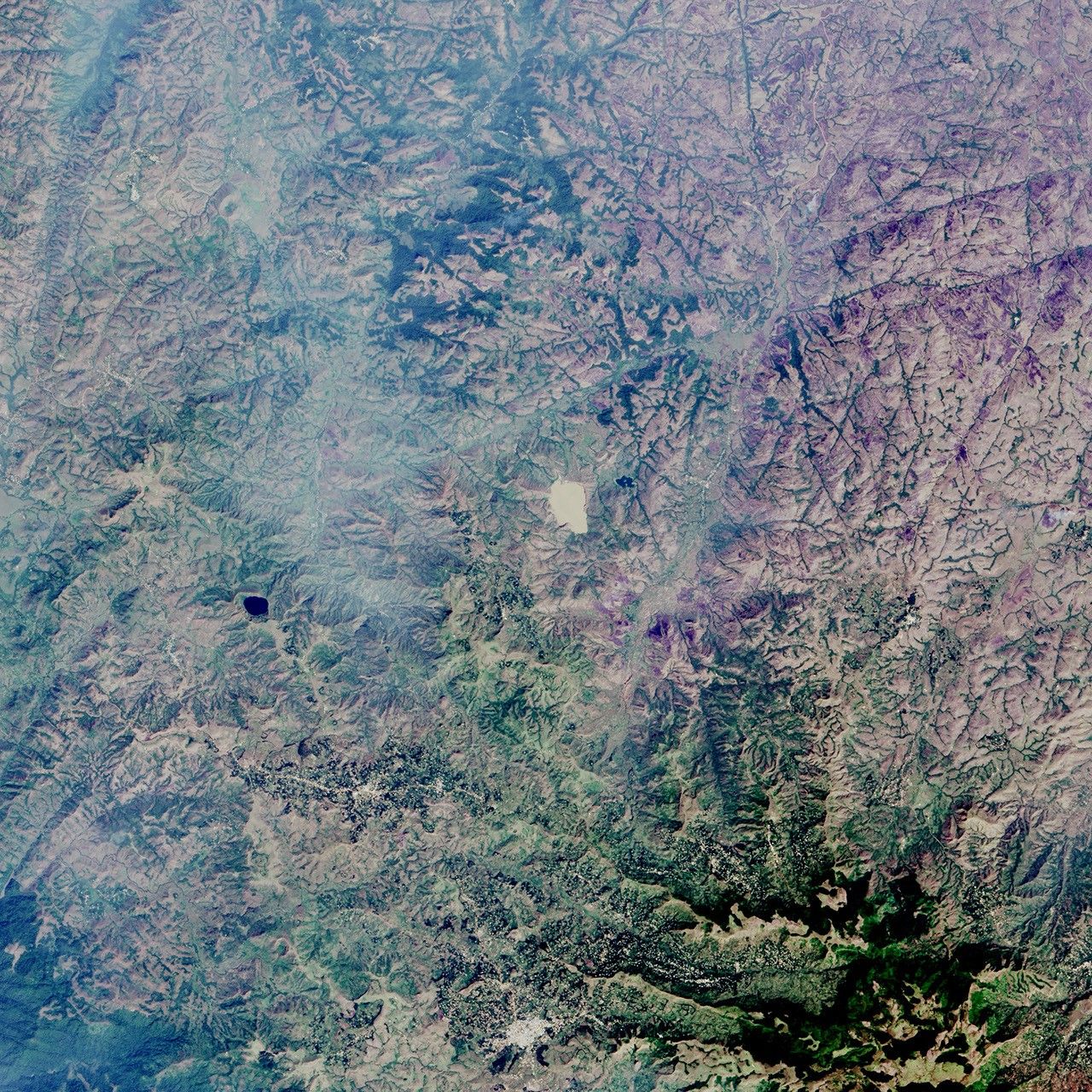
Featured image: Lake Nyos photographed by Landsat 8 on 18 December 2014. NASA Earth Observatory image by Jesse Allen, using Landsat data from the US Geological Survey. This is a later satellite view, not a photograph of the 1986 gas release.
Sources and further investigation
- US Geological Survey, 1987 scientific team report.
- Kusakabe and Ohsumi, 1987, geochemical evidence.
- Sigurdsson, 1987, lethal gas bursts from crater lakes.
- Kling and colleagues, PNAS, 2005, controlled degassing.
- Kusakabe and colleagues, 2008, long-term monitoring.
- NASA Earth Observatory, 2015, lake geography and satellite image.
- 2025 carbon-capture feasibility paper (proposal, not installation).
Have a question about this topic?
Join fellow Qurons on the Quron Forum to ask questions, challenge ideas, share discoveries and explore further.
Discuss on Quron Forum