A bird travelling at night may be following a signal that humans cannot directly feel: Earth’s magnetic field. Behavioural and molecular experiments reveal parts of this extraordinary sensory ability, while leaving important questions open.
A compass humans cannot feel
Some migratory birds use Earth’s magnetic field as an orientation cue, alongside sunlight, stars, landmarks and other information. Magnetic sensing is not a complete GPS system: a compass helps with direction, while successful migration also requires information about location, timing and habitat. The mystery is how living tissue detects such a weak physical signal.
The field offers more than north and south
Earth’s field changes in direction, inclination and strength across the globe. Behavioural experiments suggest that some birds use inclination rather than a simple polarity compass. Their orientation can change when researchers manipulate the field under controlled conditions. This is evidence for a biological sense, not proof that every species uses an identical receptor.
Why European robins became important
Migratory European robins have been central to research on light-dependent magnetic orientation. The idea is that a light-sensitive molecule could respond differently according to the direction of Earth’s field. Such an effect would provide directional information under appropriate lighting. Researchers still need to understand how any molecular signal is processed by the nervous system.
Cryptochrome and the radical-pair idea
A leading hypothesis involves cryptochrome proteins associated with the visual system. Light can trigger chemical reactions involving pairs of radicals whose electron-spin behaviour is influenced by magnetic fields. The resulting change in reaction products might be amplified into a biological signal. This is a quantum-mechanical proposal about chemistry, not a claim that birds consciously perform quantum calculations.
What the 2021 experiment proved
A Nature paper by Xu and colleagues showed that cryptochrome 4 from the European robin is magnetically sensitive in vitro. The protein’s response was stronger than corresponding proteins studied from two non-migratory bird species. That is significant molecular evidence for a candidate sensor. It is not yet direct proof that the same protein performs the compass function inside an intact bird’s eye.
Can birds see magnetic lines?
Popular illustrations sometimes depict magnetic stripes across a bird’s visual field. Those images are metaphors, not observations of avian perception. Scientists have not established what magnetic information feels or looks like to a bird. Even a retinal sensor could supply an orientation cue without producing a human-like picture of field lines.
A 2026 discovery: the pigeon that may sense magnetism through its liver
Imagine studying the navigation of a bird and discovering that the strongest clue may not be in its eyes at all. In May 2026, Lisowski and colleagues reported evidence in Science implicating superparamagnetic macrophages—iron-containing immune cells in the liver—in homing pigeons’ use of magnetic information under overcast conditions. These cells are interesting because iron-rich structures can interact with a magnetic field through physical processes unlike the light-dependent radical-pair reactions proposed for cryptochrome.
The distinction is not a trivial detail. European robin experiments have long motivated a hypothesis about a light-dependent inclination compass, whereas the pigeon research investigated orientation when celestial cues were obscured. Researchers may therefore be studying different mechanisms, different jobs within navigation, or species-dependent solutions to a similar problem. A positive result for one candidate sensor does not invalidate every other candidate. Nor does a laboratory-sensitive cryptochrome prove that the bird’s entire navigational system operates through vision.
The responsible question is now sharper: which physical receptor actually changes the animal’s decisions, under what environmental conditions, and through what neural pathway? A compelling answer would connect a specific sensor with controlled alterations in orientation, then test whether the result generalises beyond the species and conditions examined. That is precisely why magnetoreception remains exciting: a seemingly simple ability to find direction may be assembled from multiple biological instruments rather than a single mysterious sixth sense.
Further reading: Lisowski and colleagues, Science (28 May 2026); Wu and Behmoaras, Trends in Immunology (2026), interpreting the macrophage findings. These findings concern pigeons and do not demonstrate that all migratory birds use liver macrophages.
Other animals may use other mechanisms
Magnetic orientation has also been studied in sea turtles, fish, insects and other groups. Proposed biological sensors include cryptochrome-based chemistry and magnetically sensitive particles. The evidence and mechanisms vary by organism. Finding a candidate molecule in a robin cannot automatically explain navigation in a turtle.
How scientists test the hypothesis
Behavioural experiments can rotate an artificial magnetic field while controlling lighting and visual cues, then measure the animal’s preferred direction. Molecular experiments test whether a candidate protein responds to weak fields. The difficult next step is linking molecule, living tissue, nerve signals and behaviour into a convincing causal chain.
Navigation uses several senses
A migrating bird also needs to cope with wind, weather, seasonal timing and the availability of food and shelter. It may recalibrate its orientation using other environmental cues. The romantic idea of a single perfect built-in compass oversimplifies a flexible sensory system.
What sort of compass is a magnetic compass?
A familiar handheld compass points towards magnetic north because a magnet responds to the orientation of Earth’s field. The compass available to many migrating birds appears to operate differently: behavioural experiments suggest sensitivity to the field’s inclination, the angle magnetic field lines make with the surface, rather than only to a north-pole-versus-south-pole label. That distinction matters at different latitudes, where the field’s direction changes. Magnetic cues can help with broad orientation, but they do not automatically tell a bird its precise geographical coordinates. A compass is not a complete map.
Bird navigation is also a problem of combining uncertain signals. The sun moves through the sky; the stars are visible only in appropriate conditions; landmarks disappear over open water. Researchers therefore study when an animal gives greater weight to one cue and whether cues are recalibrated. A field-sensitive mechanism may be remarkably subtle yet still fit into a larger navigation system rather than dictate the entire journey.
Why the radical-pair explanation interests physicists
The central proposal is that light can initiate a chemical reaction in a protein, producing two short-lived molecular fragments with unpaired electrons. The relative quantum spin states of those electrons can affect which chemical products form. A weak magnetic field might alter those proportions, creating a chemical difference that a cell could eventually detect. This is an intriguing connection between physical chemistry and animal behaviour. It does not mean a bird consciously calculates quantum equations or directly sees Earth’s magnetic field as a painted line in the sky.
In 2021 Xu and colleagues isolated cryptochrome 4 from European robins and compared its responses with proteins from chickens and pigeons. Their laboratory experiments found magnetic sensitivity in robin cryptochrome 4 and identified molecular steps associated with that response. It was a significant demonstration in a controlled setting. But an isolated protein in laboratory conditions is not a complete retina, nervous system or migrating bird. An important remaining task is linking the molecule’s response to an actual behavioural compass in a living animal.
New models refine rather than close the case
Research continues on what kinds of molecular electron pairs can respond strongly enough to Earth’s weak field. A 2024 study in Nature Communications investigated a mechanism involving closely bound radical pairs in cryptochrome and showed theoretically how asymmetry in reaction rates could preserve a meaningful magnetic response. This work expands the possible chemistry. It should not be reported as final proof that this is the exact mechanism used by migrating birds: theoretical plausibility and in-vitro observations answer different questions from demonstrating a sensory pathway in vivo.
Testing a sense humans do not possess
To test magnetic orientation, a researcher can compare behaviour under a controlled magnetic field with behaviour when the field’s direction changes. A genuinely magnetic response should track the altered field rather than unrelated changes in lighting, room features or handling. Repeating tests across lighting conditions helps investigate proposals involving light-sensitive molecules. Appropriate controls matter because birds may be stressed, seasonal motivation changes and there are several navigation cues available at once. A convincing experiment must show that the animal responds specifically to the experimental manipulation, not merely that it happens to point in a different direction.
Biology often produces multiple possible mechanisms for a similar ability. Magnetically sensitive minerals have also been discussed as candidates in some animals. Evidence for one possible light-dependent compass therefore should not be stretched into a claim that all magnetoreception in every species must operate the same way. The field contains robust behavioural evidence, promising molecular chemistry and still-open connections between the two.
What would settle the remaining debate?
A particularly strong test would connect several levels of evidence: the suspected molecule would react at biologically relevant field strengths in the living retina; changing that molecule would change the bird’s magnetic orientation predictably; restoring its function would restore the response; and neural signalling would connect the chemical event to the animal’s behaviour. No single laboratory finding substitutes for this complete chain. Reproducible evidence at several scales matters because even an elegant mechanism may not be the one evolution actually uses.
The idea is impressive without embellishment: an animal with a brain smaller than a human fist can navigate enormous distances while drawing upon cues that humans need instruments to detect. The most fascinating part is not a paranormal mystery but the difficult scientific work of discovering how chemistry becomes perception.
Further primary research: Xu et al., cryptochrome 4 magnetic sensitivity (2021); Denton et al., radical-pair magnetosensitivity model (2024). The second study presents a proposed physical mechanism, not a demonstration of the full sensory circuit.
Why the unanswered questions matter
Magnetoreception research may help explain animal migration and the effects of certain environmental disturbances. It also illustrates how biology can exploit extremely small physical influences. Yet practical applications and precise mechanisms should not be announced before experiments establish them.
The evidence-based answer
Some birds really can use magnetic information. Cryptochrome 4 is a promising molecular candidate, supported by laboratory results. But the complete pathway from a molecule in a living eye to a navigating bird remains an active scientific question. That uncertainty is a reason to keep investigating, not to replace evidence with mysticism.
Sources
- Xu et al., Nature (2021): Magnetic sensitivity of cryptochrome 4
- University of Oxford: How birds sense magnetic fields
- Nature: Unravelling the enigma of bird magnetoreception
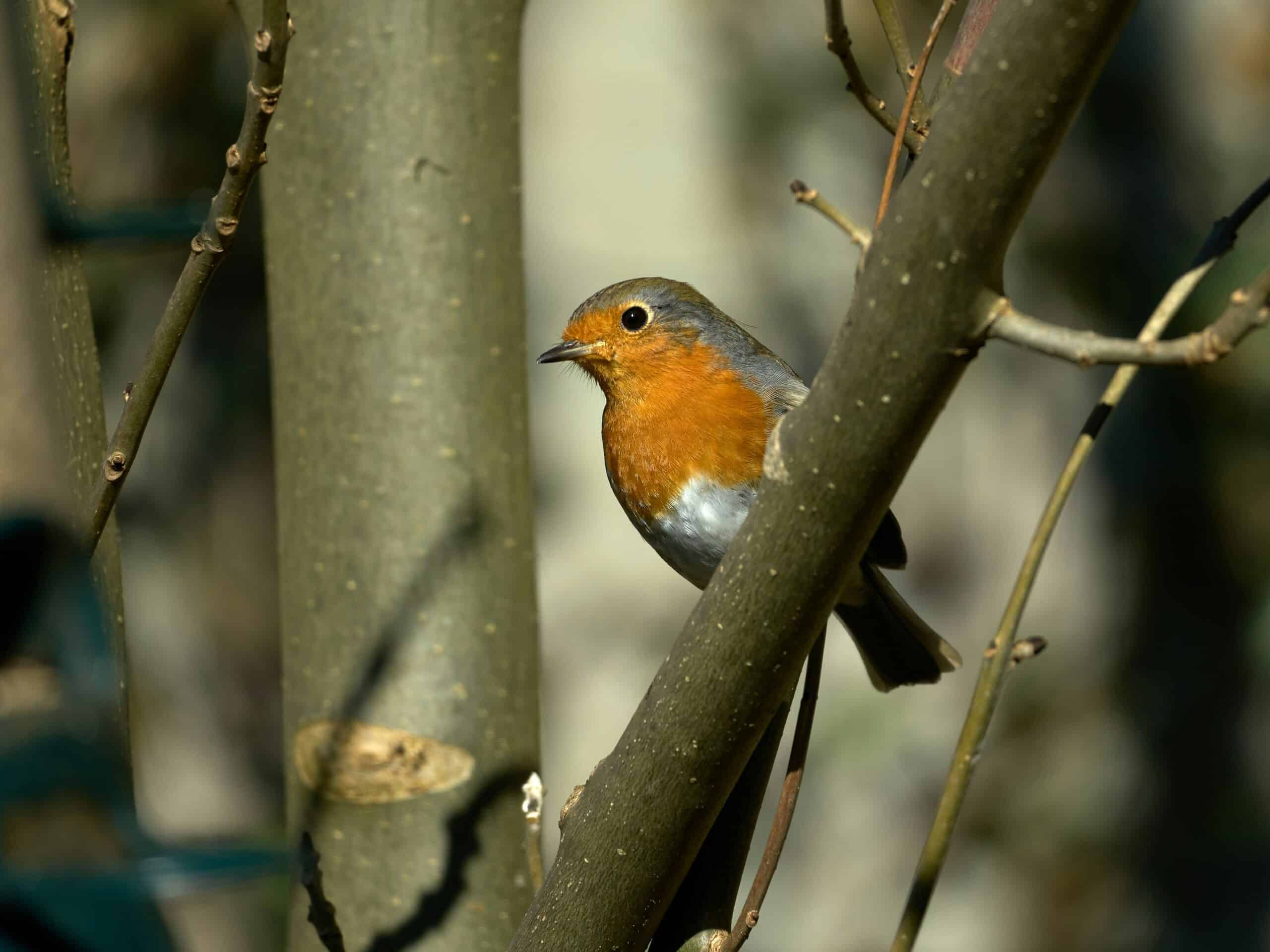
European robin photo: Diane Theresa Hendrick / Unsplash. The image does not depict an experiment.
Have a question about this topic?
Join fellow Qurons on the Quron Forum to ask questions, challenge ideas, share discoveries and explore further.
Discuss on Quron Forum