A street full of deaths, and a water pump nobody could see as dangerous
On 1 September 1854, people in London’s Soho neighbourhood were dying so rapidly that ordinary explanations could scarcely keep pace. In the streets around Broad Street, the illness was cholera: violent diarrhoea, dehydration and sometimes death within hours. The culprit, according to a widely accepted theory, was corrupted air rising from filth. The smell of the city seemed to confirm it. Yet the most consequential object in this story did not smell like a poison. It was an ordinary public water pump, drawing apparently usable water from beneath the street. A physician named John Snow suspected that the very thing families drank to stay alive was carrying the illness. His reasoning would become one of epidemiology’s most celebrated demonstrations. But the familiar version—Snow drew a map, removed a handle and stopped an epidemic—gets both the sequence and the science wrong. The true investigation is better, because it shows how evidence survives even when a memorable story does not.
Why the obvious explanation was difficult to challenge
In mid-nineteenth-century London, sewage, overcrowding and contaminated water were often neighbours. A district with foul air might also have unsafe wells, and families exposed to one were frequently exposed to the other. That made a simple comparison of clean and dirty streets a poor experiment. Cholera was especially terrifying because a healthy-looking person could become desperately ill in a short time. The organism now identified as Vibrio cholerae was not yet established as the explanation available to Snow. He reasoned from the way disease appeared to pass from person to person, from the gut-centred symptoms, and from drinking-water exposure. His argument did not require a microscope to show the pathogen; it required finding a prediction that rival explanations could not explain equally well. The question was not whether Soho was dirty. It was whether particular people, with different opportunities to drink particular water, experienced different risks despite living or working in the same broad environment.
What Snow investigated before he made the famous map
Snow’s 1855 account records an investigation conducted during the outbreak, not an inspired glance at a completed chart. He inspected the pump water on 3 September and did not see enough visible impurity to settle the question. He obtained a list of recently registered deaths, walked the affected streets and asked about the drinking habits of those who had died. Of 83 deaths on one early list, he reported that 61 people had consumed water from the Broad Street pump either regularly or occasionally. The number is an observation from a historical inquiry, not a modern case-control study with laboratory-confirmed infections. It mattered because the exposure linked people whose homes and circumstances otherwise varied. Snow also investigated apparent exceptions: people who lived near the pump but had not fallen ill, and people who lived farther away yet had consumed its water. This is the crucial move in causal investigation: look deliberately for facts that might disprove the attractive explanation, rather than merely collecting those that make it look good.
The brewery, the factory and the problem of distance
Two local comparisons made the pump hypothesis more than a map of proximity. At a nearby brewery, Snow reported that more than seventy workers had access to a separate deep well and beer, and he found no comparable outbreak among them. In a percussion-cap factory, where water from the Broad Street pump was available, he reported eighteen deaths among roughly two hundred workers, many dying at home. Neither comparison was randomized, and the exposure histories came through employers and other witnesses. They were nonetheless powerful counterexamples to the idea that everybody breathing the same local air faced the same danger. The map could not explain every illness by distance alone because water travelled. It might be carried to a workplace, served in coffee houses or taken to a household away from the pump. The invisible distribution network was not merely a set of pipes. It was a set of human habits.
A handle removed after the epidemic had already begun to fall
Snow presented his findings to the St James Board of Guardians on the evening of 7 September. The pump handle was removed the next day. That action made the suspected source harder to use and was a sensible precaution. It did not, however, create the abrupt drop in cases that popular retellings often imply. The outbreak had already peaked around the beginning of September and was declining as residents fled and exposure patterns changed. Snow acknowledged the chronological limitation in his own work. Removing the handle was a decision under uncertainty, not a controlled experiment demonstrating that one intervention immediately ended all transmission. That distinction matters today: a precaution can be justified before the evidence is complete, while the size of its effect remains unknown. To call the handle removal proof is to confuse a defensible public-health action with the larger and harder causal argument built around it.
The map appeared later, and it was not the whole argument
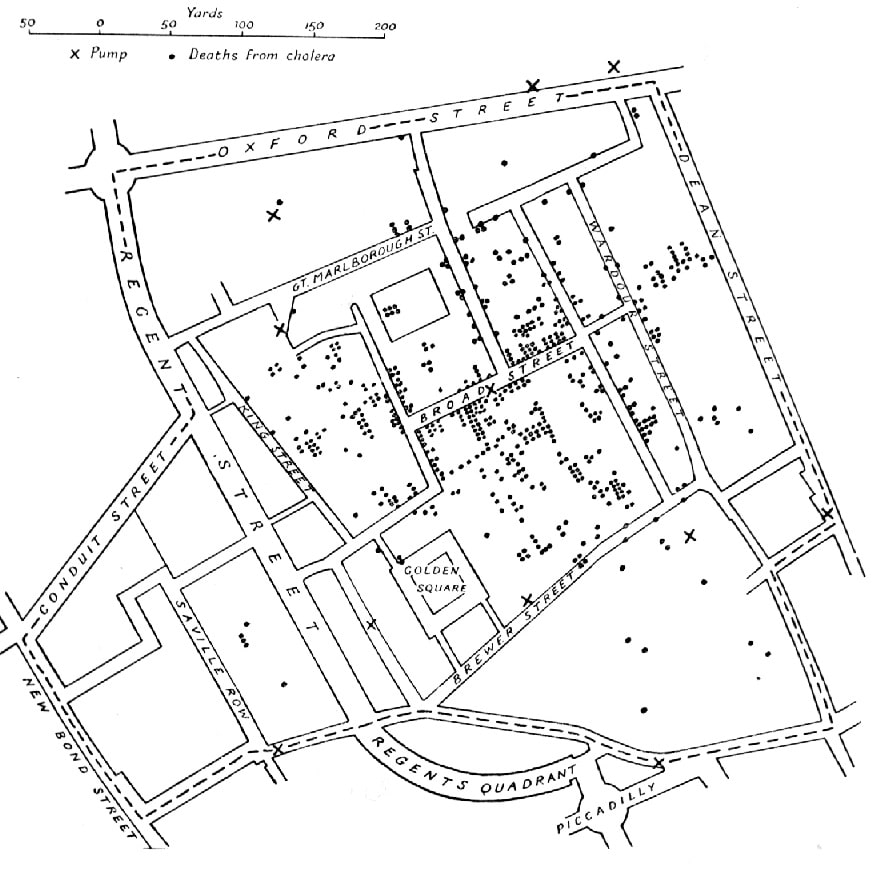
The famous black bars on Snow’s map represent fatal attacks associated with houses around the Broad Street pump. The graphic that now appears in textbooks was published with his expanded 1855 book. Snow had already argued for waterborne transmission, interviewed residents and persuaded authorities before that printed map existed. He presented an earlier version to an epidemiological society in December 1854; a related map in the parish inquiry report differed in details, including pump positioning. The map made an invisible pattern visible, but it could not by itself establish what people drank, distinguish infection from coincidence, or tell us which deaths were registered accurately. Contemporary investigators also mapped the area while pursuing different hypotheses. A chart is not a magic machine that turns dots into causes. It is a compression of evidence that must be unpacked into records, exposures, competing mechanisms and the timing of events.
The other investigation: London as a natural experiment
Snow’s broader water-company comparison supplied another line of evidence. South London households were served by companies drawing water from different parts of the Thames, creating contrasts that did not neatly follow a single street’s geography. In the first seven weeks of the 1854 epidemic, Snow calculated 315 cholera deaths per 10,000 houses served by Southwark and Vauxhall, compared with 37 per 10,000 for Lambeth’s customers. The simple ratio is 315 divided by 37, approximately 8.5—not an exact individual risk ratio and not a result from randomly assigned households. The companies’ intake locations and customers’ circumstances complicate interpretation, but the large difference made a purely neighbourhood-air explanation harder to maintain. This is an early example of exploiting a real-world variation in exposure when controlled experiments are unavailable. It is also a warning against treating any historical statistic as cleaner than the records from which it was constructed.
A clergyman found what the celebrated physician could not
The story does not belong to Snow alone. Reverend Henry Whitehead, who knew the neighbourhood and initially resisted Snow’s interpretation, carried out his own careful household inquiries. He revisited a death record concerning an infant at 40 Broad Street and learned from the child’s mother that water used to wash soiled clothing had been emptied into a cesspool. Later inspection found damaged drainage and a very short distance between cesspool brickwork and the well. This gave the water-contamination explanation a plausible physical route. It did not establish a laboratory-confirmed chain from a single infant to every victim; that would demand evidence the investigators did not possess. Whitehead’s contribution is important precisely because he was not merely a loyal assistant validating a hero. His local knowledge and willingness to revise an earlier view strengthened the investigation. Public-health discoveries are often collaborations among people who disagree about what the facts mean.
What was known, what remained inferential
The evidence supports a strong conclusion that consumption of Broad Street pump water was associated with the outbreak and that contaminated drinking water was a compelling explanation. It does not permit certainty about every individual transmission, the precise moment contamination entered the well, or the fraction of cases prevented by disabling the pump. The parish committee itself accepted water as important without endorsing every detail of Snow’s mechanism. Modern microbiology provides a much richer account of cholera transmission than was available in 1854, but that later knowledge should not be projected backward as if Snow cultured and identified the organism. His achievement was to use a coherent hypothesis to organize imperfect observations. The uncertainty does not diminish the insight. It explains why the insight was scientifically meaningful rather than a lucky guess.
A lesson for today’s epidemic maps
When modern dashboards plot cases on a map, the temptation is still to see clusters as explanations. But a cluster may reflect where people live, where they are tested, who can seek care or how a case is defined. A hotspot can suggest an investigation; it cannot replace one. Snow’s work suggests a better sequence: establish what the observations actually count; identify the exposure mechanism; investigate apparent exceptions; compare groups that differ in exposure; and reconstruct the chronology before attributing a change to an intervention. The same discipline applies to polluted drinking water, foodborne illness and hospital infections. In India and elsewhere, neighbourhood water quality and sanitation can still create shared exposure patterns, but any local claim needs current measurements and health data rather than an analogy to Victorian London. A famous historical episode is not a substitute for contemporary surveillance.
Why the more complicated story is more useful
The handle is memorable because it turns an enormous problem into a single object that someone can remove. The actual advance was intellectual: separating the place where illness occurred from the route by which a harmful agent reached people. That distinction lets an investigator explain why someone near a suspected source remained well and someone farther away became sick. It also explains why the map mattered without being sufficient, why a clergyman’s testimony mattered without being laboratory proof, and why an intervention could be right even when its exact impact was unmeasurable. The heroic myth gives us one decisive gesture. The historical record gives us a transferable method: make a prediction, search for inconvenient evidence, compare exposures and be candid about what the records cannot show. That is the more enduring revolution.
Sources and image provenance
- John Snow, On the Mode of Communication of Cholera (second edition, 1855), Wellcome Collection
- Henry Whitehead, The Broad Street Pump (1862), Wellcome Collection
- UCLA Department of Epidemiology, John Snow mapping and chronology
- Historia Medica, source-critical reconstruction of Snow’s 1855 map
- Wellcome Collection, original 1855 cholera map and public-domain status
Featured image: historical map derived from John Snow’s cholera investigation, public-domain source via Wikimedia Commons. It records historical mortality locations, not laboratory-confirmed infections.
For a related QuroPedia investigation into how evidence can be misread, see the Piltdown Man hoax and its forensic unmasking.
Have a question about this topic?
Join fellow Qurons on the Quron Forum to ask questions, challenge ideas, share discoveries and explore further.
Discuss on Quron Forum