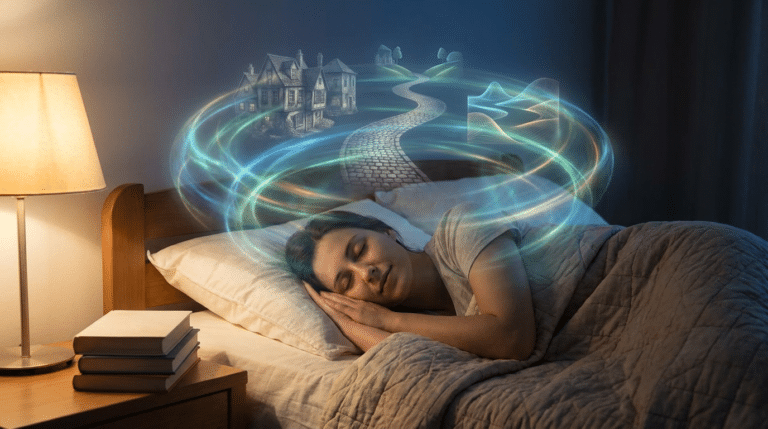

Every night, the brain can create a world that feels completely real.
People appear who do not exist. Familiar places become impossible landscapes. A person can run without moving, speak to someone who died years ago or suddenly find themselves somewhere thousands of kilometres away.
Then they wake up, and much of the experience disappears.
Dreaming is one of the strangest things the human brain does because it demonstrates that a convincing conscious world can be generated while the body is lying still in a dark room.
But why does the brain dream?
There is no single accepted answer. Scientists have proposed several overlapping explanations involving memory, emotion, learning, prediction and the changing chemistry of the sleeping brain.
When Do Dreams Happen?
Dreaming can occur throughout sleep, not only during one particular stage.
Sleep is broadly divided into non-REM stages and REM, or rapid eye movement, sleep. REM is strongly associated with vivid, story-like dreams, but people can also report dream experiences after waking from non-REM sleep.
The distinction matters because it means there is no single switch that simply turns dreaming on and off.
Different sleep stages involve different patterns of brain activity and neurochemistry, and dream experiences can change accordingly.
What Is Special About REM Sleep?
During REM sleep, brain activity in some regions can resemble aspects of waking consciousness. Visual and emotional systems can be highly active, while the body is normally prevented from making large voluntary movements through a process called REM atonia.
This combination creates a remarkable situation: the brain can construct an elaborate internal experience while the muscles of the body remain largely inactive.
REM is not the only stage in which dreams occur, but it is particularly associated with vivid dreams that contain complex imagery, characters and narratives.
Why Are Dreams So Strange?
Dreams often have an unusual combination of vividness and logical inconsistency.
A dreamer may accept an impossible event without questioning it. A bedroom can become a train station. Someone can simultaneously be a friend and a stranger. Time can jump without explanation.
One possible explanation involves the changing balance of brain systems during REM sleep. Networks involved in emotion and imagery can remain highly active, while aspects of executive control and critical evaluation operate differently from waking life.
The result can be a world that feels coherent moment by moment even when its overall narrative makes little sense after waking.
Dreams Use Memory, But They Are Not Recordings
Dreams frequently contain fragments of waking life.
A conversation from yesterday may appear. A childhood home may return. A recent worry may become the central theme of an elaborate story.
But dreams do not simply replay memories like a video.
The sleeping brain can recombine fragments from different periods of life, emotional concerns and imagined possibilities. That is why a dream may contain a real person in a completely impossible environment.
Why Emotions Can Be So Intense
Dreams can produce powerful fear, joy, grief or embarrassment.
Emotional and memory-related brain systems remain active during sleep, and the altered balance of cognitive control may allow emotional imagery to become unusually vivid.
This does not necessarily mean that every emotional dream contains a hidden message. An intense dream can reflect how the sleeping brain processes emotional information without representing a coded prediction or symbolic instruction.
Do Dreams Have a Purpose?
This is one of the hardest questions.
Several major ideas have been proposed.
One possibility is that dreaming is involved in memory consolidation or the processing of recently acquired information. Another is that dreams help process emotional experiences. Some theories propose that dreaming is a form of predictive simulation in which the brain generates possible scenarios. Other researchers argue that at least some dream content may simply emerge from the brain’s activity during sleep rather than serving a single dedicated function.
These possibilities are not necessarily mutually exclusive.
Memory Consolidation and Dreaming
Sleep is clearly important for memory.
During sleep, the brain undergoes processes that help stabilize and reorganize memories. Different stages of sleep appear to contribute differently to different forms of learning.
Dreaming may interact with these processes, but scientists have not established that every dream is a direct memory-consolidation mechanism.
A person can consolidate memories without remembering a corresponding dream, and dream content can involve material that has no obvious connection to recently learned information.
Dreams and Emotional Processing
Another hypothesis is that dreams provide a context in which emotional experiences can be reactivated and reorganized.
Sleep can influence emotional memory and how strongly experiences are remembered the next day. Dreams sometimes incorporate emotionally significant events, which has led researchers to investigate whether dream experiences contribute to this process.
Again, the evidence does not support a simple rule that every disturbing dream is the brain “working through” a specific problem.
Predictive Processing and the Dreaming Brain
Some modern theories view the brain as a prediction-generating system.
During waking life, the brain continuously combines sensory information with expectations about what is happening. During dreaming, external sensory input is dramatically reduced, so internally generated activity can play a much larger role.
From this perspective, dreams may illustrate how the brain constructs a model of reality even when the usual sensory constraints are weakened.
This is an active area of theoretical research rather than a settled explanation for every dream.
Why Do We Forget Most Dreams?
One of the strangest features of dreaming is how quickly the experience disappears.
A person can wake from a vivid dream with several details apparently available, only to lose them minutes later.
Dream memories may be fragile because the neurochemical environment of sleep is not optimized in the same way as waking memory formation. Once attention shifts to the external world, the dream memory can also be overwritten by new information.
This is why dream recall is often much better when a person remains still immediately after waking and records the dream before focusing on the day.
Why Dream Journals Work
Keeping a dream journal does not necessarily make dreams more vivid. It mainly improves recall.
Writing down fragments immediately after waking creates a record before the memory fades. Over time, a person may become better at noticing and retaining dream experiences.
This can create the impression of dreaming more frequently even when the underlying amount of dreaming has not changed substantially.
Can Dreams Predict the Future?
People sometimes report dreaming about an event before it happens.
Such experiences can feel extraordinarily convincing, but several ordinary mechanisms can produce the impression of prediction.
Humans constantly generate expectations about future events. A dream can combine those expectations with memories and emotions, occasionally producing a scenario that later resembles reality.
We are also much better at remembering striking matches than the enormous number of dreams that do not correspond to anything that happens later.
A coincidence can therefore feel more meaningful than its statistical frequency would justify.
What About Lucid Dreams?
In a lucid dream, the dreamer becomes aware that they are dreaming while the dream is still occurring.
Some people report being able to influence aspects of the dream after becoming lucid.
Lucid dreaming is scientifically interesting because it creates a partial bridge between ordinary dreaming and metacognitive awareness. Researchers have investigated whether trained lucid dreamers can communicate predetermined signals while in REM sleep using agreed eye-movement patterns.
The existence of lucid dreaming also demonstrates that consciousness during sleep is not a simple all-or-nothing state.
Why Do Nightmares Happen?
Nightmares are dreams that produce intense fear or distress. They can occur for many reasons, including stress, trauma, sleep disruption and individual differences in emotional processing.
Occasional nightmares are common. Recurrent nightmares can become clinically significant when they disrupt sleep or produce daytime distress.
The fact that the brain can generate frightening experiences without an external threat shows how strongly emotion and imagery can interact during sleep.
Dreaming and Memory Are Not the Same Thing
It is important to distinguish the occurrence of a dream from remembering it.
A person may dream extensively but wake with no reportable memory. Another person may remember a vivid sequence because they awakened at the right moment.
Research based on dream reports therefore measures remembered dream experiences, not every dream that occurred during the night.
This creates a methodological challenge when scientists compare dream frequency between people.
Why There Is No Single “Dream Center”
Dreaming involves distributed brain systems.
Visual imagery, emotion, memory, attention and self-related processing can all contribute. Different dreams can recruit these systems in different combinations.
This helps explain why dreams vary so dramatically. A nightmare, a lucid dream and a vague non-REM dream may involve overlapping but not identical patterns of neural activity.
Do Animals Dream?
Many mammals and some other animals show sleep states with patterns of brain activity that resemble aspects of REM sleep.
It is tempting to assume that they therefore experience human-like dreams, but subjective experience cannot be directly measured in a sleeping animal.
Researchers can infer sleep states from physiology and behavior, but the exact content of any animal’s conscious experience remains inaccessible.
Why Dreams Matter to the Study of Consciousness
Dreaming creates a natural experiment in the relationship between consciousness and the external world.
During waking life, perception is strongly constrained by sensory input. During dreaming, the brain can generate a convincing world with dramatically reduced external sensory information.
This shows that conscious experience is not simply a photographic recording of reality.
The brain actively constructs the world we experience.
The Bigger Mystery
Dreaming may turn out not to have one purpose.
Some aspects may interact with memory consolidation. Others may relate to emotional processing. Some may reflect predictive or generative processes, while some dream content may simply emerge from the brain’s changing activity during sleep.
What we know with greater confidence is that dreaming is a normal feature of sleep, that REM is especially associated with vivid dreams, that dreams can incorporate memories and emotions, and that the brain can construct a detailed internal world without ordinary sensory input.
Every night, consciousness demonstrates something that seems almost impossible when we are awake: the brain can build a reality convincing enough to fool the person experiencing it—and then erase most of the evidence within minutes of waking.
Curiosity Publication by Aadvik Agastya
Sources & further reading
- National Institute of Neurological Disorders and Stroke — Understanding Sleep
- Sleep Foundation — Dreams
Have a question about this topic?
Join fellow Qurons on the Quron Forum to ask questions, challenge ideas, share discoveries and explore further.
Discuss on Quron Forum