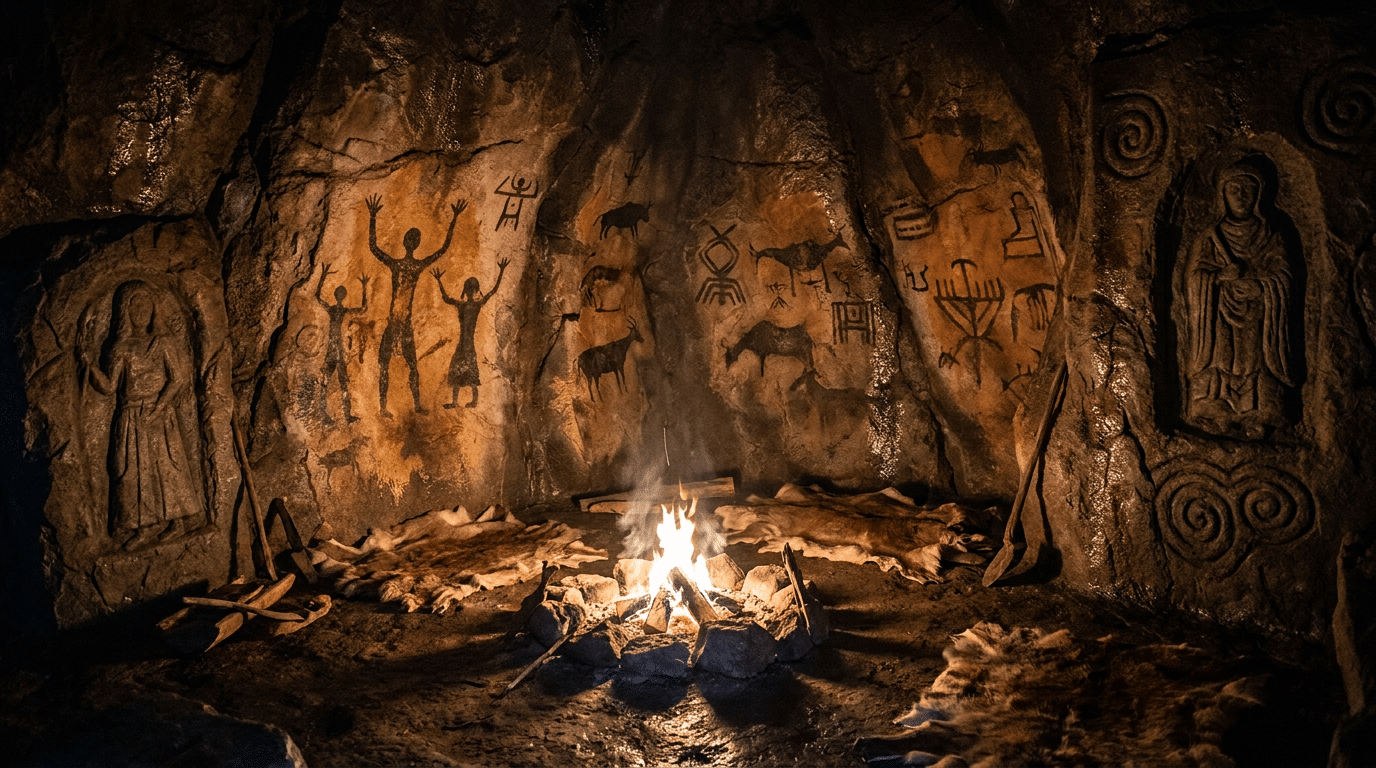
Humans have imagined gods, spirits, ancestors and other forms of supernatural agency for as long as we have evidence of symbolic culture.
But the question “Where did God come from?” hides several different questions.
One is historical: how did human concepts of divine beings develop? Another is psychological: why does the human mind so readily think in terms of agents, intentions and invisible causes? A third is social: how did private beliefs become rituals, temples, priesthoods and institutions?
And beneath all of them is a philosophical question: does the existence of religious belief tell us anything about whether a divine reality actually exists?
These questions should not be confused. Science and history can investigate the development of religious ideas. They cannot settle every metaphysical claim associated with those ideas.
There Was No Single Moment When Humanity Invented God
Religious history does not look like a single invention followed by a straight line of development.
Humans have imagined many kinds of sacred beings and forces: ancestors, spirits associated with particular places, animal beings, household powers, fertility figures, storm gods, creator deities and philosophical conceptions of ultimate reality.
Different communities developed different systems, sometimes independently and sometimes through contact.
The word “God” therefore covers an enormous range of concepts that are not interchangeable.
Why Humans Are Sensitive to Agency
One possible part of the explanation lies in ordinary human cognition.
Humans are exceptionally good at detecting agents.
If a branch moves in the forest, it can be useful to ask whether something caused it. If footsteps appear behind you, identifying an intentional agent matters. In a social species, rapidly inferring who is doing what is a major survival advantage.
This sensitivity can sometimes extend beyond situations in which a human or animal agent is actually present.
Seeing Intention in an Uncertain World
Natural events often have consequences but no obvious visible actor.
Thunder arrives with enormous sound. Disease can strike without warning. Crops can fail. Storms destroy buildings. The seasons change.
Humans naturally ask questions such as: Who caused this? Why did this happen? Was someone responsible?
In societies without modern meteorology, germ theory or plate tectonics, supernatural agency could provide a framework for explaining events whose physical mechanisms were not understood.
That does not mean every religious belief arose simply because ancient people were ignorant. Religious ideas also address morality, identity, ritual, community and questions that science does not attempt to answer in the same way.
Nature Became Meaningful
Ancient religious systems often connected natural events with moral or social meaning.
A storm might be associated with a divine being. Fertility might be linked to a deity or ritual cycle. Death might involve an ancestor or journey into another realm.
This transformed natural events from isolated occurrences into parts of a meaningful universe.
Religion therefore often did more than explain what happened. It explained what events meant.
Ritual Turns Belief Into Action
Belief becomes socially powerful when it is expressed through ritual.
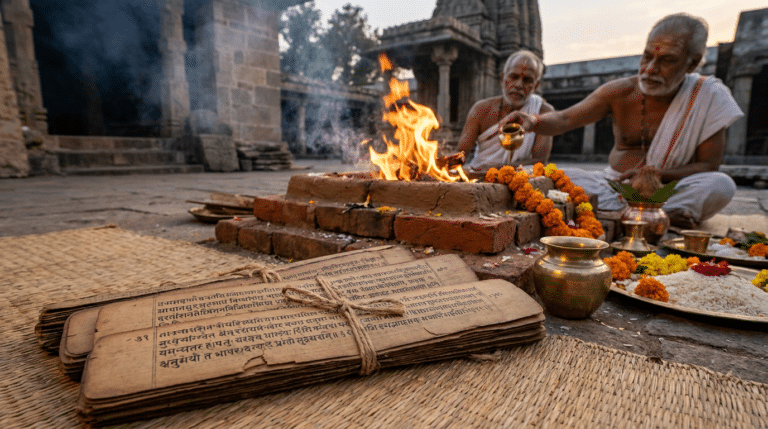
People gather, repeat words, make offerings, perform dances, observe fasting, bury their dead, celebrate festivals or visit sacred places.
Ritual creates repetition.
Repetition helps preserve traditions across generations and gives abstract ideas a physical form.
A person may forget a theological argument, but a yearly festival can continue for centuries because communities repeatedly perform it.
Why Ritual Can Strengthen Communities
Rituals can synchronize behavior.
When groups sing together, eat together, mourn together or celebrate together, they create shared experiences.
Anthropologists and psychologists have studied whether such collective practices can strengthen social bonds and cooperation.
This does not mean religion was invented solely to create social cohesion. It means that once religious practices existed, they could have social consequences that helped maintain communities.
From Local Spirits to Large Pantheons
As societies became more complex, religious systems could become more elaborate.
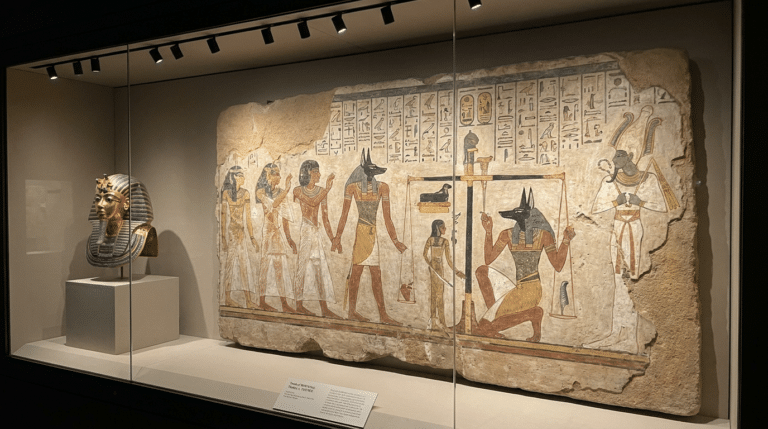
Ancient Mesopotamia, Egypt, Greece, Rome and South Asia developed rich traditions involving multiple divine beings with different powers, relationships and regional associations.
A deity might be associated with a city, river, mountain, profession, family or natural phenomenon.
Religious systems were therefore often networks rather than lists.
Gods Could Change Over Time
Religions are not static.
A deity can acquire new attributes. Two traditions can merge. A local god can become associated with a larger pantheon. A philosopher can reinterpret an inherited deity in abstract terms.
Political changes can also influence religious institutions.
But religion cannot simply be reduced to political control. Religious practices also emerge from family traditions, personal experiences, ritual needs and philosophical reflection.
Temples Were More Than Places of Worship
In many ancient societies, temples had economic and social functions alongside their religious role.
They could own land, store resources, employ specialists and organize festivals.
This meant that religious institutions could become important centers of community life.
The institutionalization of religion therefore changed the scale at which beliefs could be preserved and transmitted.
Ancestors Are Not the Same as Gods
One of the earliest and most widespread forms of supernatural belief involves the dead.
Ancestors can remain part of family identity through offerings, memorials and ritual practices.
Ancestor traditions do not necessarily involve a creator God or a universal pantheon. They represent a different way of thinking about continuity between the living and the dead.
That diversity is important because it shows that religion did not necessarily begin with a single concept of an all-powerful deity.
What Archaeology Can Tell Us
Archaeology can reveal evidence of ritual behavior.
Burials, temples, figurines, offerings, sacred spaces, unusual deposits and repeated ceremonial patterns can all indicate that communities treated particular objects or places as meaningful.
But archaeology rarely tells us exactly what a symbol meant.
A figurine may represent a deity, ancestor, human being, symbolic concept or something else entirely. Interpretation requires context and comparison.
The Problem of Projecting Modern Religion Backward
Modern readers often recognize familiar religious concepts in ancient artifacts.
Sometimes those connections are historically justified. Sometimes they are not.
A modern word such as “god,” “priest” or “temple” can conceal differences in how ancient societies organized sacred practices.
Historical interpretation therefore requires resisting the temptation to assume that ancient people believed exactly what modern believers or skeptics believe today.
Did Religion Evolve?
The phrase “evolution of religion” can mean several things.
It may refer to cultural evolution—the way beliefs change as they are transmitted between generations. It can also refer to hypotheses about psychological traits that made religious cognition possible.
These are different questions.
Cultural evolution does not imply that one particular religion is biologically programmed into humans. It means that ideas can spread, mutate, combine and persist through social learning.
Why Some Religious Ideas Are Easy to Remember
Researchers studying the cognitive science of religion have proposed that certain supernatural concepts may be memorable because they combine familiar features with one surprising violation.
A person is familiar. A person who can become invisible is not.
An animal is familiar. An animal that speaks like a human is unusual.
Such concepts can be easier to remember and transmit than completely incomprehensible ones because they remain understandable while violating expectations in a limited way.
This is one proposed cognitive mechanism, not a complete explanation of religion.
Agency Detection Is Not the Same as Belief in God
Humans may have cognitive tendencies that make agency concepts intuitive, but that does not mean every person automatically believes in gods.
Culture, education, personal experience, philosophical reasoning and social environment all influence belief.
Religious cognition is therefore the result of interactions among cognitive capacities and cultural systems rather than a single mental module for “God.”
Why Moral Systems Became Connected to Religion
Religious traditions often connect supernatural ideas with moral rules.
Promises, taboos, obligations and rituals can become associated with divine authority or ancestral expectations.
This can strengthen social norms by giving them a sacred dimension.
But morality does not depend exclusively on religion. Humans can develop ethical systems through philosophy, social contracts, empathy and other forms of reasoning.
Did Religion Help Cooperation?
Some researchers have proposed that religious rituals and beliefs may have supported cooperation in large groups by creating shared identities and expectations.
Others emphasize that religion can also create boundaries between groups or intensify conflict.
Both possibilities can occur because religious systems are embedded in broader social institutions.
It is therefore too simple to describe religion as either purely beneficial or purely harmful to social organization.
Did Monotheism Replace Polytheism?
There was no universal historical sequence in which all societies moved from many gods to one God.
Different traditions developed in different ways.
Ancient Judaism emerged within a broader Near Eastern religious environment. Christianity developed later from Jewish roots, while Islam emerged in seventh-century Arabia within a different historical context.
Even traditions centered on one supreme God can contain concepts of angels, saints, spirits, sacred places and intermediary figures.
Religious history is therefore better understood as branching, interacting and changing rather than as a single ladder from “primitive” to “advanced.”
What About Philosophical Ideas of Ultimate Reality?
Not every religious or philosophical tradition centers on a personal creator.
Some Indian traditions discuss Brahman or ultimate reality in ways that do not map neatly onto the idea of a human-like deity. Buddhist traditions can discuss ultimate questions without affirming a creator God. Daoist and other philosophical traditions likewise complicate the category.
This is another reason the phrase “the invention of God” can be too narrow.
Can Science Explain Religion?
Science can investigate the psychological, neurological and social processes associated with religious belief.
Researchers can ask how ritual affects attention, how beliefs are transmitted, how communities coordinate behavior or which cognitive mechanisms make supernatural concepts memorable.
These are empirical questions.
Science cannot experimentally determine the metaphysical truth of a deity’s existence simply by documenting how humans form religious beliefs.
The Origin of a Belief Does Not Automatically Determine Its Truth
This is a crucial logical distinction.
If a belief can be explained psychologically, that does not by itself prove the belief is false.
Humans have cognitive mechanisms for doing mathematics, but explaining those mechanisms does not show that mathematical truths are unreal.
Likewise, understanding how religious concepts develop does not logically settle whether a divine reality exists.
Conversely, the persistence or emotional power of a religious belief does not establish its metaphysical truth.
Two Questions That Should Stay Separate
There are really two investigations:
- The historical and scientific question: How did religious concepts, rituals and institutions develop?
- The philosophical or theological question: Does a divine reality actually exist?
The first can be investigated through archaeology, anthropology, psychology, history and cognitive science. The second involves philosophical arguments, theological traditions and questions that cannot be resolved simply by observing religious behavior.
Why Humans Keep Asking About the Divine
Even if science explains some of the mechanisms behind religious cognition, the underlying questions remain.
Why is there something rather than nothing? What makes a life meaningful? Why do conscious beings exist? What happens after death? Is there an ultimate reality beyond ordinary experience?
Religions provide different answers. Philosophers provide others. Science addresses some aspects of these questions while leaving others open.
The Bigger Perspective
The history of religion does not look like a single moment when humanity invented one universal God.
It looks more like a vast cultural experiment in which humans repeatedly developed ways of interpreting nature, death, morality, identity and existence.
Some traditions created pantheons. Some emphasized ancestors. Some developed concepts of one supreme God. Others focused on liberation, ultimate reality or spiritual practice without centering a creator deity.
Psychology can help explain why certain religious ideas are intuitive. Anthropology can explain how rituals and institutions spread. Archaeology can reveal sacred spaces and burial practices. History can trace how traditions changed.
But none of these methods alone answers the metaphysical question of whether the divine exists.
Perhaps the most revealing fact is not that humans invented many different gods. It is that humans have persistently looked beyond the visible world and asked whether reality is larger than what can be directly experienced.
Curiosity Publication by Aadvik Agastya
Sources & further reading
Have a question about this topic?
Join fellow Qurons on the Quron Forum to ask questions, challenge ideas, share discoveries and explore further.
Discuss on Quron Forum