The Vedas are among the oldest surviving bodies of sacred literature from South Asia. They were composed in Vedic Sanskrit and preserved for generations through highly developed oral traditions before being written down in manuscripts.
The word Veda comes from a Sanskrit root associated with knowledge. But the Vedas are not a single book, and describing them simply as “ancient Indian science” or “ancient Indian religion” misses their complexity. They contain hymns, ritual formulas, chants, philosophical speculation and reflections on the natural and social world of early Vedic communities.
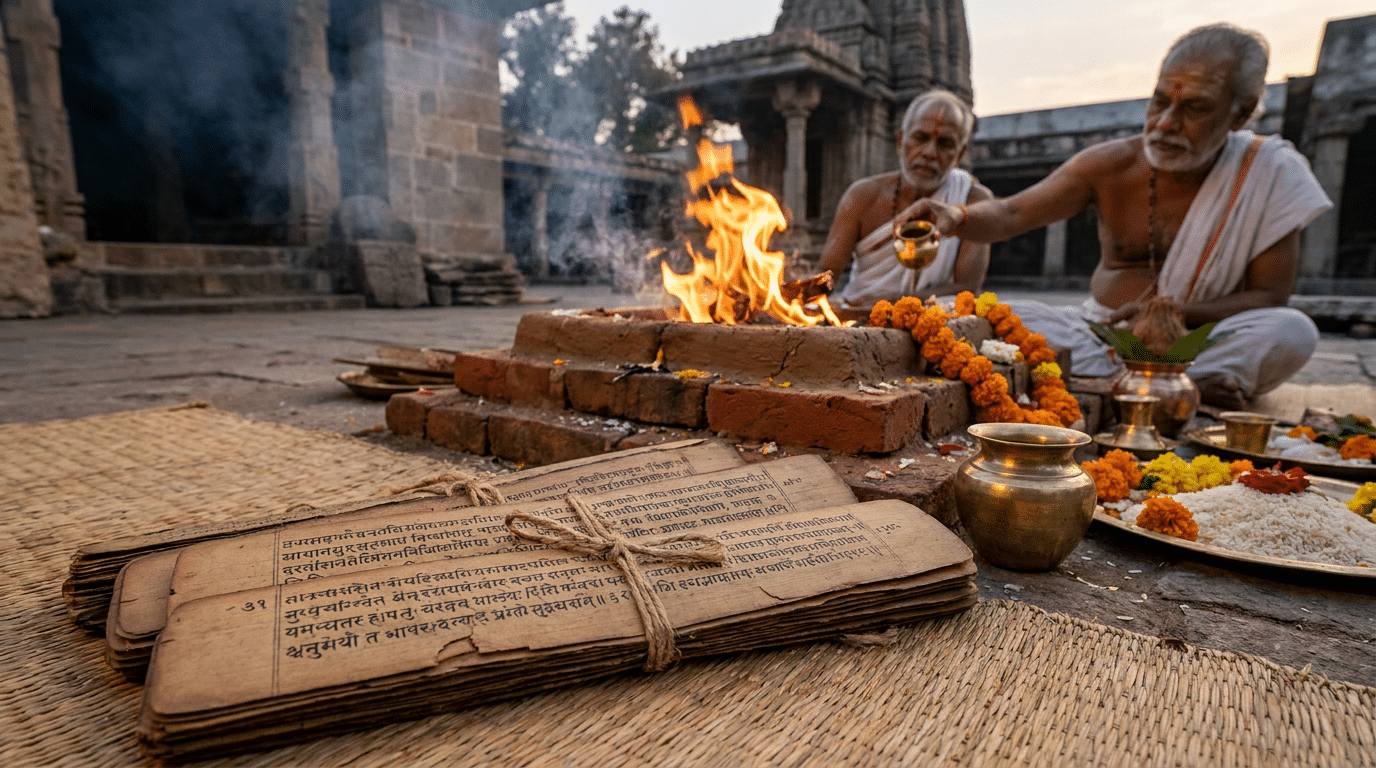
What are the four Vedas?
The Vedic corpus is conventionally organized around four principal collections, each associated with particular ritual and oral traditions.
Rig Veda — hymns and poetry
The Rig Veda is the oldest of the four principal Vedic collections. It contains hymns addressed to deities and forces such as Agni, Indra, Soma, Varuna and Ushas.
Its importance is not limited to ritual. The hymns preserve poetry, cosmological speculation, reflections on order and disorder, and glimpses of the social world in which they were composed.
Yajur Veda — ritual formulas
The Yajur Veda is closely associated with the performance of sacrifice. It contains formulas and instructions used by ritual specialists and survives in different textual traditions.
Its emphasis shows how important correctly performed ritual was within Vedic religious culture.
Sama Veda — verses transformed into song
The Sama Veda is primarily concerned with the musical performance of verses used in ritual. Much of its textual material is related to verses found in the Rig Veda, but its arrangement and melodic use are distinctive.
This tradition demonstrates that sound, pronunciation and musical performance were central to the preservation and practice of Vedic religion.
Atharva Veda — everyday concerns and ritual knowledge
The Atharva Veda contains material dealing with healing, protection, household concerns, prosperity and ritual practices, alongside hymns and philosophical material.
It therefore provides a somewhat different window into the concerns of Vedic communities.
The Vedas are not the same thing as the Upanishads
It is common to describe the Upanishads as simply the final part of the Vedas. The relationship is real but more complicated than that.
Vedic literature developed in layers. The Samhitas contain collections of hymns and formulas. The Brahmanas explain ritual practices. The Aranyakas explore ritual and contemplation, while the Upanishads develop increasingly philosophical discussions of reality, self, knowledge and ultimate existence.
The word Vedanta can literally mean “end of the Veda,” but it later became the name of major philosophical traditions that developed from Upanishadic thought.
How were the Vedas preserved without printing?
One of the extraordinary features of Vedic tradition is the precision of its oral transmission. Specialist reciters learned not only the words but also pronunciation, accent and sequence.
Different recitation methods could repeat passages in carefully structured patterns. These methods created redundancy: if a sequence was memorized in several forms, deviations could be detected through comparison.
This does not mean that every historical textual question has been solved. It means that the oral tradition was far more systematic than the common idea of “stories passed down by word of mouth” suggests.
How old are the Vedas?
The Vedic corpus developed over a long period rather than being composed on a single date. The Rig Veda is generally placed in the second millennium BCE, while later Vedic literature continued to develop over subsequent centuries.
Dating individual hymns and layers is complex because oral composition, transmission and later organization do not fit neatly into a single publication date.
This is why claims that the Vedas were written down thousands of years before other civilizations should be treated cautiously. The texts are ancient, but their history is a process rather than one date.
Do the Vedas contain scientific knowledge?
This is where popular accounts often become misleading.
Vedic literature contains observations of nature, celestial bodies, seasons, ritual calendars and the human environment. Later Indian mathematical and astronomical traditions became extraordinarily sophisticated.
But a poetic reference to the Sun, stars or cosmic order should not automatically be treated as a modern scientific statement. Science depends on explicit models, measurements, testable predictions and methods that can distinguish competing explanations.
The Vedas are valuable historical and intellectual sources without needing to be turned into modern physics textbooks.
What about the famous “speed of light” claim?
A frequently repeated claim connects a numerical statement in a much later commentary by Sayana with the modern measured speed of light. The calculation can produce a striking numerical similarity when particular units and interpretations are selected.
That does not establish that Vedic authors measured the speed of light. The relevant statement is from a medieval commentator, not an experimental measurement in the modern scientific sense, and the interpretation of the units and passage is debated.
The more historically interesting point is that Indian intellectual traditions developed sophisticated discussions of numbers, astronomy and timekeeping across many centuries.
Did the Vedas describe heliocentrism?
Vedic hymns contain poetic descriptions of the Sun, sky and cosmic order, but it is risky to translate these directly into modern heliocentric astronomy.
Systematic mathematical astronomy in India developed substantially in later periods. Scholars such as Aryabhata produced explicit astronomical models and calculations that can be studied historically on their own terms.
There is no need to make the Vedas carry the achievements of every later Indian scientific tradition.
The Vedic view of the cosmos
Some Vedic hymns ask profound questions about how the universe began and whether anyone can know its ultimate origin. The famous Nasadiya Sukta, for example, explores uncertainty about creation rather than presenting a simple cosmological answer.
This is one reason the texts remain intellectually interesting. They contain not only declarations but questions.
Ritual was central to the Vedic world
Fire sacrifice, offerings, chants and carefully structured ritual practices played a major role in Vedic religious life. Different specialists had distinct roles in performing and reciting the required material.
Ritual was connected to ideas about order, obligation, reciprocity and the relationship between humans and divine powers.
Understanding this context is important because modern readers can otherwise interpret isolated verses through categories that did not exist in the same form when the texts were composed.
From Vedic ritual to philosophical questions
Over time, Indian intellectual traditions increasingly explored questions about the self, consciousness, ultimate reality and knowledge.
The Upanishads became particularly influential in this development. Later philosophical schools interpreted Vedic and Upanishadic material in different ways, producing traditions that sometimes agreed and sometimes disagreed sharply.
There was therefore never one single “Vedic philosophy” that remained unchanged for thousands of years.
Why the Vedas still matter
The Vedas matter as religious texts, linguistic records, sources for the study of ancient South Asian society and foundations for later Indian intellectual traditions.
They also demonstrate something important about human knowledge: ideas survive not simply because they are written down, but because communities develop institutions and practices capable of transmitting them.
The deeper mystery is preservation itself
Thousands of years separate modern readers from the earliest Vedic compositions. Yet portions of that ancient oral tradition remain accessible because generations of teachers and students treated precise transmission as a cultural responsibility.
The extraordinary achievement is therefore not that the Vedas secretly contained every modern discovery.
It is that an ancient intellectual tradition survived long enough for people today to still ask questions of it.
The Vedas are not a modern science textbook, nor are they merely relics of a vanished world.
They are a record of humans trying to understand ritual, nature, order, existence and the limits of knowledge—and doing so in poetry that has survived for millennia.
The Vedas Are a Tradition, Not a Single Book
Calling the Vedas “a book” creates an immediate misunderstanding. The word refers to a large and internally differentiated body of sacred knowledge preserved through particular textual schools and ritual lineages. The earliest layers are collections of verses and formulas, but around them grew explanations, ritual interpretations and eventually philosophical works that became part of the wider Vedic tradition.
This distinction also explains why the question “When were the Vedas written?” has no single satisfactory answer. Composition, oral transmission, compilation and manuscript recording happened at different points in time. The oldest material can therefore be much older than the surviving physical manuscripts through which modern scholars encounter it.
The Four Vedas Served Different Functions
The four principal Vedas were not four competing religions. They represented complementary bodies of material within the ritual culture of Vedic India.
The Rig Veda preserves hymns, many of which invoke deities associated with fire, storms, sovereignty, dawn and ritual power. Its poetic language also contains speculation about cosmic origins, order and human existence.
The Yajur Veda is closely tied to the practical performance of sacrifice. Its traditions preserve formulas and instructions used by ritual specialists, illustrating how knowledge could be organized around performance rather than simply around reading.
The Sama Veda demonstrates the importance of sound. Much of its verse material is related to the Rig Veda, but the verses are arranged for musical recitation. In this tradition, preserving the correct sound was itself part of preserving knowledge.
The Atharva Veda contains a broader range of material, including healing, protection, domestic concerns, prosperity and philosophical reflection. It gives historians a different perspective on the concerns of ancient communities.
These differences are important because they show that Vedic culture was not built around one uniform type of religious text. It was an interconnected system of poetry, ritual, sound, specialist knowledge and social practice.
Who Preserved This Knowledge?
Vedic transmission depended on communities of specialists who learned the material through disciplined memorization. In ritual settings, different priests had different responsibilities. The traditional four-priest model corresponds broadly to the roles associated with the Rig, Sama, Yajur and Atharva traditions, although the historical development of these roles was more complex than a simple four-part division suggests.
Students did not merely memorize vocabulary. Pronunciation, accent, sequence and recitation mattered. Traditional recitation techniques could repeat words in deliberately structured patterns, allowing errors to be detected by comparison with other forms of the same passage.
This is one of the most remarkable features of Vedic history. “Oral” does not mean “casual.” The transmission system was designed to minimize variation. It cannot eliminate every historical question about how texts developed, but it helps explain how ancient compositions could survive with extraordinary continuity without relying on printing.
Composition, Transmission and Manuscripts Are Three Different Dates
When discussing ancient texts, it is useful to distinguish three events: when a passage was composed, when it was transmitted and organized within a textual tradition, and when it was eventually written into a surviving manuscript.
The first Vedic compositions are generally placed in the second millennium BCE, with the Rig Vedic material usually regarded as the oldest major layer. Later Vedic texts developed over subsequent centuries. The surviving manuscripts are much later than the original composition of the material they preserve.
This distinction prevents a common historical mistake. The fact that a manuscript is relatively recent does not make the tradition itself recent. Conversely, the antiquity of a tradition does not mean that every passage in the tradition belongs to its earliest period.
Why Dating Individual Hymns Is Difficult
Ancient oral cultures do not leave behind the same kind of publication record as modern societies. A hymn could be composed, memorized, transmitted, reorganized and incorporated into a larger collection without leaving a dated authorial signature.
Linguistic change provides one important tool. Scholars can compare vocabulary, grammar and style with other stages of Sanskrit. Internal references and relationships between texts provide additional clues. Archaeological and historical evidence can sometimes establish the broader environment in which particular traditions developed.
These methods usually produce ranges and relative chronologies rather than a single year. That uncertainty is not a weakness unique to Vedic studies; it is a normal feature of reconstructing ancient history.
The Vedic Texts Also Preserve Different Kinds of Knowledge
Vedic literature is valuable partly because it shows that “knowledge” in an ancient society did not have exactly the same boundaries as the modern word suggests. Ritual expertise, language, memory, astronomy, social custom, poetry and speculation about existence could all coexist within the same intellectual world.
That makes the modern question “Did the Vedas contain science?” difficult to answer with a simple yes or no.
They contain observations and concepts concerning the natural world, time, seasons, celestial phenomena and measurement. But modern science is defined not merely by noticing nature. It involves systematic methods for testing explanations, quantifying observations and allowing competing claims to be evaluated.
Later Indian traditions produced sophisticated mathematics and astronomy, and those achievements deserve to be studied in their own historical contexts rather than retroactively attributing them all to the earliest Vedic texts.
Why Modern Scientific Claims About the Vedas Need Care
Claims about hidden modern science in ancient scripture are attractive because they seem to connect two worlds separated by thousands of years. But a numerical resemblance or metaphorical description is not automatically evidence of a scientific discovery.
The frequently cited “speed of light” example illustrates the problem. A statement associated with the medieval commentator Sayana can be interpreted using a particular unit system to produce a number close to the modern speed of light. Yet the passage is not an experimental measurement, and the interpretation depends on assumptions about the original units and meaning.
Similarly, poetic references to the Sun moving through the heavens cannot simply be converted into a modern heliocentric model. Indian mathematical astronomy later produced explicit models and calculations—most famously in the work of Aryabhata—and those developments are historically more informative when examined on their own terms.
Respect for an ancient tradition does not require attributing modern discoveries to it. In fact, allowing the texts to speak in their own historical language often reveals something more interesting: an intellectual culture developing its own sophisticated questions about nature, order, time and existence.
From Ritual Knowledge to Philosophical Inquiry
The wider Vedic tradition did not remain intellectually static. The Brahmanas expanded explanations of ritual. The Aranyakas explored increasingly reflective interpretations. The Upanishads developed questions about self, knowledge, consciousness and ultimate reality.
This development should not be imagined as a simple moment when “religion became philosophy.” Ritual and philosophical thought continued to overlap, and different schools later interpreted the inherited texts in very different ways.
Still, the movement toward questions such as “What is the self?” and “What is ultimately real?” became enormously influential in Indian philosophy. Later traditions including Vedanta drew heavily on this literature while disagreeing over what it meant.
The Vedas and the Problem of Cosmic Origins
Some Vedic passages are striking because they do not present certainty as the only acceptable form of knowledge. The Nasadiya Sukta, for example, reflects on the origin of existence while leaving open the question of whether anyone can ultimately know how creation began.
For modern readers, the significance is not that the hymn secretly predicts a modern cosmological theory. Its significance lies in the intellectual posture it represents: speculation accompanied by awareness of uncertainty.
That combination—asking large questions while acknowledging the limits of knowledge—is one reason the Vedic corpus continues to attract historians, philosophers, linguists and readers far beyond its original ritual context.
What Makes the Vedic Tradition Historically Extraordinary?
Its importance is not dependent on proving that every later Indian achievement originated in the Vedas. The historical achievement is already considerable.
A body of poetry and ritual knowledge survived through specialized oral institutions for many centuries. Its language became a major object of grammatical analysis. Its ritual traditions influenced later religious practice. Its questions about existence fed into philosophical developments that continued long after the earliest hymns were composed.
It also provides evidence for how an ancient society organized expertise. Memory was trained. Pronunciation was monitored. Ritual roles were differentiated. Knowledge was transmitted through teacher-student relationships. Texts were interpreted rather than merely repeated.
The Vedas as a Record of Changing Questions
Perhaps the most revealing way to read the Vedas is not as a frozen encyclopedia of ancient beliefs but as evidence of intellectual change.
The earliest hymns often focus on relationships among humans, ritual, divine powers and the natural environment. Later Vedic literature becomes increasingly concerned with the meaning and mechanics of ritual. The Upanishadic traditions then pursue questions about knowledge, self and reality with increasing philosophical intensity.
The boundaries between these stages were never absolute, but the broad development shows that Indian intellectual history was dynamic. Ideas were inherited, reinterpreted, challenged and extended.
The Deeper Mystery Is Not Hidden Technology
The temptation to search the Vedas for modern inventions is understandable. Modern readers naturally look for familiar concepts in ancient texts. But the more historically revealing mystery lies elsewhere.
How does a society preserve complex information for generations without printing? How does poetry remain meaningful while languages change? How do ritual practices become vehicles for transmitting memory? And how can questions first asked in an ancient cultural setting continue to influence philosophy thousands of years later?
The Vedas offer unusually rich material for exploring all of those questions.
They are neither a secret modern science textbook nor simply an archaeological relic. They are the surviving expression of a long intellectual tradition in which poetry, ritual, memory, language, cosmology and philosophical questioning developed together.
Curiosity Publication by Aadvik Agastya
Sources & further reading
- Encyclopaedia Britannica — Veda
- Oxford Reference — Vedic literature
- British Library — Vedic texts and traditions
Have a question about this topic?
Join fellow Qurons on the Quron Forum to ask questions, challenge ideas, share discoveries and explore further.
Discuss on Quron Forum