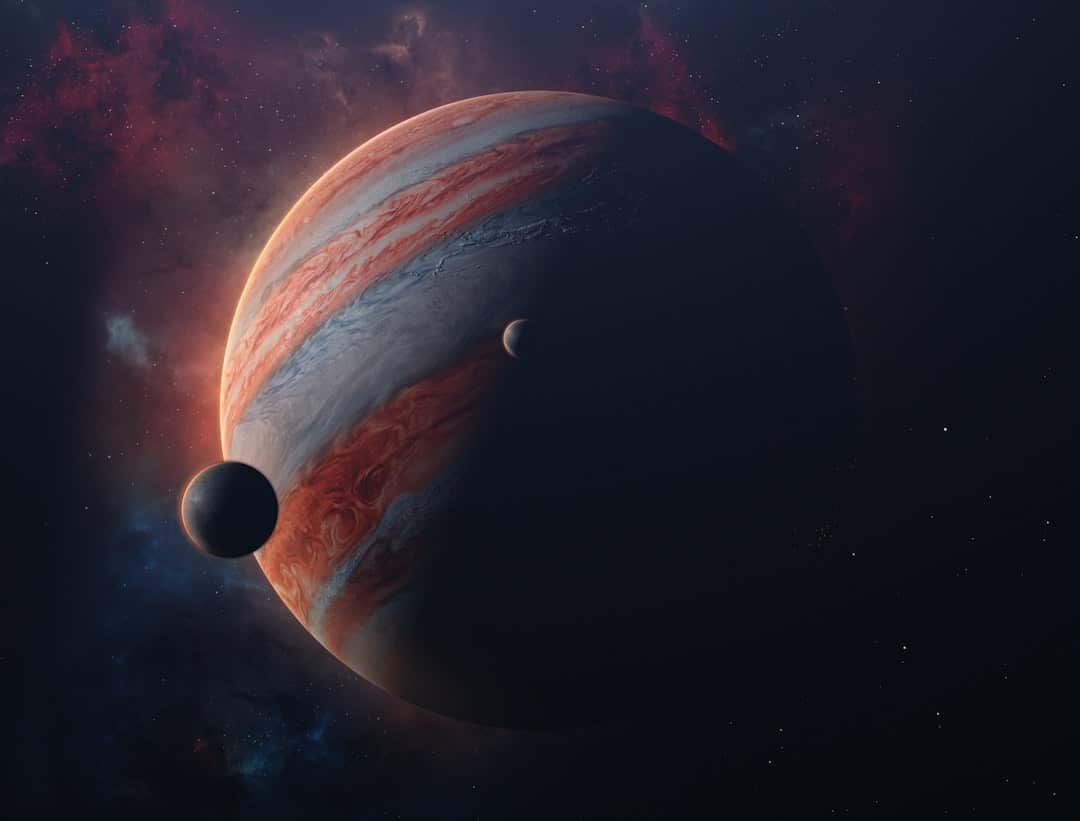
Imagine a planet with no sunrise.
No star rises over its horizon. No familiar solar system surrounds it. It drifts through the Milky Way in darkness, carrying whatever atmosphere, heat or geological activity it can retain.
These worlds are often called rogue planets, or free-floating planets. They are planets—or planet-mass objects—that are not gravitationally bound to a star.
They sound like science fiction. Astronomers, however, have evidence that such objects exist, and upcoming surveys may reveal that they are far more common than the handful we can currently study.
How does a planet become a rogue?
The most intuitive explanation is gravitational ejection.
Planetary systems are not always calm. During formation, young planets interact gravitationally with one another and with their host star. A close encounter can change a planet’s orbit dramatically. In a sufficiently violent interaction, a planet can gain enough orbital energy to escape the star’s gravitational control.
NASA notes that some free-floating worlds may have been ejected from their original planetary systems through gravitational interactions involving other planets or nearby stars.
In this scenario, the rogue planet was once part of a conventional planetary system. It simply lost its star.
But not every rogue world necessarily had a star
There is another possibility.
Some planet-mass objects may form directly from collapsing clouds of gas and dust, through processes resembling star formation but producing objects too small to ignite sustained nuclear fusion.
This creates a difficult classification problem. A free-floating object with several Jupiter masses might have been ejected from a planetary system—or it might represent an unusually low-mass object formed more like a brown dwarf.
Determining an object’s origin therefore requires more than measuring its mass. Age, environment, composition and population statistics can all matter. Current research explicitly considers both ejection and formation pathways.
Why are rogue planets so difficult to find?
A normal exoplanet can sometimes be detected because it crosses in front of its star. The star provides the light; the planet produces a tiny, repeating dip.
A rogue planet has no nearby star to illuminate it.
That makes many conventional detection techniques almost useless.
An old Earth-mass rogue planet could be extremely faint and nearly invisible against the background of space.
Gravity becomes the searchlight
The most powerful method for finding these hidden worlds is gravitational microlensing.
Einstein’s theory of general relativity tells us that mass curves spacetime. When a foreground object passes almost exactly between Earth and a distant background star, the foreground object’s gravity bends the star’s light.
To an observer, the background star briefly becomes brighter.
The invisible planet has effectively acted as a tiny natural telescope.
Why the microlensing signal is so brief
For a star-sized lens, a microlensing event can last weeks or months. For a planet-mass object racing through the line of sight, the event can last only hours or a few days.
That creates a major observational challenge.
A telescope has to be looking at the right region of the sky at almost exactly the right moment. If the event is missed, the planet may never reveal itself again from that particular alignment.
NASA describes microlensing signals from rogue planets as events that can last only a few hours to a couple of days.
What can a tiny flash tell astronomers?
The duration and shape of a microlensing event contain information about the lensing object’s mass and geometry.
Some observed events have been consistent with Earth-, Neptune- or Jupiter-mass objects, although individual events can contain ambiguities involving distance and whether the object is truly unbound or merely on a very wide orbit.
This is one reason rogue-planet astronomy is statistically powerful but individually difficult. Astronomers may infer the existence of a planet from a brief gravitational signature without ever seeing the planet itself.
Could there be billions of them?
Possibly—but the exact number remains uncertain.
Earlier studies produced estimates ranging from tens of billions to potentially trillions of free-floating planets in the Milky Way, depending on assumptions and the mass range considered. The huge range is a reminder that the current observational sample is still limited.
More recent microlensing work has suggested that Earth-mass rogue planets may be relatively common compared with more massive rogue worlds. NASA reported a study whose results suggested that Earth-size rogues could outnumber more massive free-floating planets.
These are population estimates, not a census. The real abundance will become clearer as larger surveys observe more events.
Why NASA’s Roman telescope matters
The Nancy Grace Roman Space Telescope is designed to conduct large astronomical surveys, including a microlensing survey toward dense regions of the Milky Way.
Its combination of a wide field of view and observations from space is expected to greatly increase sensitivity to faint and short-lived microlensing events.
NASA’s current mission descriptions emphasize that Roman could detect free-floating planets ranging down toward very low masses and dramatically improve our understanding of their population.
That matters because finding more rogue planets will not merely add strange objects to a catalogue. It will test competing theories of how planetary systems form and how often planets are thrown out of them.
A planet without a star could still have an atmosphere
“Rogue” does not mean “dead.”
A planet’s environment after ejection would change dramatically, especially its surface temperature. But the planet could retain an atmosphere, internal heat or geological activity depending on its mass, composition and age.
A massive planet can retain heat generated during its formation for a long time. A planet with radioactive elements inside its rocks can also continue producing internal heat.
And if a rogue world has moons, tidal interactions could potentially provide another source of internal energy.
Could a rogue planet support life?
This is where the science becomes speculative.
Surface life like Earth’s would face an obvious problem: without a nearby star, there is no continuous source of sunlight to power ordinary photosynthesis.
But habitability does not necessarily require a sunlit surface.
On Earth, ecosystems exist around deep-sea hydrothermal vents where sunlight does not provide the primary energy source. Chemosynthetic organisms obtain energy from chemical gradients.
A sufficiently massive rogue planet could conceivably retain a thick atmosphere or subsurface environment warmed by internal processes. A subsurface ocean under an insulating layer of ice is another theoretical possibility.
None of this demonstrates that rogue planets host life. It simply means that the absence of starlight does not automatically eliminate every conceivable habitat.
The problem of temperature
Without stellar heating, the surface of a rogue planet would generally become extremely cold over time.
But temperature is not controlled by sunlight alone. Atmospheric composition, pressure, internal heat and the presence of insulating ice or rock all matter.
A planet with a thick hydrogen-rich atmosphere could retain heat much more effectively than an exposed rocky body.
That makes the question of habitability one of planetary physics rather than simply a question of whether a planet has a star.
What happens to a rogue planet’s sky?
The sky would be profoundly different.
There would be no dominant local star illuminating the landscape. Distant stars would remain visible, but they would be points of light rather than sources of warmth.
From the surface of a sufficiently dark world, the Milky Way could appear spectacularly bright against an otherwise black sky.
But the absence of a local star would change the planet’s entire energy budget.
Rogue planets are laboratories for planetary formation
The real scientific value of rogue planets may not be their exotic appearance.
They can reveal how violent young planetary systems can be.
If large numbers of planets are ejected, then planetary formation is not simply the construction of stable systems. It is also a process in which many worlds may be scattered, captured, collided with or expelled.
The population of free-floating planets can therefore act as a fossil record of the gravitational chaos that occurred while planetary systems were young.
The boundary between planet and brown dwarf
There is also a deeper classification puzzle.
Brown dwarfs are objects too massive to be classified as planets but too low-mass to sustain ordinary hydrogen fusion like stars. Some free-floating planet candidates overlap the mass range associated with brown dwarfs.
This means that “rogue planet” can describe an object’s present dynamical state—floating without a star—while its origin may remain uncertain.
Scientists therefore increasingly care about both what an object is now and how it formed.
We may be surrounded by worlds we cannot see
The most unsettling part of rogue-planet research is how easily these worlds can hide.
Our galaxy contains hundreds of billions of stars, but the dark space between them is not necessarily empty. A planet can drift through that space without producing enough light for a conventional telescope to notice.
Its existence may be revealed only when its gravity briefly bends the light of an unrelated star.
The strangest planets may be the ones without suns
For centuries, planets were imagined as companions of stars because our own solar system gave us no reason to expect otherwise.
Now astronomy suggests a more complicated picture.
Some planets may be born into systems and later expelled. Others may form through pathways that blur the boundary between planets and brown dwarfs. Some may carry atmospheres and internal heat long after losing their stars.
And many may remain completely invisible except for a momentary gravitational fingerprint.
Rogue planets are therefore not merely lonely worlds.
They are clues to how planetary systems are built, disrupted and sometimes torn apart.
Curiosity Publication by Aadvik Agastya
Sources & further reading
- NASA — Roman and Earth-mass rogue planets
- NASA — Unveiling Rogue Planets
- NASA Science — Roman Microlensing
- NASA Science — Planetary Systems
Have a question about this topic?
Join fellow Qurons on the Quron Forum to ask questions, challenge ideas, share discoveries and explore further.
Discuss on Quron Forum