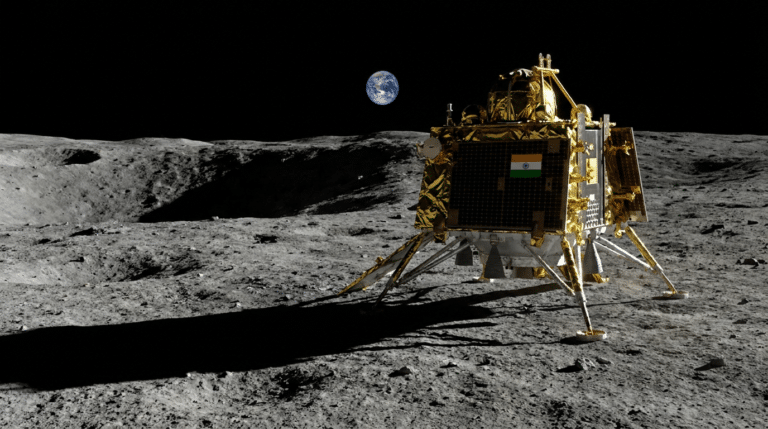
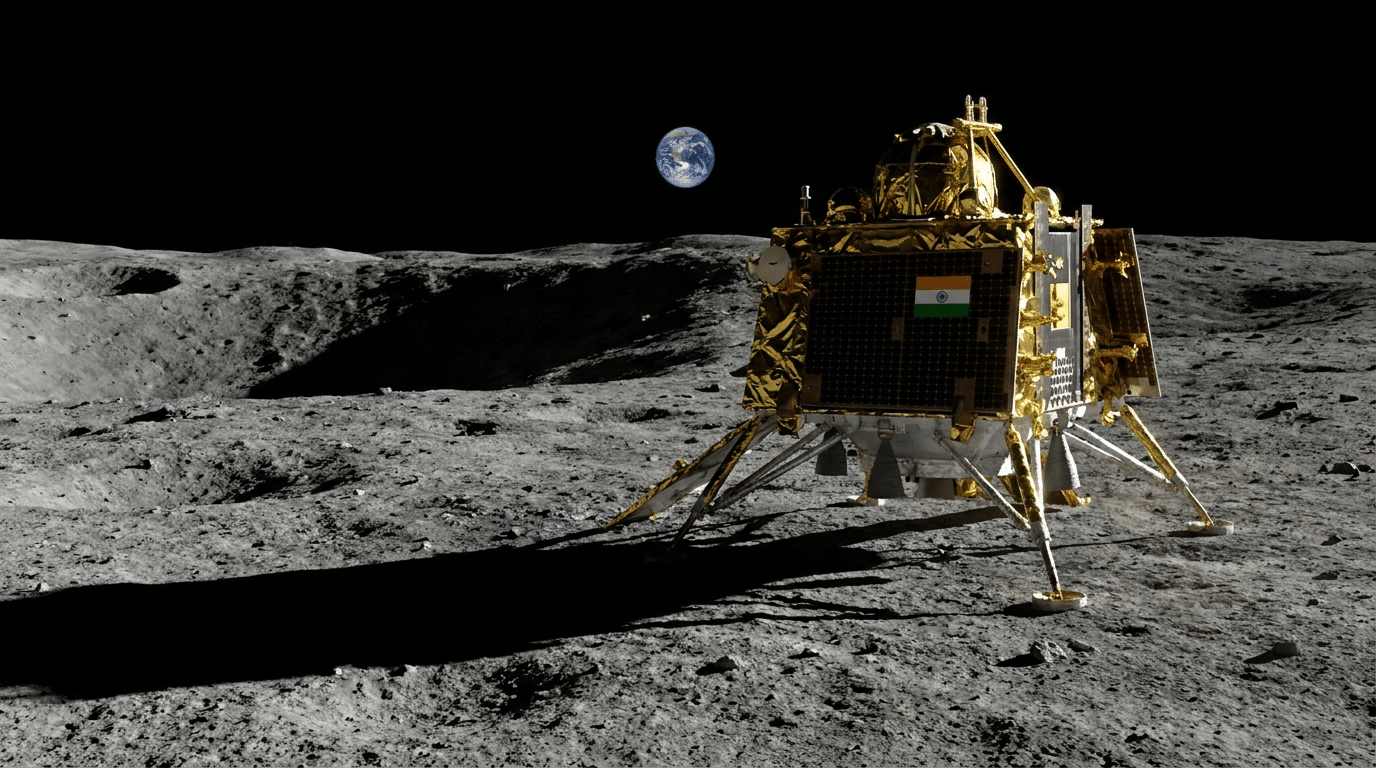
On 23 August 2023, a spacecraft descended toward one of the most difficult environments to reach in the Solar System’s immediate neighborhood: the rough, shadowed terrain of the Moon’s high southern latitudes.
Chandrayaan-3 was attempting something that had defeated earlier lunar missions around the world—performing a controlled soft landing and then operating instruments directly on the surface.
The mission succeeded. The Vikram lander reached the lunar surface and deployed the Pragyan rover, turning a distant region of the Moon into a place where measurements could be made on the ground rather than inferred entirely from orbit.
The significance of Chandrayaan-3 therefore goes beyond the symbolic achievement of landing. It was a planetary-science experiment conducted in a region where terrain, temperature and lighting create unusual scientific opportunities and engineering constraints.
What Was Chandrayaan-3?
Chandrayaan-3 was India’s follow-up to Chandrayaan-2, which successfully entered lunar orbit in 2019 but lost communication with its lander during the final descent.
The new mission was designed with a focused objective: demonstrate a safe and controlled lunar landing and operate a rover on the surface.
The spacecraft architecture included a propulsion module, the Vikram lander and the Pragyan rover. Each had a different role.
The propulsion module was responsible for transporting the lander configuration toward the Moon and also carried scientific equipment. Vikram handled the final descent and surface operations. Pragyan provided mobility, allowing measurements to be taken at more than one point around the landing site.
Why Landing on the Moon Is Difficult
A lunar landing looks deceptively simple from Earth.
The Moon is close enough to observe with telescopes, but it has almost no atmosphere. That means a spacecraft cannot rely on atmospheric drag or parachutes to slow itself during descent.
Instead, the spacecraft must use propulsion to reduce velocity while continuously determining its position and altitude.
The surface adds another problem. The Moon is covered with craters, slopes, rocks and irregular terrain. A spacecraft can approach the correct general region and still encounter a dangerous landing site during the final descent.
The Final Descent of Vikram
During the landing sequence, Vikram had to transition from orbital motion to controlled descent. Its onboard systems used sensors and navigation logic to estimate its state and guide the vehicle toward a suitable landing region.
The final phase is particularly demanding because there is very little time to correct a large error.
A successful landing therefore represents the coordinated performance of propulsion, navigation, software, sensors, communications and mechanical systems.
Chandrayaan-3 was designed with lessons from the Chandrayaan-2 landing incorporated into the mission architecture and testing process.
Why the Lunar South Polar Region Matters
The Moon’s poles are scientifically unusual because the Sun remains very low on the horizon and some crater interiors receive little or no direct sunlight for extremely long periods.
These permanently or nearly permanently shadowed regions can become exceptionally cold. Under such conditions, volatile substances—including water ice—can persist for long periods.
That possibility makes the lunar poles important for planetary science and future exploration.
But “water at the lunar poles” should not be interpreted as meaning that accessible lakes of liquid water exist there. Any water in extremely cold permanently shadowed regions is expected to occur mainly as ice or in other forms bound within the lunar environment.
Why Water on the Moon Is So Important
Water is scientifically valuable because it can preserve information about the Moon’s history and its interaction with external sources of volatiles.
It is also potentially useful for future exploration. Water can theoretically provide drinking water after processing and can be chemically separated into hydrogen and oxygen, which are relevant to life support and rocket propulsion.
But extraction is not the same as detection. Finding evidence of water does not automatically mean that a future mission can economically mine it. The concentration, physical form, accessibility and energy requirements all matter.
What Did Pragyan Do?
After landing, the Pragyan rover was deployed from Vikram and travelled across the lunar surface near the landing site.
The rover carried instruments designed to analyze the elemental composition of lunar soil and rocks. Its measurements provided direct information about the local surface environment.
This distinction between orbital and surface observations is important. An instrument on a spacecraft can map an enormous region, but its measurements often represent a remote or averaged signal. A surface instrument can examine material at a specific location and test the composition of the ground directly.
What Did the Mission Measure?
Chandrayaan-3 carried several scientific instruments on the lander and rover.
Among other measurements, the mission investigated the elemental composition of the local lunar soil and examined the thermal properties and near-surface environment.
One of the particularly interesting measurements came from the rover’s chemical analysis, which detected elements in the surrounding lunar material. Such measurements help scientists compare the landing site with other parts of the Moon and refine models of lunar geology.
The lander also carried an instrument designed to measure the near-surface plasma environment and another designed to investigate thermal properties of the lunar soil.
Why One Landing Site Cannot Tell Us Everything
The Moon is not geologically uniform.
Different regions contain different rock types, crater histories, ages and exposure environments. A measurement made at one landing site is therefore a local sample of a much larger world.
This is why planetary scientists combine surface measurements with orbital spectroscopy, imaging, gravity data and observations from other missions.
One rover reading can be extremely valuable while still being insufficient to describe the entire Moon.
The Moon Is a Record of the Early Solar System
The Moon has no global system of active plate tectonics comparable to Earth’s, and its surface preserves ancient impact scars that would be erased much more quickly on our planet.
That makes lunar geology valuable for reconstructing the history of the Solar System.
Impact craters, volcanic plains, mineral composition and surface chemistry provide clues about the processes that shaped the Moon and the environment around Earth billions of years ago.
Polar regions add another dimension because permanently shadowed environments can preserve volatile materials that are altered or lost more readily elsewhere.
Why the Landing Demonstration Matters Technologically
A successful soft landing is not just a ceremonial milestone.
It demonstrates that a spacecraft can navigate autonomously or semi-autonomously through the final phase of a planetary descent, recognize its environment, control its velocity and orientation and touch down without catastrophic impact.
Those capabilities matter for future missions that may carry larger instruments, sample-collection systems or more complex payloads.
Every successful landing also provides engineers with operational data that can inform the design of later spacecraft.
Chandrayaan-3 Built on Earlier Missions
India’s lunar exploration program did not begin with Chandrayaan-3.
Chandrayaan-1, launched in 2008, played an important role in mapping the Moon and contributing to evidence for water-related signatures on the lunar surface. Chandrayaan-2 later demonstrated the ability to place an orbiter around the Moon and produced extensive orbital science even though its lander did not complete a successful landing.
Chandrayaan-3 therefore represents an iterative process rather than an isolated technological leap.
Space exploration often progresses this way: a mission succeeds in some areas, encounters failures in others, and the next mission incorporates the lessons.
What Chandrayaan-3 Did Not Prove
The mission’s success should not be stretched into claims it was not designed to answer.
It did not prove that humans can easily establish a permanent lunar settlement. It did not determine the total quantity of water available across the Moon. It did not reveal the entire history of lunar formation.
Nor can a short-duration surface mission replace the value of long-term observations from multiple locations.
Planetary science advances by combining many measurements across time and space.
The South Pole Is Not a Simple Destination
Popular descriptions sometimes make the lunar south pole sound like a single point. Scientifically, the region is much more complicated.
There are enormous variations in illumination, slope, elevation, temperature and geological history across polar terrain. A crater rim can receive sunlight while its interior remains in deep shadow.
For spacecraft designers, this creates a difficult optimization problem. A scientifically interesting location may also be a difficult place to land, communicate from or obtain reliable solar power.
The Human Meaning of a Lunar Landing
Space missions operate through engineering and scientific procedures, but they also have a cultural dimension.
A successful landing can become a shared demonstration of what a country’s scientific institutions, engineers and researchers are capable of accomplishing.
For India, Chandrayaan-3 became an important milestone in the country’s space program and a visible example of increasingly ambitious planetary exploration.
Yet the scientific value remains independent of national symbolism. Lunar measurements become part of a global body of planetary knowledge that researchers around the world can analyze.
The Next Questions
Chandrayaan-3 did not close the scientific story of the Moon’s poles. It sharpened it.
How are volatiles distributed? How did they arrive? How long can they survive in shadowed environments? How does the lunar surface change under extreme temperature cycles? What do polar materials reveal about the history of the Earth-Moon system?
Future orbiters, landers, rovers and sample-return missions can address different parts of these questions.
The Bigger Perspective
The most important part of Chandrayaan-3 may be the transformation of distance into measurement.
The Moon is no longer merely an object seen through telescopes. At the landing site, instruments could touch the surface, analyze material, measure temperature and examine the local environment directly.
That is how planetary exploration works at its best: a question becomes a mission, a mission becomes an experiment, and the experiment produces evidence that can be tested against what scientists previously believed.
Chandrayaan-3 did not finish the exploration of the Moon. It expanded the part of the Moon that humanity can investigate directly.
The Engineering Problem Behind the Landing
A lunar landing is fundamentally different from returning a spacecraft to Earth. Earth provides a thick atmosphere that can be used for aerodynamic braking and parachutes. The Moon does not. Near the surface, the spacecraft still has substantial velocity, and the only practical way to remove it is through controlled propulsion.
That creates a demanding sequence of decisions. The spacecraft has to know where it is, estimate how quickly it is moving, determine its orientation and command its engines correctly while descending toward terrain that may contain slopes, rocks and craters.
Small errors can become large problems during the final phase. A vehicle that is slightly too fast may not have enough time to correct. A vehicle that spends too much fuel correcting its trajectory may reach the surface without sufficient reserves. The landing system therefore has to balance navigation, propulsion, fuel and terrain information simultaneously.
What Changed After Chandrayaan-2?
Chandrayaan-2 provided an enormous amount of orbital science, but the loss of communication with its Vikram lander during the final descent became an engineering lesson for the next mission.
Chandrayaan-3 incorporated changes intended to improve landing robustness. The mission included revised landing-related systems and additional attention to navigation, hazard detection, propulsion and testing. The objective was not simply to repeat the earlier attempt but to reduce the ways in which a final descent could fail.
This illustrates an important principle of space engineering: failure is not necessarily the opposite of progress. A failed mission can provide information about the real system that simulations and ground tests cannot fully reproduce. The value comes from identifying the failure mechanism and incorporating credible lessons into the next design.
How Vikram Found a Safe Place to Touch Down
The landing system had to deal with the fact that the Moon’s surface is not a smooth target. Craters can hide dangerous slopes, while boulders can create a hazard even when the spacecraft has reached the correct geographic region.
Landing therefore involves more than following a predetermined path. Sensors and onboard processing help the spacecraft estimate its surroundings and adjust its trajectory during descent.
This is a particularly difficult form of autonomous decision-making because communication with Earth cannot provide joystick-like control in real time. Radio signals take time to travel, and the final landing sequence is too rapid for ground controllers to inspect every image and command every movement.
Why the South Polar Region Is So Scientifically Interesting
The Moon’s polar environment contains places where sunlight behaves very differently from the familiar day-night cycle at lower latitudes. The low angle of the Sun can leave crater floors in prolonged darkness while nearby ridges remain illuminated for much longer periods.
Those conditions create what planetary scientists call permanently or nearly permanently shadowed regions. Temperatures can become extraordinarily low, allowing volatile compounds such as water ice to survive for long periods.
At the same time, polar terrain is scientifically valuable precisely because it is difficult. Extreme illumination contrasts, steep slopes, deep shadows and complicated topography make both navigation and scientific interpretation harder.
Water Is a Scientific Clue, Not a Ready-Made Resource
The presence of lunar water is often discussed as though it automatically translates into a future supply of usable fuel and drinking water. The reality is much more complicated.
Scientists need to know where the water is, how much is present, what physical form it takes, how strongly it is bound to the surrounding material and how difficult it would be to extract. A concentration of ice in a permanently shadowed region presents a different engineering problem from trace amounts of hydrogen or hydroxyl distributed through illuminated soil.
Water is nevertheless extremely important because it can record aspects of lunar environmental history and, in principle, provide resources for future missions after appropriate processing.
What the Rover Added to the Mission
An orbiter can survey enormous areas, but a rover can make measurements directly against the local surface. Pragyan carried instruments that allowed scientists to investigate the elemental composition of material around the landing site.
Among the mission’s notable results was the detection of several elements in the lunar soil, including the expected major components and evidence of sulphur at the landing site. Such measurements help constrain the geological character of the region and can be compared with remote observations from orbit.
The rover’s movement was deliberately modest in scale compared with terrestrial exploration. That is not a sign of limited scientific ambition. Every metre on an unprepared planetary surface requires energy, navigation and careful risk management.
The Lander Was a Laboratory Too
Vikram was more than a platform for deploying Pragyan. It carried instruments that investigated the near-surface environment and the thermal and physical properties of the lunar surroundings.
One of the mission’s instruments measured the thermal characteristics of the near-surface lunar material, while another investigated the plasma environment close to the surface. An instrument designed to investigate seismic activity also contributed measurements from the landing region.
These observations matter because the Moon’s surface environment differs radically from Earth’s. With no substantial atmosphere to redistribute heat and with long periods of sunlight and darkness, temperatures can vary dramatically.
Why a Single Landing Site Is Scientifically Limited
One of the easiest mistakes in planetary science is to treat a local measurement as though it describes an entire world.
The Moon contains ancient highlands, volcanic plains, impact basins, polar deposits and many other geological environments. A landing site samples only a tiny part of that diversity.
Scientists therefore combine surface measurements with orbital spectroscopy, high-resolution imaging, gravity measurements, crater dating and data from other missions. The strength comes from convergence: independent observations that point toward compatible interpretations.
What the Mission Demonstrated Technologically
Chandrayaan-3 demonstrated that India could carry out a controlled soft landing on the Moon and deploy and operate a rover on the lunar surface. That is a meaningful technological capability because it requires multiple systems to work together under conditions that cannot be reproduced perfectly on Earth.
The mission also generated operational experience in navigation, communications, surface mobility, thermal management, power management and lunar operations. Such experience can become a foundation for increasingly complex missions.
But it is important to distinguish a demonstrated capability from a future possibility. Successfully operating a small rover for a limited period does not by itself demonstrate the ability to construct a permanent human base, perform large-scale resource extraction or conduct long-duration crewed operations.
Why the Moon Still Matters After the Landing
The Moon is scientifically valuable partly because it preserves a record that Earth constantly modifies. Our planet has active plate tectonics, erosion, oceans and a dynamic atmosphere that destroy or obscure much of its ancient surface history.
The Moon has preserved enormous numbers of impact craters and ancient geological features. Studying them helps scientists reconstruct the history of impacts in the Earth-Moon system and the early Solar System.
The polar regions add another layer because they may preserve volatile material that has remained trapped in extremely cold environments for geological periods.
The Mission’s Most Important Legacy May Be the Questions It Created
Chandrayaan-3 did not settle the major questions surrounding the lunar south pole. It provided another set of observations with which those questions can be tested.
How are polar volatiles distributed? What processes delivered them? How stable are they over geological time? How does the lunar surface respond to extreme thermal cycles? What can polar materials tell us about the history of the Earth-Moon system?
Answering these questions will require more than one rover. Future orbiters, landers, rovers and sample-return missions can investigate different locations and environments, allowing local measurements to be placed into a much larger geological picture.
The Deeper Significance
Chandrayaan-3 is sometimes reduced to a single sentence: India landed on the Moon.
That is true, but it describes the destination rather than the scientific process.
The deeper achievement was turning a distant celestial body into an experimental environment. A spacecraft navigated toward an uncertain surface, a lander survived the final descent, a rover moved across lunar soil and instruments converted the local environment into measurements that scientists could analyze.
That is the essence of planetary exploration. A mystery becomes a measurable question; a measurable question becomes an engineering problem; the mission produces observations; and those observations become part of a scientific record that future missions can challenge, refine and extend.
Chandrayaan-3 did not finish humanity’s exploration of the Moon. It expanded the evidence base from which the next questions can be asked.
Curiosity Publication by Aadvik Agastya
Sources & further reading
Have a question about this topic?
Join fellow Qurons on the Quron Forum to ask questions, challenge ideas, share discoveries and explore further.
Discuss on Quron Forum