Mars is close enough to see from Earth with the naked eye, yet its surface belongs to a world that evolved very differently from our own. Today it is cold, dry and wrapped in a thin atmosphere. But its rocks preserve evidence of ancient rivers, lakes, volcanic activity and chemical environments that were once much more favorable to liquid water.
That history makes Mars more than a possible destination for human exploration. It is a natural experiment in planetary habitability.
Why did two rocky planets in the same solar system develop such different surface environments? Did Mars ever host life? And could humans one day operate there for long periods?
Mars is a world, not just a red desert
Mars is smaller than Earth but contains an extraordinary range of geological features. Its surface includes enormous volcanoes, deep canyon systems, impact craters, sedimentary deposits, polar ice and landscapes shaped by wind and ancient water.
Its reddish appearance comes largely from iron-bearing minerals that have undergone oxidation and other chemical processes.
Orbiters have mapped the planet globally, while landers and rovers have allowed scientists to investigate particular environments directly.
Why ancient Mars looks so different from modern Mars
Many Martian landscapes preserve evidence that the planet once experienced conditions unlike those of today.
Valley networks, deltas, lake deposits and minerals formed through interaction with water indicate that liquid water existed at the surface or near it during parts of Mars’s early history.
The important scientific question is not simply whether Mars once had water. It is where, for how long, under what chemical conditions and with how much environmental stability.
River valleys are evidence of a wetter past
Ancient valley networks resemble drainage systems produced by flowing water. Some deposits contain structures consistent with rivers and lakes.
These features suggest that Mars was not always the permanently frozen desert seen today.
But reconstructing the ancient climate is difficult. A landscape may preserve evidence of intermittent water without implying a warm, Earth-like climate lasting for millions of years.
Why did Mars become cold and dry?
Modern Mars has a very thin atmosphere compared with Earth. Surface pressure is so low that stable liquid water is difficult under most present-day conditions.
Mars also lacks Earth’s strong global magnetic field. Its atmosphere has been altered and gradually lost through several processes, including interactions with the solar wind and atmospheric escape.
The planet’s interior also cooled over geological time, changing volcanic and atmospheric processes.
The exact sequence of events remains an active research subject because Mars did not change from wet to dry in one simple step.
The loss of atmospheric pressure changed the water story
Water behaves differently under different pressures and temperatures. As the Martian atmosphere became thinner and the climate colder, long-lived bodies of liquid water became increasingly difficult to maintain at the surface.
Some water became trapped as ice, some may have moved underground, and some was lost through atmospheric escape.
Today, substantial water exists as ice and may also occur in subsurface environments, but Mars no longer has Earth’s stable surface water cycle.
Water does not automatically mean life
Finding evidence for ancient water is important because life as we know it requires liquid water, among other conditions. But habitability is not the same as inhabited.
A planet can contain water and suitable chemistry without life ever emerging. Even if life once existed, evidence could be difficult to distinguish from geological or chemical processes.
That distinction is central to modern Mars exploration.
What would count as evidence for ancient life?
Scientists search for possible biosignatures: chemical, mineralogical, isotopic or structural patterns that could have a biological origin.
The difficulty is that many apparent biosignatures can also be produced abiotically. A compelling claim therefore requires multiple independent lines of evidence and careful elimination of non-biological explanations.
A single unusual molecule would rarely be enough to establish that life once existed.
Why sedimentary rocks matter
Sedimentary environments are particularly valuable because they can preserve evidence about ancient surface conditions. Fine-grained sediments can record chemical changes and, under the right circumstances, preserve microscopic structures or organic compounds.
This is one reason Mars missions investigate ancient lakebeds and deltas rather than treating every rock as equally informative.
Rovers are geological detectives
Orbiters provide the large-scale map. Rovers provide local context.
Instruments can examine mineral composition, chemistry, textures and the physical relationships among rocks. Cameras can identify layers and sedimentary structures that help reconstruct how an environment formed.
The goal is not merely to find an interesting rock. It is to understand the geological history represented by that rock.
Curiosity and the question of habitability
NASA’s Curiosity rover has investigated Gale Crater, a location that once contained a lake environment. Its measurements have provided evidence about water chemistry, sediments and the availability of chemical ingredients relevant to habitability.
Curiosity’s work illustrates the difference between searching for life and searching for conditions that could have supported life. Much of planetary science begins with the latter.
Perseverance and the search for preserved evidence
NASA’s Perseverance rover has explored Jezero Crater, which contains a delta and ancient lake-related deposits. Its mission includes collecting and caching carefully selected samples for possible future return to Earth.
Laboratories on Earth can perform measurements that are difficult or impossible for a rover to carry out, making sample return potentially valuable for the search for ancient biological or chemical signatures.
Mars has enormous geological extremes
Mars is home to Olympus Mons, the largest known volcano in the Solar System, and Valles Marineris, a canyon system extending thousands of kilometers.
These structures show that Mars experienced large-scale volcanic and tectonic processes despite its smaller size.
The planet’s crust also preserves an unusually long record of impacts and surface evolution, making it useful for reconstructing planetary history.
Why Mars is important for understanding Earth
Earth is unusually favorable to long-term surface habitability, but we do not yet know exactly how unusual it is.
Mars provides a comparison. Both worlds formed from similar solar-system material, yet their climates and surface environments diverged dramatically.
By understanding why Mars lost the conditions that once allowed more persistent surface water, scientists can better understand the factors that help rocky planets remain habitable.
Could microbes still exist underground?
The Martian surface is harsh: intense radiation, extreme dryness and cold create difficult conditions for known terrestrial organisms.
The subsurface may be different. Shielded environments can offer protection from radiation and potentially provide access to water or chemical energy.
This makes the Martian subsurface scientifically interesting, although the existence of present-day Martian life has not been established.
Why radiation is a serious problem for humans
Earth’s atmosphere and magnetic environment provide substantial protection from space radiation. Mars offers much less shielding.
Long-duration human missions would therefore require substantial protection, potentially using habitat structures, buried facilities or local materials.
Radiation is not the only challenge. Humans also need breathable air, stable pressure, water, food, waste management, reliable power and protection from the cold.
Living on Mars would require an artificial environment
Mars is not naturally suited to unprotected human life. Its atmospheric pressure is far below that of Earth, its atmosphere is mostly carbon dioxide, and temperatures can be extremely low.
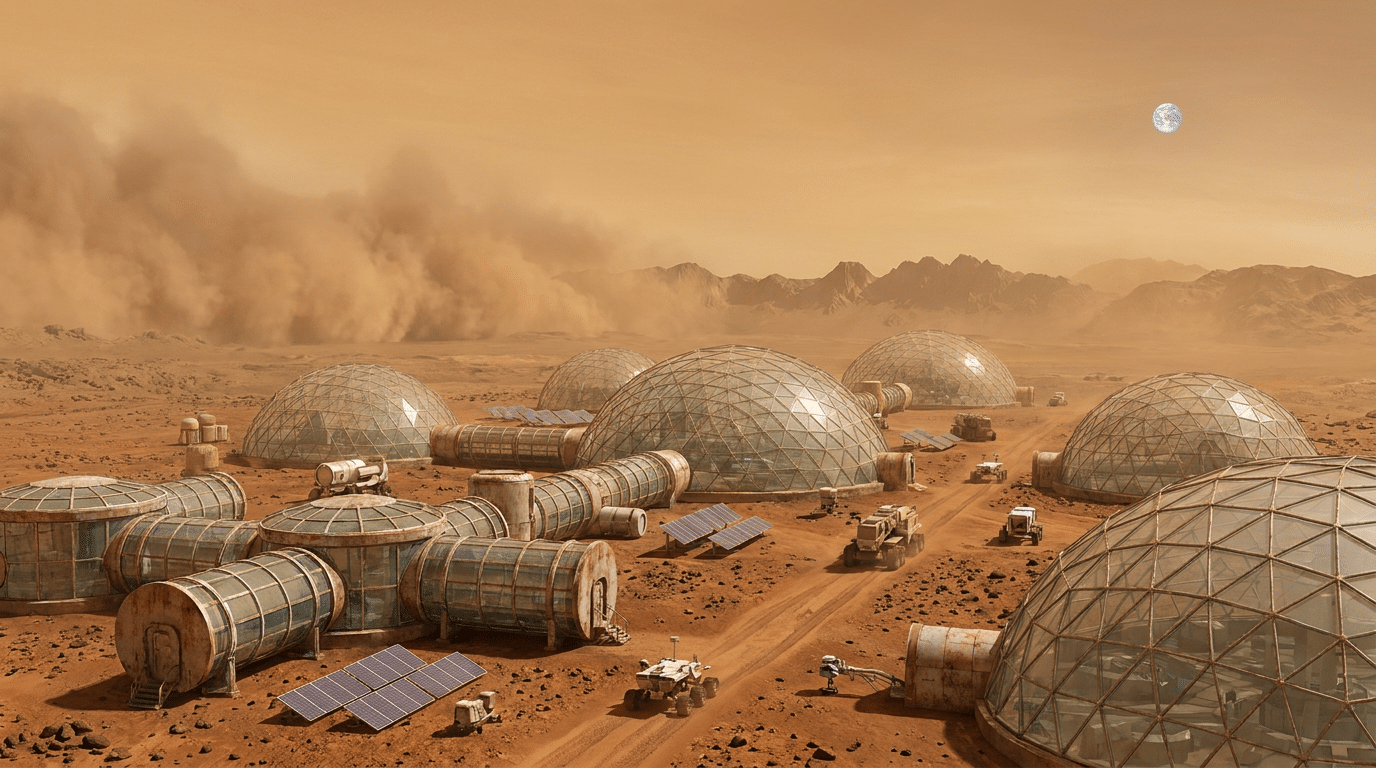
A human settlement would therefore resemble a collection of spacecraft and engineered habitats rather than a city operating directly under the Martian sky.
Could local resources help?
Long-term missions could potentially use resources found on Mars rather than transporting everything from Earth. Water ice could provide drinking water and, after processing, ingredients for other mission needs. Local materials could also potentially contribute to construction and shielding.
But “using local resources” is not the same as having abundant accessible resources. Extraction, purification, energy requirements and reliability all have to be demonstrated.
Why returning humans to Earth matters
A permanent settlement would require more than a successful landing. It would require reliable transportation, spare parts, medical capability, radiation protection, food production and the ability to survive failures.
Every system becomes harder to maintain when replacement components may be months away.
This is why human Mars exploration is fundamentally an engineering and logistical problem as well as a scientific one.
Mars is not a second Earth
Terraforming is sometimes presented as an inevitable future project, but changing Mars’s atmosphere and climate on a planetary scale would be an enormous undertaking. Current technology does not provide a practical path to transforming Mars into an Earth-like world.
Near-term exploration is therefore more realistically centered on controlled habitats, scientific fieldwork and increasingly capable robotic systems.
What we know—and what remains unknown
We know Mars once had environments in which liquid water interacted with rocks. We know its climate and atmosphere changed dramatically. We know that some ancient environments could have been habitable for microbial life.
We do not have confirmed evidence that life ever existed on Mars.
We also do not yet have a complete explanation of how Mars evolved from its ancient environments into the cold desert observed today.
The next frontier is not simply landing
Every new mission adds another piece to the planetary story. Orbiters reveal the global structure. Rovers reconstruct local environments. Sample studies may eventually provide laboratory evidence at a level impossible to achieve remotely.
Human missions would add another dimension: direct geological exploration over much larger areas and the ability to operate sophisticated equipment in the field.
Why Mars still matters
Mars represents three questions at once.
Did life ever exist beyond Earth?
Why did a once more active world become so cold and dry?
Can humans safely operate on another planet?
The first question reaches into astrobiology. The second reaches into planetary science. The third reaches into engineering and human exploration.
That combination is what makes Mars such an important scientific destination. It is not simply the next place for humanity to plant a flag. It is a world that preserves evidence about how planets change—and perhaps about whether life can arise more than once in the cosmos.
Curiosity Publication by Aadvik Agastya
Sources & further reading
Have a question about this topic?
Join fellow Qurons on the Quron Forum to ask questions, challenge ideas, share discoveries and explore further.
Discuss on Quron Forum