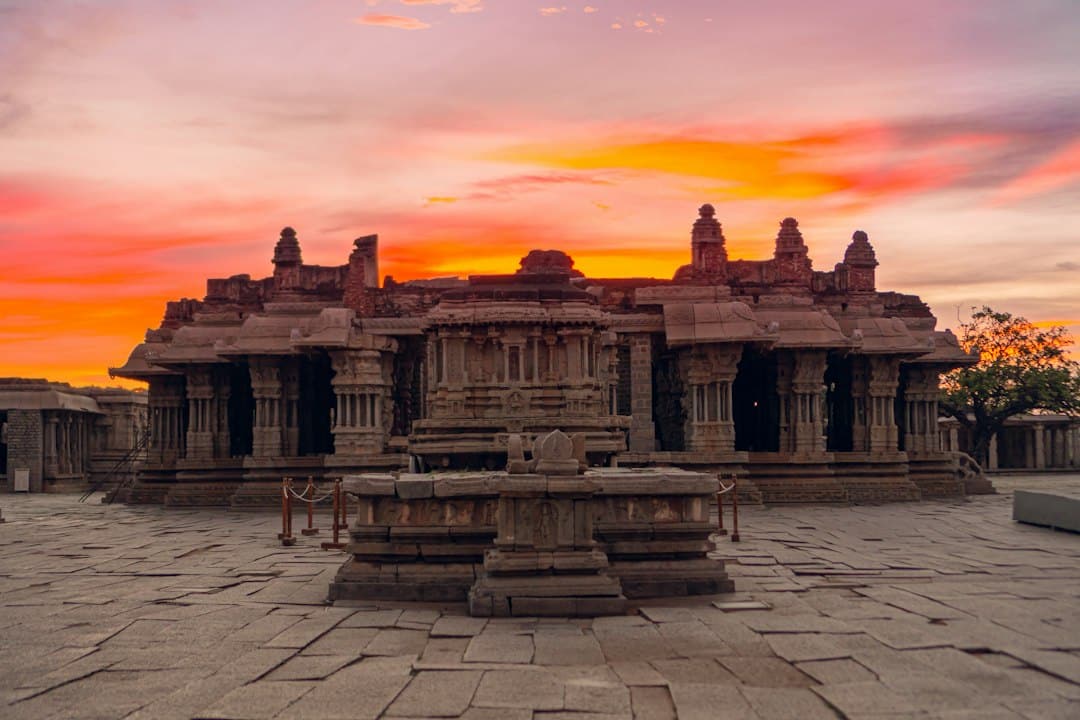
Some Indian temples do more than point toward the heavens. Their architecture can encode relationships between the Sun, seasons, directions and ritual calendars.
This does not mean every temple was an astronomical observatory. It means ancient builders could use careful orientation, openings and proportions to make celestial cycles visible within architecture.
Why direction mattered
Indian architectural traditions often gave significance to the cardinal directions. Orientation could have ritual meaning, while the direction of sunlight also affected temperature, illumination and the experience of sacred spaces.
A building can therefore be oriented for several reasons at once. Religious symbolism and practical environmental design are not mutually exclusive.
The Sun turns architecture into a clock
Because Earth rotates and orbits the Sun, sunlight changes position across the sky through the day and year. A carefully positioned doorway, window or corridor can therefore produce predictable patterns of illumination.
Ancient builders did not need mechanical clocks to recognize these cycles. Repeated observation of sunrise, sunset and seasonal changes could provide remarkably precise practical knowledge.
Calendar and ritual were connected
Traditional calendars often depend on astronomical cycles. Festivals, agricultural activities and ritual observances can be linked to lunar or solar events.
Architecture could give these abstract cycles a physical expression. A particular alignment could turn a date or season into an observable event inside a building.
Temples are not all astronomical instruments
This distinction matters. A temple may face east because of religious convention, because of a specific ritual tradition, because of local geography or because builders preferred morning light.
Finding that sunlight enters a structure on a particular day is interesting, but the alignment becomes historically meaningful only when supported by construction evidence, repeated patterns or textual and cultural context.
How researchers test an alignment
Modern researchers can reconstruct the position of the Sun at the latitude and historical date of a structure. They can compare that geometry with entrances, axes, windows and interior features.
They can then ask whether the effect is precise enough to suggest deliberate design and whether similar alignments occur across related monuments.
Why chance is a serious problem
A large building contains many possible lines, openings and sightlines. If researchers search enough combinations after the fact, some will inevitably line up with astronomical events by chance.
Strong archaeoastronomical claims therefore need clearly defined criteria, accurate measurements and evidence that the builders could plausibly have intended the relationship.
Sunlight can become a ritual experience
When a beam of sunlight enters a dark interior at a particular time, the event is not merely astronomical. It becomes sensory and social. People can see the passage of the year happening inside a sacred space.
That makes architecture a kind of calendar without numbers.
Indian temples and the sky
Across India’s diverse temple traditions, orientation, geometry and cosmological symbolism can be important. But there is no single architectural rulebook that explains every temple.
Regional styles developed under different historical and environmental conditions. Some monuments have particularly striking solar or directional relationships; others are better understood through ritual, structural and artistic priorities.
Architecture can encode knowledge without being modern science
Calling an ancient structure “scientific” can be misleading if it suggests that its builders shared modern scientific institutions and concepts.
A more useful description is that builders possessed empirical knowledge. They could observe the sky, measure directions, understand seasonal light and incorporate those observations into design.
The temple as a memory device
A building can preserve information across generations. Once a particular relationship between light, direction and ritual is embedded in architecture, later communities can experience the same pattern without recalculating it from scratch.
In that sense, architecture can become a physical memory of observations made by earlier generations.
The enduring fascination
The remarkable feature is not that ancient builders somehow possessed modern astronomy. It is that they watched the sky closely enough to integrate its rhythms into physical spaces.
A temple could become a meeting point of Sun, season, ritual and human movement—a place where celestial cycles were not merely observed, but experienced.
When Architecture Became a Calendar
Ancient Indian temples sometimes interact with the movement of the Sun in ways that make particular times of year visible through architecture. Doorways, corridors, openings and carefully oriented structures can frame sunlight at particular moments.
But identifying an alignment is only the beginning. The harder question is whether it was intentional, what astronomical cycle it represented and how confidently that interpretation can be established.
The Sun Changes Position Across the Year
The Sun does not rise at the same point on the horizon every day. Its apparent position shifts seasonally because Earth’s axis is tilted relative to its orbit. The annual extremes are associated with the solstices, while the equinoxes mark points in the year when day and night are approximately equal in length.
Architecture can turn these predictable movements into visual markers.
Direction Matters
Orientation was important in many architectural traditions for practical, ritual and symbolic reasons. A building’s direction can determine how sunlight enters a space, how it responds to heat and how its internal experience changes through the day.
That does not mean every east-facing temple was an astronomical instrument. Direction can have several meanings at once.
How an Alignment Becomes Evidence
A strong astronomical interpretation needs more than one attractive photograph showing sunlight on a statue. Researchers can examine the exact geometry, horizon profile, construction chronology, visibility from the intended location and whether the phenomenon repeats at a predictable date.
They also need to consider later repairs. A structure may have been rebuilt, extended or altered, making the present alignment different from the original one.
Calendars Were Social Systems
Calendars did more than count days. They organized festivals, agricultural cycles, ritual obligations and political life. An architectural alignment could therefore connect cosmic cycles with human schedules.
In this sense, a temple that marks a solar event is not merely displaying astronomy. It is embedding a concept of time into a social and sacred environment.
Regional Diversity Matters
Indian temple traditions developed across different climates, dynasties and religious communities. Astronomical practices therefore vary. Some buildings have demonstrable solar relationships, while claims about others remain speculative.
The safest approach is to investigate each structure on its own archaeological and architectural evidence rather than treating “ancient Indian temples” as a single technological tradition.
Architecture Makes Time Visible
The deeper fascination is that a building can become a physical model of the sky. The Sun’s movement is normally experienced as something that happens above us. An intentional architectural alignment can transform that movement into a beam of light crossing a floor, illuminating a doorway or marking a particular season.
That makes the calendar tangible: time becomes an event inside a building.
Solstices, equinoxes and architectural light
The annual movement of the Sun creates predictable extremes. Around the summer and winter solstices, sunrise and sunset reach their northernmost and southernmost positions on the horizon. Around the equinoxes, the Sun rises and sets close to due east and west.
A structure with a carefully selected axis can therefore interact with these cycles repeatedly. The geometry does not have to be mysterious. The challenge is determining whether ancient builders selected it deliberately and what cultural meaning they attached to it.
Light can mark more than a date
An alignment may identify a season, but it can also control the visual experience of a sacred image or interior space. A beam appearing in a particular location could reinforce a ritual association between a deity, the Sun and a point in the annual cycle.
That possibility is especially interesting because it connects astronomy with architecture without requiring the building to function as a scientific observatory in the modern sense.
What evidence separates design from coincidence?
Researchers can ask several questions. Is the alignment unusually precise? Does it occur on a culturally important date? Was the relevant opening visible when the building was constructed? Do other monuments from the same tradition show similar design principles?
They can also test alternative explanations. A doorway may face a particular direction because of religious convention, topography or circulation through the building. A solar effect becomes more persuasive when independent evidence points toward intentional astronomical use.
Ancient builders could use observation without modern instruments
It is easy to underestimate what repeated observation can achieve. The position of sunrise changes slowly enough to be tracked against a fixed horizon over many years. Shadows provide another way to observe the Sun’s changing altitude.
Builders did not need telescopes to notice these patterns. They needed time, measurement, practical geometry and a cultural reason to preserve the resulting knowledge.
Why modern reconstructions need caution
Many ancient structures have been repaired or partially reconstructed. A present-day alignment can therefore differ from the original design. The surrounding horizon may also have changed because of vegetation, construction or erosion.
Archaeoastronomy is strongest when architectural measurements are combined with archaeological dating, historical sources and evidence from the site’s original construction.
The broader Indian context
India’s astronomical heritage includes formal traditions of mathematical astronomy as well as practical observation of calendars and seasonal cycles. Temple architecture developed alongside these wider intellectual and religious traditions, but the relationship was not identical everywhere.
That diversity is worth preserving. It is more interesting to ask what a particular temple reveals about its own builders than to assume every monument encoded the same astronomical system.
When time becomes architecture
The most striking idea is simple: a building can make an invisible cycle visible. The movement of the Sun is continuous and abstract, but a precisely placed beam of light can turn that movement into a physical event that people gather to witness.
In that sense, architecture can become a memory of the sky—preserving observations and turning celestial rhythms into experiences shared across generations.
Curiosity Publication by Aadvik Agastya
Sources & further reading
Have a question about this topic?
Join fellow Qurons on the Quron Forum to ask questions, challenge ideas, share discoveries and explore further.
Discuss on Quron Forum