Yellowstone is often called a “supervolcano,” a term that can make the park sound like a bomb waiting to explode. The geology is genuinely extraordinary, but the science is less dramatic—and more interesting—than the popular image.
What is actually beneath Yellowstone?
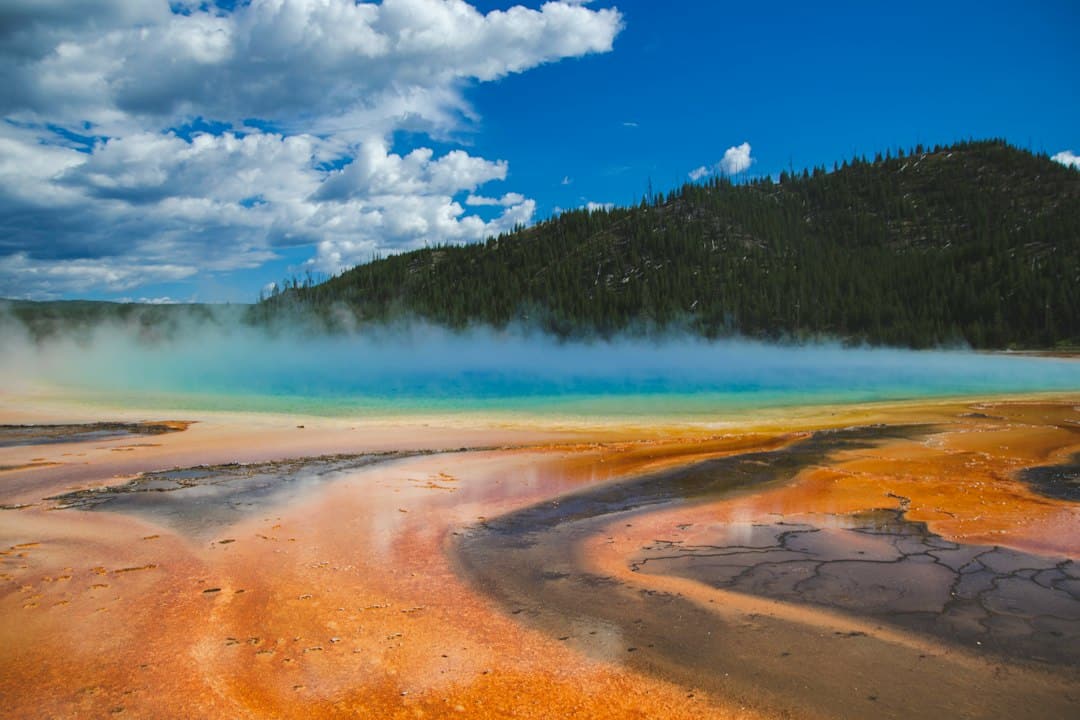
Yellowstone sits above a large volcanic system with a deep source of heat. That heat drives an enormous hydrothermal system, producing geysers, hot springs, fumaroles and other features.
The visible geothermal landscape is therefore not separate from the volcano. It is one of the ways heat and fluids move through the crust.
Why Yellowstone is called a supervolcano
The term generally refers to a volcanic system capable of producing an exceptionally large explosive eruption. Yellowstone has experienced several such eruptions in its geological history, including enormous events hundreds of thousands of years ago.
Those eruptions produced extensive deposits across parts of the western United States and altered the landscape on a huge scale.
Does a past eruption mean another one is “due”?
No. Volcanic systems do not operate like clocks.
It is tempting to calculate an average interval between major eruptions and treat that number as a countdown. But geological events do not occur according to a fixed schedule, and the interval between past Yellowstone eruptions is not a predictive timetable.
Yellowstone is active even without a giant eruption
The region experiences earthquakes, ground deformation and changing hydrothermal activity. Most of this is normal for a large active volcanic system.
Earthquake swarms can occur when fluids move through the crust. They can be scientifically interesting without implying that magma is about to erupt at the surface.
What scientists monitor
The Yellowstone Volcano Observatory and other agencies monitor seismicity, ground deformation, hydrothermal behavior and other geophysical indicators.
No single measurement provides a reliable “eruption alarm.” Scientists look for coherent changes across several independent observations and compare them with the system’s long-term behavior.
Why ground deformation matters
Inflation or deflation of the ground can occur when fluids or magma move beneath the surface. But deformation also has non-volcanic causes, including seasonal changes in groundwater and hydrothermal systems.
Interpreting deformation therefore requires context rather than treating every centimetre of movement as evidence of an impending eruption.
Earthquakes are not a countdown clock
Yellowstone experiences many earthquakes, most of them small. A swarm can attract attention because it is unusual locally, but earthquake swarms also occur in geothermal areas without leading to major eruptions.
What matters is the pattern: magnitude, depth, duration, location and relationship to other measurements.
The more immediate hazards
A giant eruption is not Yellowstone’s only geological hazard. Hydrothermal explosions can occur when heated water flashes into steam, and earthquakes can damage infrastructure.
These hazards are far more relevant to understanding the park as a living geological system than the idea of a civilization-ending countdown.
Why the supervolcano story spreads
The word “supervolcano” is memorable, and the enormous scale of Yellowstone’s past eruptions makes a compelling story. But a dramatic label can hide the difference between what happened in the geological past and what scientists can infer about present activity.
What would actually concern scientists?
A sustained and unusual change across multiple monitoring systems would deserve serious attention. Researchers would examine increasing seismicity, unusual deformation, hydrothermal changes and other signals together.
The important point is that monitoring is about detecting a change in the system’s behavior, not predicting an eruption date from a single number.
The deeper lesson
Yellowstone is a natural laboratory where heat, rock, groundwater and tectonic forces interact close enough to the surface for humans to observe them.
The scientifically interesting question is not “When will Yellowstone explode?” It is “What is the system doing now, and what evidence would show that its behavior has changed?”
That question is less cinematic—but far more useful.
Yellowstone Is Not Simply a Volcano Waiting to Explode
Yellowstone is famous because it sits above a volcanic system capable of producing very large eruptions. But describing it as a “supervolcano” can create a misleading picture of a giant mountain that is inevitably preparing for another catastrophic eruption.
Yellowstone is better understood as a complex volcanic and hydrothermal system that has experienced many kinds of activity over a very long geological history.
What Makes Yellowstone Unusual?
The Yellowstone region contains a large volcanic depression, or caldera, produced by past eruptions. Beneath it lies a magmatic system that supplies heat to the surface. That heat drives geysers, hot springs and other hydrothermal features.
The famous landscape is therefore evidence of an active geological system, even when no eruption is occurring.
Supereruption Does Not Mean Inevitable Eruption
Yellowstone has experienced enormous eruptions in the past, but geological recurrence is not a countdown clock. Volcanic systems do not behave like machines that must repeat an event after a fixed interval.
The existence of a past supereruption tells us what the system is capable of, not when such an event will happen again.
What Scientists Actually Monitor
Researchers monitor earthquakes, ground deformation, volcanic gases, hydrothermal changes and other signals. Small earthquakes are common in the region and do not automatically indicate an impending eruption.
Ground can rise or fall because magma, hydrothermal fluids and other processes move underground. Scientists therefore look for changes in several indicators together rather than treating any one unusual measurement as a prediction.
The Hydrothermal System Is Its Own Hazard
Yellowstone’s geothermal features can produce dangerous events without a large volcanic eruption. Hydrothermal explosions can occur when heated water rapidly changes pressure. These events are much smaller than a supereruption but are genuine geological hazards.
Why Supereruption Stories Spread
A potential eruption on an enormous scale naturally attracts attention, but the phrase “supervolcano” can collapse very different probabilities into one dramatic image. The scientifically important question is not simply whether Yellowstone can produce a huge eruption—it clearly has in the geological record—but what signals would indicate a significant change in the system.
What a Future Eruption Would Mean
A very large eruption would have major regional and potentially global consequences, including ash deposition and atmospheric effects. But the scale of an eruption depends on the amount and condition of eruptible magma, the eruption mechanism and other factors that cannot be inferred simply from the existence of the caldera.
The More Interesting Yellowstone Story
Yellowstone is valuable scientifically because it allows researchers to observe a living volcanic system between major eruptions. Its earthquakes, deformation, geothermal activity and geology provide a natural laboratory for understanding how magma and hydrothermal fluids interact.
The deeper lesson is that geological danger is not the same as imminent disaster. A system can be capable of extraordinary events while remaining in a comparatively stable state for long periods.
What happens between earthquakes and eruptions?
A volcanic system can change without producing a major eruption. Magma may cool, crystallize, release gases or move within the crust. Hydrothermal fluids can circulate through fractures, altering pressure and temperature. These processes can produce measurable signals even when no eruption is developing.
That is why a monitoring network is more useful than a single warning indicator. Scientists are interested in whether several independent measurements begin changing in a coordinated way.
Why Yellowstone’s magma is not one giant underground lake
Popular illustrations sometimes depict a huge chamber of liquid magma beneath the park. The real system is more complicated. Much of the magma is stored as a mixture of melt, crystals and solid rock rather than as one enormous pool of fully liquid material.
This distinction matters when interpreting seismic or deformation data. Detecting heat or partial melt does not automatically mean that an eruptible body of magma is moving rapidly toward the surface.
What is a caldera?
A caldera is a large volcanic depression that can form when an eruption removes enough magma or causes the overlying ground to collapse. Yellowstone’s calderas record several major stages in its volcanic history.
The visible landscape today is therefore the product of repeated geological processes rather than one single event. Hydrothermal features, lava flows, earthquakes and erosion continue to modify that landscape long after the largest eruptions ended.
Could scientists predict an eruption?
Volcanologists can sometimes recognize patterns that precede eruptions at particular volcanoes, especially when multiple signals change together. But prediction is not the same as assigning a precise date to a future eruption.
For Yellowstone, the practical goal is to identify meaningful changes early enough to improve scientific understanding and hazard response. Long-term monitoring also helps distinguish unusual events from the system’s normal background activity.
Why the enormous past eruptions matter
The geological record remains important because it establishes that Yellowstone has produced eruptions on very different scales. Studying their deposits allows researchers to reconstruct eruption frequency, chemistry and environmental effects.
But the past record must be interpreted carefully. A sequence of ancient events does not create a schedule for the next one. Geological history tells us about possible behavior; monitoring tells us about present behavior.
The useful way to think about Yellowstone
Instead of imagining a countdown, it is more accurate to imagine a continuously monitored geological system. Most of the time, the signals fall within patterns that scientists recognize. Occasionally, earthquakes, deformation or hydrothermal changes become unusual enough to deserve closer study.
That perspective replaces a dramatic question—“When will it blow?”—with a scientific one: “What measurable evidence would demonstrate that the system has entered a different state?”
Curiosity Publication by Aadvik Agastya
Sources & further reading
Have a question about this topic?
Join fellow Qurons on the Quron Forum to ask questions, challenge ideas, share discoveries and explore further.
Discuss on Quron Forum