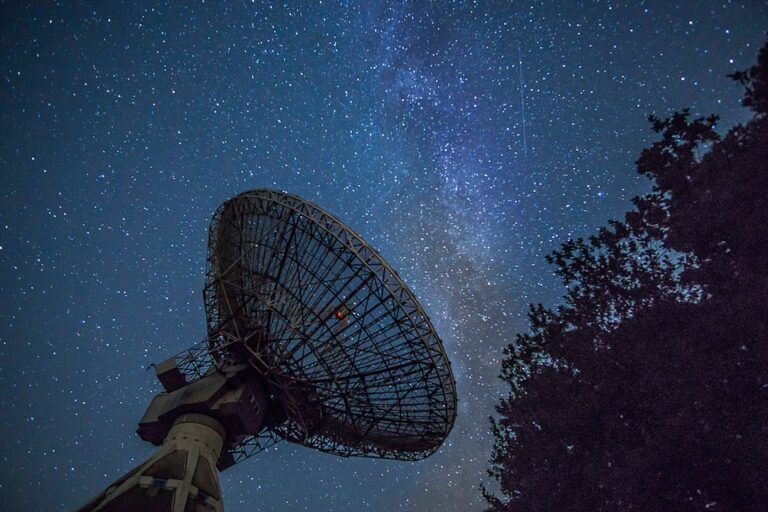
If an alien civilization exists, what would its technology look like from Earth?
We usually imagine radio messages because radio is how humans have communicated across long distances.
But an advanced civilization could leave many other traces. Astronomers call these possible clues technosignatures.
Technology changes environments
Human technology has already altered Earth’s atmosphere, night-time illumination, radio environment and energy flows.
A distant observer would not need to receive a message from Earth to suspect that something technological was happening here.
Radio remains important
Narrow-band radio signals can be interesting because many natural sources produce broader emission. A persistent, structured signal from a celestial source could therefore deserve investigation.
But radio interference and unusual natural sources can imitate interesting signatures, so confirmation is essential.
Atmospheric technology could be visible
An industrial civilization could produce chemicals that accumulate in an atmosphere.
Future telescopes may be able to examine exoplanet atmospheres in enough detail to search for combinations of gases that are difficult to explain naturally.
Artificial light is another possibility
City lights are technologically produced on Earth. Detecting comparable illumination from an exoplanet would be extraordinarily difficult, but the principle is straightforward: technology can change the light emitted or reflected by a planet.
Huge energy systems could leave infrared traces
If a civilization intercepted large amounts of stellar energy, the absorbed energy would eventually be re-radiated as heat.
Large-scale infrared emission could therefore become a possible clue, although dust and other natural sources can produce similar signatures.
Why “advanced” does not mean “obvious”
A civilization could be technologically sophisticated while using little detectable energy. It might also use technologies we do not know how to search for.
That makes technosignature research an exercise in avoiding assumptions about what aliens “should” do.
What would convince scientists?
A strong candidate would need to be repeatable, independently observed and resistant to natural explanations.
Researchers would need to establish the source, characterize the signal and demonstrate that known astrophysics cannot adequately explain it.
The deeper question
Technosignatures expand the search for life beyond the question “Did someone send us a message?”
A civilization might announce itself unintentionally simply by changing its environment.
The first evidence of extraterrestrial intelligence may therefore look less like a greeting and more like an anomaly in a dataset.
What Would Count as Evidence of Technology Beyond Earth?
A technosignature is an observable feature that could indicate the presence of technology or a technological civilization beyond Earth. The idea is broader than the familiar search for deliberate radio messages. Technology changes environments, and in principle some of those changes could be detectable across interstellar distances. The challenge is that a signal must be distinguishable from natural astrophysical phenomena.
Radio is only one possibility
Radio searches remain important because radio waves can travel enormous distances and can be produced in narrow, structured bands. A deliberately transmitted signal could potentially stand out from natural sources. But communication is only one possible signature of technology. A civilization might not be transmitting toward Earth at all.
Artificial chemicals in an atmosphere
Technology can alter planetary atmospheres. On Earth, industrial activity has produced gases that would be difficult to explain solely through natural processes. If a telescope detected a combination of atmospheric chemicals that strongly indicated ongoing industrial activity, that could become a technosignature candidate. The difficulty is demonstrating that the same combination cannot plausibly arise through geology, photochemistry or other natural processes.
Waste heat and energy use
Any civilization using substantial amounts of energy ultimately produces heat. In principle, large-scale energy consumption could therefore create an infrared signature. Searches for excessive infrared emission have been proposed as ways to identify civilizations using enormous energy resources. But stars, dust and other natural systems also emit strongly in infrared wavelengths, making interpretation difficult.
Large structures
Hypothetical megastructures could produce unusual changes in a star’s brightness or spectrum. A large engineered object crossing a star’s disk might create an unusual transit pattern. However, unusual stellar light curves have many possible natural explanations. A strange observation is therefore a reason to investigate, not automatically evidence of engineering.
Artifacts in the Solar System
A technological civilization that reached our Solar System could potentially leave physical artifacts. Searches for unusual objects, probes or debris therefore complement distant astronomical observations. The advantage is that nearby objects can sometimes be studied in much greater detail. The disadvantage is that the search space is enormous and an unusual object still requires careful natural explanations.
The false-positive problem
The central challenge of technosignature science is not simply detecting something unusual. Astronomy routinely discovers unusual phenomena. The crucial question is whether a candidate has characteristics that natural processes struggle to reproduce. Researchers therefore compare multiple wavelengths, repeat observations and independent physical models before treating an anomaly as potentially technological.
Detectability matters
Even a technological civilization may be invisible to our instruments. Its transmissions might be weak, intermittent, directional or encoded in ways we do not recognize. Its industrial activity may occur at a scale too small to detect from another star. Conversely, a civilization could be technologically advanced without deliberately broadcasting its existence. The absence of a technosignature is therefore not evidence that no technological life exists.
Why technosignatures change the search for life
Searching for life and searching for technology are related but different questions. A biosignature might indicate biological activity, while a technosignature would point toward technological activity. A future discovery could potentially provide evidence for both, but neither category has yet produced a confirmed extraterrestrial detection.
The real scientific challenge
Technosignatures turn the search for extraterrestrial intelligence into a problem of inference. Researchers must decide what technology could plausibly leave behind, whether that effect could survive interstellar travel and whether our instruments could distinguish it from nature. The most convincing discovery would not simply be strange. It would be a repeatable observation with a pattern that natural explanations cannot adequately account for.
A Technosignature Is Not Necessarily a Radio Message
The search for extraterrestrial intelligence is often imagined as listening for an intentional broadcast. Technosignatures broaden the question. A technosignature is any observable feature that could indicate technology beyond Earth, whether or not another civilization is deliberately communicating with us.
That could include unusual radio emissions, artificial-looking optical signals, industrial atmospheric chemicals, large-scale energy use or other phenomena that are difficult to explain naturally.
Why Search for Technology?
Life itself may be extremely difficult to identify from another star. A planet could contain microbes while producing little detectable change in its atmosphere. A technological civilization, by contrast, might alter its environment in ways that can travel across interstellar distances.
This does not make technology easier to detect in every case. It simply creates a different set of possible observational signatures.
Radio Signals Are Only One Possibility
Radio astronomy remains important because radio waves can travel across interstellar space and because human technology demonstrates that narrowband or structured signals can be detectable over large distances.
But radio searches face a major uncertainty: we do not know whether another civilization uses radio for interstellar communication, transmits continuously, points signals toward us, or remains active during the period when our instruments are listening.
Atmospheres Could Carry Industrial Clues
Advanced technology could potentially produce atmospheric compounds that are difficult to generate naturally in large quantities. If a future telescope detected an unusual combination of gases on an exoplanet, scientists would need to investigate both biological and geological explanations before invoking technology.
A technosignature would therefore be strongest when the observed signal is difficult to explain through known natural processes and survives detailed attempts to find alternatives.
Infrared technosignatures and the interpretation problem
Any technology that consumes energy ultimately produces heat. This has inspired searches for unusual infrared emission that might indicate large-scale energy use. The idea is physically straightforward, but the universe contains many natural sources of infrared radiation, making the signal difficult to distinguish from astrophysical backgrounds.
The Problem of False Positives
Technosignature searches face an unusual evidentiary burden. A strange signal is not automatically artificial. Pulsars, stellar activity, instrumental interference, data-processing artifacts and rare natural phenomena can all produce unexpected observations.
For this reason, confirmation matters enormously. A compelling candidate should be repeatable, independently observed when possible, geographically separated from local interference and consistent with a physical model of its origin.
What Would Count as Strong Evidence?
Evidence would become especially persuasive if a signal showed multiple independent characteristics expected from technology and could not be reproduced by known natural processes. Repeated detection from the same astronomical source would also be important.
Even then, scientists would need to distinguish a genuine extraterrestrial technology from an unknown natural phenomenon. Extraordinary claims do not require abandoning skepticism; they require unusually strong evidence.
Why Non-Detection Does Not Settle the Question
A silent sky can have many explanations. Civilizations may be rare, short-lived, quiet, difficult to detect, using technologies we have not imagined, or simply not present in the regions we have searched. Our observing windows are tiny compared with cosmic timescales.
Technosignature research therefore tests specific hypotheses rather than asking a single yes-or-no question about extraterrestrial intelligence.
The Search Is Also a Search for Our Assumptions
Looking for alien technology forces researchers to ask what technology should look like when observed from light-years away. That makes technosignature science partly an exercise in recognizing the limits of our own imagination.
The most interesting possibility may not be finding a signal that resembles human technology. It may be discovering an observable phenomenon that forces us to expand the category of what technology can mean.
Curiosity Publication by Aadvik Agastya
Sources & further reading
Have a question about this topic?
Join fellow Qurons on the Quron Forum to ask questions, challenge ideas, share discoveries and explore further.
Discuss on Quron Forum