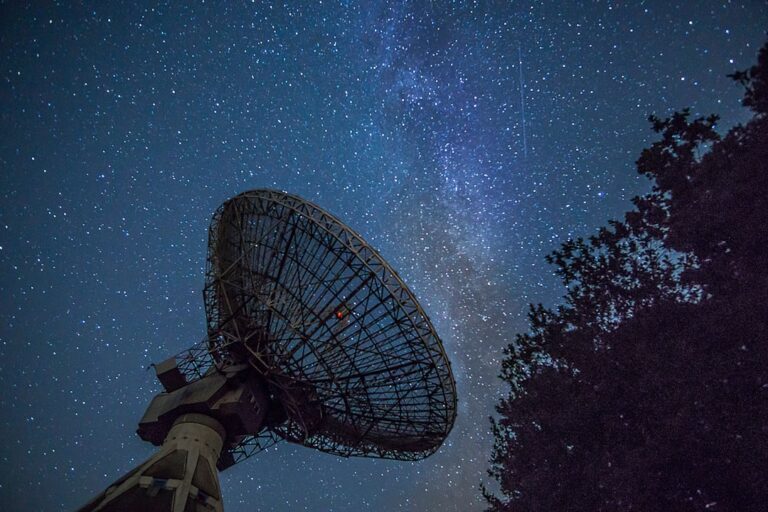
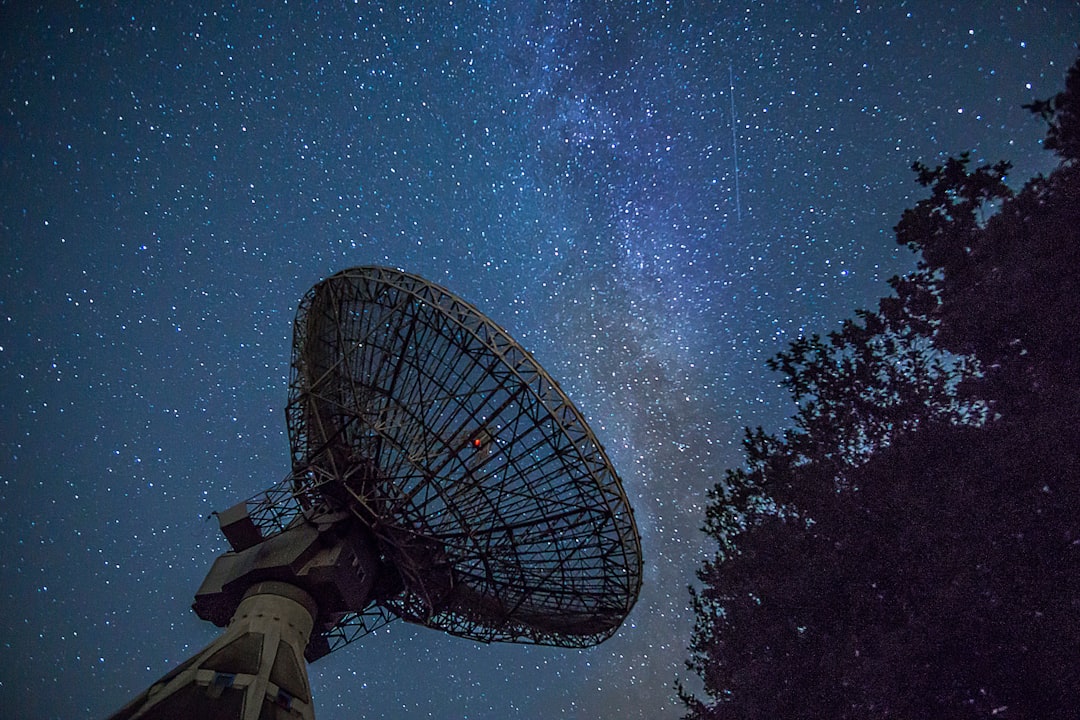
Suppose an alien civilization exists somewhere in the Milky Way.
Now suppose it never sends Earth a message.
Would that make the civilization impossible to detect?
Not necessarily.
A technologically advanced society could change its environment in ways that produce observable signals even if it never deliberately contacts another world. Astronomers call these potential clues technosignatures.
A message is only one kind of evidence
When people imagine searching for extraterrestrial intelligence, they often picture a radio transmission containing an unmistakable message.
That is only one possibility.
A civilization uses energy, builds infrastructure and interacts with its environment. At sufficient technological scale, those activities could leave detectable signatures.
The challenge is determining whether an unusual observation really requires technology or can be explained by ordinary astrophysics.
What is a technosignature?
A technosignature is an observable feature that could indicate technology beyond Earth.
Possible examples include artificial radio or laser signals, unusual atmospheric chemistry, excess infrared radiation from waste heat, or large structures that alter the light from a star.
Not every proposed technosignature is equally plausible or equally easy to detect.
The most useful searches are those in which a technological explanation produces a distinctive signal that natural processes struggle to imitate.
Radio signals
Radio astronomy has long been central to the search for extraterrestrial intelligence.
A narrow-band signal, repeating pattern or other unusual radio signature could potentially attract attention because many natural astronomical radio sources produce broad or complex emissions rather than an obviously engineered carrier.
But even here, interpretation is difficult.
Human technology produces enormous quantities of radio interference, and unusual signals can arise from satellites, instruments or terrestrial sources.
A candidate would need independent confirmation before it could be treated as evidence of an extraterrestrial transmitter.
Laser signals
Another possibility is intentional or unintentional optical communication.
A sufficiently advanced civilization could produce powerful, narrowly directed laser pulses. Astronomers could search for brief optical flashes that do not fit known natural phenomena.
Optical SETI therefore complements radio searches rather than replacing them.
Waste heat
Perhaps the most physically unavoidable technosignature is waste heat.
Any civilization using energy must ultimately release some of that energy as heat.
If a civilization harvested a significant fraction of the energy produced by its star, the resulting infrared emission could potentially become observable.
This idea is sometimes associated with hypothetical megastructures such as Dyson swarms.
Why infrared is important
A star produces enormous amounts of energy, much of it at visible and ultraviolet wavelengths.
Technology that intercepted stellar energy and later radiated that energy as heat could shift part of the system’s emission toward the infrared.
Astronomers can therefore search for stars or galaxies with unusual infrared characteristics.
The problem is that dust, disks, star formation and other natural processes also produce abundant infrared radiation.
A Dyson sphere is not the only possibility
The popular image of a civilization building a rigid shell around its star is physically and architecturally extreme.
A more realistic concept is a Dyson swarm: many independent energy-collecting structures orbiting the star.
Such a swarm would not necessarily produce a perfectly uniform signal. Its infrared output could depend on temperature, coverage, orbital distribution and the properties of the collecting structures.
Searching for technosignatures therefore does not require finding a science-fiction megastructure in a telescope image.
Pollution in an alien atmosphere
Technology can also alter atmospheric chemistry.
On Earth, industrial activity has produced molecules that would not exist at high concentrations without human activity.
If an exoplanet’s atmosphere contained a combination of gases that was difficult to maintain naturally, astronomers might investigate whether technology could explain it.
This is particularly interesting for molecules with limited natural production but potentially long atmospheric lifetimes.
The problem of false positives
Almost every proposed technosignature has a natural competitor.
Infrared excess can come from dust.
Atmospheric chemicals can be produced by geology or photochemistry.
Radio signals can come from human equipment or natural sources.
Unusual changes in a star’s brightness can arise from dust, stellar activity or complex orbital systems.
A credible detection therefore requires a process of elimination, not simply a striking image.
Could a civilization change a planet’s climate?
Large-scale technology could potentially alter atmospheric composition, surface reflectivity or energy flows.
But these effects would be extraordinarily difficult to distinguish from natural planetary processes.
A planet with an unusual atmosphere might be biologically active, geologically unusual or technologically modified. The observation alone would not tell us which.
Looking for city lights
Another proposed technosignature is artificial illumination on the night side of a planet.
In principle, a sufficiently powerful civilization could produce detectable artificial light.
In practice, resolving city-scale illumination on a distant Earth-sized planet is extraordinarily difficult. The signal would be faint, and natural reflected starlight and atmospheric effects would complicate the measurement.
It is therefore a theoretically interesting but observationally challenging idea.
Could we detect an industrial civilization accidentally?
Possibly.
A civilization does not need to want to communicate for its technology to alter its planet or surroundings.
Industrial emissions, large energy use, orbital infrastructure or waste heat could leak information into space.
That changes the philosophical question behind SETI.
We are not necessarily asking, “Who is sending us a message?”
We may be asking, “Does anything we observe require an explanation involving technology?”
What would count as strong evidence?
A convincing technosignature would ideally have several properties.
- It would be difficult to explain using known natural processes.
- It would be independently observed.
- It would repeat or remain detectable long enough to verify.
- Its properties would be consistent with a technological origin.
- Alternative explanations would be tested rather than simply ignored.
This is why extraordinary claims require more than one unusual data point.
Why repetition matters
A single unexplained signal can disappear before anyone else observes it.
A repeating or persistent signal provides opportunities for independent instruments to examine it.
Repeatability is particularly important because astronomical observations contain instrumental noise, interference and unexpected natural phenomena.
Could an advanced civilization hide itself?
Yes.
A civilization may choose not to broadcast. It may use communications that are difficult for outsiders to detect. It may minimize its energy signature. Or it may simply exist at a technological level that does not produce signals detectable across interstellar distances.
That means a non-detection does not demonstrate that intelligent life is absent.
Could we detect a civilization older than humanity?
If a civilization were millions or billions of years older than ours, its technology might look nothing like our technology.
This creates a major search problem.
Searching only for radio broadcasts assumes that another civilization uses a technology and communication strategy similar to ours.
Technosignature research tries to broaden the search beyond that assumption.
Planetary engineering
An advanced civilization might deliberately alter the climate or geography of its planet.
It might construct orbital habitats, redirect asteroids, build energy collectors or move large amounts of material.
Some of these activities could leave detectable signatures.
But the farther we move from technologies demonstrated on Earth, the more speculative the proposed signature becomes.
The problem of distance
Even a spectacular technosignature can be difficult to detect across interstellar distances.
Light spreads out. Signals weaken. Instruments have finite sensitivity. Background radiation creates noise.
And because the universe is large, an observation made today may describe a civilization as it existed hundreds or thousands of years ago.
We could theoretically detect a civilization that no longer exists.
We are searching for time capsules
Every astronomical observation is also a look into the past.
If a planet is 1,000 light-years away, the light we receive today left that system roughly 1,000 years ago.
A technosignature would therefore be a historical record.
We might discover evidence of technology long after the civilization that produced it had changed or disappeared.
Why the search is worth doing even without a message
The search for technosignatures expands our definition of what extraterrestrial intelligence could mean.
It encourages astronomers to look at planets as systems rather than merely as points of light.
It also creates new questions about planetary atmospheres, energy use, infrared emission and the boundaries between natural and artificial phenomena.
Even a null result can teach us about what kinds of technology are detectable from interstellar distances.
The civilization that never calls
Imagine that somewhere in the galaxy there is a civilization that never sends a radio message toward Earth.
We might still notice its existence if it changes its planet’s atmosphere, redirects enormous amounts of energy, builds large orbital infrastructure or produces another unmistakable technological signature.
But there is an equally important possibility: its technology may leave no detectable trace.
That means the search for extraterrestrial intelligence is not simply a search for messages.
It is a search for evidence of agency in a universe full of natural processes capable of producing astonishing patterns.
The challenge is to find the boundary between the two.
The hardest part is not detecting something strange
Astronomy regularly discovers strange things.
The difficult part is showing that “strange” means “artificial.”
That requires independent observations, careful modelling and serious attempts to explain the phenomenon without invoking extraterrestrial technology.
If humanity ever finds a convincing technosignature, the discovery will probably not arrive as a simple announcement that a telescope saw something weird.
It will arrive after scientists have tried very hard to prove that the universe could not have produced it naturally.
And if that day comes, we may not hear a message at all.
We may simply discover that somewhere, something is doing what nature alone appears unable to do.
Curiosity Publication by Aadvik Agastya
Sources & further reading
- NASA Science — Exoplanets
- NASA — Roman and exoplanet observations
- SETI Institute — Technosignatures and SETI research
Have a question about this topic?
Join fellow Qurons on the Quron Forum to ask questions, challenge ideas, share discoveries and explore further.
Discuss on Quron Forum