Europa looks like a frozen world. Its surface is dominated by water ice, crossed by cracks, ridges and reddish-brown markings, and it orbits Jupiter more than 600 million kilometers from the Sun.
Yet beneath that frozen exterior may be one of the largest liquid-water environments in the Solar System.
That possibility makes Europa extraordinary. The search for life no longer has to focus only on planets with warm surfaces and atmospheres like Earth’s. A moon can look frozen and hostile from the outside while potentially containing a deep ocean, chemical energy and a rocky seafloor below.
The crucial question is not simply “Does Europa have water?” It is whether that hidden ocean has the complete combination of water, chemistry, energy and environmental stability that life requires.
Why do scientists think Europa has an ocean?
Several independent observations point toward a liquid layer beneath Europa’s ice.
Europa’s surface is geologically young and extensively fractured. Its gravitational and rotational behavior provides information about how mass is distributed inside the moon. Measurements of its magnetic environment also indicate that a conductive layer—consistent with salty liquid water—may lie beneath the ice.
Scientists therefore have strong evidence for a subsurface ocean, although important details such as its exact depth, salinity and relationship with the ice shell remain uncertain.
Europa’s ocean is hidden under an ice shell
The ocean does not sit directly beneath a thin sheet of ordinary ice. Europa’s outer shell is a complex physical environment in its own right.
Surface cracks and ridges record stresses produced as the ice moves and responds to Jupiter’s gravitational influence. Some regions appear to have been reshaped by processes occurring within or beneath the shell.
The thickness and internal structure of the ice are important because they affect how easily material can move between the surface and the ocean.
Jupiter is heating Europa from the inside
Europa orbits Jupiter in a way that keeps it subject to powerful tidal forces. Jupiter’s gravity stretches and compresses the moon as it travels through its orbit.
Europa’s interactions with other large moons help prevent its orbit from becoming perfectly circular, allowing those tidal stresses to persist.
The mechanical energy associated with this continual flexing is converted into heat inside Europa. This process, called tidal heating, may help maintain a liquid ocean beneath the ice.
Why a liquid ocean can survive so far from the Sun
Europa receives far less sunlight than Earth. If sunlight were its only meaningful heat source, maintaining a global subsurface ocean would be difficult.
Tidal heating changes the picture. Europa is effectively warmed from within rather than relying primarily on sunlight at its surface.
This is one of the most important discoveries in modern planetary science: an environment can potentially maintain liquid water through gravitational interactions even in a region of the Solar System where surface temperatures are extremely low.
Habitability is not the same as life
This distinction is essential.
Habitability means that an environment may possess conditions compatible with life. It does not mean that life exists there.
For Europa, researchers want to know whether the ocean contains liquid water, useful chemical elements, energy sources and suitable physical conditions. Even if all of these are present, life may never have originated.
Europa could therefore be habitable but lifeless.
Water is necessary—but not sufficient
Liquid water is central to all known terrestrial biology, but life also needs chemistry and a usable energy source.
Organisms need ways to maintain themselves away from chemical equilibrium. On Earth, this can involve sunlight, organic compounds or chemical gradients produced by interactions among water, minerals and gases.
The question for Europa is whether similar energy gradients exist within its hidden environment.
Europa’s rocky interior may be crucial
Europa is not simply an ice ball surrounding an ocean. Beneath the ocean is thought to be a rocky interior.
Water interacting with rock can produce chemical reactions and alter the composition of both the water and the minerals. Under suitable conditions, those reactions can create chemical gradients that microorganisms could potentially exploit.
This is one reason astrobiologists are interested in the ocean floor as well as the ocean itself.
Earth’s hydrothermal vents provide an important analogy
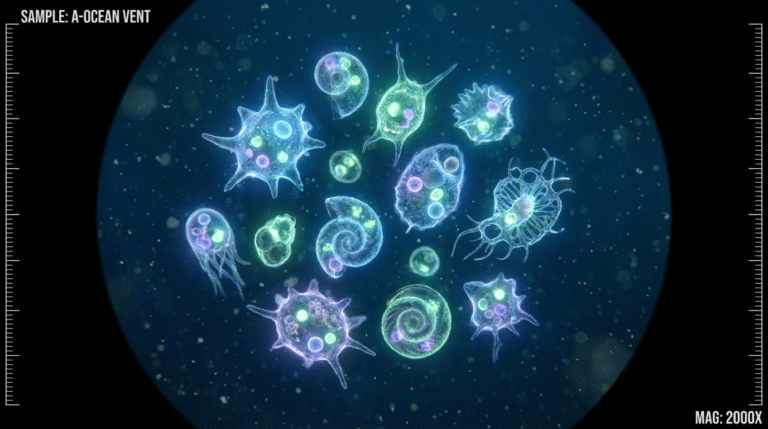
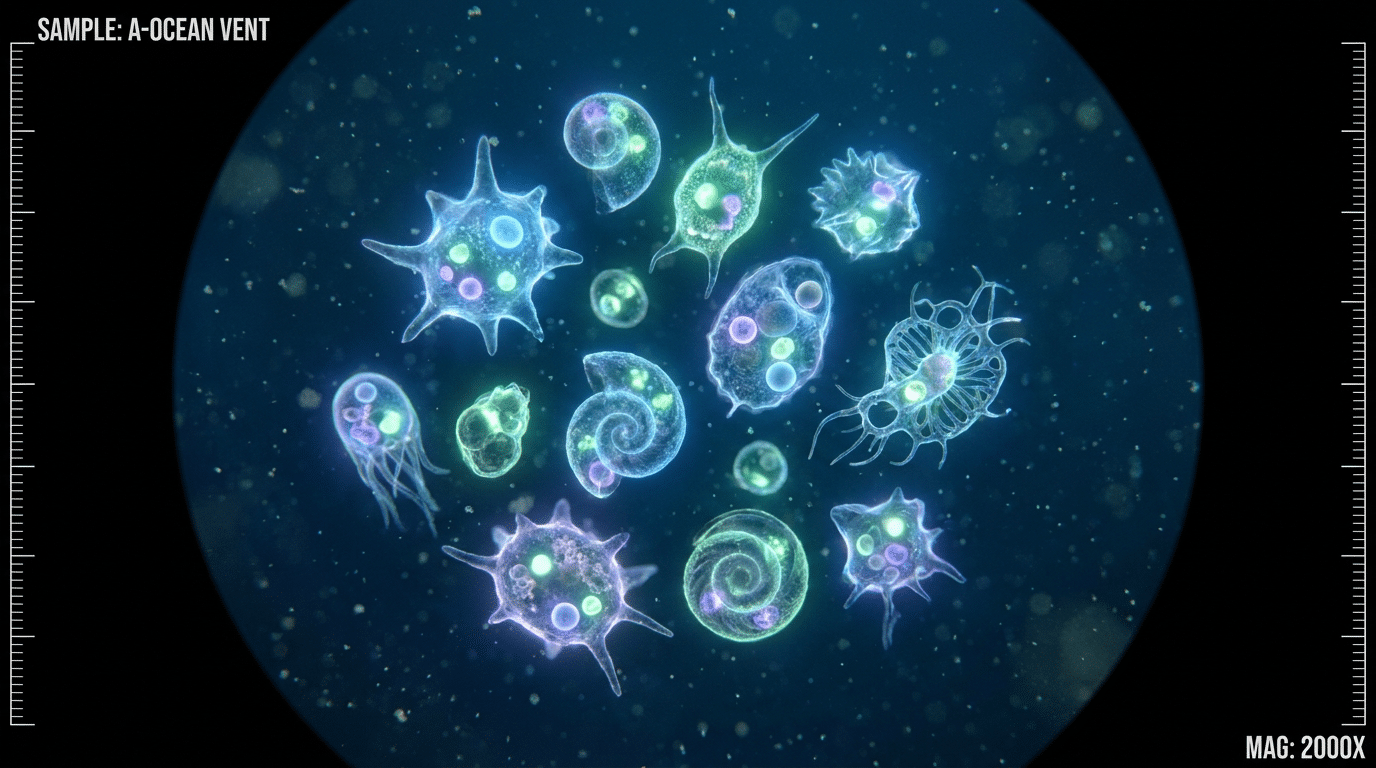
On Earth, ecosystems exist around hydrothermal vents in the deep ocean where sunlight cannot directly power photosynthesis.
Microorganisms can use chemical energy associated with the interaction of hot fluids, minerals and seawater. Larger organisms can then depend on those microbial communities.
This does not prove that Europa has life. Earth and Europa are different worlds. But terrestrial deep-ocean ecosystems demonstrate that a biosphere does not necessarily require a sunlit surface.
Could Europa’s ocean be too hostile?
Having water and energy does not guarantee a favorable environment.
Europa’s ocean may have unusual salinity, acidity, pressure and chemical conditions. The availability of nutrients and the rate at which different chemicals circulate are also important.
Scientists therefore need to characterize the complete environment rather than selecting one favorable ingredient and calling the moon “alive.”
The ice could both protect and isolate the ocean
The ice shell provides protection from the harsh radiation environment around Jupiter. That protection could be valuable for any hypothetical organisms living below.
At the same time, a thick ice shell could isolate the ocean from surface material and limit the exchange of chemicals.
This creates an important scientific question: how connected are Europa’s surface and ocean?
Could surface material reach the ocean?
Impacts, cracking and movement within the ice may transport material between different layers. If oxidized or otherwise chemically interesting material generated or altered near the surface eventually reaches the ocean, it could contribute to the ocean’s chemical inventory.
Conversely, material from the ocean might occasionally influence the surface.
If such exchange occurs, spacecraft may be able to study clues about the hidden ocean without drilling through the entire ice shell.
What would evidence of life actually look like?
Finding a single organic molecule would not establish biology. Organic chemistry can occur without life.
A convincing detection would ideally involve multiple independent lines of evidence: chemical patterns, isotopic relationships, structures or distributions that are difficult to explain through known non-biological processes.
Researchers would also need to eliminate contamination and alternative geochemical explanations.
Why “organic” does not mean “alive”
Organic molecules contain carbon and are common in many environments, including meteorites and planetary materials. Their presence can be completely non-biological.
This distinction is especially important in astrobiology because the scientific challenge is not finding interesting chemistry. It is determining whether that chemistry requires biology.
Europa Clipper is designed to investigate habitability
NASA’s Europa Clipper mission is designed to make repeated close flybys of Europa and investigate its surface, interior and surrounding environment.
The spacecraft can study the moon’s ice shell, composition, geology and interactions with Jupiter’s environment. Some instruments are intended to investigate the possible presence of materials associated with the subsurface ocean.
The mission’s scientific goal is not simply to announce “life” or “no life.” It is to determine whether Europa possesses the conditions and characteristics that make it a compelling environment for astrobiological investigation.
Why repeated flybys matter
A single observation can be ambiguous. Repeated measurements from different locations and geometries allow scientists to build a more complete picture.
Europa’s surface is not uniform, and the relationship between surface structures and the underlying ocean may vary from region to region.
Multiple passes can therefore help separate local anomalies from global properties.
Europa is difficult to explore
Jupiter’s radiation environment is intense. Spacecraft operating near Europa must be designed to withstand radiation that can damage electronics and scientific instruments.
Communication, navigation and power are also challenging at such a distance from Earth.
Landing on Europa would add another level of complexity, particularly because the surface may be hazardous and because reaching the ocean would require dealing with an ice shell whose properties are still being investigated.
Why drilling through the ice is not the immediate solution
It is tempting to imagine a spacecraft landing, drilling through the ice and dropping a probe into the ocean. In practice, such a mission would be extraordinarily difficult.
The ice may be many kilometers thick, its mechanical properties may vary, and a drilling system would need to operate autonomously under extreme conditions while maintaining communication and power.
Before attempting such a mission, scientists need to understand the ice shell and identify promising regions.
Europa changes the search for life
For much of the space age, Mars dominated discussions about extraterrestrial life because its surface can be reached and studied directly.
Europa broadened the picture.
A potentially habitable environment can exist on a world whose surface is frozen, dark and inhospitable. The important habitat may be hidden beneath kilometers of ice.
Other ocean worlds make the idea even more important
Europa is not the only icy world of interest. Saturn’s moon Enceladus also shows evidence of a subsurface ocean and has produced plumes of material into space.
Studying these worlds together could reveal whether subsurface oceans are unusual curiosities or a common type of planetary environment.
The biggest question remains unanswered
Europa may contain a huge ocean. It may contain chemical energy. It may contain conditions that are favorable to life.
None of those statements establishes that life exists there.
That uncertainty is precisely what makes the moon scientifically valuable. Europa gives researchers an opportunity to investigate whether life can arise and persist in an environment radically different from Earth’s surface.
An ocean hidden in the dark
Europa’s greatest mystery is not that it might contain aliens. It is that a frozen world orbiting a giant planet may contain an entire hidden environment beneath its surface.
If future observations reveal a chemically active ocean with the ingredients required by biology, Europa could become one of the most important natural laboratories in the search for life beyond Earth.
And if the ocean turns out to be sterile, that result would be just as scientifically valuable. It would tell us that water, chemistry and energy are not enough by themselves.
Either way, Europa forces us to reconsider what a habitable world can look like.
Curiosity Publication by Aadvik Agastya
Sources & further reading
Have a question about this topic?
Join fellow Qurons on the Quron Forum to ask questions, challenge ideas, share discoveries and explore further.
Discuss on Quron Forum