India’s lunar missions have changed what the country can ask about the Moon.
The question is no longer simply whether India can reach the lunar surface. It is what the Moon can teach us about planetary evolution, water, geology and the early Solar System.
Why study the Moon?
The Moon preserves ancient geological surfaces more effectively than Earth because it lacks plate tectonics and extensive erosion.
Its rocks therefore provide clues about the history of the Earth-Moon system and the early Solar System.
Water became a major scientific target
Orbital observations and lunar missions have provided evidence for water ice and hydroxyl-related signatures, particularly in polar regions and permanently shadowed areas.
Understanding the amount, distribution and origin of lunar water is scientifically and operationally important.
Chandrayaan changed India’s capabilities
India’s Chandrayaan missions have developed experience in lunar remote sensing, orbital operations, landing and surface exploration.
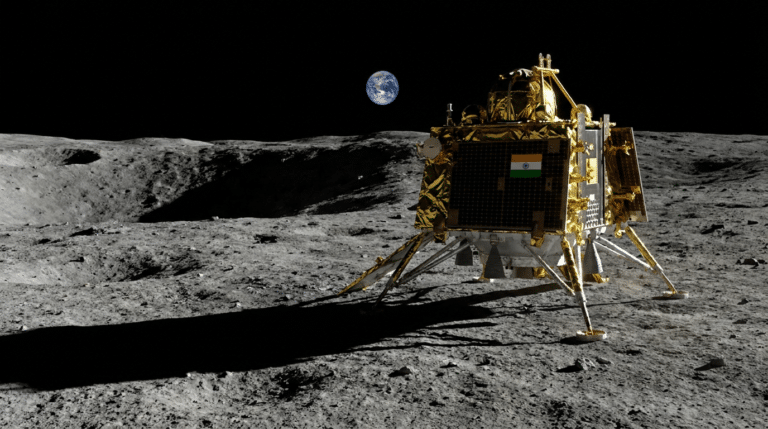
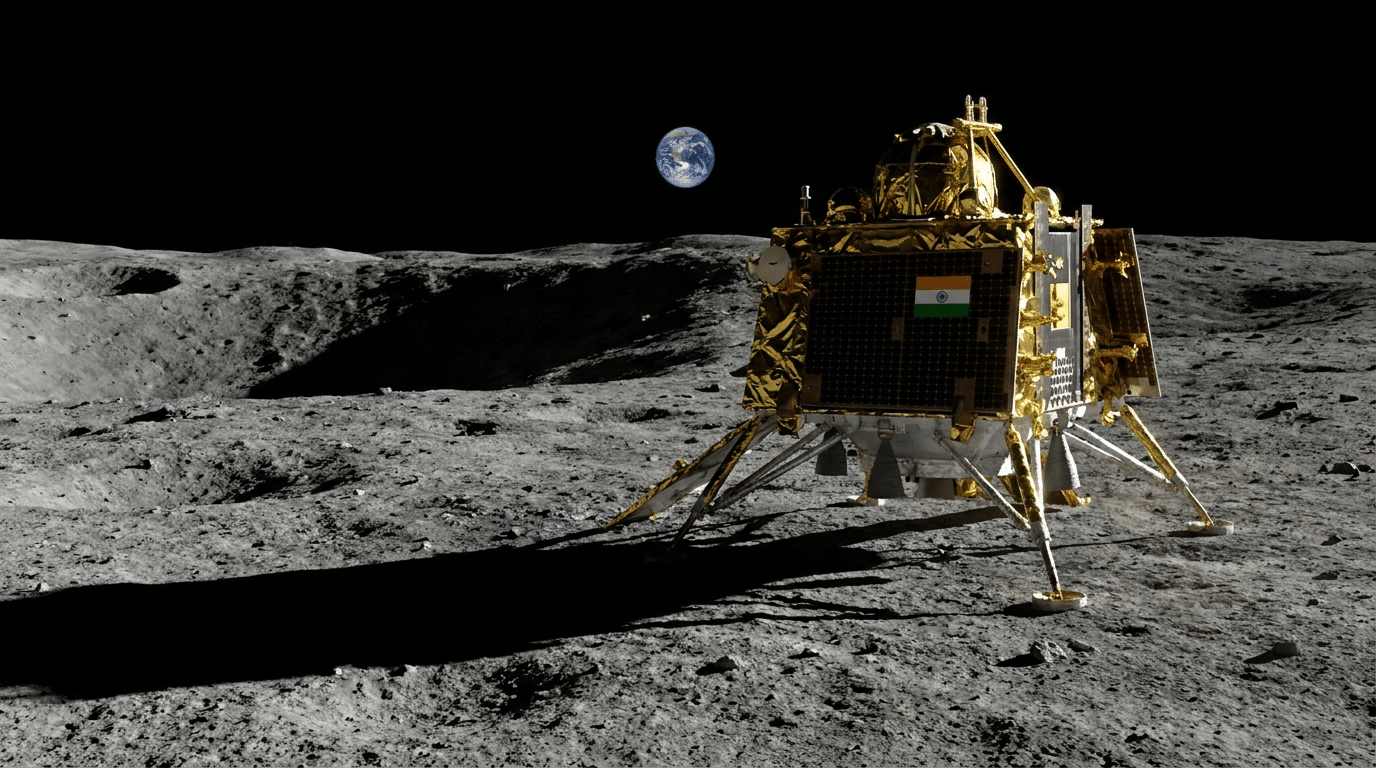
Chandrayaan-3’s successful soft landing in the lunar south polar region demonstrated capabilities that are relevant to future planetary missions.
Why the south polar region matters
Some polar craters contain regions that receive little or no direct sunlight. Temperatures can remain extremely low, allowing volatiles such as water ice to persist.
These environments are scientifically unusual and potentially valuable for future exploration.
India is also studying lunar geology
Instruments on lunar missions measure mineral composition, surface temperature, elemental abundance and other properties.
Each dataset helps build a more detailed picture of the Moon’s formation and evolution.
The deeper question
India’s lunar program is not only about national achievement.
It is part of a larger scientific effort to understand the Moon as a record of planetary history and as a nearby world where future exploration can be tested.
The Moon is close enough to visit, ancient enough to preserve clues, and strange enough to keep generating new questions.
The Moon is a geological archive
Earth constantly reshapes its surface through plate tectonics, weathering, erosion and biological activity. The Moon lacks those processes at comparable scales, so ancient surfaces can remain recognizable for extremely long periods.
That makes lunar rocks valuable records of events that affected the early Earth-Moon system.
Water is important for more than future missions
Lunar water can reveal information about how volatiles reached and moved through the Moon. Scientists are interested in whether the water arrived through impacts, solar-wind interactions or other processes and how it became concentrated in polar cold traps.
The answer has implications for planetary chemistry as well as exploration.
Why India focuses on measurement
Orbital instruments can map mineral composition, surface temperature and other properties across large regions. Landers and rovers can then make detailed measurements at selected locations.
The two approaches work together. One provides broad coverage; the other provides close-up evidence.
The Moon is a testbed for deeper space
Operations on the Moon can help engineers and scientists learn how to land, communicate, move across difficult terrain and work with limited resources away from Earth.
Those lessons matter for future exploration of Mars and other destinations, even though lunar conditions are not identical to those worlds.
What India is really looking for
The most useful answer is not a single object. India’s lunar program is investigating a collection of questions about geology, volatiles, planetary history and the practical challenges of operating on another world.
The Moon is close enough to reach repeatedly, yet ancient enough to preserve clues that Earth has erased.
The deeper value of lunar exploration
Every instrument sent to the Moon turns an idea into a measurement. Over time, those measurements allow scientists to replace assumptions with evidence.
The Moon is therefore both destination and laboratory.
What India’s Lunar Program Is Really Trying to Learn
India’s lunar missions are often discussed through the dramatic question of whether the country can reach the Moon’s south polar region. But the scientific goals are broader. Chandrayaan missions have investigated lunar mineralogy, surface chemistry, topography and the presence and distribution of water-related materials. The Moon is both a destination for engineering and a laboratory for understanding planetary formation.
Why the Moon is scientifically valuable
The Moon preserves a record of early Solar System history because it has far less geological activity than Earth. Its ancient surfaces retain impact craters and mineral signatures that can be used to reconstruct the history of collisions and planetary formation. Studying the Moon therefore helps scientists understand not only the Moon but the broader family of rocky worlds.
Chandrayaan changed the picture
India’s Chandrayaan-1 mission helped establish evidence for hydroxyl and water-related signatures on the lunar surface. Later missions have continued to investigate the Moon’s composition and environment. These findings do not mean the Moon has Earth-like reservoirs of accessible liquid water. Much of the scientifically important lunar water is associated with minerals, extremely cold regions or ice deposits in permanently shadowed areas.
Why the south pole matters
The lunar south polar region contains terrain where some crater interiors receive little or no direct sunlight. Temperatures can remain extremely low, allowing volatile substances such as water ice to persist over geological timescales. The region is therefore scientifically valuable and potentially important for future exploration.
What Chandrayaan-3 demonstrated
Chandrayaan-3 successfully demonstrated a controlled soft landing on the lunar surface and deployed the Pragyan rover near the landing region. Its instruments examined the local environment and surface materials. The mission was important not only because of where it landed but because it demonstrated the ability to conduct surface operations after landing.
Water is not the only target
Lunar exploration also studies rocks, minerals, thermal properties, seismic activity and the interaction between the surface and the space environment. Understanding these properties helps reconstruct lunar evolution. Water is especially prominent in public discussions because of its importance for future exploration, but it is one component of a much larger scientific program.
Why lunar water matters for future missions
If accessible water ice can be confirmed and characterized in useful quantities, it could eventually become an important resource for sustained lunar operations. Water can provide drinking water after processing, and its hydrogen and oxygen could potentially support propellant production. These are future engineering possibilities rather than resources already available for routine extraction.
The science and the engineering are connected
Landing in a difficult polar environment requires precise navigation, communications, thermal management and surface mobility. Scientific instruments then turn the landing into an experiment. Every successful mission therefore expands both knowledge of the Moon and experience in operating spacecraft and equipment beyond Earth.
What India is not yet claiming
Chandrayaan missions have not discovered extraterrestrial life, and finding water-related material on the Moon is not evidence of life. Nor does a successful landing mean that all lunar polar questions are solved. The quantity, physical state, distribution and accessibility of polar volatiles remain subjects of ongoing investigation.
The next questions
The most important future questions concern how lunar water is distributed, how it arrived and migrated, how the polar environment changes over time, and how safely humans or robots could work there. India’s lunar program is therefore part of a larger transition from visiting the Moon to understanding it in enough detail to conduct sustained scientific and engineering activity.
“Water on the Moon” is not one thing
Lunar water can appear in different forms. Some observations concern hydroxyl or water-related molecules associated with minerals and the surface, while permanently shadowed regions can preserve water ice. These forms have different origins, stability and practical significance. Saying simply that “the Moon has water” therefore hides several scientific questions.
Researchers want to know not only whether water exists, but how much is present, where it is concentrated, how deeply it is buried, how stable it is and how the lunar environment changes it. Those distinctions matter for both planetary science and any future resource discussion.
One landing site cannot represent the whole Moon
A rover can make extremely detailed measurements, but it samples a tiny area compared with the lunar surface. Orbital instruments provide the opposite advantage: broad coverage, often at lower spatial resolution. The two approaches are complementary rather than interchangeable.
A measurement made at one location can reveal local geology while raising questions about how representative that site is. Mapping across the Moon can reveal regional patterns while leaving uncertainty about what those materials are actually like at ground level. Repeated missions gradually connect the two scales.
The south pole is scientifically difficult for a reason
Low Sun angles, deep shadows and extreme temperature differences make polar operations challenging. Some crater interiors remain dark for very long periods, while nearby elevated terrain can receive sunlight for much longer. This unusual lighting environment affects navigation, thermal design, communications and the preservation of volatiles.
That difficulty is part of the scientific opportunity. The polar environment preserves conditions that are uncommon elsewhere on the lunar surface and may retain material from different stages of the Moon’s interaction with its space environment.
From a landing to a longer scientific story
Chandrayaan-3 demonstrated surface operations, but lunar science is cumulative. Future orbiters, landers, rovers and sample-return missions can test whether observations made at one location represent wider regional processes. Each mission narrows uncertainty and creates better questions for the next.
The larger story is therefore not simply that India reached the Moon. It is that the Moon is gradually becoming measurable at multiple scales—from global maps to local rocks—and those measurements are turning an ancient celestial neighbor into a detailed scientific record.
The Moon is a record of the early Solar System
Unlike Earth, whose surface is continually reshaped by erosion, plate tectonics and biological activity, much of the Moon preserves ancient geological evidence. Craters, rock compositions and surface deposits provide clues about events billions of years old. For India, lunar exploration is therefore about more than reaching another world: it develops the instruments and expertise needed to investigate planetary history.
Water changes the strategic value of the Moon
Water ice in permanently shadowed polar regions is scientifically and operationally important. If confirmed and accessible in useful quantities, water could potentially provide hydrogen and oxygen after processing. That possibility must be separated from the claim that the Moon contains easily accessible reservoirs; concentration, depth and extraction difficulty remain engineering questions.
Why the south polar region attracts attention
Lunar poles contain terrain with unusual illumination patterns. Some crater interiors remain in permanent or near-permanent darkness, while nearby ridges can receive sunlight for unusually long periods. These environments create both scientific opportunities and operational challenges.
India is building capability
Each Chandrayaan mission has expanded a different part of India’s lunar capability, from orbital remote sensing to controlled landing and surface operations. The scientific return matters, but so does the engineering knowledge required to make increasingly complex missions possible.
The next questions are harder
Future exploration can investigate polar volatiles, poorly studied geology and how lunar materials behave under extreme temperature cycles. Those questions move the conversation from “Can we reach the Moon?” toward “What can we reliably learn and eventually do there?”
Curiosity Publication by Aadvik Agastya
Sources & further reading
Have a question about this topic?
Join fellow Qurons on the Quron Forum to ask questions, challenge ideas, share discoveries and explore further.
Discuss on Quron Forum