QuroPedia investigation. A particle proposed to rescue conservation of energy became detectable only when physicists learned to listen for two tiny signals separated in time.
The machine was built to hear something that almost never speaks
In 1956, beside a nuclear reactor at the Savannah River Plant in South Carolina, a small group of physicists tried to detect a particle that could cross the Earth without noticing it. Their apparatus was not a telescope pointed at the sky. It was a carefully arranged collection of water, scintillating liquid and light sensors, built to recognise two flashes in a particular order. If the flashes arrived with the right delay and became more frequent when the reactor was operating, the researchers would have a compelling answer to a question that had troubled physics for a quarter-century: was the neutrino real, or merely a mathematical rescue device? The extraordinary part of the story is not that the instrument registered radiation. Instruments near reactors do that all the time. It is that the team found a way to distinguish one extremely rare interaction from a noisy environment in which almost everything else could masquerade as a signal.
A missing piece in an apparently balanced equation
The puzzle began with radioactive beta decay. When certain unstable nuclei changed into other nuclei, an electron emerged, but its energy did not always take the value expected from a simple two-body event. Rather than abandon energy conservation, Wolfgang Pauli proposed in 1930 that another, electrically neutral particle was escaping with some of the energy and momentum. Enrico Fermi subsequently developed a quantitative theory of beta decay and helped establish the name neutrino. This was not a sighting: it was a proposal that made a stubborn experimental pattern intelligible. A theorist can propose an invisible participant to reconcile measurements; a laboratory must then show that the participant has consequences no simpler explanation accounts for. For years the predicted interactions were so improbable that even a brilliant hypothesis risked remaining beyond experimental reach.
Why a reactor, not a mountain of patience?
The obvious obstacle was the weak interaction. Neutrinos ordinarily pass through material with a vanishingly small chance of striking anything. Simply increasing detector size was not enough: a bigger apparatus also catches more unwanted radiation. Cowan and Reines initially investigated a detector near the Hanford reactor, but cosmic-ray backgrounds complicated the measurements. The move to Savannah River brought a more suitable combination of intense reactor-produced antineutrinos and shielding. The Department of Energy’s historical chronology identifies the P Reactor as the site of the 1956 confirmation. In effect, the researchers did not make the neutrino more cooperative. They placed their experiment beside an immense source and designed a signature sufficiently peculiar that ordinary noise would struggle to imitate it. The distinction matters: discovery can be an achievement of experimental design rather than a sudden increase in the strength of the phenomenon itself.
The two-flash fingerprint
The underlying reaction is called inverse beta decay. A reactor electron antineutrino can interact with a proton, producing a positron and a neutron. The positron quickly encounters an electron; their annihilation yields gamma rays that can trigger an initial light signal. The neutron takes longer to slow and be captured, and cadmium in the target increases the chance that capture will produce another detectable gamma-ray burst. That delayed second signal is the key. A single flash could be almost anything. Two flashes with a characteristic relationship in time and energy are harder to explain away. The detector used a target containing cadmium-loaded water, watched by scintillation counters. The famous result was not a photograph of a neutrino: it was a statistical excess of the right paired events, backed by controls. Calling this a direct detection means an interaction attributable to the particle was observed, not that anyone watched an individual neutrino travel across a screen.
What the 1956 paper actually established
The short report by Clyde L. Cowan Jr., Frederick Reines, F. B. Harrison, H. W. Kruse and A. D. McGuire appeared in Science in July 1956 under the title “Detection of the Free Neutrino: a Confirmation.” It reported an interaction rate compatible with the expected weak-process cross section. The essential comparison was between the predicted coincidence pattern and measured counts, with reactor-related changes helping isolate the signal. The result strengthened a theory that had previously explained missing energy but lacked this kind of direct experimental confirmation. It did not prove that every property of the neutrino was understood. Indeed, decades later physicists would discover neutrino oscillations and establish that neutrinos have mass, revising the earlier simplest picture. A decisive experiment can settle one question while making the next generation of questions more precise.
An ordinary-looking background can defeat a spectacular claim
Imagine a hospital monitor that beeps whenever it detects any electrical disturbance. More beeps would not necessarily mean more heartbeats. To infer a heartbeat, the monitor must recognise a characteristic waveform and rule out interference. Cowan and Reines faced an analogous problem at a vastly smaller physical scale. Cosmic rays, ambient radioactivity and electronics could all produce activity in a detector. Delayed coincidence supplied a pattern; shielding and reactor-on/reactor-off comparisons supplied tests. The inference rests on the combination, not on a single dramatic event. This is why describing the discovery merely as ‘scientists detected three particles an hour’ misses its intellectual achievement. Counting becomes persuasive only after the experiment explains why those counts belong to the proposed phenomenon and not to its competitors.
The people behind the familiar two-name discovery
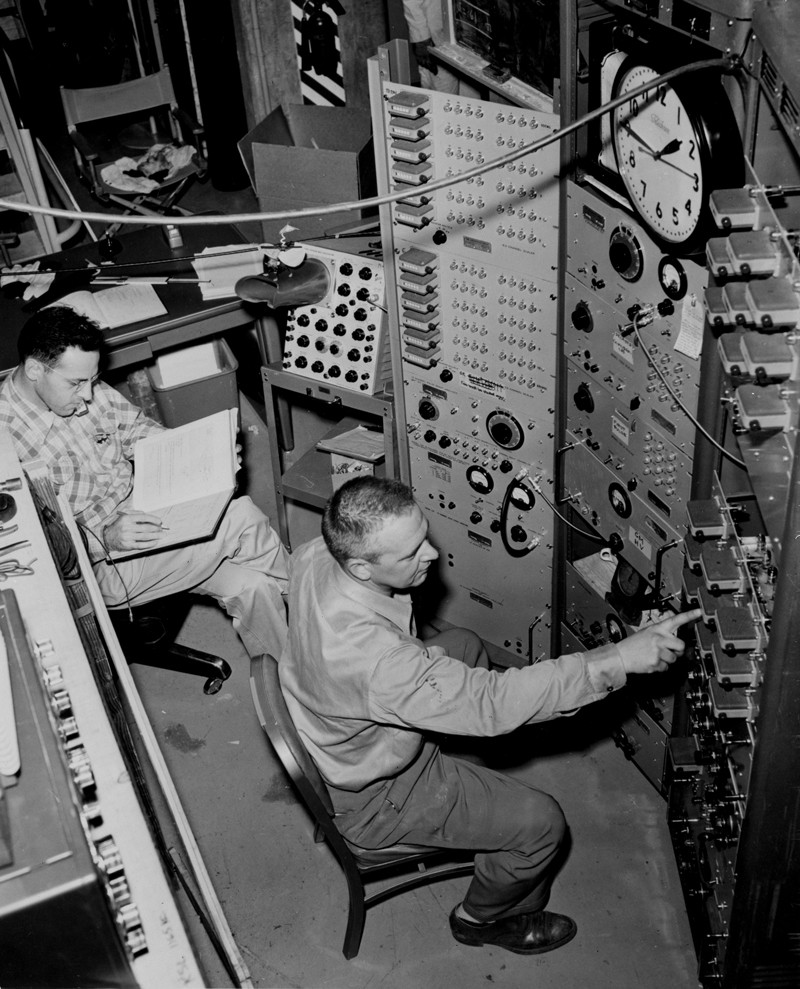
The discovery is commonly called the Cowan–Reines experiment, but the 1956 paper lists five authors. That distinction is worth preserving because complex instruments are collective work. Reines received a share of the 1995 Nobel Prize in Physics for detecting the neutrino; Cowan had died in 1974 and could not receive a posthumous Nobel. The Nobel citation identifies the achievement precisely, but an award ceremony is not the same as a complete record of experimental labour. The apparatus required chemical preparation, electronics, calibration, shielding and interpretation. Treating the result as a single inspired thought would erase the practical chain that made the theory testable. A photograph of Cowan and Reines at the controls records a real experimental setting; it does not show the elusive particle itself.
The experiment’s legacy was a method, not just a verdict
The strategy of looking for rare, correlated signals helped establish the broader craft of neutrino detection. Later experiments used different sources, targets and scales: solar neutrinos, atmospheric neutrinos, accelerator beams and reactors each answer different questions. Modern neutrino research is no longer confined to asking whether these particles exist. It investigates how their types change during travel, what their masses imply, and whether neutrinos and antineutrinos behave differently in ways relevant to the matter-dominated universe. The US Department of Energy describes the Deep Underground Neutrino Experiment as part of this continuing programme. Such projects should not be presented as mere enlarged copies of the 1956 apparatus. Their detectors and physics goals differ substantially. What connects them is the logic of constructing a trustworthy signature from events that are otherwise buried in background.
What later evidence changed—and what it did not
The 1956 result supported the existence of the electron antineutrino and its interaction with protons. It did not establish the full three-flavour picture or neutrino masses. Later discoveries of multiple neutrino flavours and flavour oscillation expanded the theory. The distinction is an antidote to a common error in popular science: assuming that a famous historical experiment contained all the implications that later research revealed. Reines and Cowan did not measure the modern oscillation parameters. Their achievement was more focused and, for that reason, more impressive. They made a particle that was previously inferred from missing energy show up through a reproducible physical consequence. When new evidence modifies the surrounding framework, it need not diminish the original finding.
An Indian connection without pretending the experiment happened in India
For readers in India, the story also offers a useful way to think about ambitious physics infrastructure. Detecting rare particles requires not only theoretical brilliance but low-background sites, reliable instrumentation, long calibration periods and institutions willing to support a measurement that might initially return only noise. Those are general lessons for any country planning advanced scientific facilities. It would be inaccurate to treat the Savannah River result as an Indian discovery, or to imply that every underground laboratory pursues identical neutrino questions. The relevant connection is methodological: strong research ecosystems need engineers, technicians, data analysts and experimental physicists working together, often for years before a result can be communicated confidently. The glamour of the discovery sits on top of an infrastructure of patience.
The more surprising lesson: invisibility can be measured
The neutrino was not made visible in the everyday sense. The team instead found a trace whose timing, rate and dependence on the reactor could be explained by the proposed particle. This is how science often reaches beyond human senses. We do not directly see a gravitational wave stretching space with our eyes, and we do not observe an atom’s electronic state as a miniature coloured ball. Instruments translate otherwise inaccessible interactions into patterns, and researchers test whether those patterns withstand alternative explanations. The danger is to mistake a persuasive visual metaphor for the evidence itself. A detector image tells us where the experiment occurred; the evidence lies in the controlled measurements. A good scientific account keeps the distinction clear.
A quiet result with a loud implication
There was no single cinematic flash announcing that Pauli’s particle had been found. There was a detector that produced a faint excess of paired signals, and a team that knew how to interrogate that excess. The result changed physics because it moved the neutrino from an explanation that worked on paper to an object that experiments could study. That is a deeper kind of discovery than simply adding another name to a catalogue. It changes what questions can be asked next. The most enduring lesson from Savannah River is that nature’s least cooperative messengers can still be questioned—provided the experiment is built to recognise a meaningful answer rather than merely to collect more noise.
Sources and evidence trail
These sources support the historical chronology, detector principle, Nobel recognition and subsequent developments. They are not interchangeable: the 1956 report is the primary experiment; the later institutional accounts provide historical and modern context.
- Cowan et al., Science (1956), DOI 10.1126/science.124.3212.103
- US Department of Energy, Savannah River Site history
- Nobel Prize in Physics 1995, official citation
- Fermilab historical account of neutrino detection
- US Department of Energy, Digging into Neutrino Research
- US Department of Energy, Mary Bishai on neutrino history (2026)
Image note: The historical photograph of Reines and Cowan shows the experimenters at the apparatus; it does not depict a neutrino.
Have a question about this topic?
Join fellow Qurons on the Quron Forum to ask questions, challenge ideas, share discoveries and explore further.
Discuss on Quron Forum