How can a river of ice suddenly race forward? A glacier surge is a dramatic change in flow, not necessarily a sign that a glacier is gaining ice. Understanding the difference reveals the hidden mechanics of frozen landscapes.
Ice moves even when it looks still
A glacier is not a solid block frozen in place. Gravity drives it downhill through internal deformation and, in some settings, sliding over its bed. A glacier can keep moving forward even while its terminus retreats because melting removes ice faster than flow delivers it. This distinction matters when interpreting a sudden advance.
What is a surge?
The National Snow and Ice Data Center defines a surging glacier as one that experiences a dramatic, periodic increase in flow speed. Some surge-type glaciers move ten to a hundred times faster than their usual rate during an active phase. Ice can be transferred rapidly from an upper reservoir to lower reaches, sometimes advancing the glacier front.
Why can speed change so much?
Friction and resistance at the glacier bed are central to the problem. Meltwater can reach the bed through cracks or form under pressure, helping ice slide. Soft, water-rich sediment can also deform. However, glaciers differ in their temperature, geometry and geology, so a single explanation should not be applied to every surge.
The build-up and release cycle
Some glaciers spend long periods moving relatively slowly while ice accumulates upstream. During a surge, a large amount of that stored ice moves downhill. The system can then return to a quieter phase. Cycles vary widely and are not precise clocks. A surge is better understood as a flow instability than as a glacier suddenly deciding to move.
Where surges occur
Surge-type glaciers are especially studied in Alaska, Iceland, Svalbard and parts of High Mountain Asia, including the Karakoram. This makes the phenomenon relevant to readers in India and Pakistan, but it should not be confused with the entire Himalayan glacier story. Neighbouring glaciers can respond differently because bed conditions and geometry differ.
A surge is not proof of glacier growth
A terminus can move forward because ice is being redistributed, even while the glacier loses mass overall. Conversely, a retreating terminus does not mean ice has stopped flowing. To understand climate change, scientists need long-term measurements of accumulation, melt and mass balance rather than a single striking satellite image.
How researchers recognise a surge
Repeated satellite images can reveal displacement of crevasses and surface features, while field instruments measure flow speed and thickness. Scientists compare records across seasons and years and examine changes in water drainage or basal conditions. An unusually fast movement is not enough on its own; the wider pattern matters.
The 1986 night when a glacier briefly redrew Alaska’s coastline
In May 1986 the advancing Hubbard Glacier closed the entrance to Russell Fiord near Yakutat, Alaska. An inlet connected to the sea had become an enclosed lake. Water from melting snow and ice accumulated behind the dam throughout the summer. This was not a hypothetical hazard: a contemporary US Geological Survey investigation recorded a roughly 34-mile-long lake, with the water level eventually rising about 83 feet above sea level. On 8 October the ice dam failed. Water rushed back towards the sea and the lake level returned close to its former tidal level within roughly a day.
Notice the chain of events. First came the changing geometry of a moving mass of ice; then an obstruction across a water outlet; then months of accumulating water; finally, a breach. These are distinct processes, with distinct measurements and warning signs. The USGS used lake-level observations to understand the evolving risk, while later satellite comparisons offer readers a visual way to follow the change in shoreline. This is what scientific investigation adds to a dramatic photograph: dates, measurements, a mechanism and an account of what happened after the image was taken.
The Hubbard example also prevents a common error. An advancing ice front is not proof that every glacier in the region has gained mass, nor is every advance identical in cause. Glaciologists must distinguish a local terminus position from flow speed, internal ice transfer and long-term mass balance. In this case, the USGS’s 1986 water report documents the damming and lake release, and USGS Earthshots supplies a satellite-image chronology. The observable event is powerful precisely because each link in the story can be checked.
When rapid ice becomes a hazard
A surging glacier may block a river or fjord, creating temporary water storage and the possibility of flooding if a barrier fails. NSIDC describes the Hubbard Glacier in Alaska moving rapidly in 1986 and damming Russell Fjord. Risk depends on local topography, water supply and the stability of the ice barrier, not merely on the word surge.
What scientists still debate
Researchers distinguish mechanisms involving basal water pressure, sediment deformation, thermal changes and the way stress redistributes through ice. These mechanisms can interact, and their importance varies between glaciers. There is no universal trigger that allows every surge to be predicted accurately years in advance.
Why the base of a glacier matters more than its surface appearance
To explain a surge, begin with the contact between ice and the ground. Ice may deform internally as its crystals slowly change shape, but an important part of movement can also occur at the bed. Water pressure, whether the bed is frozen or thawed, and the strength of sediment beneath the ice all influence how strongly the glacier is held back. A glacier can therefore look unchanged from a distant ridge while the conditions governing its motion evolve far below view. If resistance decreases over a wide area, more ice can move downhill without any corresponding sudden increase in snowfall.
The distinction between ice deformation and basal motion also explains why there is no single speed rule for every glacier. A thick cold glacier resting on solid rock behaves differently from one sliding over deformable, water-rich sediment. Even neighbouring glaciers may have different thermal structures, drainage routes and responses to seasonal melt. Surges are best understood as particular kinds of instability within that varied physical system, not as an ordinary glacier merely moving on a warm afternoon.
The Karakoram offers an important South Asian example
High mountains around the Karakoram contain numerous surge-type glaciers, making them especially important to readers in South Asia. In a detailed satellite and literature study, Copland and colleagues identified 90 surge-type glaciers in the range and described telltale signs such as looped moraines, crevasse patterns, strandlines and abrupt movement at glacier fronts. Their findings show why a single photograph or one year’s glacier-length measurement can miss a longer sequence of accumulation, release and adjustment.
Another investigation by Quincey and colleagues used satellite-based feature tracking to examine five Karakoram glaciers. They found that the onset and development of surges differed between glaciers and that measured peaks could be tens of times faster than quiet-period motion. The researchers interpreted the examined cases as being more consistent with thermal controls than a simple hydrological trigger. This is not proof that all Karakoram surges, or surges elsewhere, work identically. It demonstrates how careful observation can separate competing physical explanations.
How scientists see movement without standing on the ice
Modern satellite imagery lets glaciologists follow the same patterns in ice or debris between successive images, estimate displacement and produce maps of surface velocity. Height measurements can help reveal whether ice is thinning in an upper reservoir while thickening or advancing farther down the valley. Radar can be especially useful where clouds make ordinary photography unreliable. In the field, GPS instruments and weather measurements add detail about daily or seasonal changes, although operating instruments in remote mountain valleys presents logistical and safety challenges.
None of these measurements alone answers every question. A terminus moving forward could reflect transferred ice, altered melting or other effects. A photograph of a crevasse pattern suggests deformation but cannot quantify its cause. Researchers build a stronger explanation by comparing speed, surface elevation, mass balance and drainage observations over time. That combination is why scientific understanding of an individual surge can develop gradually even after dramatic movement is first noticed.
Climate change and surge dynamics are related—but not identical questions
A warmer atmosphere can affect melting, snowfall, water delivery to the glacier bed and the long-term amount of ice stored in a mountain range. Those influences might alter when some surges happen, but the response depends on the glacier’s physical structure. A surge can occur during a period of overall mass loss, and a retreating glacier can still contain fast-moving ice. Conversely, advance during an active phase cannot be used as standalone evidence that regional warming has stopped. The relevant questions are how much ice remains, how that mass changes over years, and how quickly it is redistributed.
For communities downstream, the hazard question is practical: does accelerated motion affect an ice-dammed lake, a road, a bridge, or the stability of a neighbouring slope? Site-specific monitoring and risk communication are more useful than declaring all fast-moving glaciers either harmless spectacles or imminent disasters. The scientific lesson is that sudden ice movement deserves attention without sensationalising its cause.
Additional primary research: Copland et al., glacier surging in the Karakoram; Quincey et al., Karakoram glacier surge dynamics. These studies describe particular observational periods, not a forecast for every glacier.
The bigger lesson
Glaciers operate on several time scales: daily flow, seasonal meltwater changes, multi-year instabilities and long-term climate trends. Headlines that treat all motion as evidence for or against warming confuse different processes. A sudden rush of ice tells us something about how glaciers move; it does not, by itself, settle how much ice Earth is losing.
What the evidence supports
- Glaciers move under gravity even while retreating.
- Some glaciers periodically accelerate by an order of magnitude or more.
- Basal water, sediment and ice dynamics can contribute, but mechanisms vary.
- Surging does not prove positive long-term mass balance.
Sources
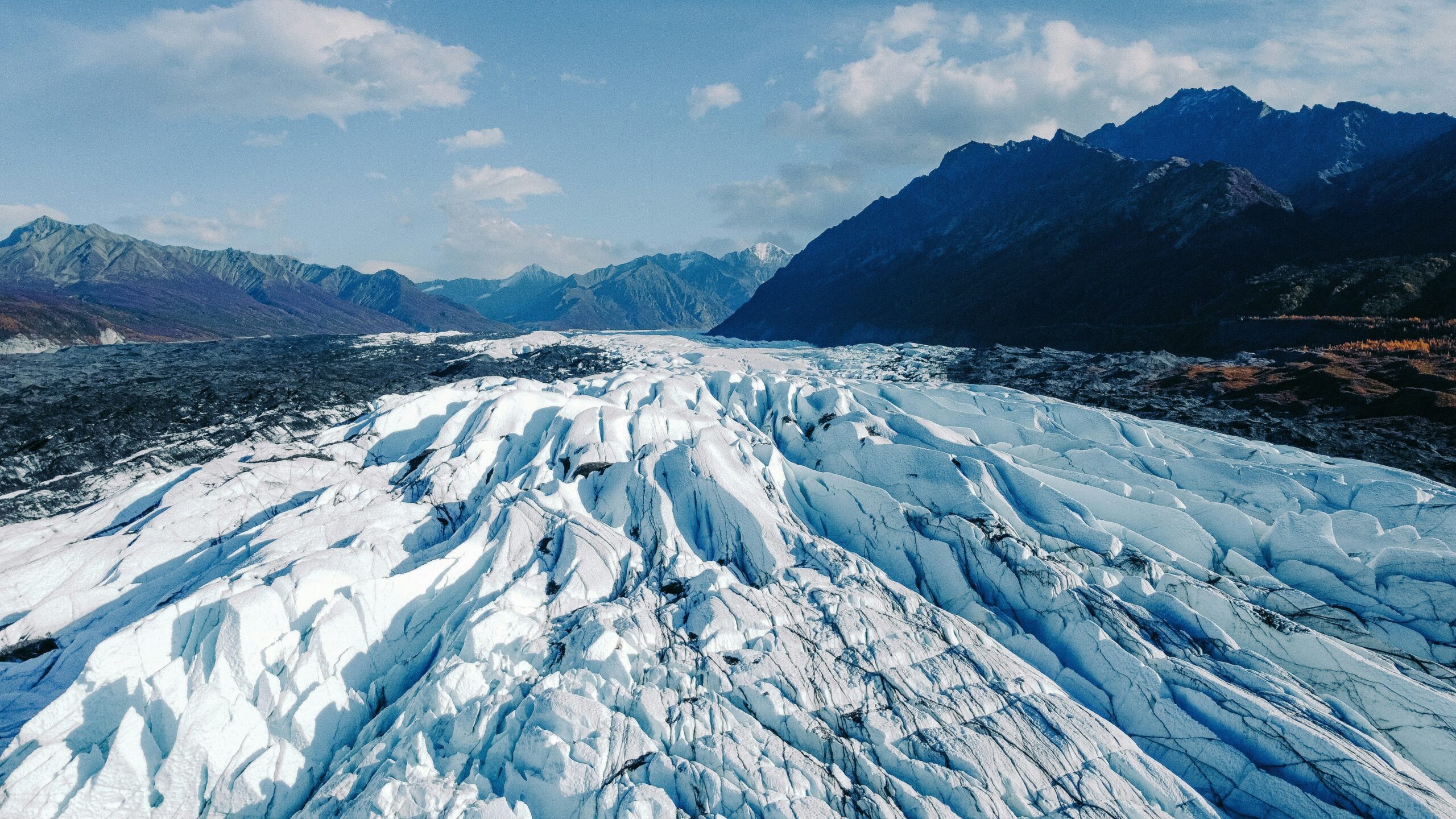
Illustrative glacier photograph: Colin + Meg / Unsplash; not a documented surge event.
Have a question about this topic?
Join fellow Qurons on the Quron Forum to ask questions, challenge ideas, share discoveries and explore further.
Discuss on Quron Forum