
Imagine two identical clocks. One remains at sea level. The other is carried to the top of a mountain. They are synchronized, separated, and later brought back together.
Would they still show exactly the same time?
According to Einstein’s general theory of relativity, no. The clock that spent more of its journey farther from Earth’s gravitational field will have accumulated a slightly different amount of elapsed time.
The difference is tiny in ordinary situations, but it is real and measurable. Near an extremely compact object such as a black hole, the effect can become enormous.
This is gravitational time dilation: the fact that clocks at different gravitational potentials do not necessarily accumulate the same amount of time between events.
Gravity changed what “time” means
Before Einstein, it was natural to imagine time as a universal background. A second was a second everywhere, regardless of where the clock happened to be.
Special relativity had already shown that motion changes the relationship between elapsed times measured by different observers. General relativity went further by incorporating gravity into the geometry of spacetime.
In Einstein’s picture, mass and energy influence the geometry of spacetime, and objects move through that geometry. Time is not separate from this structure. It is one of its dimensions.
That means gravity does not merely pull objects through space. It changes the geometry in which clocks and objects exist.
What does “time slows down” actually mean?
The phrase is useful, but it can easily create the wrong mental picture.
Suppose you are standing on Earth while another person is in a spacecraft at a different gravitational potential. Your own heartbeat, watch and thoughts feel completely normal. The other person’s clock also feels completely normal to them.
Neither person experiences their own time as malfunctioning.
The difference appears when the clocks are compared. Relativity predicts that the amount of proper time accumulated along their different paths through spacetime can differ.
There is therefore no universal clock that both observers are secretly comparing themselves against. Each follows their own local clock, and the geometry of spacetime determines how those elapsed times relate.
Why gravity affects clocks
In general relativity, a gravitational field can be understood as part of curved spacetime rather than simply as an invisible force acting at a distance.
A clock measures the amount of proper time along its path. Different paths through curved spacetime can contain different amounts of proper time between comparable events.
For a weak gravitational field, a useful approximation is that clocks deeper in a gravitational potential run more slowly relative to clocks higher up. The effect becomes stronger as the gravitational difference becomes larger.
This does not mean that gravity physically damages or mechanically slows the clock. An atomic clock, pendulum or biological process all participate in the same relativistic spacetime. The difference is fundamental rather than a defect in the mechanism.
The equivalence principle gives a clue
One of the conceptual foundations of general relativity is Einstein’s equivalence principle.
In simplified form, it says that locally, the effects of a uniform gravitational field can be closely related to the effects of acceleration. Imagine an observer inside a sealed elevator. Without looking outside, certain local experiments cannot immediately distinguish between being at rest in a gravitational field and being accelerated through otherwise empty space.
This insight helped Einstein recognize that gravity must be connected to the structure of spacetime itself.
It also leads naturally toward the idea that clocks positioned at different heights in a gravitational field can tick at different rates.
We can measure the effect on Earth
Earth does not produce anything like the extreme time dilation associated with a black hole, but its gravitational field is strong enough for modern clocks to detect differences.
A clock closer to Earth’s surface sits at a slightly different gravitational potential from one at higher altitude. If the clocks are sufficiently precise, the difference in their accumulated time can be measured.
Modern optical atomic clocks are so sensitive that relativistic frequency shifts can become measurable over surprisingly small changes in height.
This is an important feature of relativity: the theory is not merely about exotic thought experiments. Its predictions appear in precision measurements performed with real clocks.
Gravitational redshift is another way to see it
Time dilation is closely related to gravitational redshift.
Suppose light is emitted from a region deeper in a gravitational field and travels upward. An observer farther from the gravitating body measures the light at a lower frequency than it had at emission.
This is not because the photons are simply becoming tired as they travel through space. The effect follows from how frequency, time and gravitational geometry are related in general relativity.
Because frequency can be thought of as the rate at which oscillations occur according to a clock, gravitational frequency shifts provide an experimental window into gravitational time dilation.
GPS would not work correctly without relativity
One of the most practical examples is satellite navigation.
GPS satellites carry extremely precise clocks. Their clocks are affected by two relativistic effects at once.
First, because the satellites are moving rapidly relative to observers on Earth, special relativity produces a time-dilation effect associated with their motion.
Second, because the satellites are much farther from Earth’s mass, they experience a different gravitational potential. General relativity predicts a gravitational clock-rate difference.
The two effects act in opposite directions, but they do not cancel. The resulting timing difference is large enough that satellite navigation systems must account for relativity.
Without those corrections, position calculations would accumulate errors. The smartphone map that seems to place a blue dot on a street is therefore partly a practical application of Einstein’s theory of time.
What happens as gravity becomes extreme?
The effect becomes far more dramatic near very compact objects.
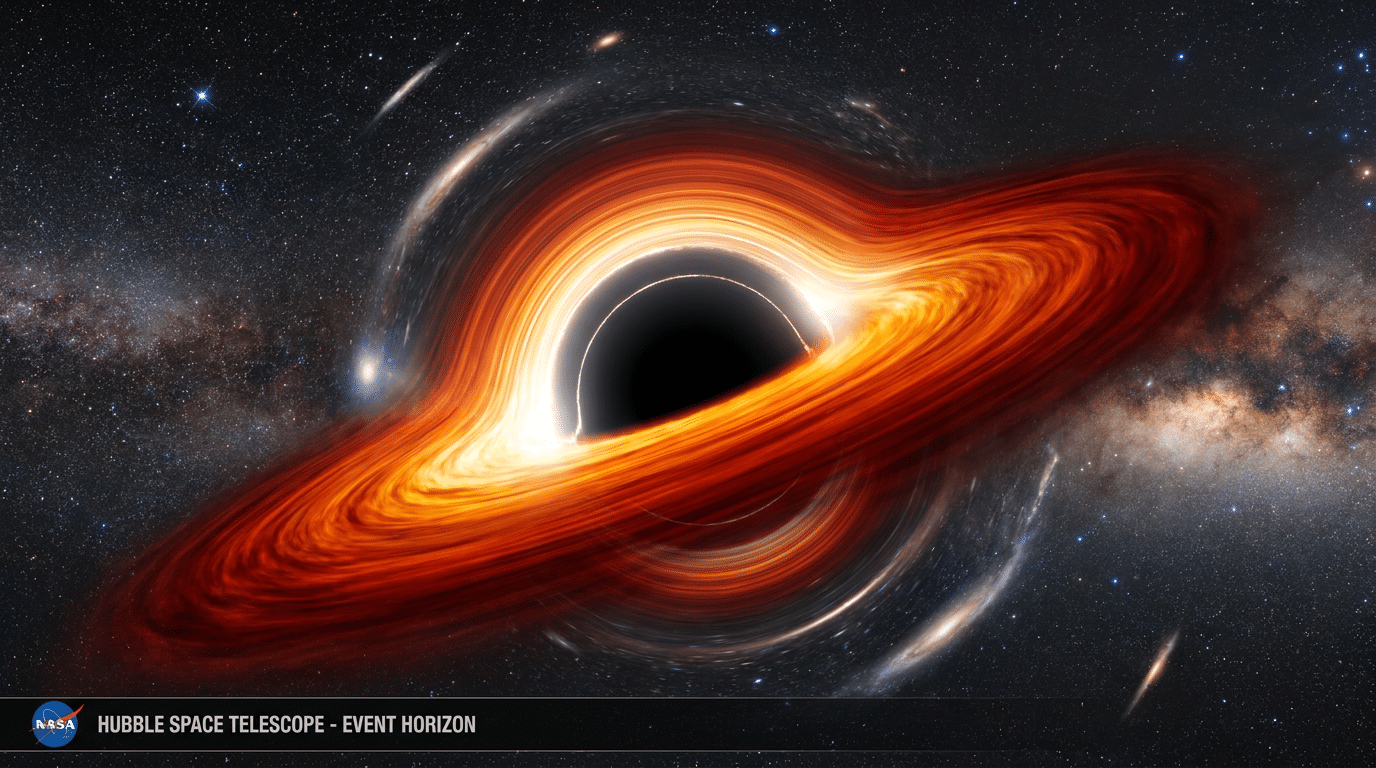
For a non-rotating black hole, a simple description using Schwarzschild coordinates shows an increasingly large gravitational time-dilation effect for a distant observer as an object approaches the event horizon.
Light emitted from the infalling object becomes increasingly redshifted and delayed according to that distant observer’s coordinates. In an idealized description, signals from the object appear to fade and become increasingly difficult to receive.
This is one reason popular accounts sometimes say that an object appears to “freeze” at the event horizon.
But does time actually stop at the event horizon?
Not for the falling observer.
An observer falling through the horizon does not encounter a physical wall at the horizon simply because it is an event horizon. For a sufficiently large black hole, crossing the horizon can occur without a locally dramatic event.
The falling observer’s own clock continues to tick normally along its local path. In their frame, their wristwatch does not suddenly stop.
The apparent freezing belongs to a particular distant description of the signals received from the falling object, not to a universal statement that time itself has ceased to exist at the horizon.
This distinction is one of the most important safeguards against misleading black-hole explanations.
Does a person near a massive object age more slowly?
Relative to someone who spends time farther from the gravitating body, yes, less proper time can accumulate for the person deeper in the gravitational field, provided the two paths are later compared appropriately.
But the person near the massive object does not feel their body running in slow motion. Their chemical reactions, heartbeat and thoughts proceed normally according to their own clock.
The difference becomes apparent only when the histories of the two observers are brought together or their clocks are compared.
Time dilation is not the same as “gravity makes everything sluggish”
This distinction matters.
A clock lower in a gravitational field does not appear internally broken. A biological organism does not notice that its neurons have suddenly slowed. Local physics remains locally consistent.
What changes is the relationship between separated clocks following different worldlines.
Relativity therefore replaces the idea of one universal flow of time with a more subtle picture: elapsed time depends on the path taken through spacetime.
Could gravity be used as a time machine?
Gravitational time dilation does allow a form of one-way travel into another person’s future in the relativistic sense.
If one traveler spends time in an environment where their clock accumulates less proper time than a distant observer’s clock, they can return having aged less than the person who remained farther away.
This is not science-fiction time travel in which someone reverses history or visits yesterday. Both people still move forward along their own paths. The difference is that they can experience different amounts of elapsed time before meeting again.
The same broad principle appears in the famous twin-paradox family of thought experiments, although those scenarios also involve motion and special relativity.
Why the effect becomes extreme around compact objects
For ordinary stars and planets, the gravitational differences between nearby locations are relatively modest. Around a compact object, the curvature of spacetime can be much stronger.
Black holes are especially interesting because the event horizon marks a boundary beyond which light cannot escape to distant observers. The geometry around the horizon produces extreme relationships between local clocks and distant observations.
Importantly, the strongest gravitational time-dilation effects do not mean that a distant observer has discovered a second universal clock. They arise from comparing clocks and signals along different paths in curved spacetime.
The deeper lesson
We often talk about time as if it were a river flowing at one universal speed.
Einstein replaced that picture with something stranger and more precise.
A clock does not measure an abstract cosmic substance called time. It measures its own elapsed proper time along a path through spacetime. Change the path, the motion or the gravitational environment, and the relationship between clocks can change.
That is why a mountain clock can disagree with a sea-level clock, why satellite navigation needs relativistic corrections, and why black holes create such extreme observational effects.
Nothing is “breaking.” No clock is malfunctioning.
The universe simply does not contain the single universal ticking that our everyday intuition led us to expect.
Why clocks are the right way to think about relativity
Relativity becomes clearer when the question is phrased in terms of clocks rather than an abstract flow of time. Every ideal clock follows a path through spacetime and records its own elapsed proper time. Two clocks can begin together and later disagree without either clock being faulty.
This is why experiments comparing precision clocks at different altitudes are so important. They turn an abstract statement about curved spacetime into a direct measurement of accumulated time.
Gravity, altitude and practical engineering
The relativistic difference between clocks at different heights is tiny for everyday distances, but modern technology can measure it. As clock precision improves, even relatively small changes in gravitational potential become experimentally relevant.
That has practical consequences beyond GPS. Precision timing supports telecommunications, navigation, scientific measurements and increasingly sensitive geophysical experiments. Relativity is therefore part of the infrastructure of accurate timekeeping itself.
There is no single place where the universe’s clock is stored
Perhaps the most counterintuitive consequence is conceptual. There is no master clock sitting somewhere outside the universe against which every local clock can be compared.
Instead, observers compare clocks through physical signals and well-defined paths. Their measurements can differ while each remains internally consistent. The disagreement is not an error in measurement; it is a feature of spacetime.
Curiosity Publication by Aadvik Agastya
Sources & further reading
Have a question about this topic?
Join fellow Qurons on the Quron Forum to ask questions, challenge ideas, share discoveries and explore further.
Discuss on Quron Forum