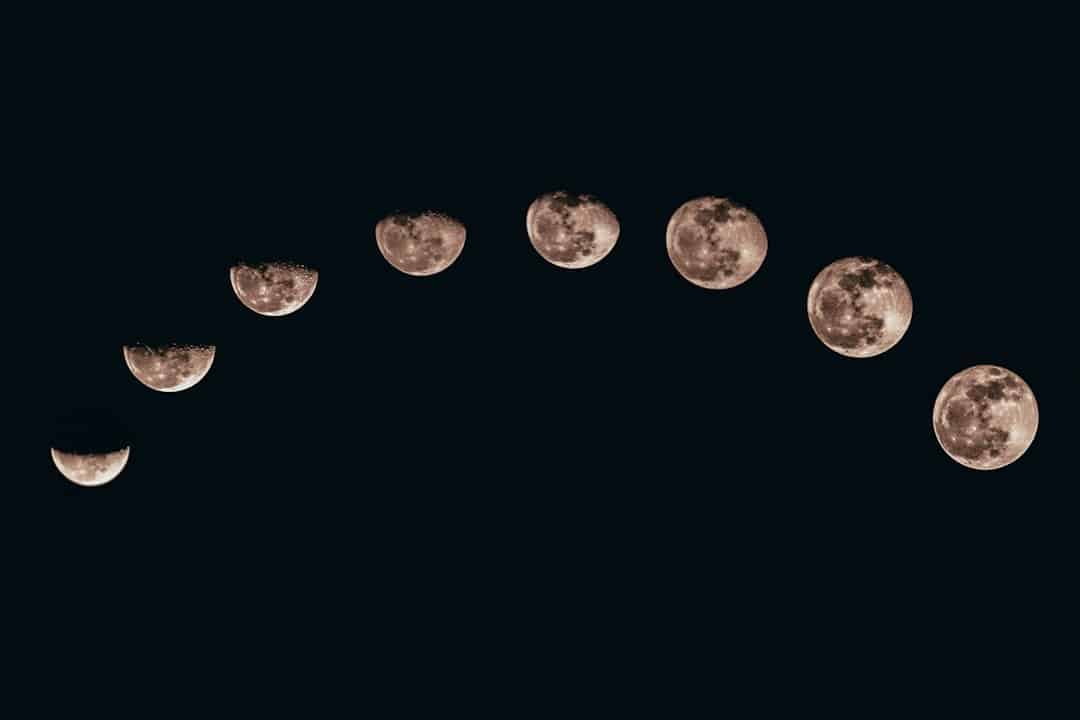
Look at the Moon from Earth and the same face always seems to be looking back.
That is not because the Moon does not rotate.
It rotates once on its axis in approximately the same time it takes to orbit Earth. This synchronization is called tidal locking.
The Moon really does rotate
If the Moon did not rotate at all while orbiting Earth, we would eventually see every part of its surface.
Instead, its rotation keeps pace with its orbital motion.
How did this happen?
Earth’s gravity raises tidal bulges on the Moon. Over long periods, internal friction dissipated rotational energy and slowed the Moon’s spin.
Eventually the rotation reached a stable state in which one lunar rotation occurs during each orbit.
It is a consequence of tides
Tidal locking is not unique to the Moon. Many moons in the Solar System are tidally locked to their planets.
Close-orbiting exoplanets can also become tidally locked to their stars.
Does one side permanently face the Sun?
No.
The Moon is tidally locked to Earth, not to the Sun. Every part of the Moon receives sunlight during its orbit, although the illumination pattern changes with the lunar day.
What about libration?
The Moon’s apparent orientation changes slightly because its orbital speed and rotation are not perfectly uniform and because its orbit is inclined.
This allows observers on Earth to see slightly more than half of the lunar surface over time.
Why is tidal locking important?
It shows that gravity can change rotation over enormous timescales.
The Moon’s present motion is not a frozen initial condition. It is the result of billions of years of gravitational interaction.
The deeper lesson
The familiar face of the Moon is evidence of a dynamic history.
Every night we see the same hemisphere because Earth and Moon have spent billions of years exchanging angular momentum through tides.
The Moon appears still.
Its orbital relationship tells a very different story.
Tidal locking takes a very long time
The Moon was not necessarily born with one face permanently pointing toward Earth. Tidal forces gradually changed its rotation. As the Moon deformed slightly under Earth’s gravity, internal friction converted rotational energy into heat.
Over enormous periods, the rotation slowed until it matched the orbital period.
Why the same face stays pointed at Earth
The simplest way to understand tidal locking is through one complete orbit. If the Moon rotates once while completing one orbit, the same hemisphere keeps turning back toward Earth.
If it rotated faster or slower, we would gradually see different regions.
The Moon is still rotating relative to the stars
This is why saying “the Moon does not rotate” is incorrect. Relative to distant stars, the Moon completes a rotation approximately once every 27.3 days.
The apparent stillness is only relative to Earth.
Libration gives us a little extra view
The Moon’s orbit is elliptical and tilted, and its rotational speed is not perfectly uniform relative to its orbital motion. These effects create libration, a subtle apparent wobble.
As a result, observers can see slightly around the edges of the lunar hemisphere over time. About 59 percent of the lunar surface can be viewed from Earth, although never all at once.
Tidal locking happens elsewhere
Many moons in the Solar System are tidally locked to their planets. The same physics can operate on planets orbiting stars very closely.
A tidally locked planet does not necessarily have a permanent night side in every detail because atmospheres and oceans can transport heat, but its rotational state is fundamentally different from Earth’s.
Earth is also changing because of tides
The tidal interaction is not one-way. Earth’s rotation is gradually slowing, while the Moon’s orbit is slowly expanding.
The changes are tiny on human timescales but significant over geological periods.
A familiar Moon hides a dynamical history
The same lunar face has looked down on Earth for thousands of years, but that stability is the outcome of billions of years of gravitational interaction.
What appears to be a static feature of the night sky is actually a record of orbital evolution.
The Moon Rotates—That Is Why We See the Same Side
One of the most common lunar misconceptions is that the Moon does not rotate. It does. The reason the same general hemisphere faces Earth is that the Moon takes almost exactly the same amount of time to rotate once on its axis as it takes to orbit Earth once. This state is called synchronous rotation or tidal locking.
Two clocks moving together
Imagine walking around a person while keeping your face pointed toward them. During one complete circuit, you must also turn your body once. The Moon behaves in the same basic way. It rotates once during each orbit, so the same side remains oriented toward Earth.
What would happen without rotation?
If the Moon orbited Earth but did not rotate at all relative to distant stars, Earth would eventually see every part of its surface over the course of an orbit. The fact that we repeatedly see the same hemisphere therefore demonstrates that the Moon’s rotation is real and synchronized with its orbital motion.
How tides created the lock
The Moon was not necessarily born with exactly the rotation rate it has today. Tidal forces between Earth and the Moon create gravitational bulges and internal friction. Over immense periods, this dissipates rotational energy and changes the body’s spin. The Moon eventually settled into a state in which one rotation takes approximately one orbit.
Why Earth did not lock as quickly
Earth is much more massive and rotates much faster than the Moon orbits it. Tidal interactions are still changing Earth’s rotation: over very long timescales, Earth’s spin gradually slows while the Moon’s orbit slowly expands. The system is therefore still evolving rather than perfectly static.
We see more than exactly half
There is an additional subtlety. Although the same hemisphere generally faces Earth, the Moon appears to wobble slightly from our perspective. This apparent motion is called libration. Because of libration, observers on Earth can see slightly more than half of the Moon’s surface over time, though never the entire far side from ordinary ground-based viewing.
The near side is not the same as the permanently illuminated side
The hemisphere facing Earth is not always the hemisphere facing the Sun. As the Moon orbits Earth, sunlight illuminates different portions of the lunar surface, producing the phases we see. “Near side,” “far side” and “dark side” are therefore different concepts. The far side receives sunlight just as the near side does.
Why the far side looks different
The near and far sides of the Moon have noticeably different surface characteristics, including differences in the distribution of dark basaltic maria and heavily cratered terrain. Scientists study these differences as clues to the Moon’s thermal, volcanic and impact history. Tidal locking itself does not mean the far side is permanently dark or untouched by sunlight.
A record of gravitational evolution
The Moon’s synchronous rotation is more than an astronomical curiosity. It is evidence of a long gravitational interaction between two bodies. Tides can transfer angular momentum, alter spin rates and change orbits over geological time. The Moon’s apparently simple behavior in the night sky therefore records a much longer history of planetary evolution.
Tidal locking is an energy-and-angular-momentum story
Earth’s gravity does not simply “pull” the Moon into a fixed orientation. The interaction involves tidal deformation and the dissipation of energy inside the Moon. Over long periods, that process changes rotational motion until a stable relationship between spin and orbit is reached.
The same general physics operates throughout the Solar System. Whenever a body’s rotation and orbit interact strongly enough over sufficient time, tidal evolution can alter its spin state. The Moon is simply the most familiar example because the result is visible from Earth every night.
Why the far side is scientifically interesting
The far side is not the “dark side,” but it is different from the near side in important ways. The near side contains extensive maria—dark basaltic plains formed by ancient volcanic activity—while the far side is more heavily dominated by cratered highlands. Scientists study this asymmetry to understand how the Moon’s interior, crust and impact history evolved.
The exact causes involve several interacting processes rather than one simple effect. Understanding the asymmetry is part of the larger problem of reconstructing the Moon’s early thermal and geological history.
A simple observation reveals a deep dynamical process
The next time the same lunar hemisphere appears in the sky, the important point is not that the Moon is “stuck.” It is that the apparent stillness is the outcome of motion: the Moon rotates, orbits, responds to Earth’s gravity and continues to exchange angular momentum with Earth.
What looks like a simple visual fact is therefore evidence of a process unfolding across billions of years.
The Moon is not refusing to rotate
The phrase “same face” can create the impression that the Moon does not rotate. It does. The Moon completes one rotation on its axis in approximately the same time that it takes to orbit Earth. That matching timing is synchronous rotation, or tidal locking.
Tides gradually created the synchronization
Earth’s gravity raises tides on the Moon, and tidal forces dissipate energy and alter rotational motion over immense timescales. The Moon likely began with a different rotation rate. Repeated tidal interactions gradually slowed its spin until the rotation period matched its orbital period.
Why libration lets us see more than half
The same face is not the same as exactly 50 percent of the lunar surface being permanently visible. The Moon’s orbit and rotation create apparent oscillations called librations. Over time, observers can therefore see slightly more than half of the lunar surface, although never the entire far side from Earth.
Far side is not dark side
The far side receives sunlight just as the near side does. “Far side” simply means the hemisphere facing away from Earth. At any moment, roughly half of the Moon is illuminated while the day-night boundary moves across its surface.
Tidal locking is common
The Moon is not unique in being tidally locked. Many moons in the Solar System are synchronized with their planets. The phenomenon becomes easier to understand when viewed as a general consequence of gravity acting over enormous periods of time.
Curiosity Publication by Aadvik Agastya
Sources & further reading
Have a question about this topic?
Join fellow Qurons on the Quron Forum to ask questions, challenge ideas, share discoveries and explore further.
Discuss on Quron Forum