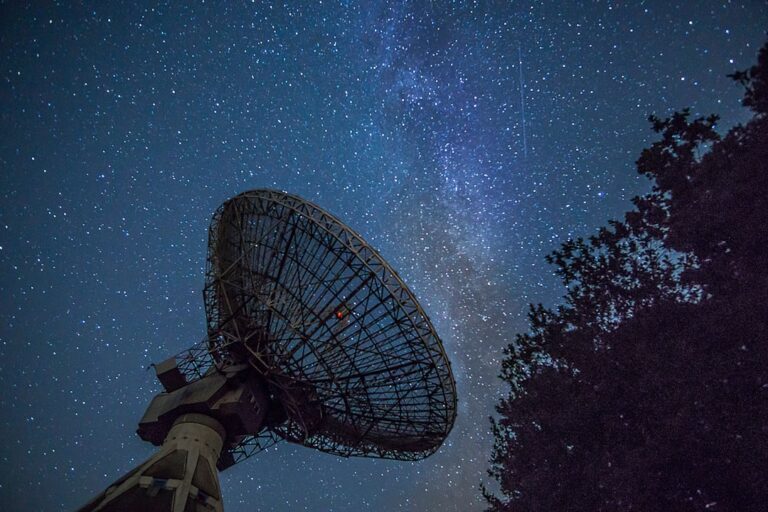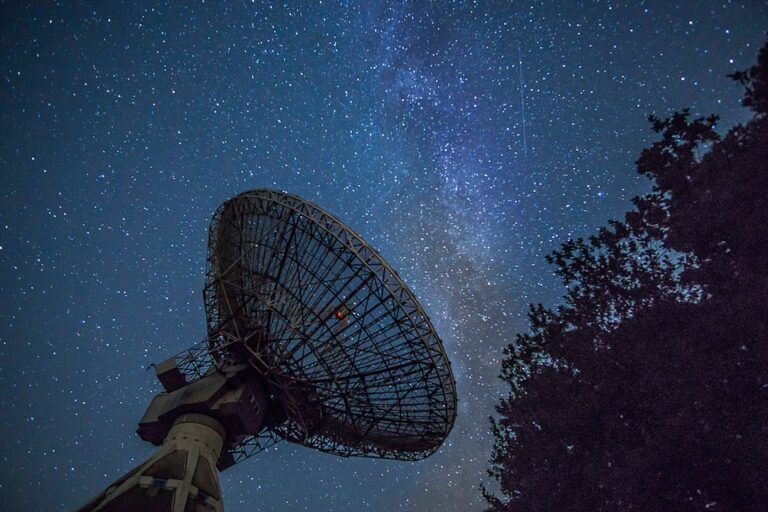
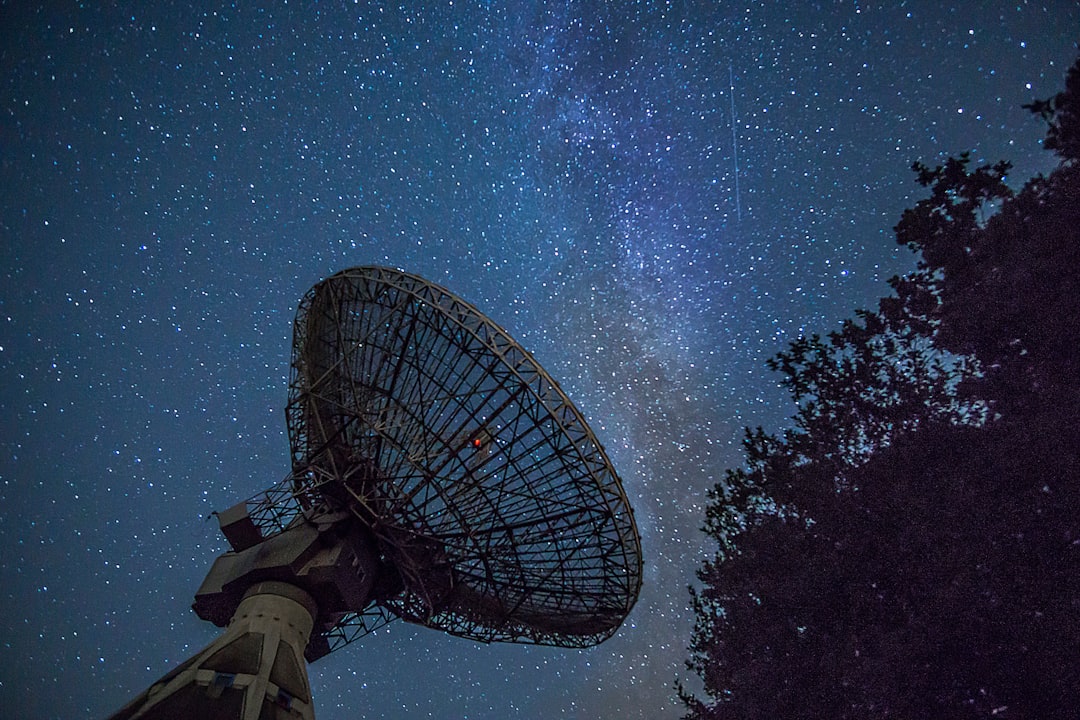
Imagine pointing a radio telescope toward a distant star and discovering a signal that does not look like the ordinary noise of the universe.
It is narrow, structured and appears to come from a particular direction.
Would that mean an alien civilization was calling?
Not necessarily. But it would be the beginning of one of the most extraordinary investigations science could undertake.
If technological civilizations exist elsewhere, they might communicate deliberately. They might also produce detectable technology without intending to contact anyone. Astronomers therefore search not simply for “alien messages,” but for technosignatures: observable features that could indicate technology.
Why would radio be useful?
Radio waves can travel through interstellar space with relatively little absorption by the tenuous material between stars. They can also be generated, focused and modulated using technologies familiar to humans.
That makes radio an attractive candidate for interstellar communication.
But the sky is already full of natural radio sources. Pulsars, galaxies, gas clouds, stellar activity and other astrophysical processes can produce powerful radio emissions.
The challenge is therefore not simply detecting radio waves. It is identifying patterns that are difficult to explain through known natural processes and then determining whether those patterns survive rigorous follow-up.
What would an artificial signal look like?
There is no single universal signature that astronomers can label “alien.” Researchers instead consider combinations of properties.
A very narrow-band signal can be interesting because many natural radio sources emit across broader frequency ranges. Artificial transmitters can deliberately concentrate energy into a narrow frequency band.
Researchers may also examine whether a signal repeats, whether its frequency changes in a way consistent with relative motion, whether it appears only when the telescope points toward a particular region of sky, and whether its behavior is consistent across independent observations.
None of these characteristics is automatically proof of extraterrestrial technology. Human transmitters can produce narrow-band signals too, and instruments can generate artifacts.
The problem of Doppler drift
Suppose a transmitter on a planet is rotating with its planet and orbiting its star while the receiving telescope is moving with Earth.
The relative motion changes the observed frequency of a transmitted signal. This is the Doppler effect.
A genuine celestial transmitter could therefore appear to drift through frequencies during an observation. Researchers can search for these patterns because they may help distinguish a distant source from some forms of local interference.
But frequency drift is not unique to aliens. Natural astronomical sources and human equipment can also create changing frequencies. The value comes from combining several independent clues.
Could an alien civilization simply broadcast in every direction?
It could, but that would be enormously expensive for a sufficiently powerful signal.
Radio energy spreads as it travels. For an approximately isotropic transmitter, the energy density decreases with distance according to the inverse-square law. By the time a signal crosses many light-years, only a tiny fraction of its original energy is passing through any particular area.
A civilization interested in efficient communication might therefore use directional beams.
That creates another problem for SETI: a narrow beam can miss Earth entirely.
Directed communication changes the search
Imagine a lighthouse that sends a narrow beam across the ocean. A ship can detect it when the beam sweeps across its position, but see nothing when the light points elsewhere.
An interstellar beacon could work in a similar way.
A civilization might deliberately target particular stars, periodically sweep a region of sky, transmit toward planets with interesting atmospheric chemistry, or communicate only when it has a reason to do so.
If Earth is outside the beam, silence tells us very little.
Interstellar distance creates a second problem: time
Even if two civilizations know each other exists, communication cannot happen instantaneously.
Radio waves travel at the speed of light. A message sent from a civilization 100 light-years away takes about 100 years to reach Earth. A reply takes another 100 years to return.
A conversation could therefore span centuries.
This changes what “communication” means on a galactic scale. Civilizations separated by enormous distances may exchange information without ever participating in a real-time dialogue.
What if the signal is incredibly powerful?
Greater transmitter power can make a signal detectable from farther away, but power is not the only variable.
A transmitter can improve detectability by concentrating energy into a narrower beam, transmitting for longer periods, choosing favorable frequencies, using efficient modulation and targeting receivers deliberately.
For a receiving telescope, sensitivity also matters. A signal that is too weak relative to background noise may remain invisible even if it is technologically generated.
This means the absence of a detection does not tell us simply whether aliens exist. It tells us something about what kinds of transmitters our search was capable of detecting.
SETI searches are searches through a huge parameter space
Imagine a radio dial with an almost unimaginable number of possible frequencies. Now add every direction in the sky, different observation times, different signal bandwidths, different drift rates and different patterns of repetition.
The number of possible signals becomes enormous.
This creates a statistical problem. If scientists search enough frequencies and enough directions, unusual events will inevitably appear.
Some will be noise. Some will be interference. Some will be instrumental artifacts. A few may be genuinely interesting astrophysical events.
The search therefore needs statistical methods that account for the enormous number of opportunities for false alarms.
Earth itself is a major source of confusion
Modern civilization fills the radio spectrum with transmissions.
Satellites, aircraft, communications networks, radar systems, electronics and other technologies can create signals that enter astronomical instruments.
Even when researchers carefully filter known interference, an unusual signal may initially look celestial.
One of the most important tests is whether the candidate remains visible when the telescope changes its pointing or when another observatory attempts to detect it.
Why independent confirmation matters
A candidate that appears once is interesting.
A candidate that appears repeatedly from the same celestial direction is more interesting.
A candidate independently detected by different instruments is stronger still.
The goal is to make it increasingly difficult for mundane explanations to survive.
This is why a spectacular announcement would ideally be preceded by careful observation, instrument checks, independent analysis and attempts to reproduce the detection.
The Wow! Signal illustrates the problem
The famous Wow! Signal detected in 1977 remains one of the best-known examples of an intriguing radio event associated with the search for extraterrestrial intelligence.
Its characteristics attracted attention because the signal appeared unusually strong and narrow-band and seemed consistent with a celestial source.
But it was not subsequently confirmed as a repeating extraterrestrial transmission.
That distinction matters. An unexplained signal is not automatically an alien signal.
The history of SETI contains many interesting candidates that became less mysterious after interference, instrumental behavior or natural explanations were considered.
What if aliens communicate in a way we have never imagined?
This is one of the deepest limitations of the search.
Human SETI programs necessarily begin with technologies humans understand.
We can search for radio signals, optical pulses, unusual infrared signatures, industrial atmospheric compounds and other proposed technosignatures. But an extraterrestrial civilization could use a communication method outside the technologies we currently monitor.
A non-detection is therefore conditional: we did not detect a signal of a certain kind, within a certain range of frequencies, directions, times and sensitivities.
Technosignatures do not have to be messages
A civilization could be detectable without deliberately communicating.
Large-scale engineering might alter the light from a star. Industrial activity could change an atmosphere. Powerful energy use could produce unusual waste heat. Artificial structures could create patterns unlike ordinary astronomical systems.
These possibilities broaden the search from “Who is sending us a message?” to a larger question: Can technology leave observable fingerprints?
Could a civilization choose to remain silent?
Possibly.
A civilization might have no reason to transmit continuously. It could consider interstellar communication too expensive, too risky or simply unnecessary.
It might communicate only within its own system. It might use extremely directional beams. It might transmit for a short period and then stop.
Even a civilization that has existed for millions of years could therefore be difficult to detect if its technological activity does not overlap with the narrow window of our observations.
What would count as convincing evidence?
A compelling discovery would probably not depend on one mysterious feature.
Researchers would want a signal or technosignature with a well-characterized celestial origin, a behavior that is difficult to explain naturally, independent confirmation, repeatable observations where possible and a detailed examination of terrestrial interference.
The strongest case would become stronger not because the signal looked exciting, but because plausible alternatives continued to fail.
The deeper question
Listening for extraterrestrial technology is sometimes portrayed as waiting for aliens to call.
In reality, it is an experiment in distinguishing an unusual observation from evidence of intelligence.
That distinction is important because the universe is full of things humans have never seen before. Strange does not automatically mean artificial, and unexplained does not automatically mean extraterrestrial.
Yet the search remains profound precisely because the possibility is testable.
Somewhere between natural cosmic noise and unmistakable technology lies a boundary that science is trying to define.
And if a signal ever crosses that boundary, the most extraordinary part may not be that we heard something.
It may be that, after every ordinary explanation was tested, something remained.
How astronomers reduce false positives
A credible technosignature search is designed around the possibility of being fooled. Candidate signals are checked against known satellite transmissions, terrestrial interference, instrument behavior and other sources of contamination. Researchers can also compare observations from different locations and instruments.
A signal that disappears when the telescope points away from the suspected source may behave differently from local interference, while a signal that appears simultaneously at separated observatories can provide additional information about its origin. No single test is sufficient, but several independent tests can progressively narrow the possibilities.
The search is also a search for what we might have missed
SETI does not test the proposition “aliens exist” in one experiment. Different surveys examine different frequencies, sky regions, signal types, durations and sensitivity thresholds.
A null result therefore has a precise meaning only in relation to the search that produced it. It can constrain certain kinds of powerful or persistent transmitters while leaving many other possibilities untouched.
Why technosignatures expand the question
The broader technosignature approach is important because communication is only one possible consequence of technology. A civilization could alter its environment without attempting to attract attention, and those alterations might leave measurable effects.
Searching for such effects turns the question from “Are extraterrestrials transmitting?” into “What observable evidence would technology leave behind?” That is a more general scientific problem, and one that can evolve as astronomical instruments become more capable.
Curiosity Publication by Aadvik Agastya
Sources & further reading
Have a question about this topic?
Join fellow Qurons on the Quron Forum to ask questions, challenge ideas, share discoveries and explore further.
Discuss on Quron Forum