Why would people travel hundreds or even thousands of kilometers to reach a sacred place when they could pray where they lived?
For much of human history, the journey itself has been part of the answer.
Pilgrimage is one of humanity’s most persistent religious practices. Across cultures, people have traveled to temples, rivers, mountains, shrines, tombs, monasteries, sacred cities and sites associated with prophets, saints or major religious events.
The practice is striking because it turns geography into meaning.
A road becomes a spiritual journey. A mountain becomes a place of revelation. A river becomes a site of purification. A city becomes sacred because generations have attached memory, ritual and identity to it.
Why leave home at all?
At the simplest level, pilgrimage is a journey to a place considered sacred or religiously significant.
But pilgrimage often involves more than reaching a destination.
The traveler temporarily leaves ordinary routines. Family obligations, work, familiar surroundings and everyday habits are interrupted. The journey can therefore create a physical and psychological boundary between ordinary life and religious practice.
That separation can itself become meaningful.
Sacred geography changes how places are experienced
Human beings do not experience physical space as completely neutral.
We attach memories, stories and identities to places.
A battlefield can become a memorial. A birthplace can become part of national identity. A temple can become sacred because believers associate it with a deity, saint or event.
Pilgrimage makes this transformation especially visible.
The physical location may be ordinary geology, architecture and roads, but the community’s accumulated stories can make the place extraordinary within its religious tradition.
The journey can matter as much as the destination
Many pilgrimage traditions include practices that make the journey physically or socially distinctive.
Pilgrims may walk long distances, fast, maintain vows, carry symbolic objects, bathe at sacred sites or follow prescribed routes.
These practices can create a sense of transition.
The traveler is no longer simply moving from one geographical coordinate to another. The journey becomes a ritual process with a beginning, a period of separation and a return to ordinary life.
Liminality: being between worlds
Anthropologists have used the idea of liminality to describe periods in which people occupy an unusual social position between familiar states.
A pilgrim can experience something similar.
They may temporarily leave their ordinary social identity behind and enter a community of travelers who share a religious purpose.
Status can become less important. People who would rarely meet in ordinary life can eat, travel and worship alongside one another.
The journey can therefore produce a temporary sense of equality and shared identity, although the exact experience varies greatly between traditions and individuals.
Why pilgrimage can strengthen community
Religion is not only a set of private beliefs. It can also create communities.
Pilgrimage places provide opportunities for people to meet others who share traditions, languages, stories and rituals.
Large gatherings can reinforce a sense that an individual’s beliefs belong to something much larger than their own private life.
Returning to the same sacred site across generations can strengthen this effect.
A parent may take a child to a place visited by their own parents. The location then becomes part of family memory as well as religious memory.
India’s extraordinary pilgrimage landscape
India provides some of the world’s most extensive pilgrimage traditions.
Hindu, Buddhist, Jain, Sikh, Islamic and other traditions have created networks of sacred places across the subcontinent.
Examples include pilgrimage associated with major temple cities, sacred rivers, Himalayan sites, Buddhist locations connected with the Buddha’s life and Sikh gurdwaras.
There is no single Indian model of pilgrimage. Different communities assign different theological and ritual meanings to their journeys.
What they share is the idea that movement through physical space can carry religious significance.
Hindu pilgrimage and sacred rivers
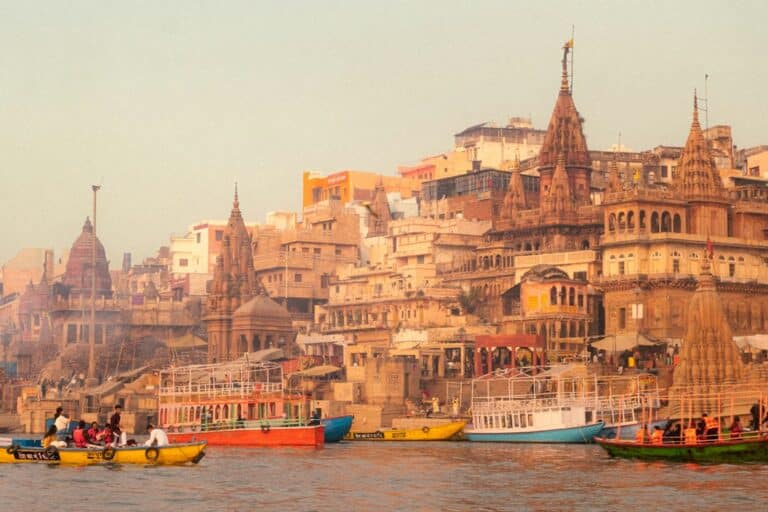
In many Hindu traditions, rivers such as the Ganga have religious significance extending far beyond their physical role as waterways.
Bathing at particular locations may be associated with purification, remembrance or religious merit.
Large gatherings can transform riverbanks into temporary cities of ritual activity.
The scale of such gatherings demonstrates how religious geography can shape real infrastructure, transportation and settlement.
The Char Dham tradition
The Char Dham pilgrimage tradition connects important sacred destinations across India.
Different pilgrimage networks and regional interpretations have developed over time, so the phrase can refer to more than one specific framework.
What is significant is the geographical imagination involved: sacred places become connected through a journey that links distant regions into a shared religious map.
Buddhist pilgrimage and memory
Buddhist traditions developed pilgrimage around places associated with the life of the Buddha and major events in Buddhist history.
Sites such as Bodh Gaya, Sarnath, Kushinagar and Lumbini became important nodes in a wider sacred geography.
For pilgrims, visiting such places can transform historical knowledge into physical experience.
Instead of simply reading that an event occurred somewhere, the traveler stands in a landscape that the tradition identifies with that event.
Islamic pilgrimage and Mecca
The Hajj to Mecca is one of the most significant examples of pilgrimage in the world.
For Muslims who are physically and financially able to undertake it under the relevant religious conditions, Hajj is a major religious obligation.
The pilgrimage brings together people from many countries and social backgrounds around shared rituals.
Its scale also illustrates how sacred geography can create enormous systems of transport, accommodation, health services, commerce and crowd management.
Christian pilgrimage
Christian pilgrimage has taken many forms, including journeys to Jerusalem, Rome, Santiago de Compostela and local shrines associated with saints and religious events.
Medieval pilgrimage routes helped connect communities across Europe.
Some routes developed hostels, churches, bridges, markets and other infrastructure to support travelers.
In this sense, pilgrimage did not merely use existing geography. It helped create new networks across it.
Pilgrimage before modern borders
Many sacred landscapes are older than the modern nation-state.
A pilgrimage route may cross boundaries that did not exist when the tradition developed.
This is why religious geography can preserve cultural connections across political divisions.
People may continue to identify a place as sacred even when political control changes or access becomes more difficult.
Pilgrimage creates economic geography
Large numbers of travelers require food, water, accommodation, transportation and other services.
Communities near major pilgrimage destinations can therefore develop economies organized partly around visitors.
Markets may expand. Roads and railways may be improved. Hotels and guesthouses appear. Religious institutions may become major landowners or service providers.
This does not mean pilgrimage is reducible to economics. Rather, religious practice can produce measurable economic consequences.
Temporary cities and permanent infrastructure
Some pilgrimage gatherings are so large that temporary settlements are created to accommodate them.
These events require careful management of water, sanitation, transport, health services and crowd movement.
After the pilgrims leave, the physical landscape may remain shaped by the infrastructure created for them.
Religious journeys can therefore leave lasting marks on geography.
Why discomfort can be meaningful
Pilgrimage is sometimes physically demanding by design.
Walking long distances, fasting or giving up ordinary comforts can create a sense of effort and sacrifice.
Psychologically, effort can also increase the perceived significance of an experience. A destination reached after considerable difficulty may feel more meaningful than one reached effortlessly.
This does not prove any particular religious claim. It helps explain why difficult journeys can function effectively as rituals.
Travel can change attention
Leaving familiar surroundings alters daily routines.
When people travel, they often become more attentive to their environment and more conscious of their own choices.
Pilgrimage traditions can frame that altered attention as reflection, repentance, purification, renewal or spiritual preparation.
The psychological experience is therefore partly created by the journey itself and partly interpreted through the religious framework of the traveler.
Pilgrimage and personal transformation
Many pilgrims describe returning home with a changed sense of identity or purpose.
Such experiences are subjective, but they can have real social consequences.
A pilgrimage may mark a transition in someone’s life, commemorate a promise, follow a period of crisis or become a milestone shared with family.
The journey can therefore function as a narrative boundary: life before the pilgrimage and life after it.
Not every pilgrimage is purely personal
Pilgrimage can also have collective and political dimensions.
Large gatherings demonstrate the size and organization of a religious community. Sacred places can become symbols of cultural identity.
At different times in history, rulers and institutions have supported pilgrimage sites because they provided religious legitimacy, economic activity or political connections.
This does not mean pilgrimage is inherently political. It means that religious practices occur within societies and can interact with institutions and power.
The risks of pilgrimage
Large gatherings also create practical risks.
Crowding, heat, disease, accidents, difficult terrain and transportation failures can threaten travelers.
Modern pilgrimage management therefore involves logistics and public-health planning as well as religious organization.
The ability to move millions of people safely to sacred locations is itself a major logistical achievement.
Why modern technology has not ended pilgrimage
In an age of video calls, virtual tours and instant information, it might seem that physical pilgrimage should become less important.
Yet pilgrimage persists.
That suggests that the value of pilgrimage is not simply informational.
A photograph of a sacred place is not equivalent to standing there. Watching a ritual is not necessarily equivalent to participating in it. The physical journey creates experiences that digital access cannot completely reproduce.
The deeper question
Pilgrimage reveals something fundamental about how humans experience place.
We do not live in a world of neutral coordinates.
We attach stories to landscapes. We remember history through buildings and roads. We transform rivers into symbols, mountains into sacred destinations and journeys into rituals.
Pilgrimage turns distance into meaning.
The destination matters because of what people believe happened there.
The journey matters because of what people experience while getting there.
And the community matters because the traveler discovers that a private belief can become a shared human tradition.
A pilgrimage therefore changes two things at once: the place being visited and the person making the journey.
Curiosity Publication by Aadvik Agastya
Sources & further reading
Have a question about this topic?
Join fellow Qurons on the Quron Forum to ask questions, challenge ideas, share discoveries and explore further.
Discuss on Quron Forum