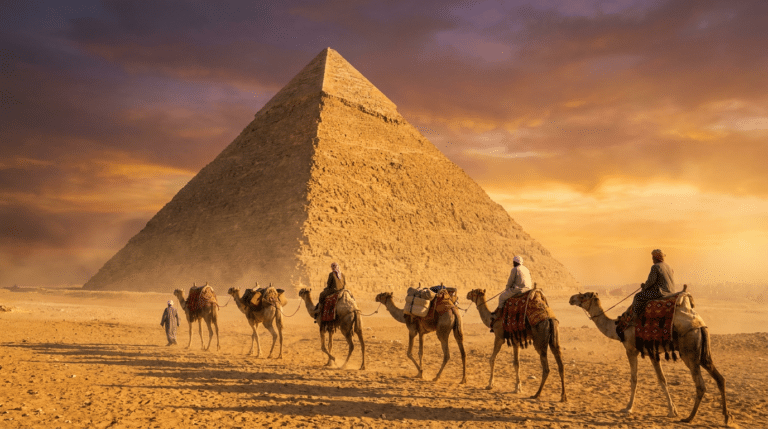
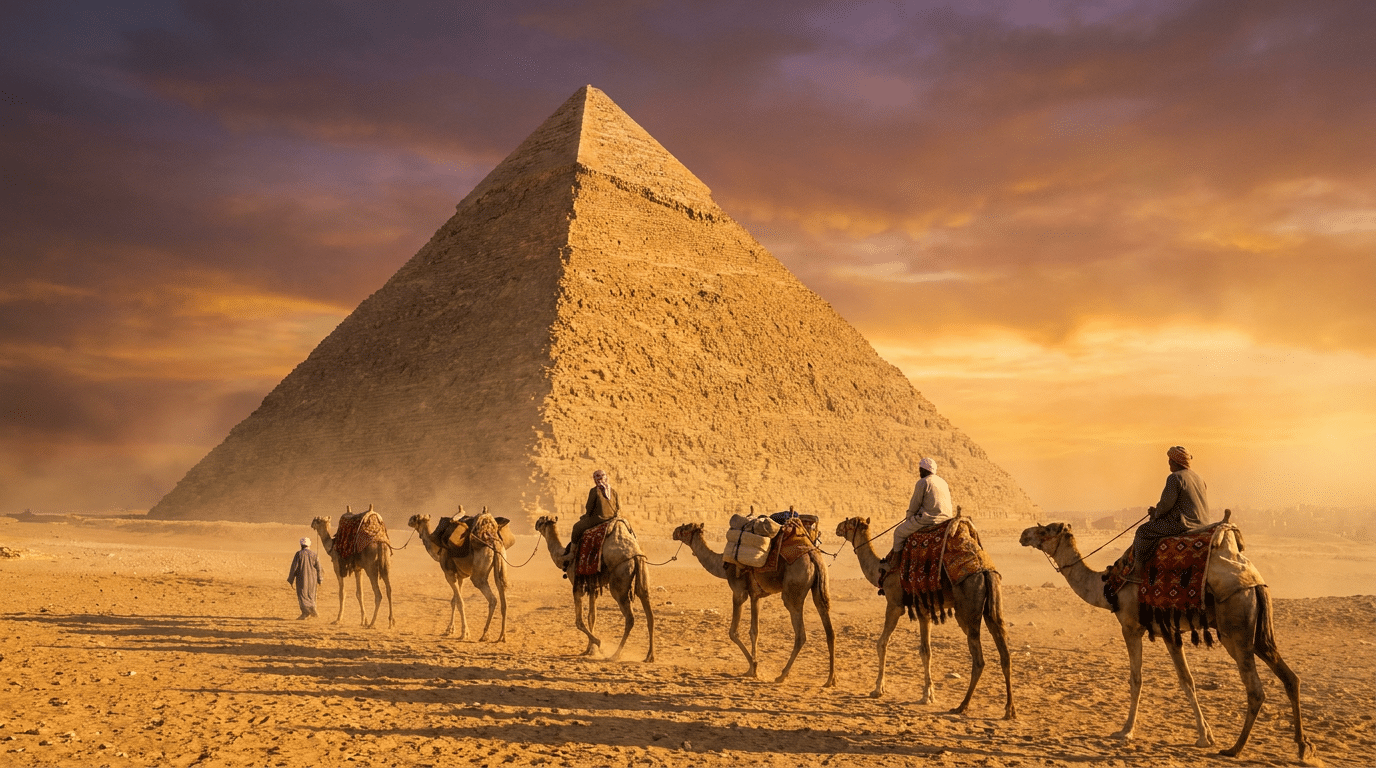
Call it the Silk Road and it is easy to imagine a single ancient highway: caravans moving east and west, carrying silk between China and the Mediterranean.
The reality was much larger.
The Silk Road was a shifting network of routes connecting cities, oases, ports and communities across Eurasia. Silk was one of its famous commodities, but the movement of goods was only part of the story.
People, religions, technologies, languages, diseases, artistic styles and ideas traveled too.
There was never one Silk Road
Routes changed according to politics, climate, security and economic conditions.
Caravans could cross Central Asia through different corridors. Maritime routes connected the Indian Ocean with Southeast Asia and the Red Sea. Cities rose and declined as trade patterns shifted.
It is therefore more accurate to imagine a network than a single road.
Silk was valuable—but difficult to move
Silk had an unusual advantage: it was light, valuable and relatively easy to transport over long distances.
That made it an ideal long-distance trade commodity.
But merchants did not necessarily carry silk from China all the way to Rome. Goods often passed through multiple intermediaries. A merchant might travel one segment while another trader handled the next.
The “road” was therefore also a chain of human relationships.
What else traveled?
Archaeological evidence and historical records show a remarkable variety of goods moving across Eurasia: spices, glassware, metals, precious stones, textiles, horses, ceramics, medicines and foods.
Some products traveled in both directions. Others were traded regionally and only indirectly reached distant markets.
The movement of goods depended on what different regions could produce and what distant consumers valued.
Ideas could travel farther than objects
Merchants carried more than cargo.
Buddhism spread along Central Asian routes and became deeply established in places far from its South Asian origins. Other religions, artistic traditions and intellectual practices also moved through connected communities.
Technologies and techniques could spread in similar ways. A craft practice did not need to be transported physically; a skilled person could teach it to someone in another region.
Why cities along the routes became important
Trade networks require places where travelers can stop, exchange goods, obtain food and find protection.
Oasis cities and caravan centers could therefore become wealthy and culturally diverse.
They were not simply rest stops. They were points where languages, religions and economic systems intersected.
The Silk Road was also dangerous
Long-distance trade required risk.
Caravans faced deserts, mountains, extreme temperatures, banditry, political instability and unreliable water supplies. Routes could become dangerous when empires fragmented or wars disrupted transport.
Political stability could therefore dramatically increase trade, while conflict could redirect it.
The network changed the cultures it connected
Trade does not merely move objects. It changes preferences.
Foods, clothing styles, artistic motifs and technologies can be adopted far from their origins. New mixtures of cultural traditions emerge at crossroads.
This makes the Silk Road important even when no silk is involved.
Did the Silk Road connect the whole world?
Not in the modern sense.
Connections were uneven, slow and vulnerable to disruption. Many communities had little or no direct contact with distant regions.
But the network demonstrates that Eurasia was more interconnected than a simple map of ancient empires might suggest.
The deeper lesson
The Silk Road was not really about silk.
It was about connections.
A textile could cross a border. A merchant could carry a story. A monk could carry a religion. A craftsman could carry a technique. A disease could travel along the same network without anyone intending it.
That is why the Silk Road matters: it shows that globalization did not begin with modern shipping containers. Human societies had been connecting distant worlds for thousands of years, long before anyone had a map of the entire planet.
Trade depended on trust as much as roads
A long-distance merchant needed more than a route. Traders required partners, credit, translators, guides, storage, protection and knowledge of local markets.
Goods often changed hands many times before reaching their final destination. The Silk Road was therefore a social network as much as a transport network.
Oases were economic engines
In arid parts of Central Asia, water made settlement possible. Oasis cities could provide food, lodging, storage and markets to travelers moving across difficult terrain.
Their importance came from geography, but their prosperity depended on maintaining connections with surrounding regions.
Ideas did not travel at the same speed as goods
A physical object could move rapidly through a chain of merchants, while a religious or philosophical idea might take generations to become established in a new region.
Transmission was therefore not simply movement. Local communities translated, adapted and sometimes transformed what they received.
Technology could move through people
Craft knowledge is difficult to separate from skilled individuals. A technique for making ceramics, metal objects, textiles or glass could spread when artisans migrated or were employed elsewhere.
This means cultural exchange can sometimes be detected through manufacturing methods rather than through imported objects.
Diseases traveled too
Networks that connect populations also create pathways for pathogens. Increased mobility can allow diseases to move across regions that would otherwise have little contact.
The history of Eurasian trade is therefore not only a story of cultural enrichment. It is also a history of ecological and epidemiological connection.
Empires could support or disrupt trade
Large states sometimes provided roads, security and administrative systems that reduced the risks of long-distance commerce. But wars, political fragmentation and changing borders could just as quickly disrupt routes.
Trade flourished when the network was reliable, not simply when a particular empire was large.
Why “Silk Road” can be misleading
The modern term encourages us to imagine one coherent route running between East and West. In reality, different networks operated at different times, with maritime and overland routes interacting.
Thinking in terms of connected corridors better reflects the historical evidence.
The legacy is still visible
Languages, foods, religious traditions, artistic motifs and technologies across Eurasia contain traces of centuries of exchange.
The Silk Road mattered because it made distant societies part of one another’s economic and cultural environments long before modern globalization.
The reality was much larger.
People, religions, technologies, languages, artistic styles, foods and diseases traveled too. Sometimes they traveled deliberately. Sometimes they moved as unintended consequences of human mobility.
A deeper look: There was never one Silk Road
The expression “Silk Road” is useful as shorthand, but it can also create the wrong mental picture. There was no single paved road stretching continuously from China to Rome.
Instead, different corridors connected different regions. Routes could pass through Central Asian valleys, desert oases and mountain crossings, while maritime networks linked ports around the Indian Ocean and connected with routes toward the Red Sea and Mediterranean.
These corridors changed over time. Political control, security, climate, taxation, warfare and demand could make one route more attractive and another less practical.
The network is therefore better imagined as a shifting web than a line on a map.
Silk was valuable because it was compact
Silk was unusually well suited to long-distance trade. It could be expensive relative to its weight, making it more practical to transport over difficult terrain than bulky low-value goods.
That did not mean every piece of silk traveled from China to the Roman world in a single journey.
Goods commonly passed through intermediaries. A merchant might buy or receive a product in one market and sell it several hundred kilometers farther on. Another trader would then continue the chain.
This system reduced the need for one individual to understand or traverse the entire Eurasian route. The “road” was partly a chain of commercial relationships.
The real infrastructure was human
Long-distance commerce required much more than a path through a desert.
Merchants needed guides, translators, storage facilities, pack animals, food, water, credit, local contacts and places where disputes could be settled. They also needed information: which ruler controlled the next territory, where taxes were collected and which route was currently safe.
Trust therefore had economic value. A merchant who knew reliable partners could operate more effectively than someone who simply knew the geography.
This helps explain why trade networks could survive political boundaries. People could maintain commercial relationships even when the states through which they traveled were culturally and politically different.
A deeper look: What else traveled?
Silk was only one category among many. Historical and archaeological evidence points to the movement of spices, textiles, metals, glassware, precious stones, ceramics, horses, medicines and foods.
Some goods moved enormous distances; others traveled mainly within regional networks before being exchanged for something else.
This distinction matters because “the Silk Road” was not a single supply chain. It was a collection of overlapping markets.
A product could move from one economic zone to another without ever being carried by someone who knew its ultimate destination.
Oases were more than rest stops
Crossing arid Central Asian landscapes required dependable water. Oasis settlements could therefore become crucial nodes in the network.
An oasis could provide water, food, lodging, storage and markets. Farmers around the settlement could supply travelers, while merchants could bring goods and information from elsewhere.
Geography created the opportunity, but institutions turned that opportunity into an economy. Irrigation, security, taxation and market organization all helped determine whether an oasis prospered.
Some cities became important precisely because travelers had limited alternatives. A settlement located near a dependable water source or strategic crossing could become disproportionately valuable.
Mountains shaped the network too
It is tempting to picture ancient traders moving smoothly across a flat Eurasian landscape. Much of the network was nothing like that.
Mountain passes could concentrate movement into narrow corridors. Deserts could force caravans toward particular wells and oases. Rivers could create opportunities for transport while also acting as barriers.
The geography of the Silk Road therefore helped determine which cities became connected. Trade routes were not simply drawn by merchants; they were constrained by the physical landscape.
Maritime routes were part of the larger story
Overland trade is the most familiar image of the Silk Road, but maritime exchange was equally important to Eurasian connectivity.
Ships could move large quantities of goods around the Indian Ocean, linking South Asia, Southeast Asia, Arabia and East Africa, with connections onward into other regions.
Sea routes and land routes were not isolated systems. Goods could move between them at ports and commercial centers.
This is another reason the “single road” image is misleading. Ancient connectivity was a network of networks.
A deeper look: Ideas could travel farther than objects
Merchants carried more than cargo.
Buddhism spread through connected communities across Central and East Asia and became established far from its South Asian origins. Other religious traditions, artistic conventions and intellectual practices also moved through networks of travelers and settled communities.
But cultural transmission was not simple copying. A religious tradition entering a new society could be translated into a different language, expressed through local artistic styles and interpreted through existing beliefs.
An idea therefore changed as it traveled.
A deeper look: Technology could move through people
Some technologies are difficult to transport as objects because their real value lies in knowing how to make something.
A skilled craftsperson could carry knowledge of metalworking, ceramics, textiles or glass production to a new community. Apprentices could then learn the technique and adapt it to local materials.
Archaeologists can sometimes identify such transfers through changes in manufacturing techniques rather than simply through imported finished goods.
This is an important feature of cultural exchange: sometimes the most significant thing that travels is not the object, but the knowledge behind it.
Languages reveal repeated contact
Trade creates situations in which people with different languages repeatedly need to communicate.
Multilingual communities could develop around markets and caravan centers. Translators, merchants and local intermediaries became valuable because they could bridge otherwise separate social worlds.
Language change does not prove that a particular object traveled along one specific route, but patterns of loanwords, inscriptions and multilingual documents can provide evidence for sustained contact.
Trade also carried diseases
The same connections that moved valuable goods also connected human populations.
Pathogens can travel when people move between communities. Dense trading networks can therefore increase the opportunities for diseases to spread across regions that previously had limited contact.
This does not mean every epidemic in Eurasia can simply be attributed to the Silk Road. Disease histories are complicated, and evidence for particular transmission routes varies.
The broader point is stronger: connectivity has both benefits and biological costs.
Empires could support trade—and disrupt it
Political stability could make long-distance travel safer. States could provide roads, checkpoints, administrative systems or military protection, while predictable taxation could make commercial planning easier.
But political power could also obstruct trade. Wars could close routes, rulers could impose heavy taxes and changing borders could increase risk.
Large empires were therefore not automatically good for trade. What mattered was whether the political environment made movement sufficiently predictable.
Trade required calculations of risk
A merchant sending goods over thousands of kilometers faced uncertainty at every stage.
There were risks from weather, theft, political conflict, spoiled goods, animal losses and changing market prices. The potential reward had to compensate for those risks.
This helps explain why high-value, low-weight commodities were so important. Silk, spices and precious materials could justify the cost of long-distance movement in a way that many ordinary bulk goods could not.
Cities became cultural crossroads
A city positioned at the intersection of several routes could become more than a marketplace.
Travelers brought languages, religious practices, clothing styles, artistic motifs and stories. Residents encountered people whose customs differed from their own. Some communities became remarkably cosmopolitan as a result.
Archaeological evidence from such places can therefore reveal cultural mixtures that are difficult to explain if societies are treated as isolated civilizations.
But the Silk Road did not connect everyone
It is easy to overstate ancient globalization.
Connections were uneven, slow and vulnerable. Many communities had little direct contact with distant regions. Even when two places were indirectly connected, information could take months or years to travel.
A merchant network crossing Eurasia is not equivalent to a modern global communications system.
The important historical point is more precise: some regions that are often imagined as separate were linked by recurring chains of exchange.
Why the name “Silk Road” can mislead us
The modern term was coined long after the ancient networks themselves existed. It is useful because it gives us a convenient label for a complex historical phenomenon, but it can encourage the idea of one coherent system.
The historical reality was messier. Routes appeared, disappeared and shifted. Some were primarily commercial; others became important for military, religious or political reasons. Maritime and overland networks overlapped.
Thinking in terms of connected corridors better reflects this complexity.
The deeper significance was connectivity
The Silk Road mattered more than silk because its greatest historical effect was not the movement of one luxury textile. It was the creation of repeated opportunities for distant societies to influence one another.
A merchant could carry a fabric. A monk could carry a religious tradition. An artisan could carry a manufacturing technique. A translator could carry words between languages. A traveler could carry a pathogen without knowing it.
None of these movements happened on one road. They happened through a changing network of human relationships shaped by geography, economics and political power.
That is why the Silk Road remains so revealing. It shows that large-scale interconnection does not require modern technology. It can emerge gradually whenever people have reasons to cross difficult distances and enough institutions exist to make those journeys possible.
Curiosity Publication by Aadvik Agastya
Sources & further reading
Have a question about this topic?
Join fellow Qurons on the Quron Forum to ask questions, challenge ideas, share discoveries and explore further.
Discuss on Quron Forum