A large ancient city could not survive on buildings alone. Thousands of people needed water every day for drinking, cooking, washing, craft production, animals and agriculture.
But bringing water into a city was only half the problem. Once people had used it, the water—and the waste carried with it—had to go somewhere.
Ancient urban societies therefore developed surprisingly sophisticated systems for wells, reservoirs, canals, pipes, aqueducts, drainage and storage.
There was no single ancient water system
Different cities solved the water problem according to their geography.
A settlement beside a reliable river could draw directly from it, while a city in a dry region might depend on wells, cisterns or reservoirs. Mountainous terrain could provide gravity-driven channels. Seasonal rainfall could be captured and stored for later use.
The most effective systems were often combinations of several methods.
Wells were simple but powerful
Groundwater was one of the most dependable sources available to ancient communities.
Wells could provide water even when rivers were distant or seasonal. Their construction required knowledge of local geology and careful reinforcement to prevent collapse.
Archaeological sites across the ancient world contain evidence of wells and water-lifting devices. In some regions, people developed mechanisms that made it possible to raise water from considerable depths.
Storage solved the problem of time
Rain does not arrive exactly when a city needs it.
Reservoirs and cisterns allowed communities to capture water during wet periods and use it later. This transformed water from a momentary resource into stored infrastructure.
The principle remains familiar today: cities with seasonal rainfall depend on reservoirs because demand and supply rarely match perfectly.
Gravity could do much of the work
The famous Roman aqueducts are often imagined as enormous bridges carrying water across the countryside. Some did exactly that, but much of an aqueduct system could run underground or along relatively modest channels.
The key engineering principle was gradient.
If water starts at a higher elevation and the channel slopes gently downward, gravity can move it toward the city without pumps. Maintaining the correct gradient over long distances required surveying skill.
Clean water and wastewater were different problems
Bringing fresh water into a city does not automatically make the city hygienic.
Wastewater had to be drained away, streets had to cope with rain, and contaminated sources had to be kept separate from drinking supplies as far as possible.
Ancient drainage systems therefore mattered as much as water supply.
But we should avoid projecting modern sanitation standards backward. Ancient cities could have impressive infrastructure while still experiencing contamination, disease and unequal access.
Who received the best water?
Water infrastructure was also a social system.
Public fountains, baths and distribution points could provide broad access, while private households or wealthy estates could have their own connections. Access could depend on wealth, location and political status.
The existence of an aqueduct therefore does not mean every resident had unlimited clean running water.
Maintenance was as important as construction
Water systems accumulate problems.
Channels can fill with sediment. Pipes can clog. Structures can crack. Wells can become contaminated. Seasonal changes can alter supply.
A successful water system required continual inspection and repair.
This is one reason ancient water infrastructure tells us something about governance. Building a large system required resources; keeping it functioning required organization over generations.
Water shaped where cities could grow
Urban planning was constrained by geography.
A city without reliable water had to import it, store it or move closer to a source. The location of rivers, springs and groundwater therefore influenced settlement patterns.
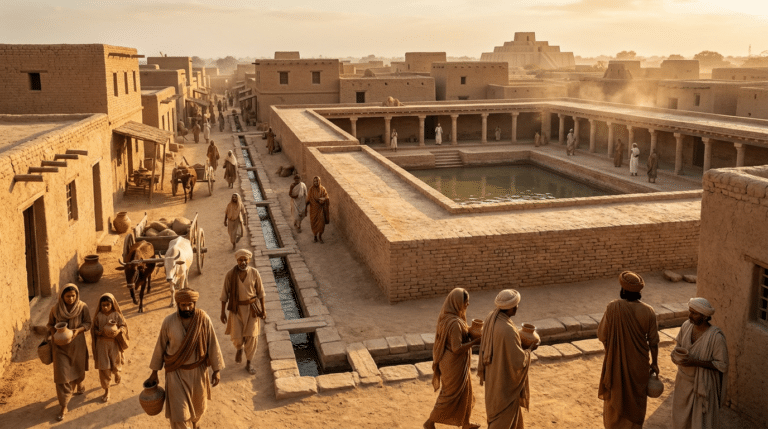
In places such as the Indus Valley, water management was integrated into urban design. In the Roman world, aqueducts allowed some cities to expand beyond the immediate reach of local springs.
The deeper lesson
Ancient water systems are sometimes presented as technological curiosities: impressive pipes, tunnels and aqueducts that make us marvel at engineering.
But their deeper significance is social.
Water infrastructure reveals how a civilization organized labor, taxation, maintenance, public space and access to essential resources.
A city is never simply a collection of buildings. It is a system for moving necessities through a landscape.
And of all those necessities, water is the one no city can negotiate with.
How did ancient engineers keep water moving?
Moving water through a city required more than finding a source. Engineers had to account for elevation, distance, friction, leakage and seasonal changes. Gravity-fed channels worked only when the route maintained an appropriate slope.
That meant surveying the landscape carefully. The famous Roman aqueducts are impressive partly because the required gradient could be maintained across long distances without modern instruments.
Storage was a form of resilience
Cisterns and reservoirs reduced dependence on a single moment of rainfall or river flow. A city with storage could survive short periods when its normal water source was unreliable.
Storage also changed the political importance of water. Whoever controlled reservoirs, wells or distribution points could influence the security of an entire community.
Water quality was a separate engineering problem
Ancient societies understood that some water sources were better than others, but they did not possess modern microbiology. A clear-looking spring could still contain pathogens, and a drainage channel could reduce visible waste without eliminating disease.
It is therefore misleading to describe every ancient water system as “clean” in the modern public-health sense.
Wastewater had to follow gravity too
Drainage channels could remove household wastewater and stormwater from populated areas. Some systems were connected to larger sewers, while others emptied into streets, fields or waterways.
The destination mattered. Moving waste away from one neighborhood did not necessarily make the wider environment clean.
Baths were social infrastructure
In Roman cities, public baths were not simply places for hygiene. They were social spaces, meeting places and demonstrations of civic investment.
The water system therefore supported culture as well as survival. Infrastructure shaped how people spent time together.
Ancient water systems reveal inequality
A city could have spectacular aqueducts while access remained uneven. Wealthy households might receive better connections, while poorer residents relied on public fountains or local sources.
This is an important reminder that infrastructure and equality are different questions. Technology can expand a resource without distributing it equally.
Maintenance was the hidden achievement
Building a reservoir or aqueduct was only the beginning. Sediment, mineral deposits, leaks and structural damage accumulated over time.
Keeping a water system functioning required workers, authority, funding and knowledge. The long life of some ancient systems therefore reveals not only engineering ability but institutional continuity.
Why water shaped civilization
Ancient water management sits at the intersection of engineering, geography and politics. Cities could grow because people learned to move, store and distribute water.
The lesson remains relevant: urban civilization depends less on buildings than on invisible systems that move necessities through the landscape.
A large ancient city could not survive on buildings alone. Thousands of people needed water every day for drinking, cooking, washing, craft production, animals and agriculture. Yet the hardest part was not simply finding a spring or river. It was turning an unpredictable natural resource into something a city could depend on.
That required a chain of decisions: where to obtain water, how to capture it, how to move it, where to store it, who could access it, and what happened after it was used. Different civilizations answered those questions differently because geography, climate, geology and political organization were different.
Ancient water management is therefore best understood not as a collection of impressive monuments, but as urban systems engineering. A well, reservoir, canal, aqueduct, drain or cistern was one component of a larger network.
There was no single ancient solution
A city beside a dependable river had a fundamentally different water problem from a settlement on a dry plateau. Some communities could draw directly from surface water. Others depended heavily on groundwater, springs, seasonal rainfall or stored supplies.
Terrain mattered just as much. A mountain spring could provide water through gravity, while a low-lying source might require lifting devices. In regions with intense seasonal rainfall, the central problem could be capturing enough water during wet months to survive dry ones.
This is why ancient water systems can look radically different while solving the same underlying problem: matching a fluctuating natural supply to a relatively constant human demand.
Wells turned geology into infrastructure
Groundwater was one of the most dependable resources available to ancient communities. A well could provide access to water even when a river was distant or its level changed seasonally.
But a well was not simply a hole in the ground. Builders had to understand where water-bearing layers could be reached and reinforce the shaft against collapse. The design also had to accommodate the methods available for lifting water.
Across the ancient world, communities developed different water-lifting technologies, from simple buckets and ropes to more elaborate devices. Their effectiveness depended on depth, volume and the energy available to operate them.
Wells also reveal an important limitation of the archaeological record. Finding a well tells us that groundwater was accessible, but not necessarily how much water it supplied or how evenly that supply was shared among residents.
A deeper look: Storage solved the problem of time
Rain and river flow rarely arrive at exactly the moment a city needs them. Storage allowed ancient communities to separate the timing of supply from the timing of demand.
Cisterns collected rainfall or other supplies. Reservoirs could hold larger quantities. Tanks and basins could regulate distribution or provide settling space. In dry environments, storage could mean the difference between surviving a seasonal shortage and facing severe disruption.
The principle is remarkably modern. Contemporary cities also use reservoirs because water demand continues when rainfall does not. What changed over time was the scale, materials and scientific understanding—not the underlying systems problem.
Gravity was an ancient engineering technology
The famous Roman aqueducts are often pictured as monumental rows of arches. Those structures are visually striking, but many aqueduct routes actually ran underground, through tunnels or along relatively modest channels.
The essential technology was gravity.
Water starting at a higher elevation can move toward a lower destination if a channel maintains an appropriate gradient. The challenge is that the slope must be carefully controlled. Too little gradient may slow flow and encourage sedimentation; too much can increase velocities and damage channels.
Maintaining a workable route across hills and valleys required surveying, construction knowledge and sustained maintenance. Roman aqueducts demonstrate this particularly clearly, but the broader principle was not uniquely Roman. Gravity-fed water transport appeared in many regions where terrain made it practical.
The source was only the beginning
A city needed more than a supply line. Water had to enter the urban environment and reach places where people could actually use it.
That could mean public fountains, wells, tanks, household connections, workshops, gardens, baths or other distribution points. The arrangement depended on the city and its institutions.
This distinction matters because an impressive aqueduct does not automatically mean universal household access. Infrastructure can deliver water to a city without distributing it equally among its inhabitants.
Water infrastructure was also social infrastructure
Public water points could become important parts of urban life. They were places where people collected water, encountered neighbors and interacted with civic institutions.
In the Roman world, baths provide an especially clear example. They were associated with washing, but also with recreation, conversation and social life. Supplying them required an infrastructure system that connected distant sources with dense urban populations.
Access, however, could depend on wealth, location, occupation and political status. A city could possess remarkable water engineering while still having significant differences in who received convenient or abundant supplies.
Fresh water and wastewater were separate problems
One of the easiest mistakes is to treat water supply and sanitation as the same achievement. They are not.
Bringing water into a settlement does not automatically prevent contamination. Used water, human waste, animal waste and stormwater still have to be managed. Ancient cities developed drains, channels, sewers, cesspits and other arrangements, but these varied enormously.
Drainage could reduce standing water and move waste away from busy areas. Yet moving waste away from one street did not necessarily make the wider environment hygienic. A channel could carry contaminated material directly into a river or another part of the settlement.
Modern microbiology also changes how we understand the word “clean.” Ancient builders could identify desirable sources, keep certain supplies away from obvious contamination and design effective drainage without knowing about bacteria, viruses or many waterborne pathogens.
Drainage had to deal with rain as well as waste
Urban drainage was not only about sewage. Heavy rainfall could turn streets into channels of moving water, threaten buildings and erode surfaces.
Good drainage therefore had multiple functions: removing household wastewater, controlling stormwater and protecting infrastructure. The exact balance depended on local climate.
This is one reason ancient urban water systems should not be judged solely by whether they resemble modern sewers. They were responses to particular environmental pressures using the materials and knowledge available at the time.
A deeper look: Maintenance was the hidden achievement
Construction tends to leave spectacular archaeological remains. Maintenance usually does not.
Channels could accumulate sediment. Pipes could clog. Mineral deposits could narrow passages. Reservoirs could fill with material. Wells could deteriorate or become contaminated. Earthquakes, floods and shifting ground could damage structures.
Keeping a water network operational therefore required recurring labor and institutional organization. Someone had to inspect it, repair it, clean it and decide how scarce water would be allocated.
This makes maintenance one of the most revealing parts of ancient water management. A ruler could commission a magnificent structure, but a functioning system required knowledge and resources to persist after the original construction project ended.
Water management could reveal political power
Large water systems required decisions about land, labor, materials and access. That made water management partly a political problem.
Who controlled the source? Who paid for construction? Who maintained the channels? Who could draw water first during shortages? Who was responsible for repairing damage?
Archaeology cannot always answer those questions directly. But the scale and organization of infrastructure can provide evidence for the institutions capable of coordinating work beyond an individual household.
Water could therefore strengthen cities while also becoming a means through which authority was expressed.
Ancient systems could fail
No water network was permanent. Drought could reduce supplies. Floods could destroy infrastructure. Rivers could change course. Groundwater levels could fall. Sediment could accumulate. Political disruption could interrupt maintenance.
Sometimes the problem was not technological weakness at all. An engineering system designed for one environmental or political situation could become poorly matched to a changed one.
This is an important archaeological lesson. When a settlement declined, it is tempting to search for one dramatic cause. Water systems instead remind us that urban resilience is usually cumulative: environmental change, infrastructure damage, political instability and population shifts can interact.
A deeper look: Water shaped where cities could grow
The location of rivers, springs and groundwater influenced settlement patterns. But engineering could modify those constraints.
In the Indus Valley, drainage and water-management features were integrated into urban design in several settlements. In the Roman world, aqueducts allowed some cities to draw on sources beyond their immediate surroundings.
Neither example means that ancient cities had unlimited control over nature. Rather, infrastructure extended the range of places where dense settlement was practical.
What archaeology can actually tell us
Ancient water systems are unusually valuable because physical traces can survive: channels, wells, reservoirs, pipes, drains, plastered surfaces and sediment layers.
But interpretation still requires caution. A basin may have had more than one function. A channel identified as an aqueduct may have been modified over time. A drainage feature does not automatically reveal how residents used it. And the survival of monumental infrastructure can distort our view toward elite or state-sponsored projects.
The strongest reconstructions therefore combine architecture with geology, hydrology, sediment analysis, inscriptions, settlement patterns and comparative evidence.
Why ancient water engineering still matters
The most interesting lesson is not that ancient people built impressive aqueducts. It is that they understood, through repeated experience, a problem every city still faces: natural water supply is variable, while human demand is continuous.
They responded with combinations of capture, storage, transport, distribution and drainage. Their solutions were imperfect, sometimes unequal and constrained by limited scientific knowledge. But they were often carefully adapted to local landscapes.
A city is therefore more than its walls, temples and houses. Beneath the visible architecture lies another city: the network that moves water through it, protects it from excess water and determines who can reach the resource.
That invisible network may tell us as much about an ancient civilization as its monuments do.
Curiosity Publication by Aadvik Agastya
Sources & further reading
Have a question about this topic?
Join fellow Qurons on the Quron Forum to ask questions, challenge ideas, share discoveries and explore further.
Discuss on Quron Forum