More than four thousand years ago, cities flourished across one of the largest cultural regions of the Bronze Age world.
They had streets laid out with remarkable regularity, standardized bricks, wells, drainage systems, craft workshops and long-distance trade networks. Their settlements stretched across parts of present-day Pakistan, northwestern India and neighboring regions.
Yet the people who built these cities remain unusually difficult to understand.
We can walk through their streets. We can examine their pottery, seals, beads and tools. We can reconstruct parts of their houses and water systems. But the writing associated with the civilization has not been securely deciphered.
The result is one of archaeology’s great paradoxes: the physical civilization is remarkably visible while much of its written voice remains inaccessible.
What Was the Indus or Harappan Civilization?
The civilization is commonly called the Indus Valley Civilization, Indus Civilization or Harappan Civilization. “Harappan” is often preferred by archaeologists because the archaeological tradition extended far beyond the Indus Valley itself.
Its major urban phase is generally placed in the third millennium BCE, although the cultural sequence began earlier and continued through later periods.
Harappa and Mohenjo-daro are among the best-known cities, but the civilization included hundreds of settlements of different sizes. Some were major urban centers, while others were towns, villages, craft sites or specialized settlements.
This diversity is important. The Harappan world was not simply a collection of identical cities.
A Civilization Spread Across an Enormous Area
The geographic scale of the Harappan cultural sphere is remarkable.
Settlements and material remains have been identified across regions with very different environments, including river plains, semi-arid areas and coastal zones.
Such geographic diversity means that communities had to adapt to different water supplies, agricultural conditions and local resources.
At the same time, archaeologists see recurring patterns in artifacts, construction methods, weights, seals and craft traditions that suggest communication and shared conventions across long distances.
Why Were Harappan Cities So Carefully Planned?
Urban planning is one of the most striking features of mature Harappan settlements.
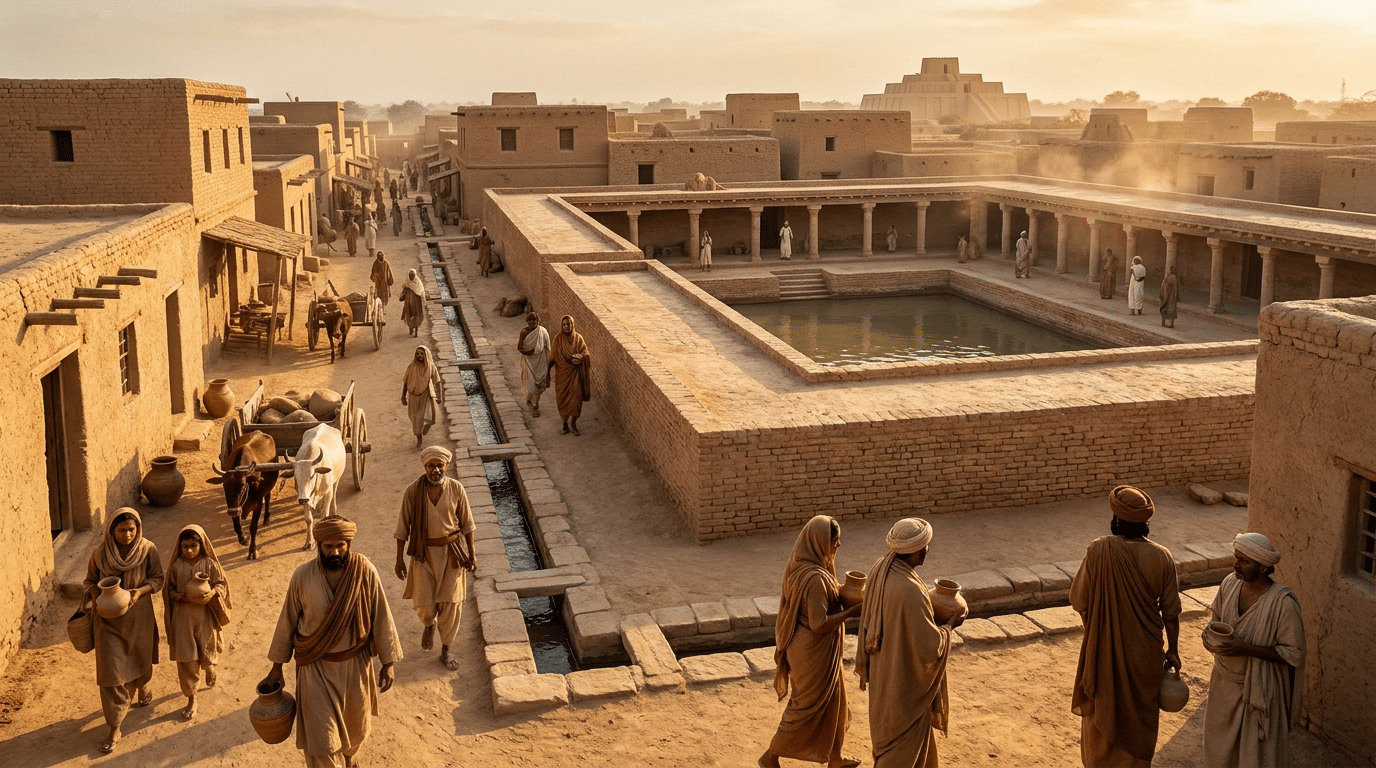
At several sites, streets and buildings show considerable organization. Bricks often follow standardized proportions, and construction appears to have been governed by shared conventions.
This does not automatically mean that every city was controlled by a single central government. Standardization can arise through many forms of institutional coordination, shared cultural practices, professional knowledge or networks of exchange.
In fact, the archaeological evidence does not clearly establish a single Harappan emperor or capital controlling the entire civilization.
The Extraordinary Importance of Water
Water management was central to many Harappan settlements.
Wells, drains, bathing spaces, reservoirs and carefully constructed channels demonstrate that communities invested heavily in controlling and distributing water.
Mohenjo-daro is especially famous for its extensive drainage infrastructure and the Great Bath, a large carefully constructed tank whose precise function remains debated but which clearly had considerable architectural significance.
Water management was not simply a technological achievement. It affected hygiene, household organization, construction and urban life.
Was the Drainage System Really That Advanced?
Popular descriptions sometimes portray Harappan cities as possessing a modern sanitation system. That is too strong.
The archaeological evidence does show impressive planning and drainage in some settlements, but ancient systems should be understood in their own context. They were not equivalent to modern sewage treatment networks, water purification plants or municipal infrastructure.
The achievement is more specific and more interesting: Harappan communities developed durable systems for managing household water and waste within dense urban environments.
What Were the Houses Like?
Harappan houses varied in size and design, but many urban buildings were constructed around courtyards and included spaces associated with bathing or water use.
Doors and rooms often opened toward internal spaces rather than directly onto major streets, although layouts varied.
Because houses are archaeological remains rather than written descriptions, interpretation requires caution. A room’s function cannot always be known with certainty simply from its shape.
Who Ruled the Cities?
This is one of the biggest unanswered questions.
Many ancient civilizations left behind palaces, royal tombs, monumental statues or inscriptions naming rulers. Harappan archaeology provides much less obvious evidence for kingship.
There are large structures and substantial public works, but their political meaning is debated.
Some researchers have proposed centralized authority; others emphasize more distributed forms of political organization. The available evidence does not currently justify reducing the entire civilization to one political model.
Where Are the Palaces?
The relative absence of unmistakable royal palaces or monumental royal tombs has attracted considerable attention.
This does not mean Harappan society was egalitarian in the modern sense. Differences in house size, access to goods and burial practices can indicate social distinctions.
It does mean that the archaeological expression of political power differed from some contemporary Bronze Age civilizations such as Egypt or Mesopotamia.
Craftsmen and Specialized Production
Harappan settlements contain evidence of skilled craft production.
Bead-making was particularly important. Carnelian, shell, faience, copper alloys, stone and other materials were worked into ornaments, tools and other objects.
Some sites appear to have specialized in particular crafts, suggesting organized production and knowledge of material properties.
Craft production also provides clues about trade because raw materials were not always available near the places where finished objects were found.
Trade Reached Beyond the Indus Region
Harappan communities participated in long-distance exchange networks.
Archaeological finds indicate connections involving materials such as carnelian, shell, metals and other goods. Mesopotamian sources mention a region called Meluhha, which many scholars associate with the Indus cultural sphere.
Harappan-style artifacts and seals have been found in contexts connected with Mesopotamia, providing evidence that goods and perhaps people or merchant communities moved across substantial distances.
This places the Indus civilization within a wider Bronze Age world of maritime and overland exchange.
What Were the Seals For?
Harappan seals are among the civilization’s most recognizable artifacts.
Many depict animals or other motifs alongside short inscriptions. Their exact functions remain debated. They may have been connected with administration, trade, identity, ownership or ritual practices, and different seals may have served different purposes.
Their importance is amplified by the writing they carry.
The Indus Script Problem
The Indus script remains undeciphered in the sense that no interpretation has achieved broad scholarly acceptance and demonstrated its reliability across the corpus.
Many inscriptions are extremely short. There is also no securely identified bilingual inscription comparable to the Rosetta Stone that would provide a straightforward key.
This creates a severe limitation. Without readable administrative records, historians cannot easily recover the names of rulers, detailed political events, laws or narratives in the civilization’s own words.
Attempts to decipher the script continue, but proposed solutions must explain the entire evidence rather than only a handful of signs.
What Can Archaeologists Learn Without Reading the Script?
Quite a lot.
Archaeologists can reconstruct settlement layouts, manufacturing processes, diet, trade, environmental conditions and patterns of resource use from physical evidence.
Plant remains reveal aspects of agriculture. Animal bones can provide information about diet and herding. Isotopic studies can help investigate movement and food sources. Sediments and ancient river landscapes can reveal environmental change.
Objects also preserve technological information. The composition of metals, the production of ceramics and the manufacture of beads can reveal how specialized knowledge was organized.
What Did Harappans Eat?
Foodways varied across the enormous geographic range of the civilization.
Archaeological evidence indicates the use of crops such as wheat and barley in many areas, along with other regionally important plants. Rice, millets and other crops appear with different patterns across time and place.
Animal remains also indicate the use of cattle, sheep, goats and other animals, while fish and other aquatic resources were important in some settlements.
The diversity of food evidence is another reason it is dangerous to describe the civilization as a single uniform society.
Religion Is Harder to Reconstruct
Religious interpretation is among the most difficult areas of Harappan archaeology.
Figures on seals, unusual structures, animal imagery and ritual-looking spaces have inspired many theories. Some interpretations have linked them to later South Asian religious traditions.
But visual resemblance is not proof of continuity.
A symbol can have different meanings in different historical contexts. Without readable texts or clear evidence connecting an object to a specific belief system, religious interpretations must remain cautious.
Why Did the Urban System Change?
The mature urban phase did not simply end in one catastrophic event.
After the peak of urbanization, many large settlements declined in size or changed their organization. Populations and cultural practices continued, but the highly urbanized system became less prominent.
Researchers have proposed several contributing factors, including changes in monsoon patterns, river-system transformations, shifting trade networks and changes in agricultural strategies.
The current picture is increasingly one of regional transformation rather than a single civilization-wide disaster.
The River Question
Rivers were central to Harappan settlement, but their courses have changed dramatically over geological and historical time.
Some ancient channels can be reconstructed through sediment studies, satellite imagery and geomorphology. Such work has helped researchers understand why settlements appeared where they did and how environmental changes may have affected agriculture and transport.
But the idea that one mysterious river simply “disappeared” and caused the entire civilization to collapse is too simplistic. Different regions experienced different environmental histories.
Climate Change Was Probably Not a Single Switch
Climate affects civilizations through agriculture, water availability, vegetation and trade. But climate change rarely operates as a single on-off mechanism.
Changes in rainfall can occur gradually or vary regionally. Communities can adapt through changes in crops, settlement locations, water management and economic relationships.
The archaeological evidence suggests that Harappan communities did adapt. The end of urban concentration did not mean the disappearance of the population.
Did the Harappans “Disappear”?
No.
This is one of the most persistent misconceptions about the civilization.
The large urban centers declined, but populations continued living across the broader region. Material traditions changed, settlement patterns shifted and later archaeological cultures emerged.
The story is better described as a transformation of the Harappan urban system than the sudden extinction of its people.
Why the “Forgotten Empire” Label Is Complicated
The title “forgotten empire” is evocative, but it can create the wrong expectation.
We do not have clear evidence for an empire in the same sense as later territorial states ruled by known dynasties. The civilization may instead have consisted of multiple urban centers and rural communities connected through shared conventions and exchange networks.
Its achievements do not require an emperor.
Coordinated standards, trade and infrastructure can emerge through complex institutions without leaving behind the unmistakable monuments of centralized monarchy.
What Makes the Indus Civilization So Important?
Harappan archaeology changes the way we think about what a civilization can look like.
Its cities demonstrate large-scale organization without providing an obvious royal narrative. Its infrastructure is impressive without being accompanied by long historical inscriptions. Its trade was extensive even though its script remains unreadable.
It forces historians to reconstruct society from material evidence rather than relying on written stories about kings and wars.
The Physical City Is Still Speaking
Every drain, brick, bead, seal and workshop is a fragment of a much larger story.
Archaeologists cannot ask a Harappan mason what a building meant or a merchant what a seal represented. But patterns in thousands of objects can reveal how people lived, moved goods, built cities and responded to changing environments.
That evidence is incomplete, but it is not silent.
The Bigger Mystery
The Indus Civilization is not mysterious because its people were somehow beyond our understanding. It is mysterious because one crucial source of information—their writing—remains inaccessible.
Everything else is an invitation to reconstruct their world carefully.
We can see the streets. We can trace the drains. We can study the beads. We can identify trade connections. We can reconstruct changing river landscapes and investigate climate records.
But somewhere among the seals and inscriptions may be a written language capable of answering questions archaeology alone cannot.
The great unanswered question is not simply why the Harappan cities declined. It is what the people who built them would tell us about their world if we could finally read their words.
Curiosity Publication by Aadvik Agastya
Sources & further reading
Have a question about this topic?
Join fellow Qurons on the Quron Forum to ask questions, challenge ideas, share discoveries and explore further.
Discuss on Quron Forum