Black holes are among the strangest objects predicted by modern physics. They are not holes in the ordinary sense and they are not cosmic vacuum cleaners. They are regions of spacetime where gravity becomes so extreme that, beyond a boundary called the event horizon, signals cannot escape to distant observers.
The idea sounds almost impossible: an object can become so compact that even light cannot get away. Yet black holes are no longer merely mathematical curiosities. Astronomers observe their effects on stars and gas, detect gravitational waves from their mergers and can image the bright environment surrounding their shadows.
At the same time, black holes expose some of the deepest unresolved problems in physics. They bring together gravity, quantum mechanics, thermodynamics and the nature of information.
How does a black hole form?
One route begins with a massive star. A star spends much of its life balancing inward gravity against outward pressure generated by nuclear reactions. When a sufficiently massive star exhausts the processes supporting its core, gravity can take over.
The core may collapse catastrophically. Depending on the mass and circumstances, the result can be a neutron star or a black hole.
Black holes can also grow after formation. They can accrete matter and merge with other compact objects. Over cosmic time, these processes can produce much larger black holes.
Stellar-mass and supermassive black holes
Stellar-mass black holes have masses comparable to those of stars and can form from stellar collapse or compact-object mergers.
At the centers of many galaxies are supermassive black holes containing millions or billions of solar masses. Their origins and early growth remain active areas of astronomical research.
There is also evidence for black holes between these broad categories, often called intermediate-mass black holes, although identifying such objects observationally can be challenging.
A black hole is not a cosmic vacuum cleaner
Gravity is determined by mass and distance. If the Sun were magically replaced by a black hole with exactly the same mass, Earth’s orbit would not suddenly spiral inward simply because the central object had become a black hole.
The difference is that a black hole can pack that mass into an extraordinarily small region. Matter that approaches sufficiently closely can encounter extreme tidal forces and strong relativistic effects.
So the danger is not that black holes “suck” from arbitrary distances. It is that their compactness creates an extreme gravitational environment near them.
What is the event horizon?
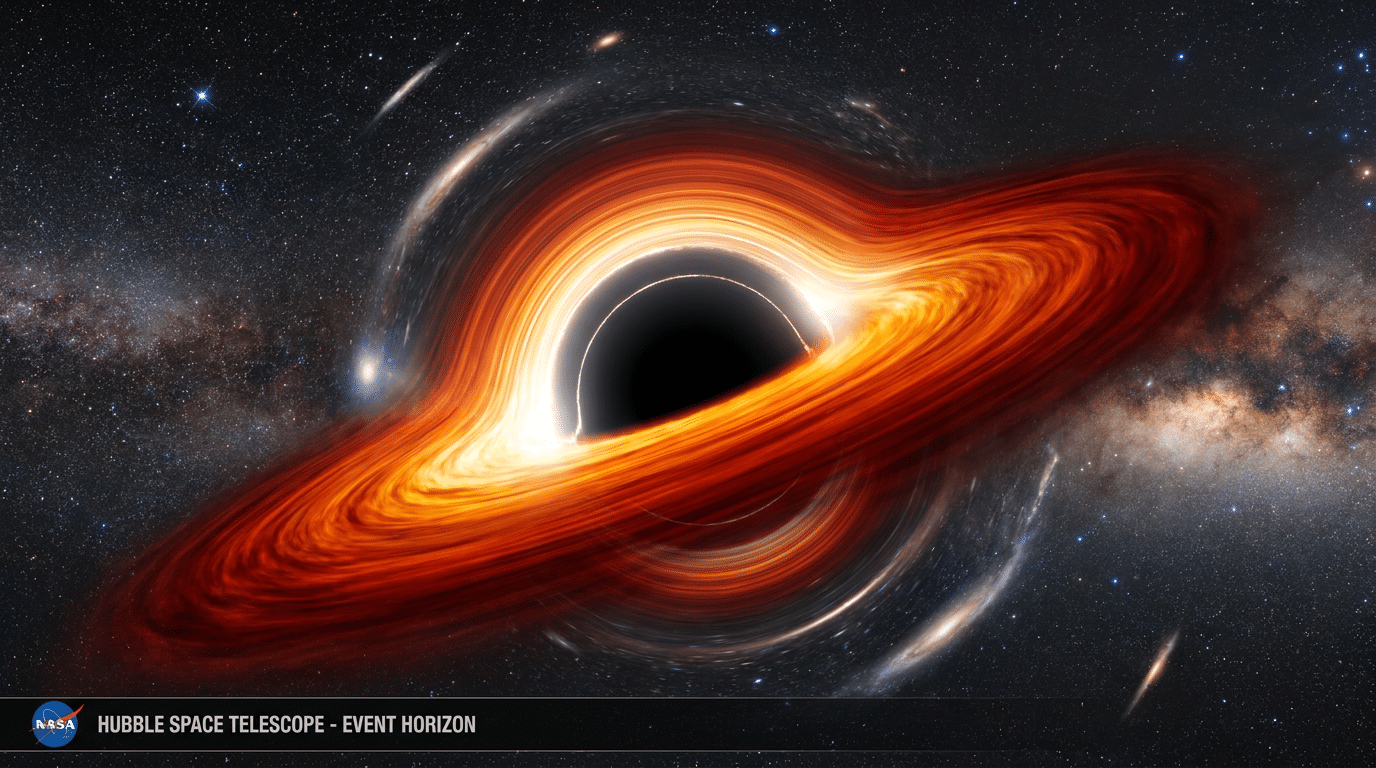
The event horizon is not a solid surface. It is a causal boundary.
Outside the horizon, light and matter can in principle travel outward. Inside it, every future-directed path leads deeper into the black hole rather than back to the distant universe.
This is a consequence of spacetime geometry in general relativity.
Why can light not escape?
A common mental picture says that gravity becomes stronger than the speed of light. That is not the most accurate way to describe the situation.
Locally, light still travels at the speed of light. The crucial change is the structure of spacetime itself. Inside the event horizon, the available future directions all lead toward smaller radial distances. There is no outward route that carries information back to the exterior.
The event horizon is therefore best understood geometrically rather than as an invisible material barrier.
What would happen to an object falling in?
For a sufficiently large black hole, an observer falling through the event horizon might not encounter a dramatic physical boundary at that exact moment. The experience depends on the black hole’s size and the observer’s trajectory.
Closer to the black hole, however, the difference in gravitational pull across an extended object can become enormous. These tidal forces can stretch matter along one direction and compress it along another—a phenomenon popularly called spaghettification.
For smaller black holes, tidal forces near the horizon can be particularly severe.
Why black holes can be surrounded by brilliant light
The black hole itself does not emit ordinary light from inside its event horizon. But material around it can become extraordinarily bright.
Gas and dust falling inward can form an accretion disk. As material moves through the disk, gravitational energy is converted into heat and radiation. Magnetic fields can also influence the flow and help launch powerful outflows.
This is why some systems containing black holes can shine across the electromagnetic spectrum.
Relativistic jets
Some accreting black holes produce narrow, powerful jets that travel outward at speeds approaching that of light.
These jets are associated with magnetic fields and the environment around the black hole and its accretion disk. They can extend enormous distances beyond the immediate vicinity of the black hole.
Jets are therefore another example of an important distinction: the black hole itself is dark, but its surroundings can generate some of the universe’s most energetic phenomena.
How can astronomers observe something invisible?
A black hole can be detected through its gravitational influence.
A star orbiting an apparently empty region may reveal the presence of an unseen massive object. Gas moving rapidly around a compact source can provide another clue. Radiation from an accretion disk can reveal the environment around the black hole.
A particularly dramatic method is gravitational-wave astronomy.
Black-hole mergers shake spacetime
When two black holes orbit one another, the system can lose energy through gravitational waves. The orbit shrinks, the objects merge and the resulting disturbance propagates outward through spacetime.
Detectors such as LIGO and Virgo have observed gravitational-wave signals consistent with black-hole mergers.
These observations provide information about the masses, spins and distances of the merging objects and opened an entirely new way of studying the universe.
What is a black-hole shadow?
In 2019, the Event Horizon Telescope collaboration released the first image of the environment around the supermassive black hole in galaxy M87.
The image did not show a solid black sphere. It showed glowing emission from hot material around a dark central region whose appearance is shaped by the extreme bending of light near the black hole.
This dark region is often called the black-hole shadow.
Why gravity bends light
General relativity describes gravity not simply as a force pulling objects through fixed space, but as the curvature of spacetime produced by mass and energy.
Light follows the geometry of spacetime. Near a black hole, that geometry is strongly curved, causing light paths to bend dramatically.
This creates the characteristic structures observed around black holes and allows the shadow to carry information about the compact object’s gravitational environment.
Hawking radiation changed the story
In the 1970s, Stephen Hawking showed that quantum effects near an event horizon imply that black holes should emit thermal radiation when viewed from far away.
This is known as Hawking radiation.
For astrophysical black holes, the predicted radiation is extraordinarily weak compared with the radiation from their surroundings, making direct observation extremely difficult.
The theoretical result is nevertheless profound because it connects black holes with quantum mechanics and thermodynamics.
Black holes have a temperature
Hawking’s result means that black holes can be assigned a temperature related inversely to their mass. Larger black holes are colder; smaller ones are hotter.
They also have an entropy proportional to the area of their event horizon, a result that helped reveal that gravity, information and thermodynamics are deeply connected.
The black-hole information paradox
Quantum mechanics treats information as fundamental. Yet if a black hole forms from matter and eventually evaporates through Hawking radiation, a difficult question appears: what happens to the information describing the original matter?
If the radiation is purely thermal and contains no recoverable information about what fell in, the process seems to conflict with a basic principle of quantum theory.
This is the black-hole information paradox, one of the most famous problems in theoretical physics.
Possible solutions remain under debate
Physicists have proposed many approaches to the information problem. Ideas involving black-hole complementarity, holography, quantum entanglement, quantum extremal surfaces and other concepts have changed how researchers think about the problem.
There has been major theoretical progress, but there is not yet a single experimentally confirmed account that resolves every aspect of black-hole information.
What is at the center?
Classical general relativity predicts that gravitational collapse can lead to a singularity, where quantities such as curvature become mathematically divergent in the idealized theory.
Many physicists interpret this as a sign that classical general relativity has reached the limit of its applicability rather than as a complete physical description of an actual infinite-density point.
A successful theory of quantum gravity may be needed to understand the deepest interior.
Do black holes destroy matter?
From the perspective of an outside observer, matter crossing the event horizon becomes inaccessible as an ordinary source of signals. But saying that matter is simply “destroyed” is too strong.
The full question depends on how quantum gravity describes the interior and the fate of information. This is precisely why the subject remains an active theoretical problem.
Why black holes matter to cosmology
Supermassive black holes appear to be closely connected with the evolution of galaxies. Active black holes can release enormous amounts of energy into their surrounding environments, potentially influencing gas and star formation.
Understanding which came first—the black hole, the galaxy or some coupled growth process—is an important question in modern astrophysics.
Black holes are laboratories for extreme physics
Black holes allow scientists to test gravity in regimes that cannot be reproduced on Earth. Their mergers test general relativity through gravitational waves. Their environments test high-energy plasma physics. Their thermodynamics raises questions about quantum information.
Few objects connect so many areas of physics.
The mystery is not simply that black holes are dark
We now have strong observational evidence for black holes as astrophysical objects. We can trace their gravitational effects, detect their mergers and observe the bright environments around them.
The deeper mystery begins where our theories have to work together.
General relativity explains gravity and spacetime on large scales with extraordinary success. Quantum theory explains microscopic physics with extraordinary success. Black holes force those descriptions into the same problem.
That is why they remain among the universe’s most valuable natural laboratories—not because everything about them is unknown, but because what we know points directly toward what we do not yet understand.
Curiosity Publication by Aadvik Agastya
Sources & further reading
- NASA — Black Holes
- Event Horizon Telescope Collaboration
- LIGO — Gravitational-Wave Astronomy
- Stanford Encyclopedia of Philosophy — Black Holes
Have a question about this topic?
Join fellow Qurons on the Quron Forum to ask questions, challenge ideas, share discoveries and explore further.
Discuss on Quron Forum