Ancient Indian literature contains descriptions of vast cosmic realms, celestial beings, extraordinary journeys and worlds that exist beyond the ordinary human experience. In modern discussions, some of these passages are presented as possible evidence that ancient India knew about extraterrestrial civilizations.
That interpretation is intriguing, but it requires a distinction that is often lost in popular retellings: an ancient text can contain an imaginative account of the cosmos without being an astronomical report in the modern scientific sense.
The Puranas are particularly interesting because they preserve elaborate cosmological, theological and mythological traditions. They ask questions that remain recognizable today—How large is the universe? Are there other realms of existence? What kinds of beings might inhabit them? How does humanity fit into a much larger cosmos?—but they approach those questions through a religious and literary framework rather than through modern observational astronomy.
What Are the Puranas?
The word Purana is commonly associated with ancient or traditional narratives, but the Puranic corpus is not a single book written at one moment. It consists of numerous texts, traditionally associated with eighteen Mahapuranas along with other Puranic works. Their present forms reflect layers of composition, compilation and transmission over long periods.
The texts cover a remarkably broad range of subjects: creation and destruction of the cosmos, genealogies of gods and rulers, sacred geography, pilgrimage places, rituals, religious teachings, philosophical ideas, stories of divine beings and accounts of different cosmic ages.
This matters when evaluating claims about extraterrestrial life. A statement in a Purana cannot automatically be separated from the narrative and theological system around it and then treated as though it were a technical observation recorded by an astronomer.
A Universe Filled With Realms
One of the most striking features of Hindu cosmological traditions is their multi-layered conception of existence. Puranic literature describes different lokas, or realms/worlds, associated with different classes of beings and different levels of existence.
Lists and descriptions vary among texts and traditions, but familiar terms include Bhuloka, the human realm, along with higher realms such as Svarga and other lokas associated with divine or celestial beings. Some traditions also describe lower regions collectively associated with Patala.
To a modern reader, the idea of multiple inhabited worlds can sound like a description of extraterrestrial civilizations. Yet that translation is not straightforward.
A loka is embedded in a cosmology concerned with gods, karma, rebirth, moral order and different modes of existence. It does not necessarily mean a rocky planet orbiting another star. In some contexts the word can carry a much broader meaning than the modern astronomical category of a planetary world.
That distinction is important. Similarity of imagery is not the same thing as equivalence of concepts.
Who Inhabits These Realms?
Puranic narratives describe many classes of non-human beings. Devas, asuras, gandharvas, yakshas, nagas, apsaras and other beings appear in different stories and traditions, often with different roles and characteristics.
Modern popular culture can easily reinterpret such beings as extraterrestrials because they are sometimes described as living outside the ordinary human world, possessing extraordinary abilities or interacting with humans. But within the texts themselves, their identities are generally religious, mythological and cosmological.
Calling a deva an “alien” therefore changes the framework of the story. An extraterrestrial in modern astrobiology is a hypothetical organism that evolved somewhere beyond Earth. A deva in Puranic literature belongs to a different conceptual system involving divinity, cosmic order and religious mythology.
This does not make the ancient idea less interesting. It simply means that the comparison should be presented as a modern interpretation rather than as a translation of the original concept.
Did Ancient Indian Texts Describe Other Worlds?
They certainly describe a universe that extends far beyond the immediate human environment. Puranic cosmology includes enormous scales of time and space, multiple regions of existence and recurring cycles of creation and dissolution.
Indian traditions also developed sophisticated discussions of cosmic time. The familiar concepts of yugas, manvantaras and kalpas place human history inside vastly larger cycles. These are theological and cosmological concepts rather than measurements produced by modern physical cosmology, but they demonstrate that Indian thinkers were willing to imagine temporal scales dramatically larger than ordinary human lifetimes.
Descriptions of multiple realms and immense cosmic cycles can therefore create a genuine point of comparison with modern questions about the scale of the universe. The comparison becomes problematic only when it is presented as proof that the authors possessed modern astronomical knowledge.
What About Flying Vehicles?
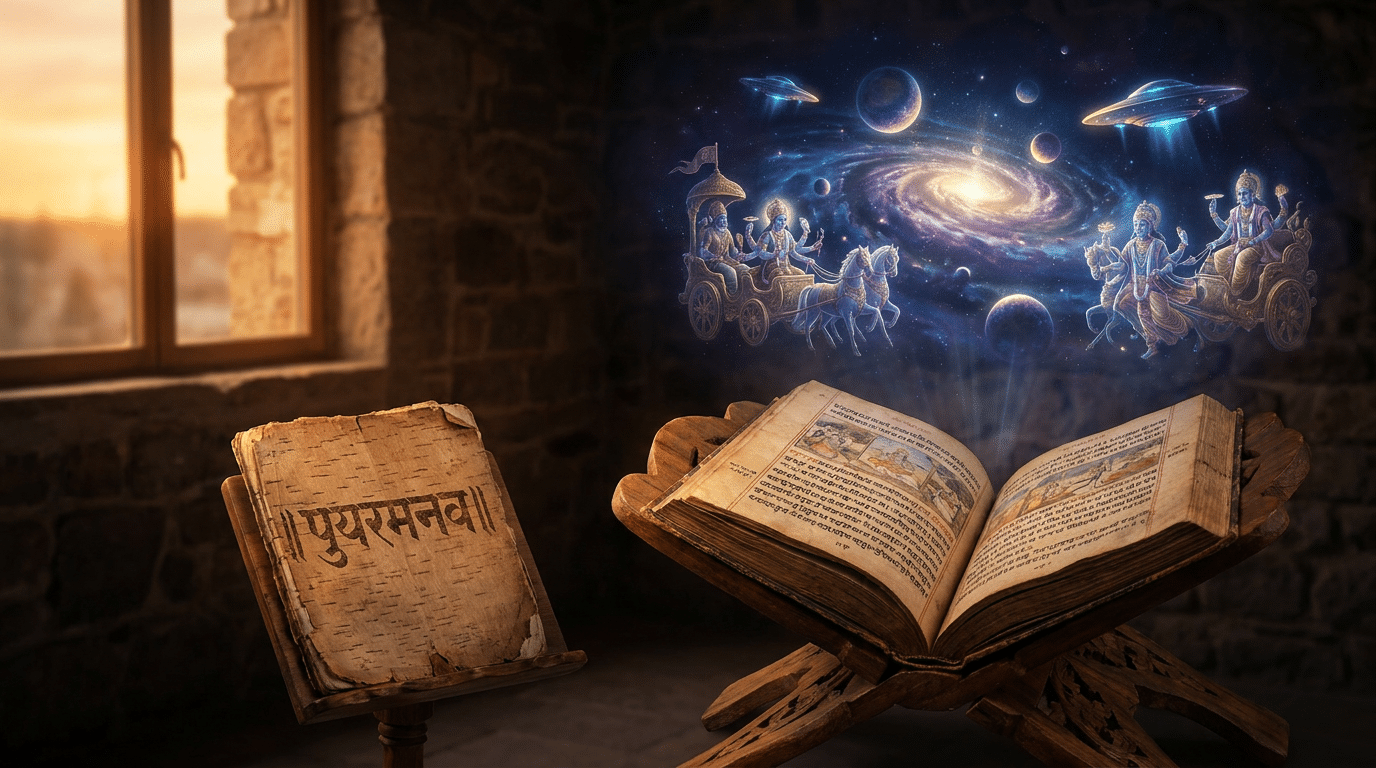
Another major source of extraterrestrial interpretations is the presence of extraordinary vehicles and aerial journeys in Indian literature. The Pushpaka Vimana, for example, is famous in the Ramayana tradition and later became part of a much wider modern discussion about ancient “flying machines.”
Stories of divine or supernatural vehicles are fascinating, but a vehicle appearing in an epic or mythological narrative is not by itself evidence of an engineered aircraft.
There is also an important chronological issue. Modern claims sometimes combine material from the Vedas, Puranas, epics and much later texts as though all of them were written at the same time. They were not. Indian literature developed over centuries, and individual works contain multiple layers of tradition.
The text known as the Vaimanika Shastra is particularly relevant to this discussion. Although often cited online as evidence of an ancient Indian aircraft tradition, scholarship has generally placed its surviving composition in the modern period rather than the distant antiquity sometimes claimed for it. It should therefore not be used as straightforward evidence that Vedic-era engineers built aircraft.
Why Does the Extraterrestrial Interpretation Persist?
The interpretation is partly driven by the remarkable visual language of the stories. A modern reader encountering accounts of celestial beings, journeys through the heavens, multiple realms and enormous cosmic distances may naturally notice similarities with ideas that appear in science fiction and astrobiology.
There is also a broader intellectual phenomenon at work. Humans routinely interpret unfamiliar information through familiar categories. When modern society has satellites, spacecraft, exoplanets and the possibility of extraterrestrial life in the cultural background, ancient stories about beings descending from the sky can acquire a technological interpretation that may not have been intended by their original audiences.
This does not mean every comparison is worthless. Comparisons can generate useful questions about how different civilizations imagined non-human life and the structure of the cosmos. The mistake is moving from interesting resemblance to historical proof without evidence connecting the two.
Could There Be Life Beyond Earth?
Modern science considers extraterrestrial life a legitimate scientific question because the universe contains an enormous number of stars and planets, and because the basic chemical ingredients associated with life are not unique to Earth.
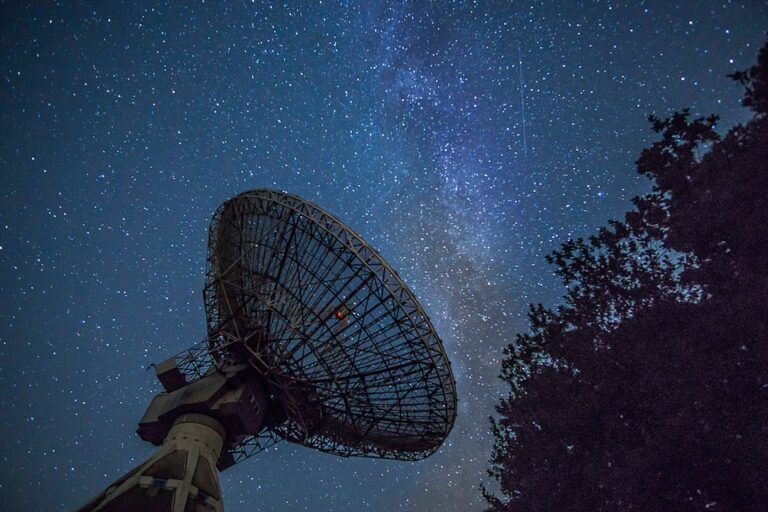
A number of research programs are therefore looking for evidence that can be tested. Scientists study potentially habitable environments, planetary atmospheres, organic molecules, conditions on icy moons and other possible biosignatures. Researchers also investigate technosignatures—the detectable effects that a technological civilization might produce.
None of this requires ancient texts to predict extraterrestrial life. The scientific case is built from observations, measurements, models and tests that can in principle be independently examined.
What Would Count as Evidence?
This is the key distinction between mythology and science.
A description of a celestial being in a religious text can be valuable historical and cultural evidence. It can tell us something about how people imagined the universe, divine beings or humanity’s place within existence. But it does not establish the biological existence of those beings.
Scientific evidence for extraterrestrial life would need to be something measurable and independently testable: for example, a biological signature in a planetary environment, a credible and independently confirmed technological signal, or physical material whose origin and biological significance could withstand rigorous investigation.
Even modern observations can be ambiguous. A molecule in an exoplanet atmosphere might have several possible sources. An unusual radio signal might turn out to be natural or human-made. A potentially habitable environment does not necessarily contain life. Evidence has to survive attempts to find alternative explanations.
Reading Ancient Cosmology on Its Own Terms
There is a deeper reason the Puranas deserve attention even without treating them as hidden science manuals.
They represent an attempt to place human existence inside an immense and layered universe. Their cosmology connects space, time, morality, divine beings, cycles of creation and the fate of living beings. That is an intellectually significant way of thinking about humanity’s place in existence.
Modern cosmology asks different questions using different methods, but the human impulse behind both can sometimes be surprisingly familiar: What lies beyond the visible world? Is our realm unique? How large is reality? Are there forms of existence we cannot perceive?
The fact that an ancient civilization asked such questions is historically interesting in its own right. It does not need to be converted into a claim about spacecraft or extraterrestrial visitors to become fascinating.
The Difference Between Inspiration and Evidence
Ancient texts can inspire modern questions about extraterrestrial life without constituting evidence for extraterrestrial life. That distinction allows two ideas to coexist without confusing their methods.
A person can read about multiple lokas and celestial beings and wonder whether the universe might contain forms of life unknown to us. That is a philosophical or imaginative connection. A scientist studying an exoplanet atmosphere is pursuing a different kind of question through observation and measurement.
The first can stimulate curiosity. The second can potentially produce empirical evidence.
Keeping those categories separate makes the discussion more interesting, not less. It allows ancient Indian cosmology to be appreciated for what it actually preserves while leaving modern astrobiology free to investigate what the universe may contain.
The Bigger Question
The Puranas do not provide a simple ancient prediction of extraterrestrial civilizations. They provide something more historically grounded: a rich cosmological tradition in which Earth is part of a much larger and layered order of existence.
Some of its imagery may remind modern readers of other worlds, celestial beings or journeys through space. But resemblance should not be confused with proof, and modern scientific concepts should not be retroactively inserted into ancient religious narratives without textual and historical justification.
Perhaps the most interesting question is therefore not whether the Puranas secretly described aliens. It is why humans across very different cultures repeatedly imagined worlds beyond their own—and why, thousands of years later, we are still looking upward and asking whether we are alone.
Curiosity Publication by Aadvik Agastya
Sources & further reading
- Encyclopaedia Britannica — Purana
- Oxford Reference — Hindu cosmological traditions
- Encyclopaedia Britannica — Hinduism
Have a question about this topic?
Join fellow Qurons on the Quron Forum to ask questions, challenge ideas, share discoveries and explore further.
Discuss on Quron Forum