Atlantis is perhaps the most famous lost civilization that archaeology has never securely found.
In the popular imagination, the story is familiar: an advanced island society, enormous wealth, a catastrophic destruction and a civilization swallowed by the sea. Explorers have searched oceans for it, writers have turned it into a symbol of lost knowledge, and modern theories have connected it with everything from Bronze Age disasters to prehistoric technology.
But the story begins in a much narrower place than the modern legend suggests.
Our earliest surviving detailed account of Atlantis comes from the Greek philosopher Plato. Understanding what Plato was doing with the story is essential before searching the oceans for a literal lost empire.
Where Does the Atlantis Story Come From?
Atlantis appears in Plato’s dialogues Timaeus and Critias, written in the fourth century BCE.
In the narrative, Atlantis is described as a powerful island civilization located beyond the Pillars of Heracles, commonly associated with the region of the Strait of Gibraltar. The Atlanteans possess considerable wealth and military power, and their society eventually becomes morally corrupted.
Plato then describes a conflict between Atlantis and ancient Athens. Atlantis is ultimately destroyed through earthquakes and floods, disappearing into the sea.
These details have become the foundation for thousands of later interpretations.
Was Plato Describing History?
This is the central historical question.
Plato presents the story through characters discussing events supposedly transmitted from ancient tradition. But the dialogues are philosophical works, not archaeological reports.
Plato repeatedly used constructed narratives, thought experiments and imagined political arrangements to explore philosophical questions. His ideal state, his discussions of justice and his accounts of cosmology all demonstrate how storytelling could be used as a tool for argument.
That does not prove beyond all possible doubt that Atlantis was invented. But it explains why historians and classicists are cautious about treating the account as straightforward eyewitness history.
Why the Story Appears in Two Dialogues
The structure of the dialogues matters.
Timaeus is primarily concerned with cosmology, nature, humanity and the structure of the universe. Atlantis appears within a larger discussion about an idealized ancient Athens and its relationship to a powerful rival.
Critias provides more detail about Atlantis itself, including its geography, political organization and wealth.
The unfinished state of Critias has also generated debate about what Plato intended to do with the story.
The Atlantis-Athens Contrast
One reason Atlantis may work so well as a philosophical narrative is its contrast with Athens.
Atlantis begins as a powerful and apparently ordered civilization, but its wealth and ambition eventually contribute to moral decline. Athens, by contrast, is presented as an idealized society capable of resisting the Atlantean power.
The story therefore allows Plato to explore questions about power, wealth, virtue and political decay.
That interpretation does not require Atlantis to be historically real. A fictional civilization can function as a philosophical model.
What Is the “Pillars of Heracles” Clue?
Plato places Atlantis beyond the Pillars of Heracles, traditionally associated with the entrance to the Atlantic from the Mediterranean.
This geographical detail has encouraged generations of explorers to search the Atlantic Ocean.
But ancient geographical descriptions do not map neatly onto modern coordinates. Place names, distances and the conceptual boundaries of the known world changed over time.
A single geographical clue therefore cannot identify a modern archaeological site by itself.
Could a Real Disaster Have Inspired the Story?
The Mediterranean world experienced catastrophic natural disasters long before Plato.
Earthquakes, volcanic eruptions, tsunamis, coastal subsidence and major storms could destroy settlements and reshape coastlines.
This makes the basic idea of a settlement destroyed by natural forces entirely plausible as a historical phenomenon.
But plausibility is not identification. Demonstrating that ancient cities could disappear beneath water does not demonstrate that one of them was Atlantis.
The Eruption of Thera
One of the most famous proposed inspirations is the enormous Bronze Age eruption of Thera, the island now known as Santorini.
The eruption was one of the largest volcanic events of the ancient Mediterranean. It devastated the local environment and was associated with major disruption to nearby communities.
The disaster is attractive as an Atlantis comparison because it combines a sophisticated Bronze Age society with catastrophic natural forces.
Yet the chronology and geographical details do not establish that Thera was Atlantis. The eruption occurred centuries before Plato, and the connection remains a hypothesis about possible inspiration rather than an archaeological identification.
Could a Tsunami Have Created the Story?
Large volcanic eruptions and earthquakes can generate tsunamis. Coastal settlements may be flooded, damaged or buried beneath sediments.
Archaeologists can sometimes identify such events through layers of unusual deposits, displaced material and abrupt environmental changes.
These discoveries demonstrate that catastrophic coastal destruction was part of the ancient Mediterranean experience.
But a tsunami layer cannot carry a label saying “Atlantis.” Researchers still need independent evidence connecting the event to the literary tradition.
What About Submerged Cities?
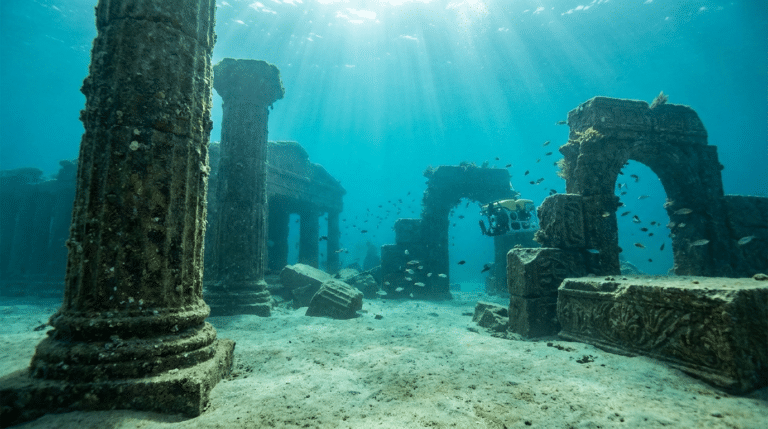
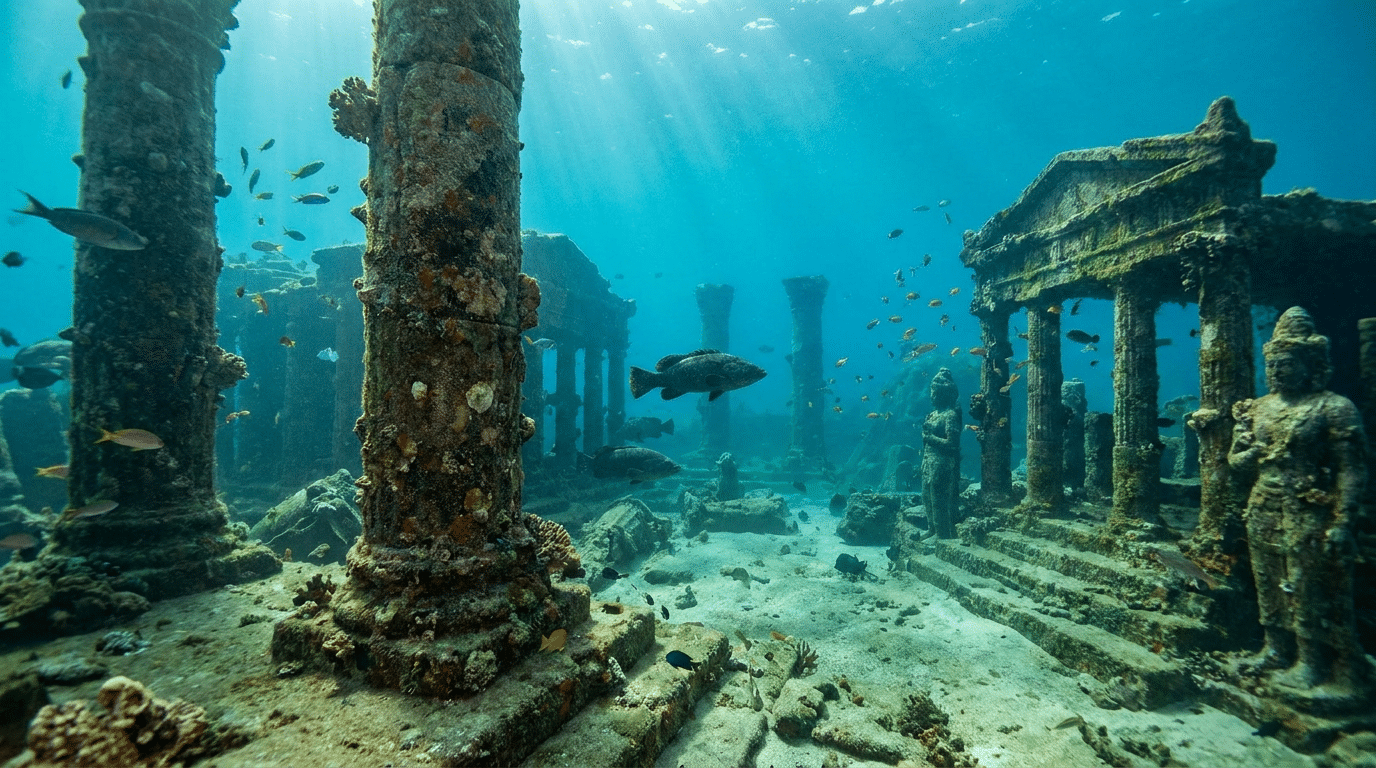
Real cities have disappeared beneath water.
Coastal subsidence, earthquakes, sea-level change, erosion and sediment movement can transform ancient shorelines. Archaeology has documented submerged settlements in several parts of the Mediterranean and elsewhere.
These discoveries are sometimes presented as proof that Atlantis must also have existed.
The logic does not follow. The fact that submerged cities are real establishes that the mechanism is possible, not that Plato was describing one of them.
Why Location Theories Multiply
Almost any region with an ancient settlement and evidence of catastrophe can become an Atlantis candidate.
Theories have placed Atlantis in the Atlantic, Mediterranean, Caribbean and other locations. Some focus on volcanic islands, others on submerged continental shelves or geological structures.
The problem is that a theory can often select a few matching details while ignoring the rest.
A serious historical identification must explain the whole account—or clearly distinguish which details are plausible, which are uncertain and which cannot be reconciled.
What Would Count as Strong Evidence?
A convincing identification would require several independent lines of evidence to converge.
- Chronology: the site must date to a period compatible with the proposed historical connection.
- Geography: its location must fit the relevant ancient description rather than only one convenient clue.
- Cultural evidence: artifacts, architecture and settlement patterns should identify a coherent society.
- Destruction evidence: earthquakes, flooding or another catastrophe should be demonstrable if the destruction narrative is taken literally.
- Historical transmission: there should be a credible pathway connecting the archaeological site to the story known by Plato.
Finding one ancient city with a catastrophic destruction layer is not enough.
Why Archaeology Has Not Confirmed Atlantis
Archaeology has uncovered extraordinary ancient civilizations, including Bronze Age societies that possessed complex cities, long-distance trade and sophisticated technologies.
None has been securely identified as the Atlantis described by Plato.
This is not because archaeologists assume legends must be false. Archaeology has repeatedly shown that traditional stories can preserve fragments of real places and events.
The issue is evidence. A historical identification requires more than resemblance.
Could Atlantis Be a Composite Story?
There is another possibility: the story may not have a single real-world source.
Plato could have drawn on broad knowledge of Mediterranean geography, memories of disasters, political ideas and existing Greek traditions, combining them into a single narrative.
Human storytelling often works this way. Real events can be transformed, simplified or combined until they serve a new narrative purpose.
Under this interpretation, searching for one physical Atlantis would miss the possibility that the story is a literary construction assembled from multiple influences.
Why “Advanced” Is a Dangerous Word
Modern Atlantis stories often describe an extraordinarily advanced civilization possessing technologies unknown to later societies.
Plato does describe Atlantis as wealthy, powerful and highly organized. But that is not the same as describing futuristic technology.
The idea of an ancient civilization more technologically advanced than modern society belongs largely to later interpretations.
Separating Plato’s text from modern additions is essential when discussing what the evidence actually says.
Why the Story Became a Modern Obsession
Atlantis contains nearly every ingredient of a perfect mystery.
There is a powerful civilization. There is a golden-age atmosphere. There is moral decline. There is a catastrophe. There is a missing location. And there is the possibility that modern people might recover knowledge supposedly lost for thousands of years.
That structure is almost designed to generate speculation.
Every unexplained underwater structure can become a clue. Every unusual geological formation can become a possible remnant. Every ancient text can be mined for another reference.
The Difference Between a Mystery and Evidence
A mystery is a question for which we do not have a satisfactory answer.
Evidence is information that changes how plausible competing explanations are.
Atlantis has an enormous amount of mystery but comparatively little evidence connecting a real archaeological site to Plato’s account.
That distinction is important because unanswered questions can create the illusion of positive evidence. The absence of an explanation is not itself evidence for a particular explanation.
Atlantis and the Human Memory of Disaster
There is nevertheless a genuinely interesting historical question behind the legend.
Ancient societies lived with earthquakes, volcanic eruptions, floods and changing coastlines. Communities could lose settlements, sacred places and agricultural land within a single generation.
Stories about destroyed cities may therefore resonate with real human experiences of environmental catastrophe even when a particular legendary city cannot be identified.
The Real Historical Value of Atlantis
Atlantis is historically important regardless of whether the city existed.
The story reveals how Plato and later cultures thought about political power, moral decline, catastrophe and the fragility of civilization.
It also illustrates how a philosophical narrative can gradually become treated as historical memory.
That transformation is itself worth studying.
The Bigger Question
Atlantis may be a lost city, a philosophical construction, a story influenced by memories of real disasters—or some combination of these possibilities.
What archaeology can say with confidence is narrower: ancient societies did experience catastrophic earthquakes, volcanic eruptions and coastal destruction, and some settlements really did disappear beneath water.
What archaeology has not established is that one of those sites is the Atlantis described by Plato.
Perhaps that is why the story remains so powerful. It offers the possibility that somewhere beneath the sea is a physical answer to a question that began as a philosophical story.
The enduring mystery may therefore be less about where Atlantis is than about why humans keep searching for a lost world that could confirm that the stories of the past were literally true.
Curiosity Publication by Aadvik Agastya
Sources & further reading
Have a question about this topic?
Join fellow Qurons on the Quron Forum to ask questions, challenge ideas, share discoveries and explore further.
Discuss on Quron Forum