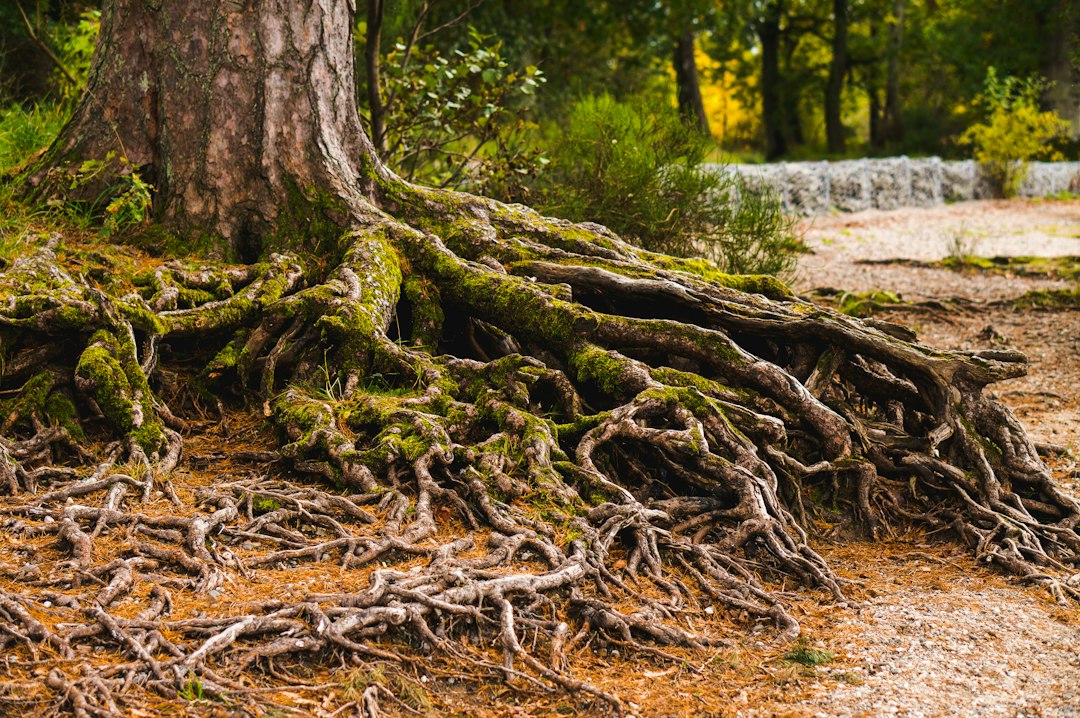
Walk through a forest and it can seem as if every tree is an isolated organism. Trunks stand apart, crowns compete for sunlight, and roots disappear beneath soil that looks almost empty.
But below the surface is another world. Tree roots interact with fungi, bacteria and other organisms in an intricate biological system. Some fungi form mycorrhizal associations with plant roots, exchanging resources with their hosts. In some cases, fungal hyphae can connect the roots of multiple plants.
That discovery helped create one of the most memorable ecological metaphors of recent decades: the “wood-wide web.” It also produced a popular question—do trees actually communicate with one another?
The scientific answer is more fascinating than either a simple yes or no.
What is a mycorrhizal fungus?
Mycorrhiza is a symbiotic relationship between a fungus and a plant root. The fungus grows through soil as a network of microscopic filaments called hyphae. These can explore spaces that individual roots cannot easily reach.
In return for carbon compounds ultimately derived from photosynthesis, mycorrhizal fungi can help plants obtain mineral nutrients such as phosphorus and nitrogen and, in some circumstances, improve access to water. Mycorrhizal associations are widespread among land plants and are fundamental to the functioning of many terrestrial ecosystems.
So are the roots actually connected?
Sometimes, yes. When compatible plants are colonized by the same mycorrhizal fungal network, fungal hyphae can provide physical pathways between their root systems. These are often called common mycorrhizal networks.
That does not mean every tree in a forest is connected to every other tree. Networks depend on the plant species, fungal species, soil conditions, age of the plants and the local ecology.
The existence and ecological importance of these networks is therefore a scientific question of degree and circumstance, not a simple forest-wide on/off switch.
Can carbon and nutrients move between plants?
Experiments have demonstrated movement of carbon and other resources through mycorrhizal systems under particular conditions. Early experiments even reported direct carbon transfer between plants connected by mycorrhizal mycelium.
More recent work continues to investigate carbon movement through common mycorrhizal networks, including the role of plants that obtain carbon through fungal partners rather than relying entirely on their own photosynthesis. A 2024 perspective argues that mycoheterotrophic plants provide important evidence for functional carbon transfer within these networks.
But detecting movement is only the beginning of the question.
Transfer does not automatically mean cooperation
Imagine that carbon moves from one plant into a fungal network and later appears in another plant. It is tempting to describe this as one tree deciding to feed another.
Biologically, that conclusion requires several additional steps.
Researchers need to establish how the material moved, how much moved, whether the transfer was intentional in any meaningful biological sense, whether the receiving plant benefited, and whether the same pattern occurs under realistic field conditions.
Resource exchange in mycorrhizal symbioses can depend on competition, plant physiology, fungal identity and environmental conditions. Reviews of the subject emphasize that the rules governing these exchanges are more complicated than a simple system of one plant generously giving resources to another.
What about the famous “mother tree” idea?
The phrase “mother tree” became popular because large, old trees can be highly connected and can interact with younger plants through belowground networks.
That observation is interesting. But the phrase can accidentally turn an ecological relationship into a human family story.
A large tree has a different root system, carbon budget and fungal community from a small seedling. If resources move between them, that movement does not by itself demonstrate that the older tree recognizes the younger tree as its offspring and deliberately feeds it.
This distinction became especially important after a 2023 review examined several popular claims about common mycorrhizal networks. The authors concluded that evidence for some widely repeated claims—including preferential transfer from mature trees to their offspring—was insufficient, and warned that positive findings had sometimes been generalized beyond what field evidence justified.
Does that mean the “wood-wide web” is a myth?
No. That would be an overcorrection.
The fungal relationships are real. Mycorrhizal fungi exchange resources with plants. Fungal hyphae can connect plant roots, and material can move through these systems.
The disagreement is about how widespread particular networks are, how important interplant transfers are in natural forests, and what those transfers actually mean ecologically.
In fact, the scientific discussion is still developing. A 2024 perspective argued that evidence from mycoheterotrophic plants supports a broader role for common mycorrhizal networks than some recent critiques suggest.
That is exactly what good science looks like: a compelling hypothesis being tested, challenged, refined and sometimes reinterpreted.
Plants communicate—but not like humans
Plants have sophisticated systems for detecting their surroundings. They respond to light, touch, temperature, water availability, pathogens and herbivore attack. They also release and detect chemical signals.
Mycorrhizal fungi themselves participate in signalling processes that allow plants and fungi to recognize compatible partners and establish symbiosis.
So the word communication can be scientifically useful if it means information or chemical signals producing a biological response.
It becomes misleading when it suggests that trees exchange sentences, intentions or conscious warnings.
The forest contains several overlapping networks
The underground system is not simply a fungal internet. Roots interact with fungi, bacteria, soil organisms, water and organic matter simultaneously.
Modern research increasingly views the plant–fungus relationship as part of a broader biological continuum. For example, bacteria associated with mycorrhizal fungi can influence nutrient exchange involving carbon, phosphorus and nitrogen.
This makes the forest less like a collection of independent trees and more like a community of organisms continuously exchanging matter and responding to changing conditions.
Why the internet analogy became so powerful
The phrase “wood-wide web” is memorable because the visual analogy is almost irresistible. Invisible fungal threads connect organisms beneath the ground in much the same way that cables and wireless links connect devices above it.
But digital networks and biological networks work differently.
The internet is engineered to transmit encoded information according to defined protocols. A fungal network evolved through ecological interactions and has no central controller. Its exchanges are governed by physiology, chemistry, resource availability and evolution.
The metaphor is useful when it helps people imagine hidden ecological connections. It becomes dangerous when the metaphor is mistaken for a literal description of how forests operate.
Why proving what happens underground is so difficult
Forests are extraordinarily difficult experimental systems. A researcher trying to measure transfer between two trees has to separate fungal pathways from direct root contact, soil movement, decomposition, microbial activity and other possible routes.
Laboratory experiments can provide excellent control but may simplify the conditions found in a mature forest. Field experiments are more realistic but introduce enormous complexity.
There is another problem: even when a substance moves, the quantity may be too small to have an important effect on the receiving plant.
That is why the strongest scientific questions are not simply “Can something move?” but “How often does it happen, under what conditions, how much moves, and does it change the outcome for the plants involved?”
Why mycorrhizal fungi matter even without the mystery
Even if we set aside every dramatic claim about tree-to-tree communication, mycorrhizal fungi remain ecologically extraordinary.
They expand the effective interface between plants and soil, influence nutrient cycling and interact with plant growth and ecosystem processes. Forest productivity and carbon cycling can therefore be affected by relationships occurring almost entirely out of sight.
Research also shows that these associations are not fixed. Different fungi and plants can interact differently, and environmental change can alter the balance of these relationships.
What researchers still want to know
Some of the most important questions are now remarkably specific.
- How common are functional common mycorrhizal networks in different forest types?
- How much carbon or mineral nutrient moves between plants through those networks?
- When does transfer improve the survival or growth of a recipient?
- Which fungal species create the most important connections?
- How do drought, warming, disturbance and invasive plants change those relationships?
Answering these questions may ultimately tell us far more about forests than the original “Do trees talk?” question ever could.
So, do trees really communicate?
If communication means that plants detect chemical and environmental signals and that biological interactions can transmit information or resources, then forests contain extensive forms of communication.
If it means that trees consciously talk to one another through a forest-wide underground internet, the evidence does not support that picture.
The most defensible conclusion lies between the two extremes. The underground fungal world is real, dynamic and biologically important. Resource transfer can occur. Plant signalling is real. But the scale, frequency and ecological significance of tree-to-tree transfers remain active areas of research, and some of the most popular claims have outrun the evidence.
The forest is stranger than the metaphor
The most interesting discovery may be that we do not need to imagine trees behaving like people to make the forest extraordinary.
A tree can exchange carbon with fungi. Fungi can acquire minerals from soil. Microbes can alter nutrient availability. Chemical signals can change plant behaviour. Roots can encounter networks created by organisms that existed long before we noticed them.
None of this requires a hidden forest conversation.
It suggests something more subtle: a forest is not merely a collection of trees. It is a living system in which organisms are linked by countless physical, chemical and biological interactions—many of which are still only partly understood.
And perhaps that is the better mystery. The forest does not need an underground internet to be connected. It already is.
Curiosity Publication by Aadvik Agastya
Sources & further reading
- Nature Ecology & Evolution — Common mycorrhizal networks and evidence
- Nature Plants — Mycoheterotrophy and the “wood-wide web”
- Nature Reviews Microbiology — Plant–fungus–bacterium nutrient exchange
- USDA Forest Service — Mycorrhizae in forest tree nurseries
Have a question about this topic?
Join fellow Qurons on the Quron Forum to ask questions, challenge ideas, share discoveries and explore further.
Discuss on Quron Forum