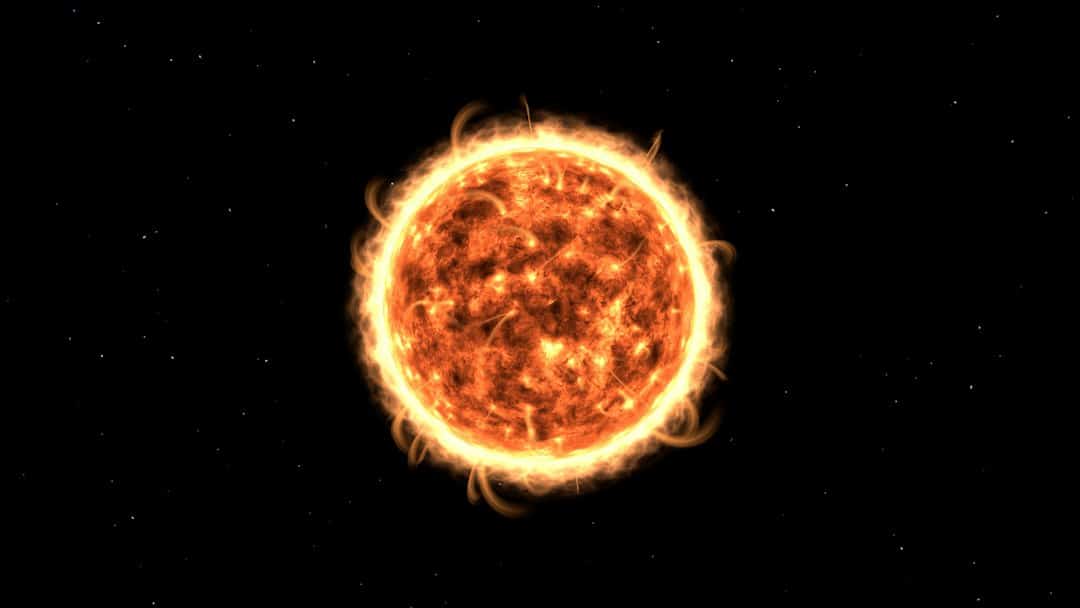
The Sun looks calm from Earth, but its surface is a constantly changing magnetic environment. When magnetic energy is suddenly released, the Sun can produce a solar flare—an intense burst of electromagnetic radiation that can briefly disturb technology across Earth and beyond.
The important word is briefly. A solar flare does not simply “hit Earth” like a physical object. Its radiation reaches us at the speed of light, while other solar eruptions can send charged particles and magnetized plasma toward Earth much later.
That distinction is at the heart of space weather.
What is a solar flare?
A solar flare is a sudden release of energy from a magnetically active region of the Sun. These regions are often associated with sunspots, where intense magnetic fields emerge through the solar surface.
As the magnetic field becomes stressed and reorganizes, energy stored in the field can be released through a process called magnetic reconnection. The resulting flare produces electromagnetic radiation across a broad range of wavelengths, including ultraviolet and X-rays.
The flare itself is therefore not a cloud of material travelling from the Sun to Earth. It is an explosive release of energy and radiation.
Why does the Sun have so much magnetic energy?
The Sun is not a solid ball rotating as one rigid object. Its hot plasma moves in complex ways, and different parts of the Sun rotate at different rates.
Those motions can twist and shear magnetic field lines. Sunspots and active regions are visible manifestations of intense magnetic structures emerging through the photosphere.
When magnetic configurations become unstable, the stored energy can be released rapidly. This is why solar flares can transform a relatively localized region of the Sun into an extraordinarily bright event.
How are solar flares classified?
NOAA classifies flares according to their peak soft X-ray intensity measured in the 0.1–0.8 nanometre band.
The main classes are:
- A — the weakest category
- B — stronger than A
- C — moderate events
- M — stronger events capable of significant space-weather effects
- X — the strongest standard category
Each class spans a tenfold increase in the measured flux. An X2 flare, for example, is twice the peak X-ray flux of an X1 flare. X-class does not have a numerical upper limit; the most powerful modern event was measured as X28 before the detectors were overwhelmed in 2003.
A flare is not the same thing as a CME
This distinction is crucial.
A coronal mass ejection, or CME, is a huge eruption of magnetized plasma from the Sun. A flare can occur together with a CME, but the two are physically different phenomena.
The flare sends electromagnetic radiation toward Earth at the speed of light. A CME travels much more slowly and can take many hours or days to arrive, depending on its speed and trajectory.
When an Earth-directed CME interacts strongly with Earth’s magnetic field, it can produce a geomagnetic storm. That storm can generate electrical currents in long conductors and affect satellites, communications and power systems.
Why do flares affect radio communication?
The most immediate terrestrial effect of a strong flare is often on the ionosphere—the electrically charged upper atmosphere through which some radio signals travel.
X-rays and extreme ultraviolet radiation from a flare can rapidly increase ionization in the lower ionosphere on the sunlit side of Earth. This can absorb high-frequency radio waves rather than allowing them to propagate normally.
NOAA describes these events as radio blackouts. They can particularly affect the high-frequency range used for some aviation, maritime and emergency communications.
Can a flare disrupt GPS?
Yes, but the mechanism needs to be described carefully.
GPS signals travel through the ionosphere, whose electron density changes in response to solar activity. Strong solar disturbances can introduce errors or scintillation in the signals, reducing positioning accuracy or, in severe cases, disrupting service.
NASA notes that strong flares and associated space-weather disturbances can affect technologies that depend on Earth’s ionosphere, including GPS and high-frequency radio.
For most people, this does not mean their phone will suddenly lose all location capability every time an X-class flare occurs. The severity depends on the event, location, signal path, technology and whether other solar disturbances are involved.
What happens to satellites?
Spacecraft lack the protective combination of Earth’s atmosphere and magnetic environment that shields people on the ground.
Energetic particles associated with solar eruptions can penetrate spacecraft systems and produce radiation effects in electronics. They can cause temporary errors known as single-event upsets and, during sufficiently intense events, damage components.
Solar activity can also heat Earth’s upper atmosphere. When the atmosphere expands, satellites in low Earth orbit encounter increased drag and can lose altitude more quickly than expected.
What about astronauts?
Earth’s atmosphere provides substantial protection from solar radiation at the surface. Astronauts outside that protection are much more exposed.
Strong solar particle events can increase radiation doses for crews in space, making space-weather monitoring an important part of mission planning.
For future missions beyond low Earth orbit, where Earth’s magnetic protection is weaker or absent, forecasting solar particle events becomes even more important.
Can solar flares damage power grids?
The answer requires another distinction.
The electromagnetic radiation from a flare can produce immediate ionospheric effects, particularly radio disruption. Large-scale effects on electrical grids are more strongly associated with geomagnetic storms driven by solar-wind disturbances and Earth-directed CMEs.
During a strong geomagnetic storm, changing magnetic fields can induce currents in long conductors on the ground. Power-grid equipment can be exposed to abnormal currents and voltage conditions.
So headlines that attribute every space-weather power-grid problem directly to “a solar flare” can hide an important chain of events.
Could a solar flare hurt people on Earth?
For people at Earth’s surface, the atmosphere and magnetic field provide substantial protection from the radiation of solar flares.
The more immediate risks are technological: radio communication, navigation, satellites and infrastructure can be affected by sufficiently strong space-weather events.
At high altitudes and especially in space, radiation exposure becomes a more significant concern. Airline crews and passengers on polar routes can also encounter elevated radiation during certain solar-particle events, although the magnitude depends on the event and flight conditions.
The Sun has an approximately 11-year activity cycle
Solar activity rises and falls over an approximately 11-year cycle. During periods of higher activity, the Sun generally produces more sunspots, flares and other eruptive events.
Solar Cycle 25 began in 2019, and activity increased toward its recent maximum. That does not mean the Sun becomes dangerous on a fixed schedule; rather, the probability of significant solar activity changes over the cycle.
Can we predict solar flares?
Scientists continuously monitor the Sun using spacecraft and ground-based observatories.
Forecasters examine sunspot groups, magnetic structure, ultraviolet and X-ray emission, and other indicators of solar activity. NOAA’s operational forecasts estimate the probability of C-, M- and X-class flares associated with active regions.
But predicting the exact time and size of an individual flare remains difficult.
This is similar to terrestrial weather forecasting in one important respect: observations can identify changing conditions and estimate probabilities, but they do not turn a complex physical system into a perfectly predictable clock.
The famous Carrington Event
In September 1859, British astronomer Richard Carrington observed a powerful solar flare during what became the most famous historical geomagnetic storm.
Telegraph systems were disrupted, sparks were reported from equipment and auroras became visible unusually far from the polar regions.
The event is often presented as a prediction of a future technological apocalypse. A more useful lesson is simpler: modern civilization is vastly more dependent on electrically interconnected infrastructure than it was in 1859, so understanding space weather matters even though the exact effects of a future extreme event cannot be predicted from one historical example.
The Sun can reach Earth without touching it
A solar flare demonstrates something strange about our relationship with the Sun.
The Sun is nearly 150 million kilometres away, yet an eruption there can change the electrical behavior of Earth’s upper atmosphere within minutes.
Its radiation can interfere with radio signals. Its particles can threaten spacecraft. Its eruptions can disturb Earth’s magnetic environment. And the resulting currents can sometimes reach infrastructure on the ground.
None of this requires the Sun to send a physical object directly toward us.
What actually makes a solar storm dangerous?
The danger is not determined by the flare’s letter alone.
Scientists must consider the flare’s location, radiation, associated particle acceleration, whether a CME was launched, whether that CME is directed toward Earth, its magnetic orientation and the state of Earth’s magnetosphere when it arrives.
A large flare on the far side of the Sun may have little direct effect on Earth. A somewhat smaller event accompanied by an Earth-directed CME can produce a significant geomagnetic storm.
This is why space weather is a system rather than a single number.
The next time the Sun erupts
We often imagine the Sun as a steady source of heat and light.
It is actually a dynamic magnetic star capable of releasing enormous bursts of energy and material.
The atmosphere protects us from much of the immediate radiation, but modern civilization has created technologies that extend far beyond that protective shell.
Our satellites, radio networks, navigation systems and electrical infrastructure have effectively become sensitive instruments for detecting the Sun’s moods.
A solar flare is therefore not just an explosion on a distant star.
It is a reminder that Earth is embedded in a much larger space-weather system—and that sometimes, what happens on the Sun does not stay on the Sun.
Curiosity Publication by Aadvik Agastya
Sources & further reading
- NASA Science — What Is a Solar Flare?
- NASA Science — Solar Storms and Flares
- NOAA Space Weather Prediction Center — Solar Flares and Radio Blackouts
- NASA — Solar Flares FAQs
Have a question about this topic?
Join fellow Qurons on the Quron Forum to ask questions, challenge ideas, share discoveries and explore further.
Discuss on Quron Forum