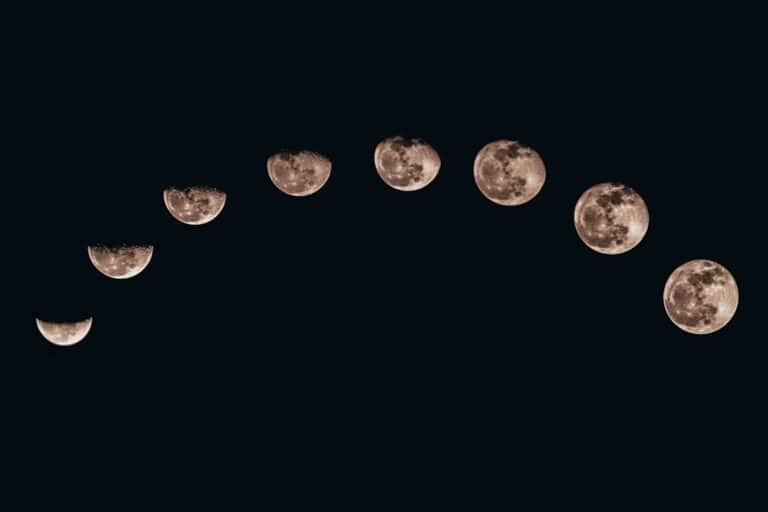
There is a simple fact about the Moon that seems as though it should guarantee a solar eclipse every month: the Moon passes between Earth and the Sun every time there is a new moon.
Yet most new moons produce no eclipse at all.
The reason is not that the Moon misses the Sun by a huge distance. It misses by a surprisingly small angle. But in orbital mechanics, a few degrees are enough to turn a perfect alignment into a near miss.
A solar eclipse requires three things to line up
A solar eclipse occurs when the Moon passes between Earth and the Sun and its shadow falls on part of Earth.
The Moon must therefore be in the new moon phase, but phase alone is not enough. The Sun, Moon and Earth must also be aligned closely enough for the Moon’s shadow to intersect Earth.
NASA describes the geometry in exactly these terms: eclipses occur when the three bodies line up, with the Moon’s shadow creating an umbra and a penumbra.
So why doesn’t every new moon create an eclipse?
Because the Moon’s orbit around Earth is tilted by about 5 degrees relative to the plane of Earth’s orbit around the Sun.
Imagine the Earth’s orbit around the Sun as a flat sheet of paper. The Moon’s orbit around Earth is not perfectly aligned with that sheet. It is slightly tilted.
Most of the time, when the Moon reaches new moon, it passes a little above or below the Sun as seen from Earth.
The Moon is there. The Sun is there. The new moon occurs on schedule.
But their shadows do not line up.
Five degrees sounds tiny—until you consider space
A five-degree inclination is small on a diagram. Over the enormous distances between Earth and the Moon, however, that angular difference is enough for the Moon’s shadow to miss Earth entirely.
NASA’s eclipse models show that the Moon’s tilted orbit causes its shadow to pass above or below Earth during most new moons.
This is one of those cases where a small geometric difference produces a huge difference in the outcome.
The Moon crosses Earth’s orbital plane at two nodes
The tilted lunar orbit intersects the plane of Earth’s orbit at two points called nodes.
When the Moon is near one of these nodes, it is close to the same plane as the Sun and Earth.
That creates the opportunity for an eclipse.
But opportunity is not the same thing as certainty. The new moon must occur at approximately the right time as the Moon passes the node. If the timing is wrong, the Moon can still pass above or below the Sun’s position enough for its shadow to miss Earth.
This creates an “eclipse season”
The periods when the Sun is near one of the Moon’s orbital nodes are called eclipse seasons.
There are generally two eclipse seasons each year, separated by roughly six months. Each season lasts several weeks, providing a window in which solar or lunar eclipses can occur.
This explains why eclipse calendars often seem to come in clusters. The universe is not suddenly producing more new moons. The geometry has simply entered a period when the orbital planes are favorably aligned.
But even during eclipse season, an eclipse is not guaranteed
The Moon still has to be close enough to a node at the exact moment of new moon.
If the alignment is slightly off, there may be no solar eclipse at all—or only a partial eclipse.
The exact geometry determines how much of the Sun the Moon appears to cover and where that shadow falls.
Why are there different kinds of solar eclipses?
The Moon’s orbit is not a perfect circle. Its distance from Earth changes.
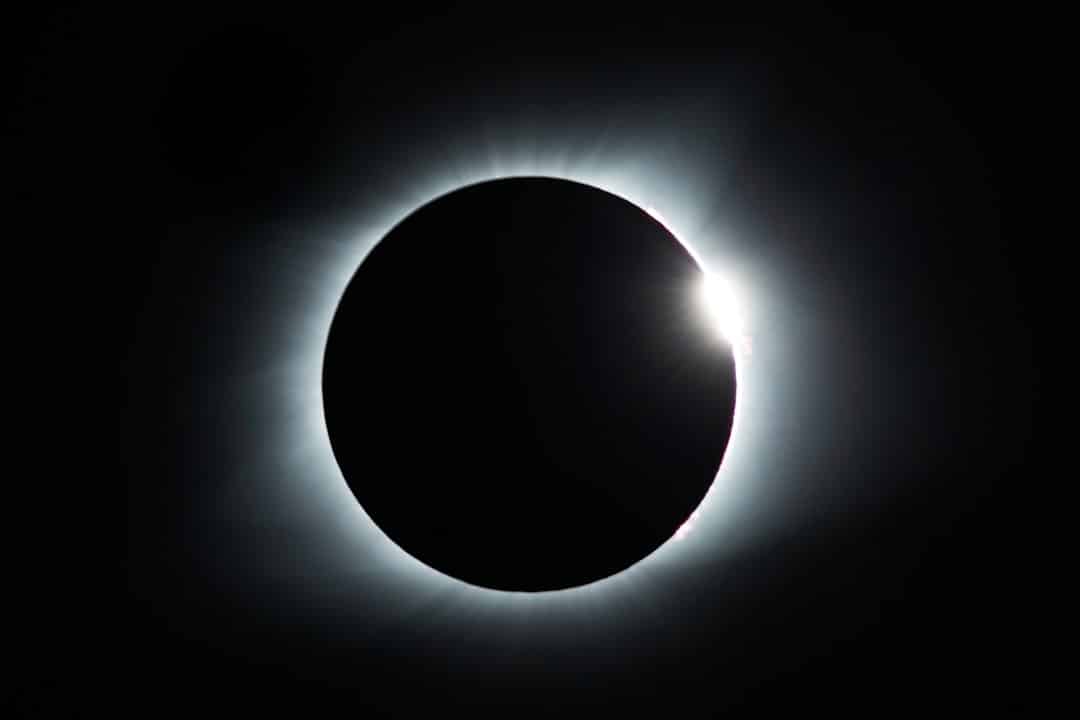
When the Moon is relatively close to Earth, its apparent disk can look large enough to completely cover the bright face of the Sun, producing a total solar eclipse for observers inside the narrow path of totality.
When the Moon is farther away and appears slightly smaller, it may not completely cover the Sun. Instead, a bright ring remains around the Moon, producing an annular eclipse.
Depending on the alignment, an eclipse can also be partial or, in unusual circumstances, hybrid.
The Moon and Sun happen to look almost the same size
This is one of the remarkable coincidences of our sky.
The Sun is vastly larger than the Moon, but it is also vastly farther away. Their apparent angular sizes in Earth’s sky can therefore be similar.
Because the Moon’s apparent size changes with its orbital distance and the Sun’s apparent size changes slightly with Earth’s orbital distance, some alignments produce total eclipses while others produce annular eclipses.
The fact that totality is possible at all is therefore the product of geometry and timing, not a permanent property of the Moon.
Why doesn’t everyone on Earth see the same eclipse?
Even when the Moon’s shadow reaches Earth, it does not cover the entire planet.
The umbra is the narrow central region where the Sun can be completely blocked. The surrounding penumbra produces a partial eclipse.
Because the umbra is small compared with Earth, totality is visible only along a relatively narrow track across the surface.
Someone thousands of kilometres away may experience only a partial eclipse—or no eclipse at all.
Earth’s rotation changes the view too
Earth is rotating while the Moon’s shadow moves across its surface.
The path of totality is therefore not a stationary stripe on a map. It is the result of a moving shadow interacting with a rotating Earth.
This is why eclipse maps look like long curved tracks rather than simple circles.
Why are total solar eclipses so short?
The Moon’s umbra is moving rapidly across Earth’s surface, and the region in which totality is visible is relatively narrow.
For an observer inside the path, the partial phases can last much longer, but totality itself is usually measured in minutes.
The exact duration depends on the geometry and the observer’s location within the path.
Could the Moon ever stop producing total eclipses?
Yes, over very long timescales.
The Moon is slowly moving away from Earth due to tidal interactions. As its average distance increases, its apparent diameter becomes smaller.
Eventually, in the distant future, the Moon will no longer appear large enough to completely cover the Sun from Earth’s surface. Total solar eclipses will cease, although partial and annular eclipses can continue under appropriate geometry.
This means total solar eclipses are not a permanent feature of Earth.
Why the alignment is a cosmic coincidence
The Sun’s apparent size, the Moon’s apparent size, the Moon’s orbital inclination and the changing distances of all three bodies combine to create the eclipse patterns we see.
A solar eclipse therefore depends on several moving parts:
- the Moon must be at new moon;
- the Moon must be near an orbital node;
- the three bodies must be aligned closely enough;
- the Moon’s apparent size determines whether the eclipse is total or annular;
- and the observer must be inside the relevant shadow path.
The eclipse that almost happens
Most new moons are not failed eclipses in any dramatic sense. They are simply ordinary orbital alignments in which the Moon’s shadow passes above or below Earth.
That is the key to understanding the mystery.
The Moon is not avoiding the Sun. The Earth-Moon system is following predictable orbital geometry, and most months the geometry is slightly wrong for a shadow to reach us.
Why ancient observers could predict eclipses
Once civilizations began recording the motions of the Sun and Moon over long periods, eclipse recurrence became predictable.
One important historical cycle is the Saros, a period of about 18 years after which eclipse geometry repeats in a related way. The details are more complicated than simply expecting the same eclipse to appear in the same place, but the cycle demonstrates how accurately ancient astronomers could recognize repeating celestial patterns.
Modern predictions are vastly more precise because they use detailed measurements of orbital motion, Earth’s rotation and the shape of the Moon.
The real answer is beautifully simple
We do not get a solar eclipse every month because the Moon’s orbit is tilted.
That five-degree inclination means that at most new moons, the Moon passes above or below the Sun’s apparent position. Only when a new moon occurs near one of the orbital nodes does the geometry become favorable.
Then another question begins: Is the Moon close enough to cover the Sun completely? Where does the shadow land? Is the observer inside it?
A total solar eclipse is therefore not simply “the Moon passing in front of the Sun.”
It is a rare intersection of orbital planes, timing, distance and geography.
And that is why something that happens somewhere on Earth every so often can still feel like one of the rarest events imaginable when the shadow finally passes over you.
What the eclipse geometry really looks like
The key is to think in three dimensions rather than as a simple picture of the Moon moving around Earth. The lunar orbit is a tilted plane, and that plane slowly changes its orientation over time. The nodes are therefore moving targets rather than permanent points in the sky.
When a new moon occurs sufficiently close to a node, the Moon can cast its shadow across Earth. When the timing misses the node, the Moon still reaches the new phase but its shadow passes above or below Earth. The distinction is only a matter of geometry, yet it completely changes what observers see.
Eclipses are predictable because the geometry repeats
Once the orbital periods and the motion of the nodes are known, eclipse circumstances can be calculated far into the future. This predictability is not evidence that eclipses are simple; it is evidence that the underlying orbital motions follow stable physical laws.
Ancient observers could recognize eclipse cycles without understanding modern gravitational physics. Modern astronomy can go much further by calculating the exact timing, duration and geographic path of an eclipse.
Curiosity Publication by Aadvik Agastya
Sources & further reading
- NASA Science — Why Do Eclipses Happen?
- NASA Science — Types of Solar Eclipses
- NASA Science — Eclipses and the Moon
- NASA — Eclipse Frequency and Recurrence
Have a question about this topic?
Join fellow Qurons on the Quron Forum to ask questions, challenge ideas, share discoveries and explore further.
Discuss on Quron Forum