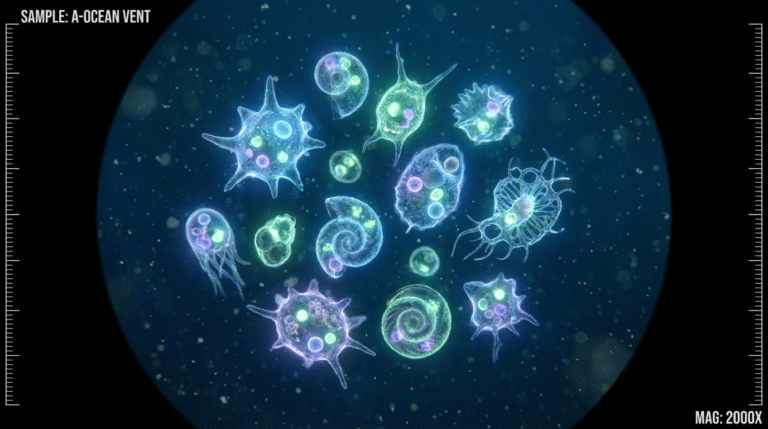
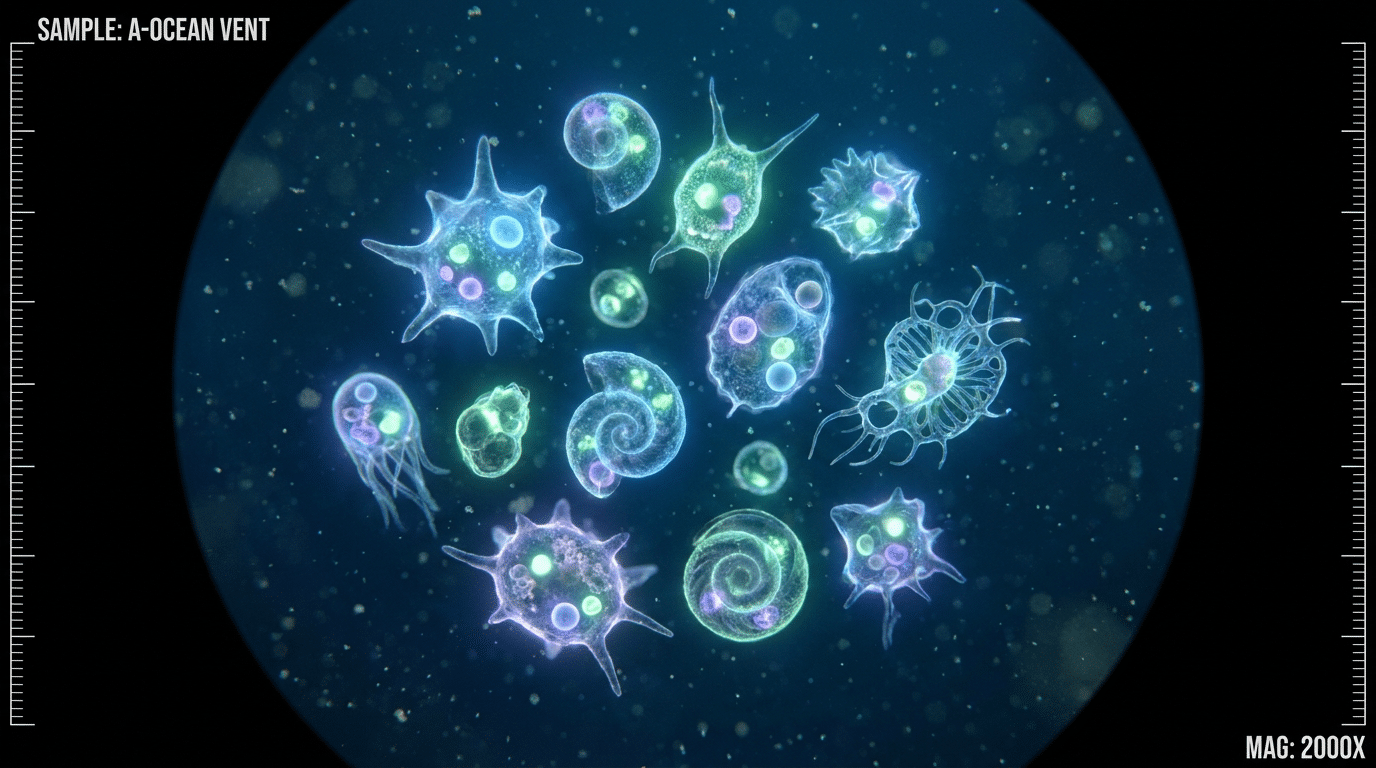
Finding life beyond Earth may not begin with a photograph of an alien organism.
It could begin with chemistry.
Imagine a planet orbiting a distant star. No telescope can photograph its surface in enough detail to show a living organism. Yet when the planet passes in front of its star, a tiny fraction of starlight filters through the planet’s atmosphere.
Different gases absorb different wavelengths. Those missing wavelengths can reveal the chemical composition of an atmosphere.
If the atmosphere contains an unusual combination of gases that is difficult to maintain without continual biological activity, astronomers may have found something extraordinary.
This is the idea behind biosignatures: observable features that could provide evidence for life.
A biosignature is not simply a molecule associated with life
This distinction is fundamental.
Earth teaches us that certain gases can be strongly associated with biology. Oxygen is the obvious example. Much of Earth’s atmospheric oxygen is sustained by photosynthetic organisms.
But a molecule does not carry a label saying “made by life.” Chemistry and geology can sometimes produce the same substance.
A biosignature therefore has to be evaluated in context. Scientists need to ask not only whether a gas is present, but whether known non-biological processes on that particular planet could plausibly produce and maintain it.
How can an atmosphere be studied from light?
One important technique is transmission spectroscopy.
When an exoplanet passes between its star and Earth, some starlight travels through the planet’s atmosphere before reaching our telescopes. Molecules in that atmosphere absorb specific wavelengths.
By comparing the spectrum of the star when the planet is not transiting with the spectrum during transit, astronomers can look for changes associated with atmospheric absorption.
The effect is tiny. The planet may be thousands of times smaller than its star, and the atmosphere is only a thin layer around it. This makes the measurement technically demanding.
Reflection and emission provide other clues
Not every atmospheric investigation depends on a transit.
A planet can reflect starlight, and its atmosphere can also emit thermal radiation. Spectral observations can sometimes reveal chemical signatures through these pathways.
Different observing geometries provide different information. A planet seen at different phases can also show changes associated with clouds, atmospheric circulation and surface properties.
The goal is to combine whatever information the system makes observable rather than relying on a single measurement.
Why oxygen alone would not prove life
Suppose astronomers detected oxygen in an exoplanet atmosphere.
That would be exciting, but it would not automatically establish biology.
Ultraviolet radiation from a star can break water molecules apart. Hydrogen can escape more readily into space, leaving oxygen behind. Certain surface and atmospheric chemical processes can also generate oxygen without organisms.
The strength of the evidence would therefore depend on the planet’s complete environment.
How much water does it have? What is the star’s ultraviolet output? What minerals are present? How thick is the atmosphere? Is the planet geologically active? Could the observed oxygen be produced through known abiotic pathways?
The idea of atmospheric disequilibrium
One reason scientists are interested in combinations of gases is chemical disequilibrium.
On Earth, life continually alters the atmosphere. Oxygen and methane, for example, can coexist in substantial amounts even though they tend to react chemically when given enough time and suitable conditions.
Biological activity continually replenishes them.
Finding a combination of gases that should rapidly react away under the planet’s conditions could therefore be interesting.
But even disequilibrium must be interpreted carefully. Geological and photochemical processes can sometimes maintain unusual atmospheric states without biology.
The star matters as much as the planet
A planet does not exist in isolation.
The star determines the spectrum of radiation reaching the planet, influences atmospheric chemistry and can produce flares and energetic particles that alter the atmosphere.
A red dwarf, for example, can have an activity environment very different from that of a Sun-like star. The same atmospheric gas may therefore have different implications around different stars.
Understanding the host star is part of interpreting the planet.
Clouds and hazes can hide the answer
An atmosphere is not a transparent laboratory.
Clouds and photochemical hazes can obscure deeper atmospheric layers and flatten or distort spectral features. A planet with a rich atmosphere might therefore produce a spectrum that is surprisingly difficult to interpret.
This is one reason atmospheric retrieval is not simply a matter of matching one absorption line to one molecule. Scientists use physical models to estimate which combinations of temperature, pressure, composition and clouds could produce the observed spectrum.
What does an atmospheric retrieval actually do?
Researchers begin with observations and ask which atmospheric models are consistent with them.
Because several different atmospheric compositions can sometimes produce similar spectral signatures, the problem can be degenerate.
A retrieval therefore produces probability distributions and uncertainties rather than a perfect inventory of every molecule.
Better data can narrow those possibilities, while additional observations at different wavelengths can help distinguish competing models.
JWST has changed what is possible
The James Webb Space Telescope has made detailed observations of exoplanet atmospheres possible for a growing number of worlds.
Its infrared capabilities are particularly useful because many molecules have strong spectral features in infrared wavelengths.
But JWST does not turn biosignature detection into a simple exercise.
Signals from small rocky planets can be extremely weak. Stellar variability can complicate observations. Clouds and atmospheric composition introduce degeneracies. Instrumental and data-analysis uncertainties must also be considered.
For potentially habitable rocky planets, the challenge is often not detecting an atmosphere at all, but obtaining enough information to distinguish competing interpretations.
What would a convincing biosignature look like?
There is unlikely to be a single universal checklist that automatically proves life.
A convincing case would ideally contain several independent lines of evidence.
The atmosphere would need to contain a potentially biological signature at a statistically meaningful level. The planet would need to have environmental conditions compatible with the proposed biological process. Known abiotic mechanisms would need to be investigated and shown to be insufficient or significantly less plausible. Independent observations would need to reproduce the signal.
Confidence would grow as the biological interpretation continued to survive attempts to explain the observations without biology.
False positives are not a failure of the search
Scientists actively look for ways a potential biosignature could be produced without life.
This is sometimes misunderstood as excessive skepticism. In reality, it is what makes a biosignature useful.
If a gas can easily be generated by ordinary planetary chemistry, then its presence alone carries limited information about biology.
Every identified false-positive pathway improves the search by telling astronomers what not to mistake for life.
Could life be chemically different from Earth life?
Most current biosignature research begins with life as we know it because Earth is the only confirmed example of biology.
That provides a concrete framework: carbon chemistry, liquid water, organic molecules and familiar metabolic processes.
But this approach has a limitation. Extraterrestrial life, if it exists, might use chemistry that differs significantly from terrestrial biology.
The scientific challenge is to remain open to unfamiliar possibilities while still making predictions that telescopes and experiments can test.
Why “habitable” does not mean “inhabited”
A planet can have conditions that permit some form of life without actually containing life.
Liquid water, suitable temperatures and useful chemical ingredients may create an opportunity rather than a biological fact.
Earth itself reminds us that habitability and life are related but distinct questions.
A biosignature search therefore comes after a much larger chain of reasoning: What is the planet like? What chemistry is possible? What energy sources exist? What gases are present? Which processes can explain them?
Discovery would probably be gradual
The public imagination often expects a single dramatic announcement: “Scientists have found alien life.”
In practice, the path would probably be slower.
An intriguing spectrum might first be reported. Other researchers would analyze the data. Alternative atmospheric models would be tested. New observations would be requested. The host star would be studied more carefully. Laboratory and planetary-chemistry models would be refined.
Independent teams would try to reproduce the result.
The scientific strength of the claim would increase not because one observation looked extraordinary, but because the evidence remained consistent as scrutiny increased.
The deeper question
Searching for life in an atmosphere is really an exercise in learning how to recognize biology without seeing the organism itself.
A distant planet may be too small to resolve. Its oceans may be invisible. Its continents may be beyond the reach of our telescopes.
Yet its atmosphere can interact with light in measurable ways.
The challenge is to determine whether those chemical fingerprints are simply the products of a planet—or the products of a planet on which something is alive.
The hardest part may not be finding an interesting molecule.
It may be proving that the molecule is telling us what we think it is telling us.
Curiosity Publication by Aadvik Agastya
Sources & further reading
Have a question about this topic?
Join fellow Qurons on the Quron Forum to ask questions, challenge ideas, share discoveries and explore further.
Discuss on Quron Forum