The experiment hidden inside a shadow
On 29 May 1919, the Moon temporarily erased the Sun from a narrow path across Earth. In the Brazilian town of Sobral and on the West African island of Príncipe, astronomers tried to photograph something much less conspicuous than the eclipse: stars that should have appeared a fraction of a millimetre away from their expected places on glass plates. The shift, if it could be measured, would be evidence that sunlight was not the only thing affected by the Sun. Light arriving from distant stars would have changed direction while passing its gravitational field.
The scene is often condensed into a victorious photograph and the sentence that an eclipse proved Einstein right. That shorthand hides a more interesting experiment. The teams needed to separate a physical effect smaller than the apparent width of a human hair at a distance of several metres from changes caused by lenses, temperature, atmosphere and the measuring apparatus itself. They also had two observing sites, different instruments, clouds, awkward photographs and results that did not all agree. Their problem was not whether a dramatic eclipse occurred. It was whether the photographic plates could be trusted to tell them what the eclipse meant.
Why the Sun could appear to move stars
A star photographed at night has a position relative to neighbouring stars. Near a total eclipse, that same star can be photographed apparently close to the Sun, normally impossible because daylight overwhelms it. If the Sun’s gravity deflects the star’s light, the star appears displaced outward from the solar disc. The stars themselves have not shifted during those months. The apparent change is in the path of their light and in the geometry by which observers infer direction.
Einstein’s 1915 general theory of relativity predicted approximately 1.75 arcseconds of deflection for light skimming the Sun’s visible edge. An arcsecond is one three-thousand-six-hundredth of a degree. At greater angular distances the effect falls, roughly inversely with the light ray’s closest approach to the Sun. The contemporary account by Frank Dyson explains why stars too close were lost in the bright corona and stars too far away showed displacements too small to measure well. The theory was being tested not by an eclipse’s beauty but by a spatial pattern: larger apparent shifts closer to the Sun.
The alternative was not simply ‘gravity or no gravity’
Early twentieth-century physicists did not need Einstein to imagine that gravity might influence light. A Newtonian-style calculation, if light were treated in a particular particle-like way, could yield about half the relativistic value at the Sun’s edge, roughly 0.87 arcseconds. A zero-deflection result was another possibility. The observing programme therefore had to discriminate among quantities that were all extraordinarily small, not merely discover that an image looked different.
That distinction matters because a measurement of ‘some bending’ would not by itself identify the right theory. In the original 1920 paper, Dyson, Eddington and Davidson compared measured stellar displacements with the predicted dependence on distance from the Sun. The pattern, the instrument calibration and the uncertainty around each estimate were part of the claim. The celebrated numerical answer was the last step of a chain of reasoning, not the first.
Two expeditions, three troublesome sets of photographs
The Royal Greenwich Observatory’s Frank Watson Dyson coordinated the effort. Arthur Stanley Eddington and Edwin Cottingham observed from Príncipe; Andrew Crommelin and Charles Davidson worked at Sobral. The path of totality made both places attractive, but a map of the eclipse path could not guarantee clear skies. Príncipe’s clouds reduced the usable material. At Sobral the observers operated a large astrographic instrument and a smaller four-inch telescope, creating an opportunity to compare independent optical systems under the same eclipse.
That redundancy became crucial. The four-inch Sobral instrument produced comparatively useful images. The larger astrographic instrument suffered image-quality and scale problems, associated in the historical analysis with temperature or focus changes, which made its inferred deflection less dependable. The Príncipe material was scantier and less precise because of the weather. There was no magical single photograph whose meaning was self-evident. The teams had to decide which measurements were sufficiently stable to carry the conclusion and which were too compromised.
The difficult number behind the newspaper headline
Historical summaries commonly report a Sobral four-inch result around 1.98 arcseconds and a Príncipe result around 1.61 arcseconds, with appreciable uncertainties; the problematic Sobral astrographic data yielded a lower figure near the Newtonian expectation. These figures should not be flattened into three equally reliable votes. Their observational conditions and systematic errors differed. Nor should the rejected astrographic set simply be erased from the story: its presence is exactly why the episode remains a useful case study in judging instruments.
The astronomers concluded that the usable measurements supported the larger relativistic bending. At a joint Royal Society and Royal Astronomical Society meeting in November 1919, the result became international news. The press translated an intricate argument about photographic scale into the apparent overthrow of Newton. Newton’s gravitational theory did not suddenly stop predicting planetary motion. General relativity offered a deeper account, one that reduced to Newtonian physics in many ordinary circumstances while differing in demanding tests such as the path of light close to a massive body.
Did Eddington throw away data because he liked Einstein?
The strongest popular retelling of the controversy says that Eddington selected the results that matched his preferred theory. It is legitimate to ask whether an investigator’s expectations influence decisions about noisy observations. But the historical claim that one man simply discarded a good result because it disagreed with Einstein is stronger than the evidence warrants. Dyson and other observers were involved, and the troubling large-instrument photographs had documented optical problems. A fair assessment asks whether the quality criteria were justified independently of the desired answer.
The Max Planck Society’s historical review describes later remeasurement of surviving material in 1979 and reports a value near 1.90 ± 0.11 arcseconds. This retrospective exercise did not transform the 1919 observations into modern precision astronomy, but it weakened the simplistic accusation that the original conclusion depended on an arbitrary preference. There is room to discuss selection, uncertainty and fame without rewriting a complicated collaboration as either immaculate genius or deliberate fraud.
What a photographic plate can and cannot prove
Imagine drawing a grid on transparent paper, placing it over a second grid and finding that several dots have moved slightly. Before attributing their displacement to physics, you must ask whether the paper stretched, the camera tilted, the lens changed focal length or the reference grid was recorded under different conditions. Eclipse photography faced versions of all those questions. The stars were measured against comparison plates taken when the Sun was elsewhere in the sky, and instrumental scale had to be inferred rather than assumed.
An apparent displacement is therefore not a direct snapshot of curved spacetime. It is an estimate produced by a measurement model. The striking achievement of 1919 was that astronomers could extract a meaningful physical test from glass plates with imperfect images. The corresponding vulnerability was that a small change in calibration could move the estimate by a substantial fraction of the effect. Modern discussions of the experiment should preserve both truths: it was audaciously informative and far less precise than a textbook diagram suggests.
A century later, the photograph acquired a second life
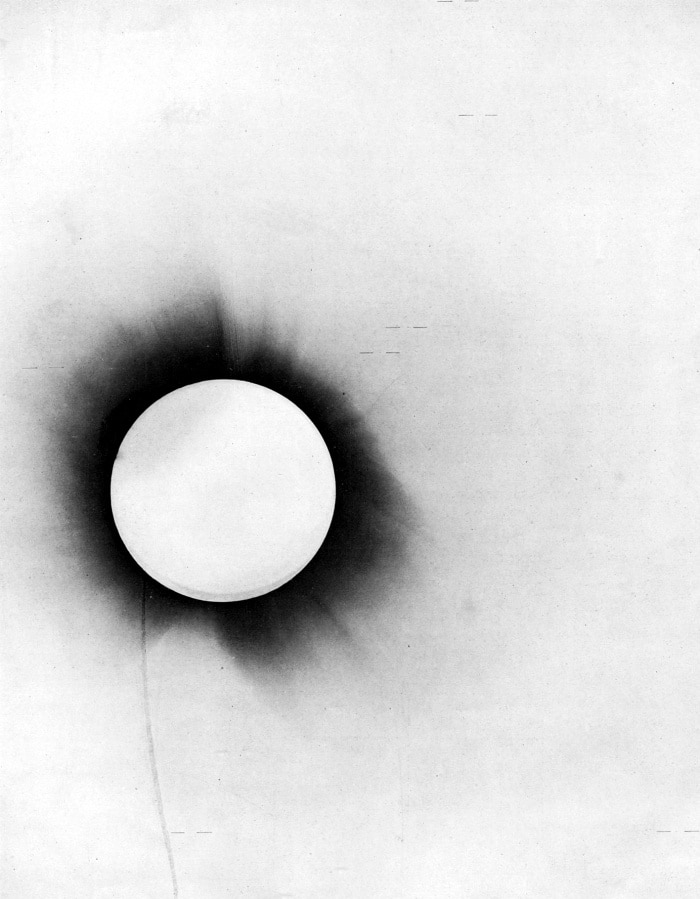
Some of the original expedition plates have been lost, while copies survived in observatory collections. The European Southern Observatory’s 2019 release documents a digitally restored scan of a surviving copy of a Sobral plate held at Heidelberg. Processing reveals stars and solar-coronal detail difficult to see in the historical reproduction. This is an authentic record associated with the 1919 eclipse, not a modern re-enactment; the restoration must nevertheless be described as restoration rather than a raw original negative.
That image is visually persuasive, but a beautiful scan is not itself a fresh independent measurement of relativity. The original science depended on comparing positions with reference exposures and calibrations. The restoration reminds us that images can preserve evidence for generations while also changing how that evidence looks to later audiences. The most responsible caption tells viewers both what the photograph actually records and what further analysis is needed before a physical conclusion follows.
Einstein did not rest his theory on one rainy afternoon
General relativity has since faced much more exacting tests: radio observations of deflection, the timing of signals passing near the Sun, gravitational lensing by galaxies and clusters, precision spacecraft navigation and observations of gravitational waves. These are not interchangeable experiments. They probe different regimes and sometimes different theoretical assumptions. Their combined strength is that a theory cannot easily survive by one lucky adjustment to one set of glass plates.
The 1919 eclipse was important as an early discriminating test and as a cultural event that carried a difficult idea into newspapers. It was not the final proof of every consequence of Einstein’s theory. Nor does the theory imply that Newton was useless: engineers still use Newtonian approximations whenever their precision is adequate. The scientific surprise is that a slight change in the apparent position of distant stars could expose a limit in an enormously successful older description of gravity.
A lesson for the next surprising measurement
Consider a new claim today that a telescope, particle detector or environmental sensor has found a small unexpected signal. Before asking whether it changes the world, ask four less glamorous questions. What competing numerical predictions existed before the data were collected? How was the instrument calibrated? Which observations were excluded, and were the reasons recorded independently? Has the signal survived tests using different equipment or a different physical method? Those questions make discovery stories more exciting, not less, because they show exactly how hard it is to earn confidence.
QuroPedia has explored a related discipline of inference in the Cowan–Reines neutrino experiment, where a pattern of delayed signals mattered more than a single dramatic flash. The eclipse story shares that logic. An observation becomes evidence when a model explains why a particular pattern should occur and rival explanations have been actively confronted. The distinction travels far beyond astrophysics—from medical trials to forensic history.
The deeper legacy of Sobral and Príncipe
The memorable image of 1919 is a dark Sun ringed by light. The intellectually consequential image is less spectacular: a graph relating tiny stellar displacements to distance from the solar limb. The first captured attention; the second carried the test. The expeditions show that a landmark scientific announcement can be both substantially right and historically untidy, with uncertain plates, difficult judgment calls and legitimate debate about the strength of the early evidence.
Einstein’s prediction did not win because one famous astronomer wanted it to. It gained credibility because observers made a risky quantitative comparison with nature, subsequent measurements challenged it repeatedly and a broader structure of evidence survived. The eclipse did not turn the sky into a verdict. It gave scientists a narrow opening through which to ask a question the daytime Sun usually hides: does gravity bend the light by the amount a new theory demands?
Sources and image note
- Dyson, Eddington & Davidson (1920), original Royal Society paper
- Dyson (1921), Nature technical explanation
- Max Planck Society, centenary historical review (2019)
- European Southern Observatory, 1919 plate restoration and context (2019)
- International Astronomical Union, Sobral historical photograph
Featured image: a historical 1919 Sobral eclipse plate reproduction, public domain, via Wikimedia Commons; this is not a modern photograph or a depiction of the Príncipe observing station. Scientific conclusions rely on comparative plate measurements, not on viewing the image alone.
Have a question about this topic?
Join fellow Qurons on the Quron Forum to ask questions, challenge ideas, share discoveries and explore further.
Discuss on Quron Forum