
On 28 November 1967, a graduate student in Cambridge found a clock that nobody had built. Its ticks arrived from the same small region of sky, separated by roughly 1.3 seconds. They were radio pulses, not sounds, and the instrument that detected them was not a sleek dish but a sprawling array of wires and posts. The remarkable thing was not merely that the signal repeated. It repeated so reliably that the researchers had to confront an uncomfortable question: what natural object could behave with such precision?
That question would lead to the discovery of pulsars, extraordinarily compact stellar remnants. But the path from an unexplained mark on paper to a new class of astronomical objects tells a subtler story about how science handles anomalies: first establish that the anomaly is real, then discover what it rules out, and only then decide what it means.
A few millimetres of trouble in a mountain of paper
Jocelyn Bell, later known as Jocelyn Bell Burnell, was a doctoral student working with radio astronomer Antony Hewish at the University of Cambridge. Their instrument, the Interplanetary Scintillation Array, had been built primarily to study the rapid fluctuations in radio signals from distant sources such as quasars. Bell helped construct it and then operated the array and examined its paper records. These were not instantly searchable digital files: the observatory’s output demanded sustained human inspection.
In the summer of 1967 she noticed an unusual trace, a little disturbance she later described as a bit of scruff. It occupied an almost negligible portion of the recorder’s output. An automatic rejection rule might have classified it as interference; a hurried observer might never have noticed it twice. Bell instead recognised that the disturbance appeared repeatedly when the same part of the sky passed through the telescope’s field of view.
This was the first important test. A terrestrial radio transmitter, electrical disturbance or instrumental fault would not ordinarily return in precisely the way a fixed astronomical source does as Earth rotates. The observation did not prove an extraordinary cosmic explanation, but it made a purely local one harder to sustain. Bell and Hewish then sought a faster recording system to examine the fine structure hidden in the original trace.
The night a blur became a sequence of pulses
On 28 November, the higher-speed recording revealed a succession of distinct pulses about 1.3 seconds apart. The source is now known as PSR B1919+21, historically CP 1919. The number is a position designation, not an encoded message. What had seemed like a patch of interference became a repeatable phenomenon with a measurable period.
It helps to imagine an old mechanical clock heard through a wall. At first one hears only an indistinct vibration; with better recording one discovers a regular tick. Yet the Cambridge signal was not generated by a clockwork mechanism. Radio waves had travelled across space to a receiver on Earth, and the periodicity had to be explained by astrophysics.
The original 1968 Nature discovery paper, authored by A. Hewish, S. J. Bell, J. D. H. Pilkington, P. F. Scott and R. A. Collins, was appropriately cautious. It described an unusual pulsating radio source and considered whether the radiation might be associated with oscillations of white dwarfs or neutron stars. This matters because hindsight makes the conclusion look inevitable. The published investigators were documenting a new phenomenon before its physical identity had been settled.
Why ‘little green men’ was a question, not a finding
The researchers informally used the nickname LGM, for ‘little green men’. That detail is irresistible in popular retellings, but it is easy to distort. The nickname does not establish that the team believed extraterrestrial intelligence was the best explanation. They were confronting an unfamiliar signal and testing possibilities, including the possibility of artificial transmission, while looking for evidence that could discriminate among them.
The decisive advance was not a philosophical argument about aliens. Bell found further sources pulsing at different rates in other parts of the sky. An individual beacon is conceivable; several unrelated celestial clocks, with their own periods and positions, strongly suggest a natural class of objects. In other words, repetition within one source first made the anomaly interesting; repetition across sources made the physical problem tractable.
That distinction is still essential when discussing possible technosignatures. A signal’s apparent orderliness is not sufficient evidence of intelligence. Researchers need independent confirmation, a known sky position, exclusion of human interference and a serious comparison with natural mechanisms. QuroPedia’s earlier investigation of technosignatures explores why apparently artificial patterns demand especially careful tests.
A dead star can behave like a lighthouse
Why should a star send a beam every second or so? The modern answer begins with the death of a sufficiently massive star. After core collapse, matter can be compressed into a neutron star: an object containing more mass than the Sun within a region only tens of kilometres across. It has an intense magnetic field and can rotate rapidly. Charged particles accelerated in its magnetosphere produce radiation, including radio emission.
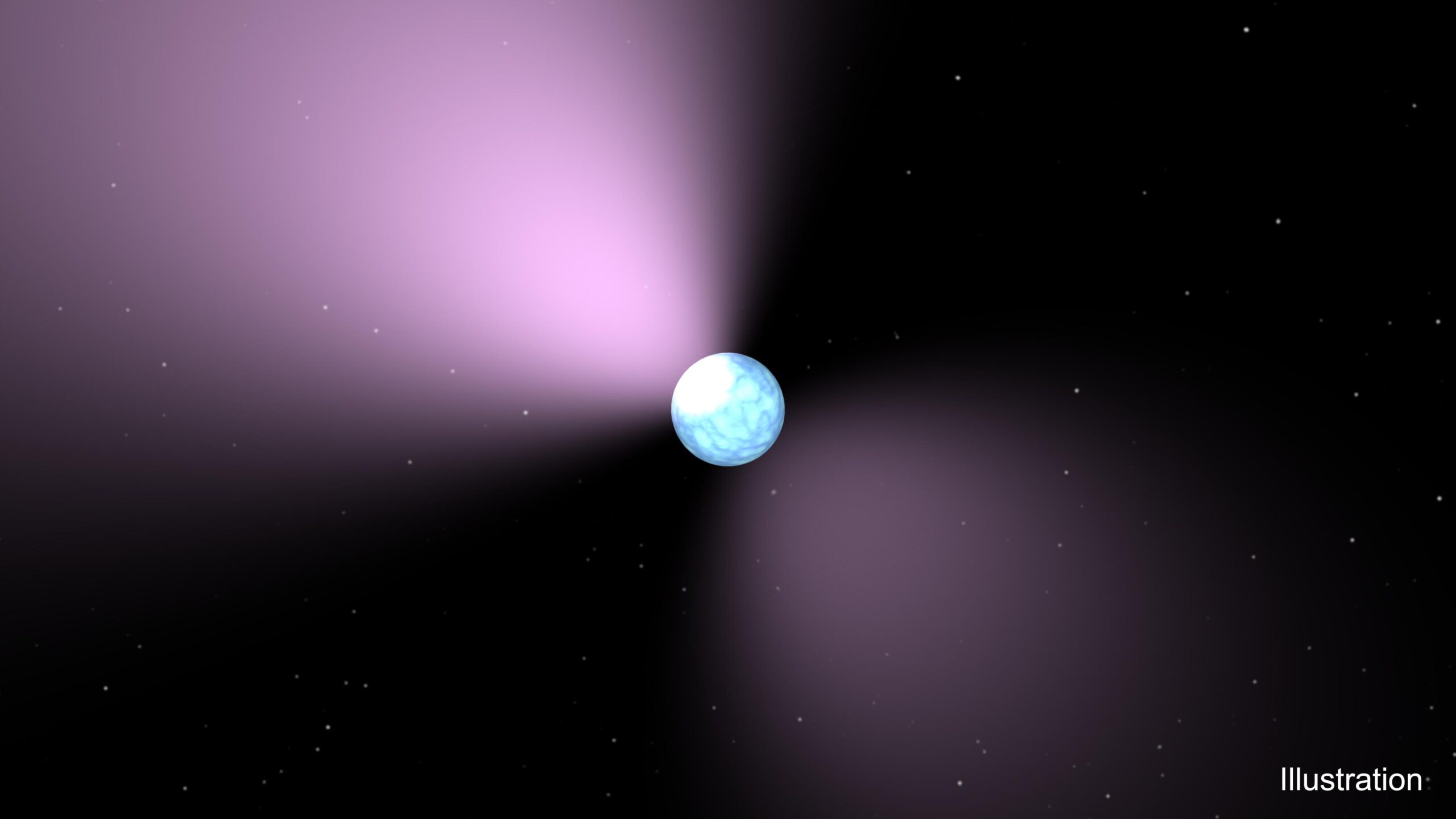
If the emitting region’s beam is not aligned with the rotation axis, the beam sweeps across space. Earth receives a pulse whenever that beam crosses our line of sight, just as a sailor sees flashes from a lighthouse even though the lamp itself shines continuously. The pulses are not usually individual explosions. They are glimpses of a rotating emission pattern.
The analogy is useful but incomplete. A lighthouse has a physical lamp, a mechanically fixed beam and an operator. A pulsar’s emission arises from plasma, magnetic fields and relativistic particle motion. Its pulses can have complex shapes, fluctuate in brightness and show irregularities in timing. Astronomers infer the underlying rotation from the pattern, rather than directly photographing a spinning surface.
The extraordinary density also explains why ordinary large stars are implausible sources of such rapid, stable periodicity. A giant stellar body cannot rotate at arbitrary speed without gravitational and structural constraints. A compact remnant can rotate much faster. The original 1968 paper’s uncertainty between candidate compact objects therefore represented a meaningful physical narrowing, not a failure to know what had been seen.
What the later measurements changed
Additional observations rapidly strengthened the neutron-star interpretation. In April 1968, P. F. Scott and R. A. Collins reported pulse structure that made a simple binary-star explanation unlikely. By the end of that year astronomers had identified many more pulsars, giving theorists a growing set of periods and behaviours to explain. The class was not defined by one spectacular recording but by observations that could survive repeated tests.
NASA’s updated pulsar overview describes thousands of known pulsars, including millisecond objects that rotate hundreds of times each second. The numerical census grows with surveys, so a count printed in an older textbook should not be treated as permanent. A millisecond pulsar is not simply a faster version of the original discovery in every respect: many have been spun up through the transfer of matter and angular momentum from a companion star.
Nor are pulsars perfect clocks. They gradually lose rotational energy, and some undergo abrupt changes in spin rate known as glitches. Interstellar plasma delays lower-frequency radio waves more than higher-frequency ones, complicating the observed arrival time. Astronomers must account for those effects before interpreting small timing differences as evidence of distant gravitational phenomena.
The surprising afterlife of the first signal
Bell’s discovery began as a problem in radio astronomy. It became a tool for measuring the universe. Because the arrival times of pulses can be predicted and compared, astronomers use pulsars to test gravity, investigate neutron-star interiors and study the interstellar medium. Some binary pulsars have provided stringent tests of general relativity. Pulsars distributed across the Milky Way can even act collectively as a vast detector.
In 2023 the NANOGrav collaboration released its 15-year pulsar timing data. Its analysis reported correlated timing variations consistent with a low-frequency gravitational-wave background. These are not direct observations of the Cambridge source’s original 1967 signal, and the leading interpretation involves a population of supermassive black-hole binaries rather than individual neutron-star explosions. The intellectual connection is methodological: tiny deviations from many reliable clocks can reveal changes in the space through which their signals travel.
There is an elegant reversal here. The original pulses were suspicious because they were too regular. Decades later, scientists became interested in the departures from regularity, once the mundane causes of those departures had been modelled. A mysterious signal turned into a precision instrument.
The recognition question is part of the history
In 1974 the Nobel Prize in Physics recognised radio-astronomy work by Martin Ryle and Antony Hewish. Bell Burnell was not included, a decision that has prompted sustained debate about how credit is assigned in collaborative science, especially when a junior researcher performs the crucial observation. It is possible to acknowledge Hewish’s leadership in designing the instrument while also recognising Bell’s indispensable role in constructing, operating and interpreting it.
The University of Cambridge’s account of the original chart offers a particularly tangible corrective to abstract arguments about credit: the evidence survives as a physical record of the discovery. The chart did not interpret itself. It took an observer who remembered an anomalous mark, sought it again and persisted until the measurement could be repeated.
Bell Burnell later received major recognition, including a Special Breakthrough Prize in Fundamental Physics in 2018. Recognition today does not erase the historical debate, but it broadens the account from a single award decision to the scientific work and subsequent career of the person who first noticed the signal.
How scientists separate an extraordinary observation from an extraordinary explanation
There are three levels of confidence in this story. Directly observed: radio pulses repeated from specific positions on the sky, with measured periods. Strongly supported physical interpretation: pulsars are rapidly rotating, magnetised neutron stars, an explanation tested across thousands of objects and multiple wavelengths. Still active research: the detailed mechanisms of radio emission, the physics of ultra-dense matter and the origins of particular timing irregularities.
Confusing these levels creates two opposite errors. One is to dismiss a surprising observation because its first explanation sounds implausible. The other is to mistake the most exciting hypothesis for an established result. The Cambridge team avoided both by asking what better recordings and additional sources would show.
For readers in India, where radio astronomy has a major presence through facilities such as the Giant Metrewave Radio Telescope, the lesson is especially resonant: discovering something important need not require an optical image of a distant object. It may require carefully measured patterns in invisible radio light, calibrated instruments and the patience to ask whether a small irregularity repeats.
The signal was not a message. It was a new way to ask questions.
The story of the first pulsar is often sold as an alien scare that turned out to have a simple answer. The real ending is much more surprising. The signal did not become less interesting when astronomers rejected the idea of a beacon. It revealed matter crushed beyond everyday experience, magnetic fields of extraordinary strength and a natural timing system sensitive enough to help investigate gravitational waves.
Bell Burnell’s original discovery also illustrates a scientific virtue that rarely appears in a dramatic headline: attention. The first clue was small, unglamorous and surrounded by ordinary noise. The breakthrough came from treating it neither as an embarrassment nor as a miracle, but as a claim that deserved another measurement.
Sources and evidence notes
- Hewish et al., Nature (24 February 1968) — original discovery paper; source of the initial observational claim and contemporary uncertainty.
- Scott and Collins, Nature (20 April 1968) — follow-up observations and constraints on early explanations.
- University of Cambridge, original pulsar chart exhibit — institutional documentation of Bell Burnell’s discovery and preserved evidence.
- NASA, Pulsars — contemporary overview of neutron-star physics and the expanding observed population.
- NANOGrav, public 15-year data release — modern application of pulsar timing to gravitational-wave research.
- American Physical Society, historical account — context for the 1967 discovery and recognition debate.
Image note: the featured NASA/JPL-Caltech artwork is an artist’s concept of a pulsar, not a photograph of PSR B1919+21 or of the 1967 discovery.
Have a question about this topic?
Join fellow Qurons on the Quron Forum to ask questions, challenge ideas, share discoveries and explore further.
Discuss on Quron Forum