
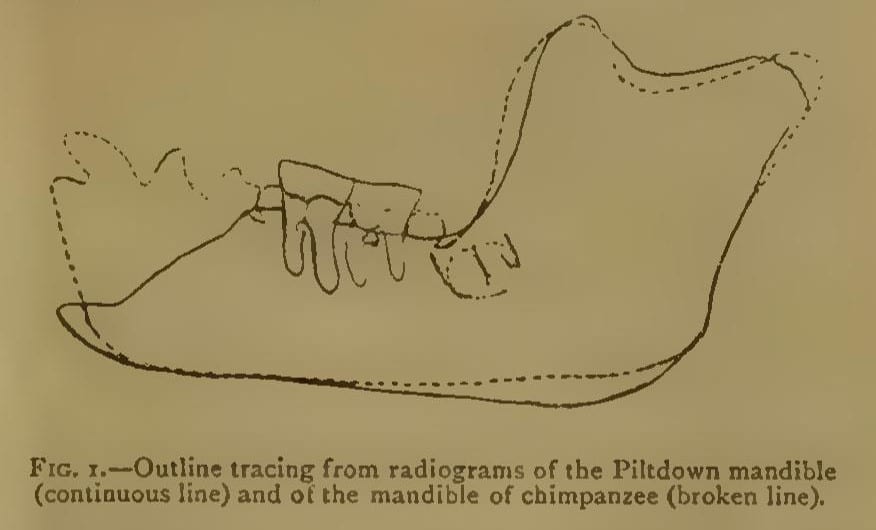
In November 1913, anatomist David Waterston looked at a jawbone that was supposed to belong to an ancient human ancestor and saw something troubling: it resembled an ape’s jaw far more closely than a human one. The skull fragments displayed beside it appeared human. If both belonged to one individual, the discovery could rewrite the story of evolution. If they did not, the reconstruction might be an elaborate mistake—or something worse. Waterston published his objection in Nature. It was a warning hidden in plain sight, forty years before the fraud was decisively exposed.
The object of his doubt was Piltdown Man, announced in Sussex, England, in 1912. The assembled remains appeared to combine a large, human-like braincase with a primitive jaw. That pairing appealed to scientists who imagined that a large brain might have evolved before recognizably human teeth and faces. The puzzle was not merely how a fossil could be so strange. It was how several independent-looking clues—darkened bones, nearby animal fossils, worn teeth, and a second discovery site—could all point toward the wrong conclusion.
A skull that arrived with an irresistible story
Charles Dawson, a solicitor and enthusiastic collector of antiquities, reported finding cranial fragments in gravel near Piltdown. He brought them to Arthur Smith Woodward, Keeper of Geology at what is now London’s Natural History Museum. Excavations yielded more fragments, an ape-like lower jaw, teeth, tools and animal remains. In December 1912 the finds were presented at the Geological Society of London. The reconstructed ancestor was named Eoanthropus dawsoni, Dawson’s dawn man.
Early twentieth-century palaeoanthropology had very few human fossils compared with today. Researchers disagreed about the sequence in which different human traits evolved. The find appeared to offer a distinctive answer: a substantial brain housed above an archaic jaw. A contemporaneous Nature report treated the circumstances of the discovery as strong evidence of antiquity. That contemporary enthusiasm matters. We can now see the fraud, but the first investigators were operating in a field where fossil comparisons and reliable dating methods were limited.
The apparent age also came from context. Fossils and objects were said to have emerged from old gravels. Their surfaces had a matching reddish-brown stain. For a geologist, a specimen’s geological setting is part of the evidence; an isolated tooth on a desk tells a much thinner story than one recovered in a documented layer. At Piltdown, however, the supposedly corroborating setting had been manipulated. The deception exploited the distinction between where an object was found and how it got there.
The first contradiction was anatomical, not chemical
Waterston’s 1913 illustration compared the Piltdown mandible with an ape’s. Other specialists likewise questioned whether the jaw and cranium belonged together. Their concern was structural: the joint, the shape of the bone and the relation between teeth and jaw did not form an easy anatomical whole. Yet an objection is not the same as a conclusive refutation. Missing pieces could be invoked to explain the mismatch, and some reconstructions differed substantially.
The teeth were especially persuasive because their chewing surfaces looked unusually flat, as if worn in a human pattern. Here was the critical trick: a feature interpreted as evidence of evolutionary relationship had actually been manufactured. Later microscopic examination found scratches consistent with deliberate filing. This is a vivid example of a general problem in science: an observation can be real—the teeth really were flattened—while the inferred cause is false.
The skull’s human-like appearance was not fabricated from scratch. The hoax combined authentic biological materials from different sources. The forgery lay in alteration, arrangement and invented provenance. It was more dangerous than a wholly artificial object because each genuine fragment could withstand some scrutiny when examined alone.
Why did the second site make the fraud harder to dismiss?
In 1915 Dawson reported additional material from a place later called Piltdown II, a few kilometres from the original site. To a believer, similar fossils from a second location looked like replication. To a sceptic, the provenance remained heavily dependent on one collector. Dawson died in 1916, and no comparable discoveries followed.
Replication is powerful only when the evidence is sufficiently independent. Two results from laboratories using separate samples and independently documented methods are not equivalent to two finds controlled by the same intermediary. Piltdown II looked like a second witness, but modern forensic work found matching preparation techniques across the two sites. The same apparent reinforcement became evidence of a shared method of deception.
This does not mean every early scientist was gullible. Some doubted the assemblage, and other fossil discoveries increasingly made Piltdown’s proposed evolutionary sequence look odd. But suspicion was unevenly distributed, and access to the originals was limited. In a discipline dependent on rare museum specimens, that restriction mattered. A beautiful reconstruction circulated more readily than the underlying material could be retested.
In 1953, chemistry turned an argument into a test
The decisive shift came when researchers stopped asking only whether the anatomy could be interpreted as plausible and asked whether the bones had the chemical history expected of ancient fossils. Kenneth Oakley, Joseph Weiner and Wilfrid Le Gros Clark re-examined the material. Fluorine testing helped challenge the claimed age: bones buried in the same environment can accumulate fluorine from groundwater, although the method requires care because local conditions vary. It is not a universal clock that reads an absolute age from a single measurement.
The investigators also examined nitrogen content, staining and tooth wear. In a December 1953 Nature communication, Oakley and Weiner reported that the mandible’s chemical composition indicated modern bone, while chromate staining and artificially abraded molars indicated deliberate fraud. The significance was cumulative. One suspicious tooth could be debated. A modern jaw deliberately stained to resemble ancient material and bearing filed teeth was a different proposition.
The bones had not simply been mistaken for something old. They had been prepared to look old. Later examination revealed that some teeth had been damaged during filing and that substances used to stain and repair the fragments were detectable. The elaborate story of an ancestral species collapsed into a more ordinary account of human workmanship.
What twenty-first-century forensic tools added
The fraud was exposed in 1953, but the identity and working methods of the forger remained open questions. In 2016 Isabelle De Groote and colleagues published a reanalysis in Royal Society Open Science, combining DNA evidence, high-precision measurements, spectroscopy and virtual anthropology. Their results suggested that a single orangutan specimen and at least two human individuals supplied much of the assemblage.
The study found a striking pattern: material from both Piltdown sites had been stained and packed with gravel, and holes had been plugged with pebbles and filling compounds. CT imaging revealed concealed internal details. DNA evidence connected teeth attributed to the two sites to the same orangutan. The researchers concluded that a single perpetrator was the most likely explanation and identified Dawson as the strongest suspect, because he was linked to both sites.
That conclusion should not be inflated into a courtroom conviction. A consistent method is evidence of common authorship, and Dawson’s central role is highly suggestive, but the researchers did not produce a confession or eyewitness account. Historians have considered other suspects and questions about possible assistance. The strongest responsible statement is that modern forensic evidence substantially strengthened the case against Dawson, not that every historical uncertainty vanished.
Even the orangutan evidence has geographical texture. The Natural History Museum reports that the jaw likely came from an orangutan associated with Borneo, specifically the Sarawak subspecies. Such precision is remarkable for material once displayed as a European ancestor. The supposed missing link had instead become an accidental record of museum specimens, global collecting networks and the techniques of a forger.
Why did the hoax fit its era so well?
Piltdown did not succeed solely because a convincing object was planted. It fitted a compelling narrative. Britain, with its scientific institutions and imperial collections, had a powerful interest in the geography of human origins. The discovery of Homo heidelbergensis in Germany in 1907 formed part of the background against which an English fossil ancestor gained attention. A fossil with a big brain and ape-like jaw also harmonized with some contemporary assumptions about which human trait mattered most.
This is not evidence that every supporter was driven by nationalism or prejudice. Motives varied, and the scientists involved held different anatomical theories. It does show how prior expectations can shape what researchers find easy to believe. A result that appears to confirm a favored sequence of evolution may receive a more sympathetic hearing than an awkward contradiction.
There is a second, less comfortable lesson: the hoaxer did not need to forge every part of the chain. He needed to control the points where trust entered it—discovery location, selection of fragments, alteration of surfaces and access to the objects. Scientists then supplied the rest, including arguments, diagrams and museum authority. The deception became socially durable because it was repeatedly explained, not because it was repeatedly independently verified.
How the evidence stacks up
| Question | Evidence then | Evidence now |
|---|---|---|
| Did skull and jaw belong to one ancient individual? | Association in reported gravel; reconstructions | Different biological sources; altered assembly |
| Were the teeth naturally worn? | Flattened chewing surfaces interpreted as human-like | Microscopic filing marks and damage |
| Were the bones ancient? | Staining and claimed geological context | Chemistry inconsistent with claimed antiquity; artificial staining |
| Were two sites independent confirmation? | Second set of alleged discoveries | Matching preparation methods and connected orangutan material |
| Who made the forgery? | Unknown | Strong circumstantial and forensic case for Dawson; not absolute proof |
The wider scientific lesson is about provenance, not embarrassment
Modern laboratories have more sophisticated dating methods, imaging and genetic techniques than those available in 1912. Yet technology alone cannot guarantee protection against manipulation. A laboratory may precisely analyze the wrong sample, or a spectacular image may be authentic but described with a false origin. The strongest safeguard is an auditable chain from collection through preparation to interpretation, with enough access for independent investigators to challenge it.
That principle applies well beyond fossil hunting. An archaeological inscription without excavation records, a medical result without a reliable patient cohort, or a viral science photograph without provenance can all be compelling while withholding the context needed to judge them. In India as elsewhere, claims about newly found antiquities or extraordinary scientific breakthroughs deserve questions about the material record before they deserve a confident headline.
Piltdown also shows science correcting itself, but not on a comforting timetable. The correction took decades. Early critics had raised real objections; later investigators developed tests that could settle key issues; twenty-first-century researchers then refined the forensic account. The process worked because claims remained open to re-examination, not because scientists were incapable of being misled.
Consider the contrast with another historical mystery explored on QuroPedia, the Somerton Man case: in both, new methods changed what could responsibly be said about old evidence, while some questions remained unresolved. The direction of the answer differed—identity in one case, forgery in the other—but the discipline of separating evidence from interpretation was the same.
A tooth can be genuine and a discovery can still be false
The most unsettling object in the Piltdown story is not the skull. It is the filed tooth. Its material was real; its shape had been changed; the interpretation depended on that changed shape. The lesson is sharper than a warning against obvious fakes. Evidence does not become trustworthy merely because it is physical, old-looking or housed in a museum. We also need to know who handled it, what changed, what independent observations agree, and which conclusion the data actually support.
The so-called dawn man never existed. The arguments it inspired did. That is why Piltdown remains useful: it shows how a convincing explanation can survive an unconvincing specimen—and how patient, specific tests can eventually reverse the direction of an entire story.
Sources and image documentation
- Nature, “Palæolithic Man” (19 December 1912) — contemporary account of the announcement and its reception.
- Oakley and Weiner, “Chemical Examination of the Piltdown Implements,” Nature (1953) — chemical and alteration evidence.
- De Groote et al., “New genetic and morphological evidence suggests a single hoaxer created ‘Piltdown man’,” Royal Society Open Science (2016) — DNA, imaging and comparative forensic evidence.
- Natural History Museum, “Piltdown Man hoax findings” (2016) — museum interpretation of the research and specimen history.
- Dean, De Groote and Stringer, “Arthur Smith Woodward and his involvement in the study of human evolution” (2016) — institutional and historical context.
- David Waterston’s 1913 illustration of the Piltdown mandible, originally in Nature; public-domain historical image. It depicts the contested specimen as published, not a genuine ancient human.
Have a question about this topic?
Join fellow Qurons on the Quron Forum to ask questions, challenge ideas, share discoveries and explore further.
Discuss on Quron Forum