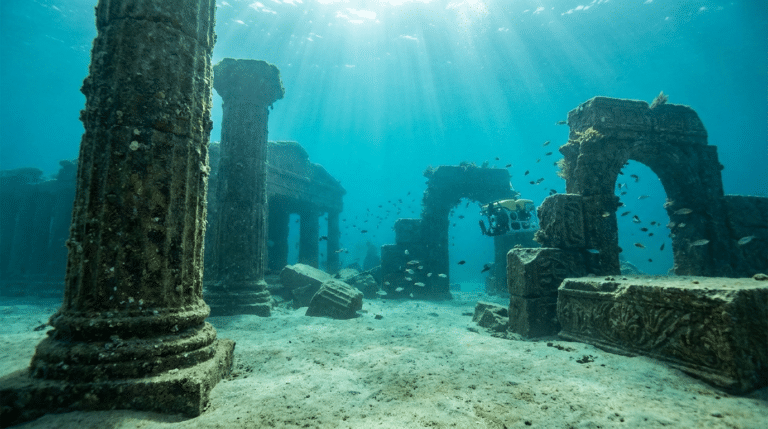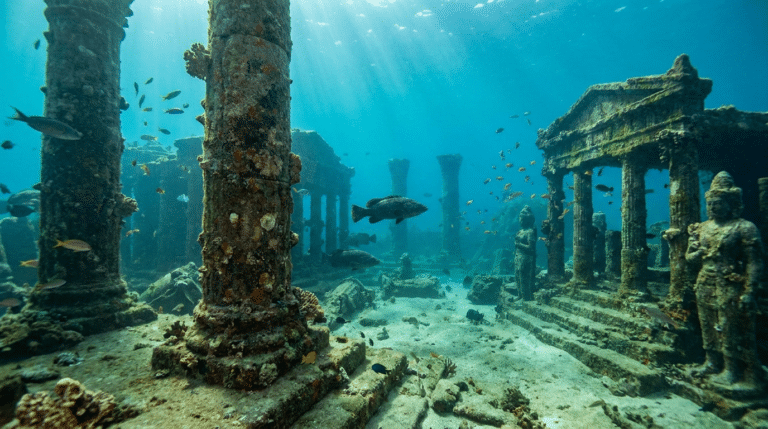
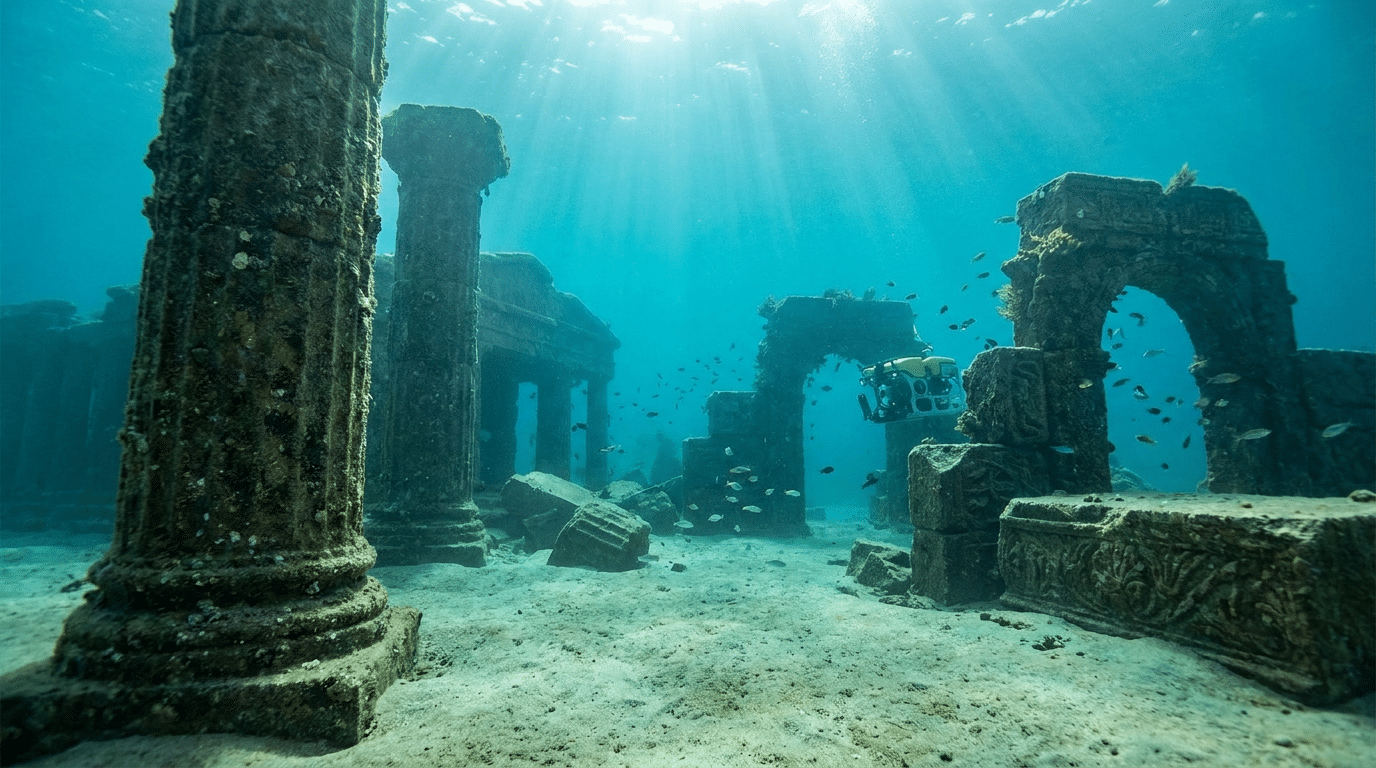
Few Indian archaeological questions sit as naturally at the intersection of faith, landscape and history as the story of Dwarka.
In Hindu tradition, Dwarka is the magnificent city associated with Krishna. The Mahabharata and later traditions describe it as a powerful coastal city, and narratives about the end of Krishna’s earthly life connect the city with a dramatic disappearance beneath the sea.
There is an important reason the story attracts archaeologists as well as historians and pilgrims: the Gujarat coast really does contain archaeological remains, including material discovered in and around submerged coastal environments. The difficult question is not whether ancient people lived along this coastline. They clearly did. The difficult question is whether any particular remains can be securely identified with the specific Dwarka described in the literary tradition.
That distinction turns a simple “myth or fact?” question into a much more interesting investigation of archaeology, changing coastlines and cultural memory.
What Does the Literary Tradition Say?
Dwarka, also called Dvaraka or Dvaravati in different sources and contexts, occupies an important place in Krishna traditions. In the Mahabharata, Krishna and the Yadavas are associated with the city after leaving Mathura. Later Puranic traditions add further details about its construction, grandeur and eventual submergence.
In these narratives, the city is not simply a settlement. It is a sacred place embedded in a larger theological story. Its relationship with Krishna gives the city significance that goes far beyond its physical buildings.
This matters archaeologically because a religious text and an excavation answer different questions. A text can preserve a tradition, describe an idealized sacred city or combine memories from different periods. Archaeology deals with physical remains that can be dated, compared and interpreted.
There Is a Real Dwarka in Gujarat
Modern Dwarka is a pilgrimage city on the western coast of Gujarat, on the Saurashtra peninsula. Its location is one reason the ancient tradition is so compelling: the physical landscape is genuinely maritime.
Coastal environments, however, are difficult archaeological archives. Land can erode. Sediment can accumulate. Rivers and currents can move material. Storms can rearrange objects. Changes in relative sea level can alter shorelines. Human construction can also disturb earlier deposits.
As a result, an underwater stone structure does not automatically represent a city that was deliberately swallowed by the sea. It might be part of a harbour, a defensive structure, a landing facility, a later construction phase or material displaced from its original location.
What Has Underwater Archaeology Found?
Marine archaeological investigations along the Gujarat coast have documented submerged structures and cultural material, including stone features, anchors and pottery in the wider Dwarka region. These discoveries are significant because they demonstrate that maritime activity and human settlement existed along a coastline whose physical history has changed substantially.
Underwater archaeology is particularly valuable in India because many coastal sites cannot be reconstructed from land archaeology alone. Ancient ports may now lie partly underwater, while other evidence may survive only in sediment or fragmented structures.
But archaeology works by assembling multiple independent clues. A wall, anchor or ceramic fragment becomes more informative when its position, associated material, construction technique and date form a coherent sequence.
The Dating Problem
Dating is central to the Dwarka question.
Suppose archaeologists identify a submerged structure that is genuinely ancient. That establishes that people constructed or used something at that location during the period represented by the evidence. It does not automatically establish that the structure belonged to Krishna’s city.
For a historical identification to become persuasive, several clocks would need to align: the archaeological remains would need to fit the relevant period; their cultural characteristics would need to be compatible with the literary account; the site would need to occupy a plausible location; and there would need to be a credible historical sequence linking the physical settlement to the textual tradition.
This becomes especially challenging because Indian epics and Puranic texts were transmitted and developed over long periods. Their surviving forms cannot simply be treated as contemporary eyewitness reports of every event they describe.
Could a City Really Have Been Submerged?
Yes—coastal settlements can disappear beneath or become heavily affected by water without requiring a supernatural event.
Relative sea level can change because of global sea-level fluctuations, local geological processes and changes in land elevation. Coastal areas can also be modified by erosion, sedimentation, storms and tectonic activity.
A settlement might therefore experience a gradual transformation of its shoreline, repeated flooding, erosion or partial submergence. Different archaeological layers could record different phases of this process.
This is an important point because a genuine geological or environmental explanation does not prove the Dwarka tradition, but neither does it make coastal-submergence traditions impossible. Archaeology has documented many cases in which ancient human landscapes have been dramatically altered by environmental change.
Myth, Memory and Geography
One of the most interesting possibilities is that sacred traditions and real landscapes can influence each other over time.
A coastal settlement can become associated with powerful stories. Those stories can shape pilgrimage routes and local traditions. Pilgrimage can preserve the importance of a place long after its original settlement patterns have changed. Later generations can then encounter both an inherited narrative and an ancient landscape.
This does not mean a legend must be invented from nothing. Cultural memory can preserve fragments of genuine historical experience while transforming them through religious storytelling.
At the same time, a literary account may create a sacred geography whose importance does not depend on a one-to-one historical correspondence with a particular archaeological site.
The Problem With “The Underwater City Has Been Found”
Popular accounts sometimes move quickly from the discovery of submerged remains to the statement that Krishna’s lost city has been discovered.
That conclusion goes beyond what archaeology can normally establish from isolated underwater finds.
A submerged structure can establish that something was built or deposited there. To identify it with a specific historical city requires a chain of evidence: secure dating, cultural attribution, architectural context, stratigraphy, geographic continuity and ideally independent historical or inscriptional evidence.
Without that chain, the responsible conclusion is more limited: the coastline contains archaeological evidence of ancient human activity and maritime use, while the exact relationship between those remains and the literary Dwarka remains a question for continued research.
What About the Mahabharata’s Chronology?
Chronology is another area where modern claims can become difficult to evaluate.
The Mahabharata is an enormous layered epic whose composition and transmission took place over centuries. Traditional chronologies and modern historical dating approaches are not identical, and there is no simple agreement that allows every event in the epic to be assigned a single archaeological date.
This does not make the text historically useless. Epic literature can preserve information about geography, social institutions, political relationships, religious traditions and remembered places. But individual elements must be evaluated according to the type of claim being made.
A place name may have a long historical life. A literary description may combine remembered geography with theological symbolism. An archaeological site may predate, overlap with or postdate the period in which a particular version of the story was written down.
What Evidence Would Make the Identification Stronger?
A stronger archaeological case for identifying a particular submerged settlement with the literary Dwarka would require several lines of evidence converging.
- Secure dating: the principal structures and associated material would need dates compatible with the historical period being proposed.
- Continuous cultural context: pottery, tools, architecture and other material would need to form a coherent settlement sequence rather than isolated finds.
- Geographic plausibility: the site would need to correspond convincingly with the coastal setting described by the relevant traditions.
- Independent corroboration: inscriptions, contemporary records or other evidence could provide additional support.
- Environmental reconstruction: geological and marine evidence would need to explain how the settlement came to occupy its present submerged or coastal position.
No single artefact can normally establish all of this by itself.
Why Underwater Archaeology Is So Difficult
Excavating on land is already challenging. Working underwater introduces additional complications.
Visibility can be poor. Currents can disturb sediments. Objects may have moved after deposition. Organic material can decay differently from material on land. Modern maritime activity can disturb older archaeological layers. Even accurately mapped structures must be interpreted within the changing history of the seabed.
Researchers therefore rely on careful mapping, stratigraphic relationships, material analysis, dating techniques and comparisons with known archaeological sites.
The absence of a perfectly preserved city should not automatically be treated as evidence against an ancient settlement. But the presence of scattered underwater remains should not automatically be treated as proof of a particular legendary city either.
Why Dwarka Matters Beyond the Question of Proof
Even if archaeology never establishes a one-to-one correspondence between the submerged remains and Krishna’s Dwarka, the research remains valuable.
It contributes to the history of India’s western coastline, maritime trade, coastal settlement and interactions between land and sea. It also demonstrates how much archaeological evidence can disappear when shorelines move.
More broadly, Dwarka provides an excellent case study in how archaeology and cultural memory interact. Sacred traditions preserve meanings that archaeology cannot measure directly, while archaeology can reveal physical landscapes that texts describe only imperfectly.
Faith and Archaeology Are Asking Different Questions
For a religious believer, Dwarka may be significant because of its association with Krishna regardless of whether an archaeological excavation can identify the exact buildings described in scripture.
For an archaeologist, the question is narrower: what physical evidence survives, when was it created, how was it used, and what can reasonably be inferred from it?
These approaches do not have to be treated as enemies. They simply operate with different standards of evidence.
The challenge begins when archaeological evidence is asked to prove a theological claim, or when a religious narrative is treated as though it were an excavation report.
The Lost City at the Edge of the Sea
Dwarka remains compelling precisely because several histories overlap there.
There is the living sacred city. There is the literary Dwarka associated with Krishna. There is the archaeological record of ancient settlement and maritime activity along the Gujarat coast. And there is the changing physical coastline that can preserve, destroy or conceal evidence of earlier human activity.
Those histories may intersect in ways that future research can clarify. But they should not be collapsed into a single claim before the evidence supports it.
The most interesting question may therefore be broader than “Was Krishna’s Dwarka found?” It is this: how do real landscapes, environmental change, historical memory and sacred stories combine to create places whose meaning survives for thousands of years?
What the Archaeological Record Can—and Cannot—Tell Us
The most useful way to approach Dwarka is to separate three questions that are often blended together. First, did people occupy and use this part of the Gujarat coast in antiquity? Second, did some of those settlements or harbour environments later become submerged or otherwise altered? Third, can the surviving remains be identified specifically with the Dwarka of Krishna traditions?
The first question is an archaeological question for which there is substantial evidence of ancient coastal activity in the region. The second is a geological and archaeological question that can be investigated through bathymetry, sediment studies, coastal geomorphology and the dating of individual deposits. The third is much harder because it requires a historical identification, not merely proof that an ancient settlement existed.
This distinction is more than academic. Archaeology rarely identifies a famous place because one spectacular object suddenly supplies its name. Identification normally emerges from a combination of chronology, material culture, location, architecture, inscriptions, environmental evidence and a sequence that connects different discoveries into one historical picture.
Dwarka Has More Than One Archaeological Story
Another complication is that “Dwarka” can refer to several overlapping things: the modern pilgrimage city, the archaeological remains around the present settlement, submerged material in the wider coastal zone, and the literary-sacred city described in Hindu traditions. Treating all four as if they were automatically the same archaeological entity can create false certainty.
Ancient coastal cities were not necessarily fixed points on a modern map. Harbours could shift, shorelines could migrate and settlements could be rebuilt. A place could retain its cultural name while its physical centre moved. Conversely, archaeological remains found near a historically important place can belong to different periods of occupation.
That means the important question is not simply whether something ancient has been found “near Dwarka.” Researchers must establish what was found, exactly where it was found, how it was deposited, when it dates from and whether its archaeological context connects it to other remains.
Underwater Remains Are Not the Same as a Sunken City
Submerged archaeology can produce some of the most visually persuasive evidence—and some of the easiest evidence to misunderstand. A line of stones photographed beneath the sea may look like the remains of a wall or street, but interpretation depends on its construction, orientation, relationship to surrounding deposits and whether natural processes could have produced or rearranged the feature.
Stone is especially difficult to interpret in isolation. Natural rock formations, transported blocks, collapsed structures and deliberately constructed walls can sometimes appear similar when separated from their original archaeological context.
Anchors and pottery can be more informative because they can indicate maritime activity and cultural connections, but even these objects have to be dated and interpreted in context. An ancient anchor establishes that a vessel or maritime activity was associated with a particular environment; it does not by itself establish the identity of the city that used it.
For that reason, underwater archaeology relies heavily on mapping and context. The location of a structure relative to other structures, the sediment surrounding it, associated artefacts and evidence for successive occupation can tell researchers much more than an isolated underwater object.
How Could the Coastline Have Changed?
The physical setting of Dwarka is essential to understanding the submergence question. A coastline is not static. Relative sea level reflects both changes in the level of the sea and changes in the elevation of the land. Erosion, sediment movement, storms and local geological processes can also reshape coastal environments.
These processes do not have to produce a dramatic single-day catastrophe. A settlement may experience repeated flooding, shoreline retreat, harbour silting or gradual loss of usable land. Parts of a settlement can be abandoned while other parts continue to be occupied. Over generations, the relationship between a city and the sea can change substantially.
This is why geological evidence needs to be integrated with archaeology. If a submerged settlement is proposed, researchers need to establish not only that structures are underwater but also the sequence of environmental changes that placed them there.
There is an important distinction here: demonstrating that a settlement could have been submerged is not the same as demonstrating that a particular traditional account describes that event. The environmental mechanism can be plausible without proving the identity of the city.
Why Dating Is More Complicated Than a Single Number
Archaeological dates describe particular samples or layers. They do not automatically date an entire city, and they certainly do not automatically date a literary character or event.
A structure may have been built during one period and repaired or reused centuries later. Pottery found nearby may have been deposited after the building was constructed. A sample used for radiocarbon dating can provide a date for the material tested, while the historical question concerns the structure or occupation associated with it. Archaeologists therefore have to consider stratigraphy, sample selection and context alongside the numerical date.
This matters especially when very different dates are proposed for Dwarka. A very early date from one sample cannot simply be transferred to every structure at the site. Likewise, evidence for a later occupation does not erase evidence for an earlier one. A credible chronology should explain the sequence rather than select the oldest or newest number because it best fits a preferred narrative.
The Literary Chronology Has Its Own Problem
The literary evidence has to be treated with similar care. The Mahabharata is a large, layered epic transmitted over a long period, and the Puranic literature developed through its own complex textual histories. The existence of a tradition in a surviving text therefore does not mean that every detail was written down at the moment the described event occurred.
At the same time, saying that a text is layered does not make it historically meaningless. Literary traditions can preserve geographical knowledge, social memories, names of places and ideas about earlier political worlds. The historical value of each element has to be assessed separately.
This creates an interesting possibility for research: archaeology and literature may preserve different parts of a long cultural memory. But establishing that relationship requires more than finding a modern archaeological site whose name resembles a famous place in a text.
Three Interpretations of the Evidence
The evidence can reasonably be approached through several competing interpretations.
- Historical-continuity interpretation: some archaeological remains may preserve material traces of a coastal settlement tradition that contributed to the later memory of Dwarka. This would still require detailed evidence before identifying particular remains with Krishna’s city.
- Multiple-settlement interpretation: different archaeological remains may represent several occupations or maritime installations from different periods. In this view, the modern sacred geography may have accumulated around a region with a long and changing settlement history.
- Sacred-geography interpretation: the literary Dwarka may function primarily as a sacred and theological place whose importance does not depend on a one-to-one correspondence with a surviving archaeological city.
These interpretations are not equally testable in every respect. Archaeology can test questions about structures, dates, materials and environmental change particularly well. It is much less equipped to test theological meaning directly.
What Would Count as a Major Breakthrough?
A particularly strong identification would require several independent lines of evidence to converge rather than one spectacular discovery. Imagine, for example, a securely dated settlement complex whose architecture and material culture fit a proposed period; a coherent sequence showing that the complex was occupied as a substantial coastal centre; geological evidence demonstrating when and how relevant parts became submerged; and independent inscriptions or other contemporary evidence connecting the settlement to the historical name being proposed.
Even then, historians would still have to examine how closely the archaeological city corresponds to the literary description. Archaeology can establish that a place existed and how people used it. It cannot automatically verify every narrative detail attached to that place.
This is the evidentiary threshold that separates a fascinating hypothesis from a well-supported historical identification.
Why the Question Has Survived for So Long
Dwarka is unusually powerful as a historical question because none of its ingredients is imaginary. There is a real coastline, a real archaeological record, a long literary tradition, a living pilgrimage centre and a dynamic geological environment. The uncertainty arises from the relationship between these things.
That relationship is also why new discoveries should be interpreted cautiously. A new underwater structure can change the archaeological picture without immediately settling the literary question. A new geological reconstruction can make one form of coastal change more plausible without proving that it caused the traditional submergence. A newly analysed inscription or artefact can strengthen a chronology without identifying an entire city.
The story becomes more interesting, not less, when evidence is allowed to remain at the level it can actually support.
The Deeper Mystery
Perhaps the enduring mystery of Dwarka is not simply whether archaeologists will one day uncover a city and place a definitive label on it. It is how landscapes become repositories of memory.
People build settlements beside rivers, seas and trade routes. Coastlines change. Buildings disappear. Communities move. Stories survive. Centuries later, a sacred tradition may still point toward a landscape in which fragments of several different historical periods remain buried or submerged.
That makes Dwarka a remarkable case study in the meeting of archaeology, geology, literature and cultural memory. The evidence can establish that ancient people lived and worked along this coast and can help reconstruct how the landscape changed. The stronger claim—that a particular submerged complex is the very city of Krishna described in sacred tradition—requires evidence that has not yet been demonstrated conclusively.
And that is precisely what makes the investigation worth continuing: the sea may preserve traces of the past, but deciding what those traces mean requires much more than finding stones beneath the water.
Curiosity Publication by Aadvik Agastya
Sources & further reading
Have a question about this topic?
Join fellow Qurons on the Quron Forum to ask questions, challenge ideas, share discoveries and explore further.
Discuss on Quron Forum