Modern mathematics feels universal because the symbols are now familiar almost everywhere. A number such as 10,507 can be written and understood across languages and continents without anyone needing to explain why the zero sits where it does.
That apparent simplicity hides a long history.
Indian mathematical traditions made major contributions to decimal place-value notation, the development of zero as a number, arithmetic with negative quantities, algebraic methods and mathematical astronomy. These ideas did not remain confined to the subcontinent. They moved through intellectual networks into the Islamic world and, through further transmission and adaptation, eventually became part of the mathematical language used in Europe and beyond.
The story is therefore not simply one of “ancient genius.” It is a story about notation, cumulative discovery, practical problems, intellectual communities and the movement of ideas across civilizations.
Why Place Value Was Such a Powerful Idea
Consider the difference between a positional numeral system and a system in which every magnitude requires its own symbol.
In a positional decimal system, the same digit changes value according to where it appears. The 5 in 5,000 represents thousands; the 5 in 50 represents tens; the 5 in 5 represents units.
This seems obvious because modern arithmetic has made it habitual. Historically, however, positional notation was an enormous conceptual and practical improvement.
It allowed very large numbers to be represented compactly and made written calculation more systematic. Addition, subtraction and multiplication could be performed through repeatable algorithms rather than requiring a separate symbolic strategy for every magnitude.
India and the Decimal Place-Value Tradition
Indian mathematical traditions developed sophisticated decimal place-value methods. Evidence comes from a range of texts and manuscripts, although dating individual sources can be complicated because mathematical ideas were transmitted in both oral and written forms and surviving manuscripts may be later copies of older works.
The important point is not that one person suddenly invented the entire modern numeral system. Mathematical notation develops cumulatively.
Different symbols, conventions and computational methods can evolve over time before becoming part of a mature system. Indian mathematicians then used that system to address problems in arithmetic, algebra and astronomy.
Zero Had Two Jobs
Zero’s historical importance comes partly from the fact that it performs two different functions.
First, it can act as a placeholder. In a number such as 205, the zero indicates that there are no tens while preserving the position of the hundreds and units.
Second, zero can be treated as a number in its own right.
That second step is conceptually significant. Once zero can participate in arithmetic, mathematics has a way to represent not merely an empty position but a quantity at the boundary between positive and negative numbers.
Why Zero Was Not an Obvious Idea
“Nothing” seems easy to imagine, but representing nothing mathematically raises unusual questions.
If zero is a number, what happens when it is added to another number? What happens when a number is subtracted from itself? How does zero behave under multiplication? What happens when something is divided by zero?
Modern mathematics answers these questions within a highly developed framework. Early mathematicians had to build that framework gradually.
Recognizing zero as a number therefore represented more than adding a new symbol. It expanded the set of quantities that mathematical operations could describe.
Brahmagupta and the Arithmetic of Zero
The seventh-century mathematician Brahmagupta is especially important because his work gave explicit rules for arithmetic involving zero and negative numbers.
His Brahmasphutasiddhanta, composed in 628 CE, treated positive quantities, negative quantities and zero systematically within mathematical procedures.
Some of his rules correspond closely to familiar modern arithmetic, while others reveal the limits of the mathematical framework available at the time. Division by zero, for example, does not fit cleanly into the modern rules for arithmetic.
This is exactly why historical mathematics is interesting. Earlier mathematicians were not simply using modern mathematics with different symbols. They were actively working out concepts whose definitions and rules were still developing.
Negative Numbers and the Language of Debt
Negative numbers can seem as abstract as zero. Indian mathematical texts sometimes explained positive and negative quantities through practical analogies such as fortune and debt.
A debt is something owed rather than something physically possessed, but it can still be included in a calculation. This gives a useful intuitive framework for quantities below a reference point.
Once negative numbers are accepted as legitimate mathematical objects, equations become more flexible. Algebra can treat unknown quantities and signed values within a common symbolic system.
From Arithmetic Toward Algebra
Indian mathematicians did not stop at numerical calculation. Mathematical traditions developed procedures for solving equations, manipulating unknown quantities and working with series and geometric problems.
These methods were closely connected to astronomy, where calculations could become demanding.
Astronomical models required numerical tables, angular calculations and predictions of celestial positions. Mathematics therefore became a practical instrument for understanding cycles in the sky.
Aryabhata and Mathematical Astronomy
Aryabhata, who wrote the Aryabhatiya in the fifth century, is one of the most influential mathematicians and astronomers of classical India.
His work includes mathematical methods, trigonometric ideas and astronomical calculations. It demonstrates how closely mathematics and astronomy were connected in the intellectual traditions of the period.
The importance of this connection is easy to overlook. Astronomy provides repeated, measurable patterns. If a calculation predicts the position of a celestial body incorrectly, the discrepancy can become visible through observation. Such practical problems encourage the development of increasingly efficient computational techniques.
Mathematics Was Also an Astronomical Tool
Calendars, planetary calculations and eclipse predictions all require quantitative reasoning.
Indian astronomical traditions therefore generated demand for algorithms, tables and numerical approximations. Mathematical knowledge did not exist solely as abstract philosophy; it could be applied to timekeeping and the organization of ritual and civil calendars.
This relationship between mathematics and astronomy was common across many civilizations. What distinguishes Indian contributions is the particular combination of decimal notation, computational methods and later developments in algebraic reasoning.
The Bakhshali Manuscript and the History of Zero
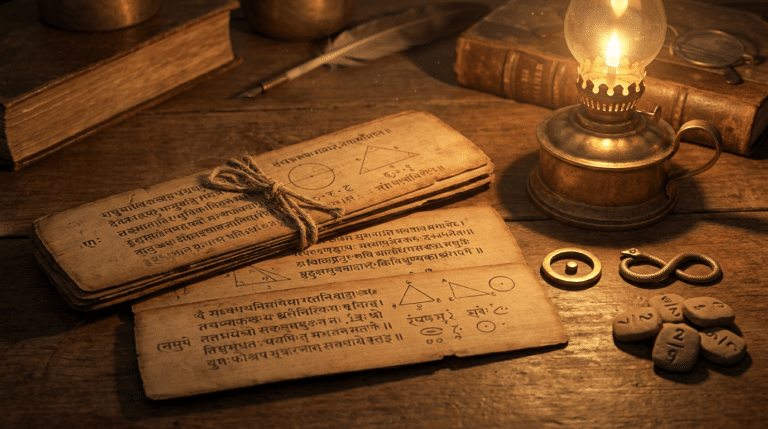
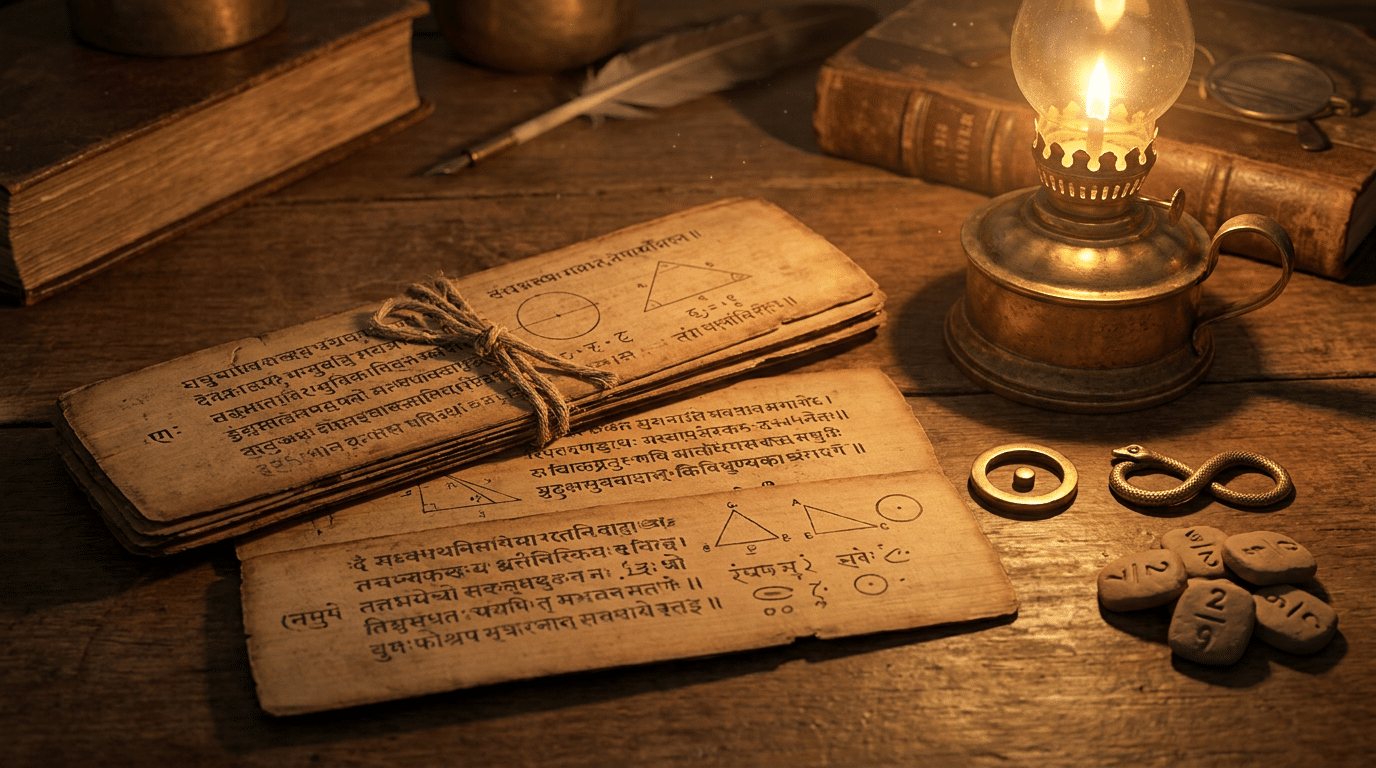
The Bakhshali manuscript is an important source in discussions of early Indian mathematics. It contains mathematical problems and uses a dot-like symbol in contexts associated with zero.
Its dating is complicated. Different parts of a manuscript can have different histories, and scientific dating of the physical material does not necessarily tell us the exact date when every mathematical idea in the text was first developed.
This is a useful reminder that historical claims about “the first zero” require precision. There is a difference between the earliest known symbol, the earliest known use as a placeholder and the earliest securely documented treatment of zero as a number.
How Mathematical Ideas Travelled
Mathematics did not develop inside sealed cultural containers.
Ideas travelled with scholars, texts, trade networks and political connections. Indian mathematical and astronomical works were translated and transmitted into the Islamic intellectual world, where scholars studied, criticized and extended them.
From there, mathematical knowledge eventually entered European intellectual networks.
The modern numeral system is therefore the product of a long chain of transmission. The phrase “Arabic numerals” describes an important stage in that history, because the numerals reached Europe through Arabic-speaking mathematical traditions, but many of the underlying decimal methods had earlier Indian histories.
Why Calling Them “Indian” or “Arabic” Is Only Part of the Story
Mathematical notation changes as it travels.
A symbol can be modified. A computational method can be explained differently. A translator can introduce terminology that later becomes standard. A mathematical idea can be combined with methods developed somewhere else.
The history of the modern numeral system therefore cannot be reduced to a single inventor or civilization. It is a story of cumulative development across cultures.
What “Infinity” Has to Do With It
The title of this article invokes infinity, but it is important not to suggest that ancient Indian mathematicians simply invented modern set theory or the formal mathematics of infinite quantities.
Indian mathematical traditions did, however, engage with very large numbers, infinite processes and mathematical concepts that pushed beyond ordinary finite arithmetic. Later Indian thinkers also discussed infinity in sophisticated ways.
These historical ideas should be understood in their own mathematical context rather than treated as direct equivalents of modern analysis.
Why Notation Changes What Mathematics Can Do
Notation is not merely decoration.
A good notation system reduces cognitive effort. Once numbers can be represented compactly and manipulated through standardized algorithms, problems that were previously cumbersome become tractable.
Zero and place value therefore had consequences far beyond writing numbers more conveniently. They created a computational language that could support increasingly complex arithmetic and algebra.
That language later became indispensable to science, engineering, finance and computing.
From Ancient Arithmetic to Modern Computing
It would be anachronistic to say that ancient Indian mathematicians invented computers. They did not.
But modern digital technology relies heavily on positional numerical representation and arithmetic operations. The conceptual history of computing therefore sits downstream from centuries of mathematical development.
Zero became particularly important in later binary systems, where the distinction between 0 and 1 provides the foundation for digital representation.
The path from ancient decimal notation to modern computing is long and indirect, but it illustrates how a mathematical abstraction can eventually become part of an entirely different technological system.
Why “Genius” Is Not Enough
Great mathematical advances rarely appear from nowhere.
They depend on earlier notation, existing problems, teachers, texts, debates and communities capable of preserving and extending ideas. A mathematician can make an extraordinary conceptual leap, but the leap becomes historically influential only if other people can understand, transmit and develop it.
That is why the history of Indian mathematics is more interesting than a list of isolated inventions. It is a history of an intellectual ecosystem.
A Global Mathematical Inheritance
The arithmetic used on a modern calculator may feel culturally neutral, but its history is not.
It carries traces of many civilizations: ancient systems of counting, place-value ideas, Indian developments in decimal arithmetic and zero, mathematical work in the Islamic world, European transformations and much later developments in algebra, calculus and computing.
No single civilization owns modern mathematics. Mathematical knowledge becomes global precisely because ideas cross boundaries.
The Bigger Perspective
The most important contribution of Indian mathematics may not be one isolated formula. It may be the development and refinement of ways to represent and manipulate numbers that made increasingly sophisticated calculation possible.
Place value made numbers compact. Zero filled an essential structural role and became a number in its own right. Negative numbers expanded the range of arithmetic. Algebra provided methods for unknown quantities. Astronomy supplied demanding practical problems that encouraged calculation.
These developments then entered wider intellectual networks and were transformed as they travelled.
Modern mathematics is therefore not a straight line from one genius to another. It is a vast conversation across centuries and civilizations.
The Real Revolution Was in Representation
Zero did not merely add another number to the counting sequence. Place value did not merely shorten notation.
Together, they changed what humans could conveniently represent.
Once a number system can express absence, position, magnitude and signed quantities in a compact symbolic language, calculation becomes dramatically more powerful.
That is why the history of Indian mathematics is ultimately a story about representation: change the language in which numbers can be expressed, and you change the mathematics that becomes possible.
Curiosity Publication by Aadvik Agastya
Sources & further reading
Have a question about this topic?
Join fellow Qurons on the Quron Forum to ask questions, challenge ideas, share discoveries and explore further.
Discuss on Quron Forum