
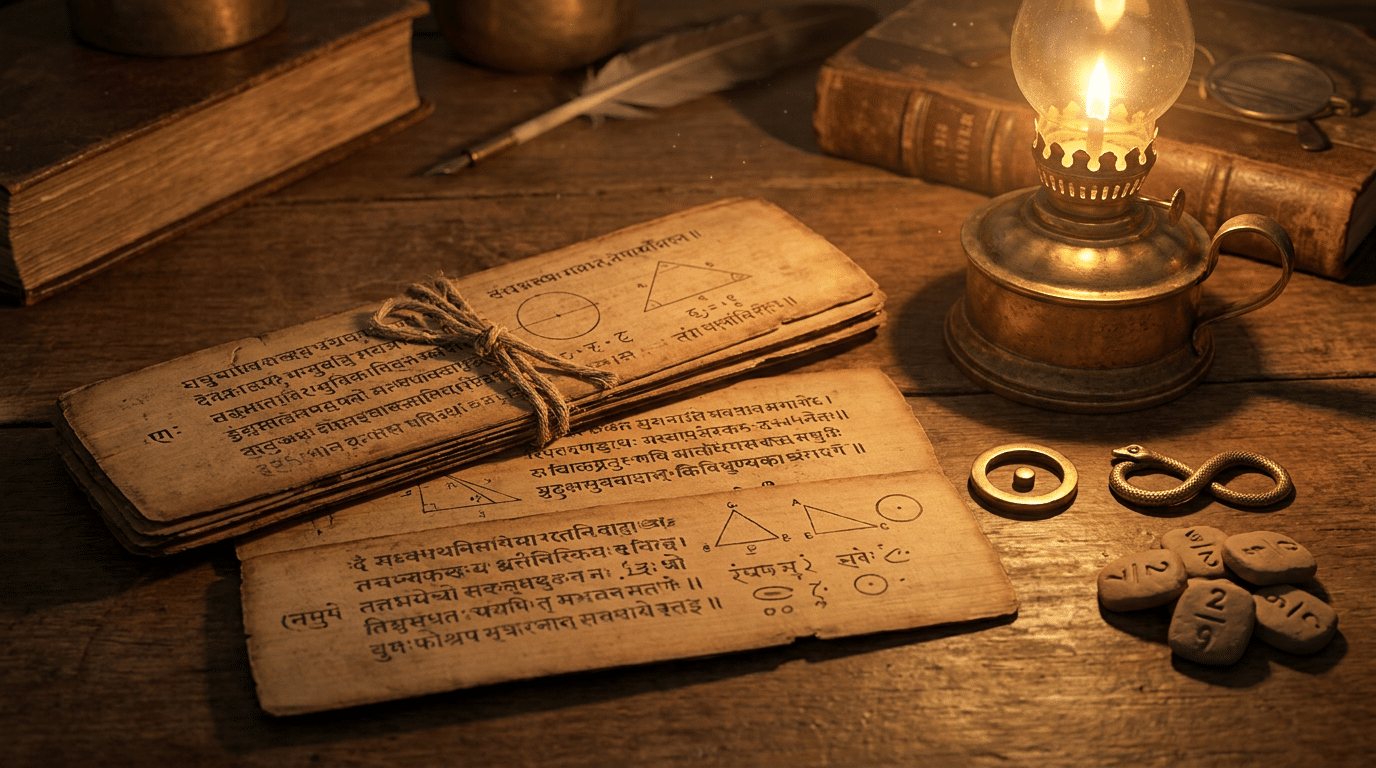
Today zero feels obvious. We write 10, 100 and 1,000 without thinking about the strange idea hidden inside them: a symbol representing nothing can change the value of every other symbol around it.
The development of zero as a number and positional placeholder transformed mathematics.
Zero was not invented in one moment
Different civilizations used ideas resembling zero in different ways. The Maya developed a zero-like concept in their calendrical mathematics, while ancient Mesopotamian systems used placeholders in positional notation.
The Indian mathematical tradition played a crucial role in developing zero as a number with arithmetic properties.
A placeholder changes everything
In a positional number system, the position of a digit determines its value.
The zero in 105 tells us that there are no tens. Without a placeholder, representing such numbers clearly becomes much harder.
Zero became a number
Indian mathematicians developed rules for performing calculations involving zero. Brahmagupta’s seventh-century work included arithmetic rules involving zero and negative numbers.
This was a major conceptual step: zero was not merely an empty space but an object that could participate in calculation.
Why negative numbers mattered too
Once zero is treated mathematically, numbers below zero become easier to conceptualize.
Debt and credit provided practical metaphors for positive and negative quantities.
Zero changed algebra
Modern equations depend heavily on zero. Solving an equation often means finding the value that makes an expression equal to zero.
Calculus, coordinate geometry, physics and computing all depend on the concept.
Zero also changed how we think about absence
There is a philosophical difference between “nothing is here” and “the quantity is zero.”
Zero turns absence into something that can be manipulated symbolically.
From mathematics to computing
Digital electronics commonly represent information using binary states associated with 0 and 1.
The modern computer therefore depends on a mathematical concept that began as a way to represent absence and positional structure.
The deeper lesson
Zero looks like nothing.
Yet it is one of the most powerful ideas in mathematics.
It allows place-value notation, negative numbers, algebraic equations, calculus and digital computation to work with extraordinary precision.
Sometimes the biggest mathematical revolutions begin with giving a name to an empty space.
Why Zero Was Such a Difficult Idea
Humans have always been able to recognize absence. The mathematical challenge was giving absence a stable place inside a numerical system. A symbol representing an empty position becomes especially powerful when it works within a place-value system: the same digit can represent different quantities depending on where it appears.
Zero as Placeholder and Number
These are related but distinct achievements. A placeholder prevents ambiguity between numbers such as 101 and 11. Treating zero as a number adds another layer: it can participate in arithmetic operations. Indian mathematical traditions played a major role in developing this more systematic treatment.
Brahmagupta’s Contribution
Brahmagupta’s seventh-century work gave rules for calculations involving zero and negative numbers. Some rules resemble the arithmetic taught today, while other questions—most famously division by zero—remain outside ordinary arithmetic. The significance was not that every modern rule appeared at once, but that zero had entered formal mathematical reasoning.
Why Positional Notation Changed Everything
Place-value notation makes large calculations compact and repeatable. That matters for astronomy, trade, surveying and later algebra. Once numerical operations become easier to write and manipulate, increasingly complicated mathematical structures become practical to develop.
A Networked History
The numeral system later associated with “Arabic numerals” travelled through intellectual networks connecting South Asia, the Islamic world and Europe. Its history is therefore not a story of one civilization inventing modern mathematics in isolation. Ideas were transmitted, translated, modified and taught across languages and centuries.
Zero’s deepest legacy is conceptual: it gave mathematics a precise way to represent absence while fitting that absence into a system capable of describing enormous quantities, equations and eventually the digital logic underlying modern computing.
Zero Was More Than an Empty Space
Zero is so familiar that it is easy to underestimate how profound the idea is. A symbol that means “nothing here” seems simple, but mathematics needed to distinguish an empty position from an absent number and then develop rules for calculating with zero. The history of zero is therefore not a single invention but a long development involving notation, place value and arithmetic.
Placeholder and number are different ideas
A positional numeral system needs a way to show that a particular place is empty. In a number such as 205, the zero tells us that there are no tens while preserving the hundreds and units positions. This placeholder function is already powerful, but it is conceptually different from treating zero as a number that can be added, subtracted and manipulated like other quantities.
Earlier civilizations had forms of zero
Ancient mathematical traditions developed symbols or conventions for empty positions at different times. Babylonian mathematics, for example, used positional notation with devices that could indicate missing places. Maya mathematicians also developed a zero within their own vigesimal numerical system. The global history therefore cannot be reduced to the claim that one civilization suddenly invented the entire concept from nothing.
The Indian breakthrough
Indian mathematicians developed a highly effective decimal place-value system in which zero could function both as a placeholder and as a number. This combination was especially powerful because the same compact notation could represent very large numbers and support systematic arithmetic.
Brahmagupta and arithmetic rules
In the seventh century, the Indian mathematician Brahmagupta gave explicit rules for calculations involving zero in his work Brahmasphutasiddhanta. He treated zero as a number and described operations involving positive and negative quantities. His treatment was an important step toward a coherent arithmetic involving zero rather than merely a symbol marking an empty place.
Division by zero remained difficult
Arithmetic with zero is not entirely straightforward. Adding or subtracting zero behaves predictably, but division by zero does not produce an ordinary finite number. Historical mathematicians grappled with such issues, and modern mathematics distinguishes carefully between operations that are defined and those that are not. The difficulty illustrates that inventing notation is only the beginning; mathematical consistency requires defining what operations mean.
How the idea traveled
Indian numerals and mathematical techniques spread westward through scholarly and commercial networks, including the Islamic intellectual world. Arabic-language mathematicians adopted and developed Indian numerical ideas, and these traditions later influenced European mathematics. The modern decimal numeral system is therefore the result of transmission and further development across several cultures.
Why zero transformed mathematics
Place value makes arithmetic dramatically more compact and scalable. Without a zero placeholder, representing large numbers and performing calculations in a positional system becomes far more cumbersome. Once zero functions as a number as well, algebraic manipulation becomes more systematic. Modern mathematics, from equations to coordinate systems, depends on this conceptual infrastructure.
Zero reaches computing
The significance of zero extends beyond arithmetic. Digital electronics commonly represent information using binary states, often described as 0 and 1. The zero used in computing is not exactly the same historical concept as Brahmagupta’s arithmetic zero, but the ability to represent absence, state and position mathematically is part of the conceptual lineage that made positional and symbolic systems so powerful.
The deeper achievement
Zero’s history is best understood as a story of abstraction. Humans first needed ways to represent quantities, then empty positions, and eventually “nothing” as an object that could participate in mathematical rules. That progression changed what equations could express and helped create the numerical language used throughout modern science and technology.
“Who invented zero?” has no one-line answer
The question sounds as though zero should have appeared in a single moment, but several achievements are involved. One is a symbol for an empty position. Another is a consistent decimal place-value notation. Another is treating zero as a number with arithmetic properties. Another is transmitting those ideas into new mathematical traditions. Different societies contributed to different parts of this story.
That is why historical claims about zero should distinguish between early zero-like placeholders and the later fully developed arithmetic concept. The Indian tradition occupies a central place in the latter development, especially in the formal rules associated with Brahmagupta.
Why zero behaves differently from ordinary numbers
Zero is the additive identity: adding it leaves a number unchanged. It is also the boundary separating positive and negative numbers. But it is not an ordinary positive quantity, and division by zero cannot be handled as if zero were simply another denominator.
These properties make zero a structural element of mathematics. It does not merely tell us that a collection contains no objects; it helps define relationships between numbers themselves.
Nothing in the world is not automatically the number zero
If a room contains no chairs, we can say the number of chairs is zero. But “nothing” in philosophical language can mean much more than a numerical quantity. Zero is precise precisely because it applies within a defined system: zero apples, zero meters, zero units of a variable. It does not by itself answer the much larger philosophical question of what absolute nothingness would mean.
From notation to a new mathematical landscape
Once zero became part of a robust positional and arithmetic system, mathematics could express increasingly complex relationships compactly. Equations could be rearranged around zero, coordinate systems could locate positions on either side of an origin, and later mathematical analysis could formalize limits and rates of change.
The historical importance of zero is therefore not only that it filled an empty place. It helped create a language in which absence, balance, boundaries and algebraic structure could be represented with the same precision as ordinary quantities.
Zero was more than an empty place
A placeholder and a number are not quite the same idea. A notation system can represent an empty position without treating zero as an independent number with arithmetic properties. The conceptual leap involved representing “nothing in this position” consistently and then using that concept in calculation.
Indian mathematics gave zero an operational life
Brahmagupta, writing in the seventh century, is especially important because his Brahmasphutasiddhanta discussed calculations involving zero and negative numbers. Some rules differed from modern conventions and division by zero remained problematic, illustrating a developing mathematical system rather than a finished modern theory.
From India into wider mathematical culture
The numeral system associated with Indian mathematics traveled through intellectual networks into the Islamic world and later into Europe. Arabic-speaking scholars preserved, developed and transmitted mathematical knowledge, helping shape the numeral system that eventually became widespread in Europe. The history is therefore one of transmission and further development across cultures, not a simple one-way story.
Why zero changed computation
Place-value notation makes large numbers compact and arithmetic systematic. Once zero can mark an empty position, numbers such as 101, 1001 and 10001 can be distinguished within the same positional framework. That becomes enormously important for algebra, astronomy, accounting and eventually digital computing.
Curiosity Publication by Aadvik Agastya
Sources & further reading
Have a question about this topic?
Join fellow Qurons on the Quron Forum to ask questions, challenge ideas, share discoveries and explore further.
Discuss on Quron Forum