
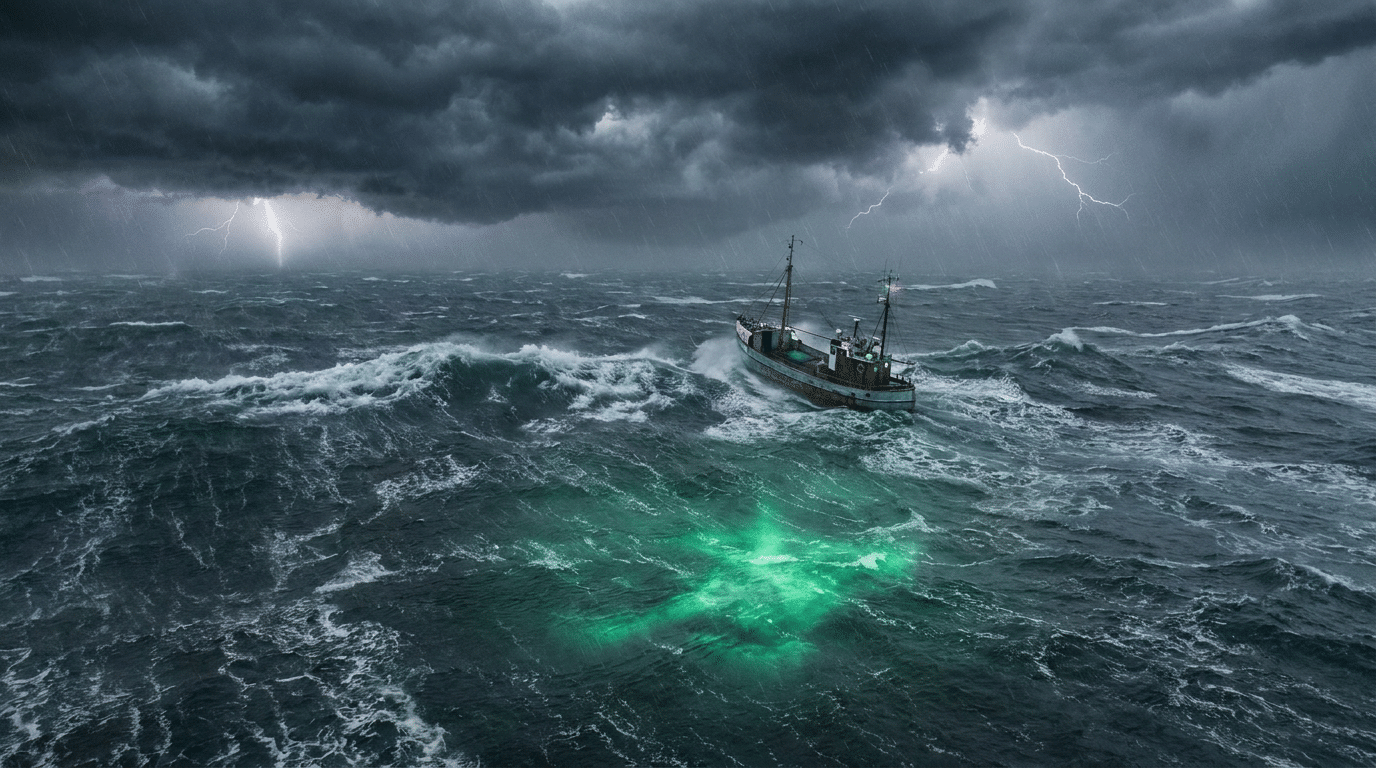
On December 4, 1872, the merchant brigantine Mary Celeste was found drifting in the Atlantic Ocean about 400 miles east of the Azores. The ship was afloat, its cargo was largely intact, and supplies remained aboard. But there was one extraordinary absence: not a single person was on board.
Captain Benjamin Spooner Briggs, his wife Sarah, their two-year-old daughter Sophia and seven crew members had vanished.
The ship was not a wreck. It was not burned to the waterline. It had not disappeared beneath the waves. It was simply continuing without the people who had been sailing it.
That is the fact at the center of the Mary Celeste mystery. Almost everything else is an attempt to explain it.
What we actually know
The Mary Celeste had begun its voyage from New York bound for Genoa, Italy, carrying 1,701 barrels of industrial alcohol. Briggs, his family and seven crewmen were aboard. After roughly two weeks of difficult Atlantic weather, the ship’s log recorded its final entry on November 25, 1872.
Nine days later, the crew of the Dei Gratia spotted the vessel and realized something was wrong. A boarding party found a ship that was still capable of sailing, although there was water in the lower part of the vessel and one of its pumps had been disassembled. The only lifeboat was gone. The crew’s belongings remained aboard, and a substantial supply of food and water was still available.
None of the ten people aboard the Mary Celeste was ever seen again.
Why the ship’s condition made the mystery so powerful
Abandoned ships are not automatically mysterious. A vessel can be deserted because it is sinking, burning or under attack.
The Mary Celeste was different.
According to the historical evidence summarized by Smithsonian, the ship was seaworthy enough to continue its journey. Its cargo was largely intact. The lifeboat was missing, suggesting that the people aboard had deliberately left the ship rather than simply disappearing from it.
That creates a puzzle with two separate questions.
First: why would experienced sailors abandon a vessel that was still afloat?
Second: once they entered a small lifeboat in the open Atlantic, what happened to them?
The first question may eventually have plausible answers. The second is much harder because there were no survivors to tell us what happened.
The alcohol cargo became part of the legend
Because the ship carried industrial alcohol, later retellings often turned the cargo into the center of dramatic theories involving intoxication or explosions.
The historical record is less sensational.
Of the 1,701 barrels, nine were found empty. Investigations later noted that these barrels were made from red oak, a more porous wood than the white oak used for the others, making leakage a plausible explanation. The boarding party did not report finding the ship filled with explosive fumes.
That does not solve the mystery. But it illustrates an important rule for historical mysteries: a strange detail can become much more dramatic as it travels through newspapers and retellings than it was in the original evidence.
What about piracy, mutiny or murder?
The Mary Celeste quickly attracted theories of foul play. That was understandable in an era when communication across the ocean was slow and evidence was difficult to verify.
But the physical condition of the ship provides no straightforward proof of a massacre, piracy or mutiny. British authorities in Gibraltar ultimately did not establish foul play.
Later stories became increasingly imaginative. Arthur Conan Doyle’s famous 1884 fictional account helped turn the incident into a cultural mystery, but his story was not a factual reconstruction of the event. Other retellings added murder, sea monsters and other dramatic elements.
This is one reason the Mary Celeste is so difficult to discuss today: the historical case and the mythology surrounding it have become intertwined.
Could the captain have ordered an evacuation?
One line of investigation asks a much less theatrical question: what could have made a captain believe his ship was suddenly unsafe?
Modern investigations have explored scenarios involving water entering the vessel, uncertainty about the ship’s pumps, weather conditions and concerns about the cargo. Smithsonian’s earlier reconstruction of the case considered the possibility that Briggs could have believed the ship was taking on dangerous amounts of water and ordered the people aboard into the lifeboat.
If something like that happened, the decision might have been rational at the moment even if the ship later proved capable of remaining afloat.
That distinction is crucial. A ship can look seaworthy after the danger has passed. A captain making a decision in heavy weather does not have access to the later evidence we have today.
The missing lifeboat changes everything
The lifeboat is perhaps the most important physical clue.
If the ten people deliberately left the Mary Celeste, they would have had to believe that remaining aboard was more dangerous than entering a small boat in the Atlantic. Once they separated from the ship, their survival depended on weather, navigation, supplies and the ability to remain connected to the vessel.
A particularly dangerous possibility is that the lifeboat was attached to the Mary Celeste temporarily or intended to remain close to it. If the connection failed, the ship could have continued drifting or sailing while the people in the lifeboat were carried away.
That scenario does not require pirates, murder or anything supernatural. But without direct testimony, it remains a reconstruction rather than a demonstrated fact.
Why the mystery refuses to die
The Mary Celeste has survived as a mystery partly because the evidence is tantalizingly incomplete.
We know enough to establish that something extraordinary happened. We do not know enough to reconstruct the final moments with certainty.
That gap invites stories.
Once a case becomes famous, every missing detail becomes an invitation for imagination. A normal uncertainty can be transformed into a hidden clue. A later fictional story can be remembered as if it were an eyewitness account. A newspaper exaggeration can become “what happened” after enough retellings.
The Mary Celeste is therefore a mystery not only about ten missing people, but also about how mysteries themselves are created.
What we know, what we suspect, and what we don’t
We know: the ship was found abandoned in December 1872; ten people were missing; the lifeboat was gone; the ship still contained cargo and provisions; and the crew was never found.
We can investigate: weather, ship design, navigation, cargo behavior, water levels and the condition of the vessel to test possible scenarios.
We cannot establish: exactly why the people left, what happened in the lifeboat, or the precise chain of events that followed.
That final category is where the mystery remains.
The real lesson of the Mary Celeste
The temptation is to ask for the perfect explanation: What happened?
But historical evidence sometimes refuses to provide one.
The Mary Celeste teaches us that an explanation can be plausible without being proven. It also teaches us to separate the original evidence from the stories that accumulated afterward.
More than 150 years later, the ship remains famous not because we know what happened, but because we can see exactly how much we don’t know.
Ten people disappeared. A ship survived. And between those two facts lies a gap that history has never completely closed.
What did the investigators find when they examined the ship?
The later legend often makes the Mary Celeste sound almost perfectly untouched, but the vessel was not in pristine condition. The boarding party encountered evidence of a difficult voyage and equipment problems, including water in the hold and a pump that had been partly dismantled. Some navigational equipment was missing or damaged, and the ship’s papers were incomplete.
Those details matter because abandonment decisions are rarely based on one dramatic event. A captain might respond to several uncertainties at once: water levels, weather, the reliability of equipment and concern about cargo. None of these clues proves that this was the reason for the abandonment, but they make a sudden decision to leave more understandable than the popular image of a perfectly safe ship mysteriously emptied of its crew.
Could an alcohol leak have created danger?
The cargo provides another possible piece of the puzzle, although it should not be turned into a certainty. Nine barrels of alcohol were empty when the ship was inspected. Later analysis suggested that leakage from the red-oak barrels could account for this without requiring a spectacular explosion.
It is nevertheless possible that alcohol vapour or the smell of escaping cargo contributed to concern aboard the vessel. The difficulty is evidentiary: we do not have a surviving statement from Briggs or his crew describing what they smelled, saw or believed was happening.
This distinction is important in a historical mystery. A physically possible scenario can help explain the evidence, but possibility is not proof that the scenario actually occurred.
Why the lifeboat may be the most important clue
The missing lifeboat tells us that the disappearance was connected to a decision involving the ship and the people aboard it. If everyone entered the boat voluntarily, they presumably believed the vessel presented an immediate enough danger to justify leaving it.
But a lifeboat is vulnerable to exactly the conditions a large sailing vessel can survive. A separation caused by a line breaking, worsening weather or a navigational mistake could have transformed a temporary evacuation into a fatal one. The Mary Celeste could then continue without them.
That reconstruction remains unproven, but it requires fewer extraordinary assumptions than many later theories. It also explains why finding the ship intact does not necessarily mean that abandoning it was irrational at the time.
Why there may never be a final answer
The central problem is that the people who could have resolved the mystery disappeared with the lifeboat. Physical evidence from a ship can reveal conditions, but it cannot always reveal what a person believed in a particular moment.
Even a modern investigation would face uncertainty if the witnesses, communications and crucial records vanished. For an event in 1872, after a long ocean voyage and more than a century of retelling, the evidentiary gap is even larger.
The responsible conclusion is therefore narrower than the most exciting theories: several mechanisms could plausibly explain why the ship was abandoned, but the surviving evidence does not identify one with certainty.
Curiosity Publication by Aadvik Agastya
Sources & further reading
Have a question about this topic?
Join fellow Qurons on the Quron Forum to ask questions, challenge ideas, share discoveries and explore further.
Discuss on Quron Forum