
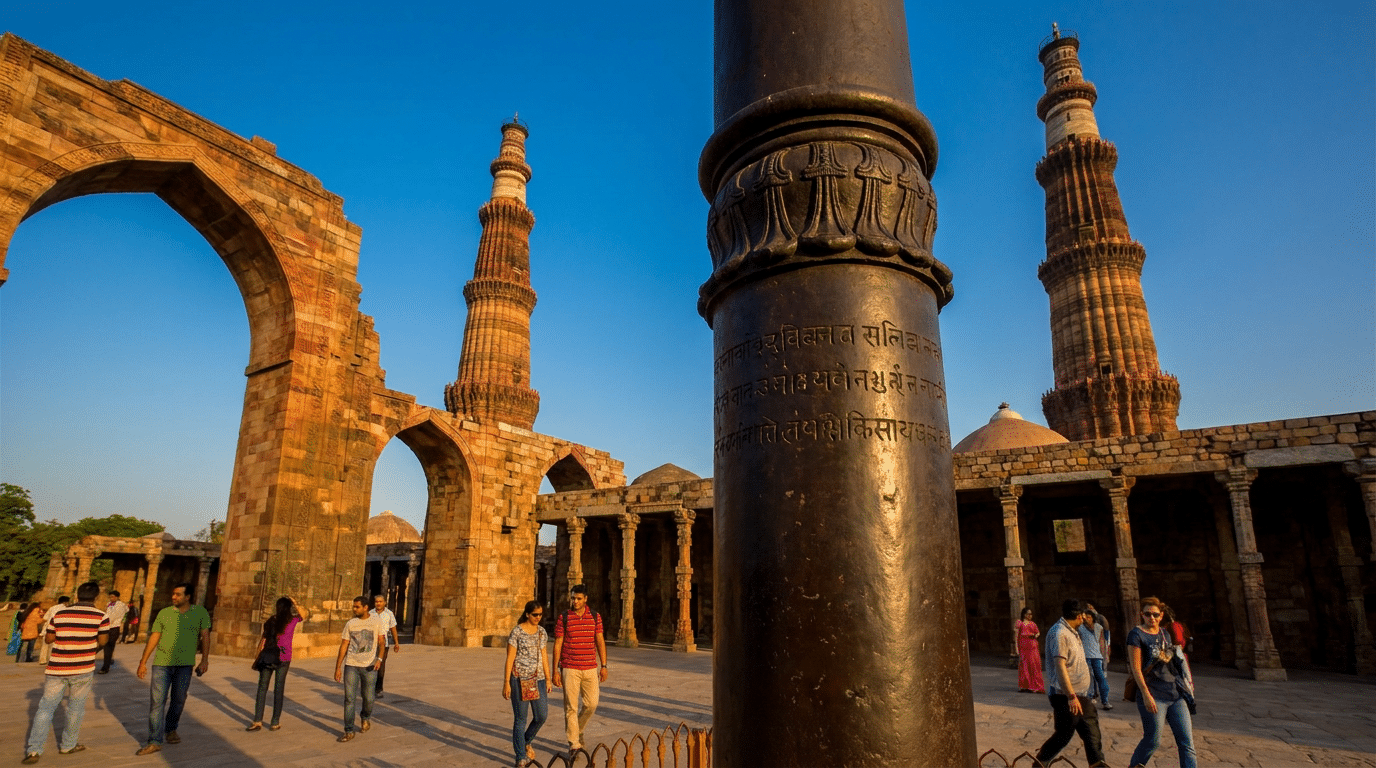
In the grounds of the Qutb complex in Delhi stands an object that seems almost ordinary at first glance: a tall iron column.
It is anything but ordinary.
The Iron Pillar has survived for roughly sixteen centuries, exposed to the atmosphere, while developing far less destructive corrosion than many people would expect from an ancient iron object. That unusual durability helped turn the pillar into a technological mystery.
But there is an important correction to the popular story. The pillar is not completely rust-free. It has corroded. What is remarkable is the way a protective layer developed on its surface and slowed further corrosion under the environmental conditions in which it survived.
The real story is therefore not that ancient India somehow escaped the laws of chemistry. It is that ancient metalworkers produced a large wrought-iron monument whose composition, manufacturing history and environment created unusually favorable conditions for long-term preservation.
What Is the Iron Pillar?
The pillar is a large wrought-iron monument traditionally associated with a ruler identified in its inscription as Chandra. The inscription, written in Sanskrit using Gupta-period script, provides important historical evidence about the monument and its patronage.
Its exact original location and the circumstances under which it was moved to its present setting have been subjects of historical discussion. The pillar’s association with the Gupta period places it within an era known for important developments in art, architecture, science and metallurgy in the Indian subcontinent.
Its significance is therefore broader than its resistance to corrosion. It is simultaneously an archaeological object, an inscription-bearing monument and an example of large-scale ancient ironworking.
It Is Wrought Iron, Not Modern Steel
The material traditionally described as wrought iron differs from modern industrial steel.
Ancient ironmaking generally involved smelting iron-bearing ores and producing a relatively heterogeneous material containing iron, slag and other elements. Repeated heating and forging could consolidate the metal and expel or redistribute some of the non-metallic material.
The Iron Pillar’s structure reflects this manufacturing history. It was not cast as one giant piece of modern industrial metal. It was produced through labor-intensive ironworking and forging processes that required substantial practical knowledge.
How Could Ancient Craftsmen Make Something So Large?
Producing a large iron column presented an enormous engineering challenge.
Iron could be heated and hammered into workable pieces, but ancient furnaces did not operate like modern blast furnaces. Large components therefore had to be produced through repeated cycles of heating and forging.
Forge welding could be used to join heated pieces. Under the right conditions, surfaces brought together at high temperature could bond through hammering and pressure.
A large monument could therefore be assembled from many worked sections rather than cast in one operation.
The finished pillar represents not one technological trick but an entire chain of skills: ore selection, smelting, furnace operation, heating, forging, joining and finishing.
Why “It Does Not Rust” Is Misleading
Iron reacts readily with oxygen and moisture. Under suitable conditions, corrosion can transform metallic iron into a mixture of oxides and other corrosion products.
The Iron Pillar has experienced corrosion. Its surface contains corrosion products, and researchers have identified protective compounds associated with the material.
The interesting question is therefore not why the pillar avoided corrosion altogether. It is why the corrosion process became comparatively slow and protective rather than rapidly destructive.
The Importance of Phosphorus
One of the features that has attracted considerable metallurgical interest is the pillar’s phosphorus content.
Ancient ironmaking practices could produce material with chemical compositions different from modern industrial steels. In particular, the use of certain ores and processing methods could leave relatively elevated phosphorus levels.
Phosphorus can influence the chemistry and structure of the corrosion products that form on iron. In the case of the Iron Pillar, researchers have linked the development of a protective surface layer with phosphorus-containing compounds and the repeated interaction between iron, moisture and the environment.
This does not mean phosphorus alone explains everything. Corrosion is a system-level process, and the pillar’s durability reflects several factors operating together.
The Protective Corrosion Layer
Corrosion products are not always equally destructive.
If corrosion products remain porous and unstable, water and oxygen can continue reaching fresh metal, allowing corrosion to progress. Under other conditions, the surface layer can become more protective and slow the rate at which the underlying iron is attacked.
The Iron Pillar appears to have developed a relatively stable protective layer over time. That layer acts as a barrier between the atmosphere and the underlying metal.
The process is not instantaneous. The pillar’s remarkable condition is partly the result of a very long corrosion history in which the surface chemistry evolved over centuries.
Manufacturing and Environment Work Together
It would be misleading to explain the pillar entirely through its composition.
Corrosion depends on environmental exposure: humidity, rainfall, temperature, pollutants, wetting and drying cycles and the chemical composition of the surrounding atmosphere all matter.
Delhi’s environment has changed substantially over the centuries, and the pillar’s present setting is not identical to the conditions under which it was originally made or displayed.
Its durability therefore reflects an interaction between the material and its environment rather than a single anti-rust ingredient.
Did Ancient Smiths Understand the Chemistry?
There is no reason to assume that ancient metalworkers possessed a modern molecular theory of corrosion.
They did not need one to produce durable iron.
Craft traditions can preserve practical knowledge through repeated observation. Smiths could learn which ores produced workable iron, which furnace conditions produced desirable material and which forging methods created strong objects without knowing the chemical equations involved.
This distinction is important in the history of technology. Practical knowledge and theoretical explanation are different forms of knowledge, and sophisticated practical results can exist long before modern scientific theories explain them.
Was the Pillar Deliberately Designed to Resist Rust?
It is difficult to demonstrate that its makers intentionally engineered a corrosion-resistant alloy in the modern sense.
They may have selected materials and followed established forging practices because those methods reliably produced useful iron. The resulting composition and corrosion behavior could have been partly understood empirically without the craftsmen knowing why the material behaved as it did.
That possibility is more historically plausible than imagining a hidden ancient version of modern corrosion engineering.
The Role of Slag and Microstructure
Ancient wrought iron can contain non-metallic inclusions and slag particles left over from smelting and forging. These features influence how the metal interacts with oxygen and moisture.
The internal structure of the pillar is therefore important. The material is not chemically uniform in the way a carefully controlled modern alloy can be.
Researchers examining ancient iron artifacts can use metallography and chemical analysis to study these variations and reconstruct aspects of the manufacturing process.
Why the Pillar Became Famous
The pillar’s unusual preservation became especially striking as modern visitors encountered an enormous exposed iron object that had survived for centuries.
Its fame was reinforced by the popular claim that it had never rusted. The reality is more scientifically interesting: corrosion occurred, but the rate and nature of corrosion produced an unusually durable surface.
The story is a useful reminder that a scientific explanation does not make an archaeological object less impressive. Understanding the mechanism can reveal just how many variables had to align for the result to occur.
The Inscription Adds a Historical Dimension
The pillar is not merely an engineering artifact. Its inscription places it within a historical and political context.
The Sanskrit inscription praises a ruler known as Chandra and describes military and religious achievements in conventional royal language. Scholars use its script and linguistic characteristics, together with archaeological context, to help date and interpret the monument.
This is important because technology does not exist separately from society. Producing a large monument required skilled workers, access to ore and fuel, organization of labor and a political or religious context capable of supporting the project.
Can Modern Engineers Reproduce It?
Modern metallurgy can reproduce many of the relevant chemical and physical processes, but reproducing the exact long-term history of the original pillar is a different challenge.
A new iron object does not begin with sixteen centuries of environmental exposure. Its corrosion behavior will depend on its precise composition, microstructure, surface condition and surroundings.
Scientists can recreate aspects of the material and test corrosion mechanisms, but the original pillar remains a unique archaeological record of a manufacturing process followed by an unusually long natural experiment.
Does the Pillar Prove Lost Ancient Technology?
The pillar demonstrates that ancient Indian metalworkers possessed sophisticated practical knowledge. It does not demonstrate a technology beyond the explanatory reach of modern metallurgy.
Modern corrosion science can identify mechanisms consistent with the pillar’s preservation. The fact that ancient craftsmen did not know those mechanisms in molecular terms does not make the result mysterious in the supernatural sense.
Instead, it shows how human craft traditions can discover effective solutions through experience long before science develops the language to explain them.
The Bigger Lesson in Ancient Metallurgy
The Iron Pillar challenges a common assumption about the past: that ancient technology must have been either primitive or inexplicably advanced.
Reality is more interesting.
Ancient craftspeople could be exceptionally skilled in particular materials while lacking modern theories of chemistry and physics. Their knowledge was embodied in furnaces, tools, recipes, workshop routines and generations of accumulated experience.
Modern science can then examine those artifacts and reconstruct the physical processes that made their achievements possible.
The Real Mystery
The Iron Pillar does not need to be “rust-proof” to be extraordinary.
Its significance lies in the convergence of metallurgy, craftsmanship, historical context and environmental chemistry. Ancient workers produced a massive wrought-iron structure using techniques that required substantial skill. Its material composition helped generate a protective corrosion layer, while its environment allowed that layer to remain effective for centuries.
The mystery is therefore not that ancient India somehow broke the laws of chemistry.
The mystery—and the achievement—is how effectively human craftsmen learned to work with those laws without having modern chemistry to describe them.
Curiosity Publication by Aadvik Agastya
Sources & further reading
Have a question about this topic?
Join fellow Qurons on the Quron Forum to ask questions, challenge ideas, share discoveries and explore further.
Discuss on Quron Forum